Blog Archives
Opportunities to Lead

In Scaling Pyramids, you present an in-depth look at the three layers of successful leadership and share with readers your own reflections on what it means to lead with patience. Why was this an important book for you to write?
A lot of the leadership training that focuses on the entry and mid-level is really focused on managing, not leading. A lot of the core leadership literature is focused on the leader at the top. So there is a gap – how to shift from managing to leading, how to lead without authority, how to make meaningful change from the middle.
I had my own struggles with managers who believed they were leaders, but more people fled them than wanted to follow them but I also had some really great role models and influencers, so I wanted to share lessons I learned from both. I also recognized I made (and can continue to make) some mistakes and learned some lessons along my leadership journey. I know I am not the only one, and I know from my leadership journey that more people than just me can learn from those lessons, so I wanted to share them to benefit others. Not Pollyannaish, not “follow these steps and become an instant success,” but real lessons, hard won in the course of a real life.
What is a common misconception you feel people have about becoming a successful leader?
That you have to have a title, rank, or position. The truth is, if you have one follower, you are a leader. The question then becomes, what do you do with that? How can you nurture that flame and grow as a leader? Do you even want to? If the answer is yes, then look for opportunities to lead where you are, regardless of title, rank, or position. I think a second misconception is, “leadership is lonely, I have to do it on my own.” The truth is that to be successful you need to surround yourself with others: role-models, mentors, and coaches that can support you in your leader development and that you in turn can support as you grow.
What is one piece of advice someone gave you that changed your life?
“You know, you seem to carry a lot of anger, and I think you don’t realize how it affects you and those around you.” He actually started the conversation with, “Can I speak into your life?” which was a shocking question for me. And it was a conversation that changed my life because it was a big blind spot that I had, and working with him to recognize it and overcome it changed a lot for me and made me a much better leader. For you, it may not be anger, but recognizing that you have blind spots and finding trusted confidants who will tell you the truth about them and help you work through them is incredibly important.
What is one thing you hope readers take away from your experiences?
For those in the middle, you can lead and make a difference from wherever you are. There is a graphic in the introduction to my book that illustrates my journey through my bureaucratic pyramid. I never made it to the top. I have not been Secretary of State. But I made a difference and an impact on the entire organization, in more ways than I realized. You can, too.
For those at the top, investing in the leadership development of those at the bottom and middle of the organization will make your organization stronger, lead to improved employee retention, and better outcomes. Letting toxic managers flourish will have the opposite effect.
Author Links: GoodReads | Facebook | Crisis Lead | Website | Scaling Pyramids | LinkedIn | Amazon
Scaling Pyramids: Leadership Lessons from a Mid-Level Bureaucrat is an honest, engaging, and research-informed exploration of what it means to lead from the bottom and middle of an organization—especially within complex systems that aren’t always built for innovation, agility, or humanity.
Drawing on more than 25 years of experience as a federal law enforcement officer, diplomat, educator, and public servant, author Christopher Stitt brings a rare combination of street- level credibility and scholarly insight to the leadership conversation. Throughout the book, he weaves together personal stories from his global assignments with contemporary leadership research from behavioral science, organizational psychology, and decision- making theory.
The result is a practical and thought- provoking field guide for those who are tired of waiting for permission to lead—and ready to make a difference right where they are. In these pages, you’ll find lessons on how to influence up, down, and across your organization. You’ll learn how to build trust, coach others, think strategically, and maintain your integrity even when politics or process get in the way. You’ll discover why the middle of the organizational pyramid isnot a waiting room for the next promotion—it’s the center of gravity where culture, performance, and credibility are either built or broken.
Whether you’re managing teams in a government agency, navigating the corporate hierarchy, or trying to make change from within a large institution, Scaling Pyramids offers you a road map grounded in both lived experienc and real evidence. With a voice that is both candid and deeply practical, Stitt reminds us that leadership isn’t about rank—it’s about showing up, stepping up, and speaking up in the moments that matter.
If you’ve ever felt overlooked, underutilized, or underestimated in your role, this book is for you.
It’s time to lead. Not someday—now.
Scaling Pyramids – Leadership Lessons from a Mid-Level Bureaucrat


Scaling Pyramids is a direct and surprisingly warm look at what it means to lead from the middle of a large, often clunky system. The book moves through three layers of leadership. First, you lead yourself. Then you learn to lead others. Finally, you learn to lead the whole organization from wherever you stand. Stitt uses stories from his decades in federal service to bring these lessons to life. He mixes them with ideas from behavioral science and organizational psychology, and the result reads like a field guide for anyone trying to make a difference inside a bureaucracy. He shows how real leadership often happens far below the top, and how influence grows when you understand people, values, and the way systems move.
Author Christopher Stitt admits his flaws and doubts, and that made the book feel personal and real. His stories about learning who shaped him, figuring out his values, and dealing with the limits of his own energy made me pause more than once. I felt like I was sitting with someone who had lived through the hard parts and was not trying to sound perfect. Some chapters resonated with me more than I expected. The parts about self-care, migraines, and the quiet pressure of constant rotation in new jobs felt especially relatable. I kept thinking, this is the stuff most leadership books skip. Here, it becomes the center of the lesson.
The sections on leading others also stuck with me. He talks about employees as snowflakes because no two motivations match. It sounds simple, yet the way he explains it made me nod more than once. His stories about managing discipline, building alliances, and using awards with purpose made me reflect on how often leaders get these things wrong. The tone is patient. The advice is practical. I could feel his years of trial and error behind the guidance. At times, I laughed, especially when he drew leadership ideas from Dungeons and Dragons. Other times, I felt the weight of what it means to lead in an environment where rules, hierarchy, and personalities collide.
This is not a book about heroic leaders with big titles. It is for people who grind through the middle. People who want to contribute even when they feel unseen. People who want to influence without losing themselves. I would recommend Scaling Pyramids to early-career professionals, mid-level managers, public servants, and anyone who has ever wondered how to lead when they are not in charge. The book has heart. It has clarity. It has enough grit to feel lived in. And it reminds us that leadership begins long before anyone calls you a leader.
Pages: 177 | ASIN : B0FCD28TQ3

It’s Time For a ‘Revolt’
Revolt Against the K-12 Status Quo is a potent and meticulously researched critique of the systemic inequities in the U.S. public school system, particularly regarding the stark discrepancies in educational funding across different states. Why was this an important book for you to write?
Forgive me, but I have a long-winded answer. There are several reasons why it was important for me to write the Revolt Against the K-12 Status Quo.
I am, by disposition, repelled by injustice and have sworn hostility against injustice –especially government-sponsored injustice exemplified by the decades-long vast disparities in K-12 education funding & spending among the 50 states and the District of Columbia.
How can it be constitutionally acceptable in these ‘United’ States of America for Idaho, the lowest among the states, to have a per-pupil funding of $9,802, a measly 31.41%, not even a third, of the $31,205 per-pupil funding for the District of Columbia? Where in the US Constitution does it say that your youngster attending a public K-12 school would have to suffer—by accident of geography—from the deleterious impact of less-than-equal funding per pupil?
The idealist in me has long wondered why this all-important, consequential issue has slipped under the radar screens of education advocacy groups and/or civil rights organization; not one of them has raised a fuss and railed against the inequity, the injustice of unequal K-12 funding/spending per pupil.
As a super fan of American democracy, I am a true believer in America’s abiding promise of equal rights and opportunities for all. That said, and the staggering disparities that have bedeviled the current K-12 funding system, in my view, violate the letter and spirit of the EQUAL PROTECTION CLAUSE of the Fourteenth Amendment.
I wrote this book to serve as a wake-up call for the relevant policy-makers, elected and appointed, to engage in a national discourse that might lead to a re-examination of the sustainability of the long-standing policy that says K-12 education is merely a federal interest.
If the resulting conversations triggered by this book effectively helped to launch bona fide efforts to begin to mitigate –if not entirely eradicate– the unequal educational opportunities for young boys and and girls across the nation … such a scenario could spell the start of inexorable progress toward equality for all in the educational arena. If, as a grateful immigrant, you have always wanted to make a difference –no matter how modest that difference might be– could you imagine a more consequential, a more satisfying, offering at the altar of American democracy?
What were some ideas that were important for you to share in this book?
A local responsibility, a state function, and merely a federal interest: this three-legged structure of the K-12 education system has produced vast disparities which are unjust as they are inequitable, by way of funding and spending disparities –appalling disparities with serious constitutional implications, chief among them the EQUAL PROTECTION CLAUSE of the Fourteenth Amendment.
Where does the blame lie? The American people’s inattentive embrace of the problematic policy –which says K-12 education is merely a federal interest– and the defeaning silence on the part of education advocacy groups and civil rights organizations, have allowed the vast disparities among the 50 states to fester for far too long.
The questions are: In a country which proclaims equal rights and equal opportunities for all, why have the educational opportunities of young boys and girls in the bottom low-funded states, been effectively snubbed, demeaned, and degraded – by the affliction of an unequal K-12 funding system? When will America’s young boys and girls in the low-funded states stop getting the short end of the stick, time and time again?
The American people’s inattentive embrace of the problematic policy which says education is merely a federal interest, must end. It’s time for a ‘revolt against the patently inequitable K-12 funding/spending status quo.
How much research did you undertake for this book and how much time did it take to put it all together?
The basic research for the statistical and historical data contained in this book took me four months, with help from a Manila-based virtual assistant who worked with me a full three months. Looking back, I think I went overboard and put on my CPA-auditor hat by vetting and cross-checking the validity/accuracy of the statistical data by consulting other sources. But a big chunk of the research data –data related to student outcomes/standardized test scores– ended up in the waste basket. Although test scores were arguably somehow germane to the book’s thesis, I decided to keep the book’s focus on purely funding & spending level.
What is one thing that you hope readers take away from Revolt Against the K-12 Status Quo?
It’s long past time for a ‘revolt’ against the inequitable K-12 funding status quo via a federal EQUALITY IN EDUCATION ACT. The sooner it happens, the better it will be for American democracy.
Author Website
In this book, you will find the gap between the top-funding/spending states and the low-funding/spending states to be as wide as the Grand Canyon. This book describes the inequity as appalling, astonishing, incomprehensible, mystifying, outrageous, and unbelievable. The book’s thesis: Society’s inattentive embrace of the problematic policy which says education is merely a federal interest must end. It’s time for a ‘revolt against the K-12 status quo. It’s time for a federal EQUALITY IN EDUCATION ACT to codify the Equal Protection Clause of the Fourteenth Amendment. The sooner it happens, the better it will be for American democracy. EQUALITY IN EDUCATION can get America on the road to a more perfect union
Abiding Promise of Equal Rights
Revolt Against the K-12 Status Quo is a potent and meticulously researched critique of the systemic inequities in the U.S. public school system, particularly regarding the stark discrepancies in educational funding across different states. Why was this an important book for you to write?
Forgive me, but I have a long-winded answer. There are several reasons why it was important for me to write the Revolt Against the K-12 Status Quo.
I am, by disposition, repelled by injustice and have sworn hostility against injustice –especially government-sponsored injustice exemplified by the decades-long vast disparities in K-12 education funding & spending among the 50 states and the District of Columbia.
How can it be constitutionally acceptable in these ‘United’ States of America for Idaho, the lowest among the states, to have a per-pupil funding of $9,802, a measly 31.41%, not even a third, of the $31,205 per-pupil funding for the District of Columbia? Where in the US Constitution does it say that your youngster attending a public K-12 school would have to suffer—by accident of geography—from the deleterious impact of less-than-equal funding per pupil?
The idealist in me has long wondered why this all-important, consequential issue has slipped under the radar screens of education advocacy groups and/or civil rights organization; not one of them has raised a fuss and railed against the inequity, the injustice of unequal K-12 funding/spending per pupil.
As a super fan of American democracy, I am a true believer in America’s abiding promise of equal rights and opportunities for all. That said, and the staggering disparities that have bedeviled the current K-12 funding system, in my view, violate the letter and spirit of the EQUAL PROTECTION CLAUSE of the Fourteenth Amendment;
I wrote this book to serve as a wake-up call for the relevant policy-makers, elected and appointed, to engage in a national discourse that might lead to a re-examination of the sustainability of the long-standing policy that says K-12 education is merely a federal interest.
If the resulting conversations triggered by this book effectively helped to launch bona fide efforts to begin to mitigate–if not entirely eradicate–the unequal educational opportunities for young boys and girls across the nation…such a scenario could spell the start of inexorable progress toward equality for all in the educational arena. If, as a grateful immigrant, you have always wanted to make a difference–no matter how modest that difference might be–could you imagine a more consequential, a more satisfying, offering at the altar of American democracy?
What were some ideas that were important for you to share in this book?
A local responsibility, a state function, and merely a federal interest: this three-legged structure of the K-12 education system has produced vast disparities which are unjust as they are inequitable, by way of funding and spending disparities–appalling disparities with serious constitutional implications, chief among them the EQUAL PROTECTION CLAUSE of the Fourteenth Amendment.
Where does the blame lie? The American people’s inattentive embrace of the problematic policy–which says K-12 education is merely a federal interest–and the deafening silence on the part of education advocacy groups and civil rights organizations have allowed the vast disparities among the 50 states to fester for far too long.
The questions are: In a country which proclaims equal rights and equal opportunities for all, why have the educational opportunities of young boys and girls in the bottom low-funded states, been effectively snubbed, demeaned, and degraded – by the affliction of an unequal K-12 funding system? When will America’s young boys and girls in the low-funded states stop getting the short end of the stick, time and time again?
The American people’s inattentive embrace of the problematic policy which says education is merely a federal interest, must end. It’s time for a ‘revolt against the patently inequitable K-12 funding/spending status quo.
How much research did you undertake for this book, and how much time did it take to put it all together?
The basic research for the statistical and historical data contained in this book took me four months, with help from a Manila-based virtual assistant who worked with me a full three months. Looking back, I think I went overboard and put on my CPA-auditor hat by vetting and cross-checking the validity/accuracy of the statistical data by consulting other sources. But a big chunk of the research data –data related to student outcomes/standardized test scores–ended up in the waste basket. Although test scores were arguably somehow germane to the book’s thesis, I decided to keep the book’s focus on purely funding & spending levels.
What is one thing that you hope readers take away from Revolt Against the K-12 Status Quo?
It’s long past time for a ‘revolt’ against the inequitable K-12 funding status quo via a federal EQUALITY IN EDUCATION ACT. The sooner it happens, the better it will be for American democracy.
Author Links: Website | Amazon
In this book, you will find the gap between the top-funding/spending states and the low-funding/spending states to be as wide as the Grand Canyon. This book describes the inequity as appalling, astonishing, incomprehensible, mystifying, outrageous, and unbelievable. The book’s thesis: Society’s inattentive embrace of the problematic policy which says education is merely a federal interest must end. It’s time for a ‘revolt against the K-12 status quo. It’s time for a federal EQUALITY IN EDUCATION ACT to codify the Equal Protection Clause of the Fourteenth Amendment. The sooner it happens, the better it will be for American democracy. EQUALITY IN EDUCATION can get America on the road to a more perfect union.
Revolt Against the K-12 Status Quo
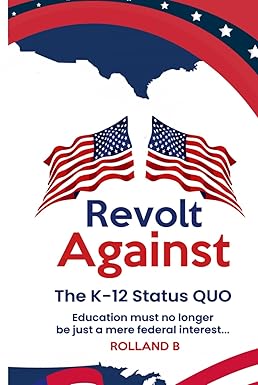
Revolt Against the K-12 Status Quo, by Rolland B., is a potent and meticulously researched critique of the systemic inequities in the U.S. public school system, particularly regarding the stark discrepancies in educational funding across different states. Author Rolland B, leveraging his extensive experience in school finance, delves deep into the disparities rooted in geographic, not racial, differences. He challenges the status quo by revealing a 75% discrepancy in educational spending between states, urging for a federal overhaul to address this injustice.
I found this book to be both a statistical revelation and a call to action. Rolland B.’s analysis is thorough and persuasive, particularly his discussion on how these funding inequities disproportionately affect minority students. His examination of the U.S. Constitution and the suggestion to leverage the Ninth and Tenth Amendments for educational equity is thought-provoking and novel. While I enjoyed the book, I think it would be further enhanced by a more nuanced exploration of potential solutions and a deeper analysis of the impact of funding disparities on actual educational outcomes.
Revolt Against the K-12 Status Quo excels in shedding light on a critical, often overlooked aspect of American education. Rolland B’s passion for the subject is evident. While the book is densely packed with statistics and legal discussions, it remains accessible, thanks to Rolland B.’s clear and direct writing style.
I recommend this book to educators, policymakers, and anyone interested in educational equity. Its rigorous analysis and passionate advocacy make it a valuable resource for understanding and addressing the systemic issues in U.S. public education. Its insights are indispensable for those involved in or concerned about the future of American education.
Pages: 145 | ASIN : B0CTWGS2QC




 LITERARY TITAN