Blog Archives
The Shattered Ones


The Shattered Ones follows Ace, a worn-down former protector living in a world swallowed by endless darkness. The sun has vanished. Cities crumble. People lose themselves. Ace tries to drink away what he used to be until a terrified man shows up with news that sparks a search for others like Ace. The story turns into a fight against a brutal gang, a ruthless corporation, and a rising evil while Ace pieces together a strange calling and a fragile hope. By the end, the light finally returns, and the survivors stand in a new world trying to understand what comes next .
I kept feeling this push and pull between grit and heart. The writing dives hard into bleak moments, and sometimes it hit me hard. The city felt alive in a sad way, full of broken people stumbling through pitch-black days. But the author slips in these quiet emotional beats that land with surprising force. Ace’s exhaustion felt real. His shaky hope felt real, too. Those shifts kept me leaning in. I found myself rooting for him even when he was trying his best not to care.
Then the book swings into big action scenes and wild turns. At first, I thought the scale jump might drown the human parts, but it actually worked for me. The chaos made the tender moments brighter. One scene near the end, when the group finally sees the first glow of returning sunlight, honestly caught me off guard with how moving it felt. The writing eases up and lets that warmth sit for a moment.
By the time the epilogue rolled in, the hopeful tone felt earned. The world is far from fixed, but the people are trying, and that small spark of rebuilding hit me in the gut. Seeing Ace in a park months later, watching kids laugh while the city comes back to life, made the whole journey feel worth it. It showed how much he lost and how much he still carries.
I’d recommend The Shattered Ones to readers who like dark worlds but need a thread of light to hold on to. Anyone who enjoys character-driven dystopian stories, rough-edged heroes, or tales about finding purpose in a broken place will get something out of this. It’s heavy at times, sure, but it leaves you with a feeling that you’ll remember.
Pages: 338 | ASIN : B0DBZX1FWS

Pandora’s Box Has Been Opened

Liberator: The People’s Guard follows the Liberator as he faces off against two new super villains, one has the ability to take any form, both organic and not, and a being that absorbs the life force of others. What was the inspiration for the setup of your story?
It was really just the natural evolution of the story. Volume 2, left off with the idea of the various nations ramping up their eugenics experiments, so it naturally led to the question of “what would happen if someone were accidentally exposed to this super soldier serum?” Like the book says, Pandora’s box has been opened and there’s no closing it now. Plus it was also a case of creating a rouges gallery for the hero. A hero is only as good as the villains they fight. The Liberator really doesn’t have a main adversary the way Superman has Lex Luthor, Batman has the Joker, or the Ninja Turtles have Shredder. I just needed some more villains for him to fight and I decided to make these two female for a more gender balanced story. Incidentally, several months ago I was in a store at a mall, talking with one of the staff about my books. When I told her about Oksana and her ability to absorb the life force of others, she loved the irony of the fact that women are the live givers, and here’s this woman who’s essentially taking that life force energy back. Something I never even thought about when writing, or at least I wasn’t consciously aware of it.
What were some ideas that were important for you to personify in your characters?
In the case of the villains, as stated above, it was really just a matter of creating a rouges gallery for the hero. Upon creating the villains the first question was “How did they get these powers?” Then I went from there. With Oksana, it was about a plant operator who hated her job, her life, who was under constant stress and upon getting her powers her reaction was basically, “Now’s my chance to get back at everyone who ruined my life.” As for Mistika, I’ve often read about how in the Soviet Union they would brag about how they evolved beyond “capitalist/materialist greed”. While that was the official government stance, the reality was quite different. For Mistika it was just a case of, “With these powers I can have/do whatever I want and no one can stop me!” As for Tovarich, it was really hammering home the fears and doubts in the back of his mind. The idea that maybe he’s not the hero everyone thinks he is. He’s the guy who’s staying up at night wondering “What if the state I’m supposed so serve is actually the REAL bad guy here?”
How did you balance the action scenes with the story elements and still keep a fast pace in the story?
I always put the story first. For me it’s a question of “does this scene serve the overall story?” I’m not the type of person to just put random action scenes just for the sake of having an action scene. It’s like with a movie, having gratuitous violence, sex, language, CGI, special effects for no reason other than “Hey, look what we can do,” doesn’t make for a good story. It’s like my script writing teacher in college (the late Michael Monty) often said, if your story is garbage, no amount of violence, special effects, sex and so on will save it. Basically I play the scene out in my head as if it were a movie, then I try to find the words to properly describe what I’m seeing in my mind, so I can give you as clear a picture as possible when you’re reading the book. Particularly when the Liberator was fighting Oksana. When it begins, you’ve basically got Superman fighting a normal woman only for it to end with him being the normal man fighting Supergirl. It was a case of how do I realistically make her drain his powers without him figuring it out too soon. The idea of her messing with his mind seemed like a logical way to throw him off. That and I like it when a story goes into the character’s heads; what are they thinking? Why do they think/feel this way? What do they believe in and so on. For me personally, that’s more exciting than giving them cool powers and seeing what they do with them.
Will there be a follow-up novel to this story? If so, what aspects of the story will the next book cover?
Oh yes volume 4 will continue the story. (Don’t tell me you didn’t notice the “sneak peek at volume 4” part in the book!) I actually wrote both together as one story, but I was having a bit of writer’s block, so the story as a whole wasn’t finished. I was debating, “should I wait until I finish it all, or just put out what I’ve got so far and make it like a two-part episode of a TV series?” In the end I decided, since I’ve got most of the first half done, I’ll finish that part up and come back to finish the rest later. I don’t write in a linear fashion. I’ll often just jump between parts in no particular order, writing and playing connect-the-dots with the different scenes in the book. If I can’t think of something, I’ll just write down “add more later” in brackets, then come back to it. While I don’t want to give away too many spoilers, it will feature some unexpected twists and a villain team up with Mistika, Oksana and the Intellectual.
Also I naturally have to throw in a plug for my other series “Mystical Force”, as I’m currently writing volume 7 of that one. That will introduce a character I’ve been teasing for the last few volumes, the “descendant of the darkness” mentioned in the prophecy all the way back in volume 1. Hopefully that one will be out around spring of 2026.
Author Links: Twitter | Facebook | Instagram | LinkedIn | GoodReads | YouTube | Website
While trying to fight her, she ends up draining the Liberator of his powers, leaving her the super- powered being while he’s nothing more than an ordinary man. The Liberator’s super-strength and invulnerability left many criminals cowering in fear. Now it seems he’s about to find out what it’s like to be on the receiving end.
Included in this book is a special bonus story: “The Misadventures of Captain Communist,” a humorous parody of the Liberator series. Meet Vladimir Prokov, dictator of the Soviet Union and its greatest hero (by decree of the Central Committee), Captain Communist, along with his trusty sidekick (and real hero of the story), Socialist Boy. Together, they fight to protect the workers of Russia from the icy hand of that cold-hearted capitalist, Mr. Free-Enterprise, who wants to run his own business selling frozen treats. It’s camp comedy and political satire blended with superhero shenanigans for flavour. See good triumph over evil, or evil triumph over good, or one form of evil triumph over another form of evil. It really all depends on where your social/political/economic views lie . . .
Liberator: The People’s Guard Vol. 3 Metamorphic-Humans

The third volume of Liberator: The People’s Guard throws us straight into a harsh world where ruthless politics, dangerous science, and volatile new powers keep clashing. Early scenes in Cherbosk show terrified workers drowning under impossible state demands, then the chaos explodes when a catastrophic chemical spill sets off a chain of events that births new metamorphic humans. Soon after, a violent shapeshifter named Mistika tears through banks and museums while the Liberator scrambles to understand her powers and the government’s role in creating beings like her. The story mixes political fear, personal struggle, and huge action in a country desperate to control forces it barely understands.
As I read through these chapters, I felt pulled in by the sense of pressure everyone seems to live under. The writing made me feel that tight knot of stress in my stomach, the one you get when you know something terrible is coming, and there is nothing you can do but watch it arrive. Oksana’s frantic attempts to please her superiors hit me hard. She rushes, she panics, she breaks things, and she pays the price. Those scenes made me feel frustrated and sad because you can see her fear coming off the page. Then you have Mistika, who storms into a bank like a comic book villain brought to life. Her scenes are intense and sometimes brutal, and I was shocked at how casual she is about killing. The casualness made her feel more real and more frightening.
The political tension is strong, and I kept feeling uneasy about how often the government hides the truth. The conversations about the super soldier serum made me pause, especially when Tovarich realizes he might not be the only one or even the first one. That whole debate around a genetic arms race made the story feel bigger than a simple superhero fight. It gave me this weird mix of worry and curiosity. I liked that the book did not give easy answers. Instead, it let the fear simmer while the characters tried to keep moving forward.
This volume would be perfect for readers who enjoy superhero stories that lean darker and more political. If you like action mixed with fear, moral tension, and characters who feel trapped by forces bigger than they are, this is a strong fit. I would recommend it to fans of gritty comic book worlds and anyone who likes stories about power that comes with a cost.
Pages: 116 | ASIN : B0FTV1KZ2X

Moral Awakening
Switch and Blue Eagle is a coming-of-age superhero novel where a young sidekick battles villains, expectations, and his father’s outdated ideals in a world that no longer sees justice in black and white. What inspired you to explore the father-son dynamic at the heart of the story?
It’s actually an element from my worldbuilding. When I first started doing this, I was inspired by the TTRPG Masks. When me and a gaming group I was part of were preparing to start a campaign in that, I looked over the basic information and saw that the ages of comic book history–the Golden Age, the Silver Age, and so on–were canon as Generations in Masks. So I decided to follow suit with in-universe Ages of Heroism. I’ve always loved the contrast between more serious, darker takes on superheroes and their lighter, more kid-friendly takes of old. So Blue Eagle and Switch ended up being the first two characters I created–along with Queen Venus and one more character that you can likely guess who it is if you read the epilogue–as a contrast between the Silver Age and the Modern Age of Comics and Heroism.
So, in my larger world, I have Silver Age characters and their values, I have Dark Age characters and their values, and I have the younger Modern Age characters trying to find their place in the world.
I know that sounds like an answer to a different question, but the father-son dynamic in this story was actually built from worldbuilding rather than character exploration, at least in the beginning. Once that foundation was built, I started asking myself, “What would people from different Ages of Heroism disagree on when it comes to superhero-ing? What differences would a superhero from each era of comics have, like Superman of the 1950s and Rob Liefeld’s Youngbloods characters in 90s Image Comics, and today’s teen heroes like Miles Morales and Kamala Khan? What complications would those differences create when the people who have those differences also have a father-son and superhero-sidekick relationship? What are some real-life, dare I say political, equivalents to those disagreements?” And this was ultimately my answer.
Jack often questions what makes someone truly “good.” How do your own views on morality shape the story?
Haha, when I was a dumb, edgy 20-something, I really hated Superman (now that I have a fully functioning frontal lobe, I’m now a huge Superman fan). I thought he was way too powerful to have good stories with suspense and stakes, but I also hated how he was essentially a paragon of perfect morality. It was like being super strong allowed him to dictate what was right and wrong. One thing I always said was that, unless a hero possesses “super-morality” as an actual superpower, they have no more credibility on morality and ethics than anyone else.
I now see Superman in a different light, but Blue Eagle represents that part of the old me that was right. That feeling that those in power—churches, pundits, corporate compliance departments—shouldn’t get to dictate what is right and wrong just because they have societal power. A conservative media influencer has no grounds to determine that trans people are immoral while saying nothing about school lunch programs being defunded; a company shouldn’t be able to say an employee having outside income is a conflict of interest while it funds destructive pipeline construction on sacred indigenous land; an elected official shouldn’t be able to say that the presence of migrants is immoral criminal behavior while they take bribes and makes laws that help their rich friends at the expense of education, healthcare, and the environment.
Switch, on the other hand, represents in his teens the moral awakening I didn’t have until my thirties. That society has a real responsibility to lift up its “lowest” and give people real chances to succeed. People don’t succeed in life on their own. We all have support from family, friends, community, and institutions. And when those systems fail people, they are left with paths in life that we would never choose for ourselves. So instead of using force to punish those we deem to be immoral, rightly or wrongly, I believe there is a duty for society at large to ensure that we all have the tools to live happy, dignified lives.
It was that moral conflict that I wanted to place at the core of Blue Eagle and Switch’s disagreements. The father-son conflict and Switch’s desire for independence aside, there is a difference regarding the moral responsibilities that come with power.
The book blends superhero action with introspective realism. Did you set out to challenge typical comic tropes from the start?
Not really. This is another thing born from worldbuilding. This is not the first story I’ve written in this universe, only the first one that I’ve published. And even before I decided to write SWITCH and Blue Eagle, the Blue Eagle Universe, as I call it, was always a superhero universe played mostly straight. It certainly plays with, satirizes, celebrates, and challenges, as you say, comic tropes as well. But it also is one played straight, meant to exist alongside the Marvel, DC, Image, Astro City, Valiant, and other shared universes.
If anything, I would say that the world this book is set in is less “What if superheroes existed in the real world?” and more “What if realistic people existed in a superhero world?”
Jasper’s subplot humanizes the villains. Was it important for you to blur the line between hero and antagonist?
Not really. Not for this book, at least. That’s because I don’t really view Jasper as an antagonist, but one of the two main characters. He just works for the bad guys. The actual antagonists of this book—other than any high-minded literary concept like “Switch’s inner struggles” or something—are the villains. Queen Venus is the primary antagonist, which is fitting as she is the primary member of the Blue Eagle Rogues Gallery.
Actually, the idea for Jasper and the broad spot he sits between the two conflicting ideological positions presented was inspired by a movie I saw from 1990. It was a very high-brow, snooty, underground arthouse film you’ve probably never heard of, called Teenage Mutant Ninja Turtles. Haha. But seriously, in that movie, there are two characters in that film whose fate is really the thematic center point of the movie, and that’s Charles and Danny Pennington. Fatherhood and family are the central themes of that film, with the Turtles and Splinter representing a nurturing and loving family and Shredder and the Foot Clan representing harshness and distance. They present two sides of it, while the Penningtons are teetering on the fence. In the end, they fall into the Turtles’ side, reuniting and beginning the process to reconcile and become closer.
Broadly speaking, Jasper is the same as the Penningtons. Switch believes in societal responsibility and rehabilitation, while Blue Eagle touts personal responsibility and tough love. Jasper’s the case study to prove one of them right and one of them wrong.
Author Links: GoodReads | BlueSky | Facebook | Website | Amazon
Switch the Blue Eaglet is the son and teen sidekick of Blue Eagle, one of Herald City’s top superheroes. But being a sidekick isn’t all glory. Switch is tired of living in his father’s shadow, tired of his strict rules, and tired of being told he’ll never be strong enough to stand on his own.
Jasper Clemens is just another faceless villain henchman. All he wants is to get out of the criminal business. But his debts to the mob keep piling up, and he’s stuck taking the riskiest jobs in order to protect his family.
When a dangerous supervillain launches her deadliest scheme yet, it’s up to Switch and Jasper to stop her. Can Switch prove to the world he’s more than just a sidekick? Does Jasper have what it takes to be a true hero?
Or is Herald City doomed?
Perfect for fans of coming-of-age superhero tales, this short novel delivers action, heart, and a fresh twist on what it really means to be a hero.
Don’t miss this adventure of SWITCH and BLUE EAGLE!
SWITCH and Blue Eagle: A Superhero Sidekick Novel is a short prequel to my main series currently under development, SWITCH and the Challengers Bravo, and the introduction to my larger superhero world of Herald City. It has two focus characters. There is Switch the Blue Eaglet, the sidekick of Blue Eagle, who deals with the self-doubt that comes with the constant criticisms he gets from his father, as well as his unreliable powers. He wants to eventually become a superhero on his own, but he feels the need to prove his worth first. And then there is Jasper Clemens, a supervillain henchman who wants to get out of the business. But his debts to the mob keep piling up, and the only way to keep his family safe is to take on more and more dangerous jobs. And in the background of all of this, Queen Venus, the archenemy of Blue Eagle and Switch, is sprouting her deadliest plan yet and the whole world might be at stake.
Trigger warnings include fantasy violence, father-son family drama, and mob debt.
Andersen Light: A Meta-Normal Novel
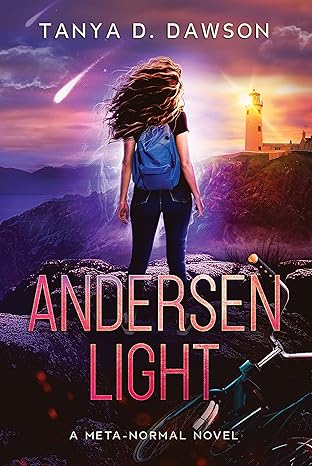

Tanya D. Dawson’s Andersen Light is a coming-of-age novel that weaves fantasy, trauma, healing, and self-discovery into the life of Georgie Jones, a brave teenager escaping abuse and finding her place in a world bigger and stranger than she imagined. After surviving an unsettling family situation, Georgie relocates to the coastal town of Mystic Creek to live with her father. What begins as a grounded emotional journey slowly opens into a metaphysical one, involving dreams, psychic mentors, a mysterious lighthouse, and a destiny Georgie could never have foreseen.
What hit me first and hardest was the honesty in the way Georgie’s trauma is portrayed. Dawson doesn’t sugarcoat it. She takes you inside the mind of a kid trying to hold it all together, and it’s messy and brave and human. It made me uncomfortable in places, but in the right way. Georgie isn’t a perfect heroine. She’s scrappy, smart, overwhelmed, and trying to find light in all the dark. The writing in these parts feels raw, coming straight from the heart. Dawson nails the voices of kids and teens without slipping into awkward attempts to sound “young.” There’s also something comforting in how safe the adult characters, like her father and the lightworker Luther become. There’s hope alongside the pain, and that balance matters.
I was surprised by the book’s mysticism. At first, it reads like contemporary fiction with serious emotional weight. Then suddenly, you’re in dream realms, lighthouses channel energy, and the story folds into something more like magical realism or soft sci-fi. That shift felt a bit jarring. I wasn’t always sure if the magical side added clarity or distraction. Some of the metaphysical explanations slowed the pace a bit. There were moments where the surreal worked beautifully, especially when it paralleled Georgie’s emotional healing.
Andersen Light is heartfelt and different. It’s for readers who like emotional depth in their YA, especially those who appreciate a blend of real-life grit with cosmic wonder. If you’re someone who’s survived something or loves stories about kids finding their strength, this will resonate with you. I’d recommend it to teens and adults alike, especially those who believe that healing can be both practical and mystical.
Pages: 405 | ASIN : B09HY7W6QK
Liberator: The People’s Guard: Vol. 2 Genetic Arms Race

In Liberator: The People’s Guard: Vol. 2 Genetic Arms Race, the second installment in Craig Weidhuner’s dynamic series, we are introduced to the fascinating world of genetic supremacy, a sharp departure from the traditional nuclear arms race. This science fiction narrative centers on Tovarich Revanov, also known as the Liberator, Ruthenia’s state-sponsored superhero. Endowed with extraordinary abilities due to a secret DNA-altering formula, Tovarich represents the pinnacle of human potential, evoking comparisons to a modern-day Superman.
Weidhuner’s novel adeptly explores the geopolitical tensions that escalate as rival nations, notably Usonia, become entangled in a desperate quest to replicate Ruthenia’s groundbreaking achievement. This pursuit sets off a chain of events, teetering on the brink of an international crisis, and raising the possibility of former adversaries uniting to confront a common threat. The narrative places Tovarich at the heart of this tumultuous scenario, posing intriguing questions about his role in the unfolding drama. The book thrives on its brisk pacing and action-driven plot, making it an exhilarating read. Weidhuner’s writing style is accessible and engaging, perfect for a leisurely reading experience without demanding excessive intellectual exertion. The fight scenes are particularly noteworthy, vividly rendered with cinematic flair, reminiscent of epic battles from a Marvel blockbuster. These sequences add a palpable sense of excitement to the story. Weidhuner shows notable growth as a storyteller from the first book in the series. While the initial installment was criticized for its predictability, this sequel introduces unexpected twists and a heightened sense of suspense, maintaining the reader’s engagement throughout. The novel also shines in its exploration of pertinent themes, such as the risks of extremism, illustrated through the actions of a far-right military general. These elements add depth to the narrative, encouraging readers to ponder the broader implications of the story’s events.
Genetic Arms Race is a commendable addition to Craig Weidhuner’s series Liberator: The People’s Guard, offering a blend of sci-fi intrigue, action, and thought-provoking themes. It stands as a testament to Weidhuner’s evolving narrative skills and his ability to craft a story that is both entertaining and reflective of contemporary issues.
Pages: 113 | ASIN : B0CM9TSVC8
Resilience And Its Power
Evolved follows a former agent grappling with his identity as he embarks on a rescue mission to save loved ones while unraveling a tapestry of intrigue, all within a world that fuses superhero elements. What was the inspiration for the setup of your story?
There are moving parts, as I see it, to the story. There is obviously the superhero aspect of the story which would be considered an event in any comic now. A huge change in the dynamic of how the world in which the Evolved takes place and the characters must find a solution. People with gifts, the Evolved, are being hunted. The inspiration behind that part of the story is from being a huge X-Men nerd my whole life, but also combining that with the real-life situations I think the world could barely fathom. The story was conceptualized during the quarantine when the world was seeing such division, when kids were being kept in cages.
The more personal story very much originated around Pahras’ relationships, more so with his family than anyone else. The inspiration behind the story was definitely relationships in my life. I’ve always loved the idea of a superhero but I definitely wanted a hero who wasn’t the norm by any stretch. When I decided this was going to be a superhero story, I knew I wanted to tell a story that maybe isn’t touched upon. Yes, Pahras has these complicated romantic relationships, but the inspiration behind the setup was always to have this man, who has superpowers, find an equilibrium in facing his even more complicated familial relationships.
Pahras Rowe is an intriguing and well-developed character. What were some driving ideals behind your character’s development?
From the very beginning, Pahras was always going to have this indomitable spirit. Blow him up, submerge him in the ocean, take his powers, whatever else, and he’s going to fight back. He is resilient beyond his abilities, which was always something I needed him to have to make the story believable. I look to characters like X-Men’s Storm, who briefly lost her abilities in the comics and went on to not only be an asset to her team but be the leader of her team through her sheer fortitude and capability. I wanted Pahras to be able to push forward, even when there was no hope.
One of my favorite parts to write was a chapter where they infiltrate a high-security prison, and he has to perform a feat not even he believes he can do, but he preserves. I feel that in that moment, I hope it showed a lot of development. At the start of the story, we find him meandering on a sabbatical of sorts, having left the team and the love of his life. It was that chapter that, while writing, informed me (as the author) of where I needed him to go.
I also knew very early on that one of his biggest conundrums would be how much he is or is not like his father. In the story, his father is a Magneto-like character, with the added scope of growing up an African-American man at a time when it wasn’t easy to be one. At the core of the story, and Pahras’ psyche, the question really is how much is Pahras like him? Is the world safe in his hands? And I think the story does a good job of answering that question and in what good and bad ways.
What were some themes that were important for you to explore in this book?
I think some of the most important themes in the story have more to do with family and the relationships we foster. Pahras had a lot of fatherly relationships to sort out and in a metaphorical and very literal way, those relationships informed his other relationships. You also see that in other characters. I wanted the story to be very revealing as far as what a family can look like. Not everyone has the stereotypical relationships, and not every family we are born into is as important as the family we find.
Another big theme I really hope shown through is resilience and its power. Very early on when I was outlining the story, I had to make a lot of decisions about what powers Pahras would have and how that would affect him in the long run. Losing his powers, an extension of himself that he had become so reliant on, caused him to readjust how he took on life. It sometimes made him feel powerless and sometimes made him feel empowered, and when he looked back at what he accomplished, it was with pride.
I also hope that I conveyed the power of letting go. It’s a lesson that I have to constantly remind myself of because I am far too much like Pahras. When we meet Pahras in the beginning of the novel, he is holding onto everything. And by the end of the book, there is a moment with his uncle and cousin where he has this cathartic talk where he is at peace and he knows what he has to do. Of course, I am not stating everything that happens to get him there (check out the book) but he has this moment where he is acutely aware of himself because he said the things he needed to say, did what he needed to do, and was ready to face the future, unburdened by his past.
It was a good moment as an author.
What is the next book that you are working on, and when will it be available?
Right now, I am outlining. I wasn’t able to stop myself and I did write a couple of chapters to the sequel. How could I not with where the story leaves off? The next book I release will be a sequel and will likely lean more into the mystical side of the universe. At this current time, I am not too sure when the release date will be. Follow me on social media, my website, and my Amazon Author page for updates!
Author Links: Twitter | GoodReads | Website | Amazon
His idyllic vacation is interrupted when the DISA agency, his employers, begin brutalizing and enslaving superhuman individuals, like himself. It isn’t long before his employers catch up with him, and the race is on.
Luckily, his uncle, Gerald Stone, and wayward father Solomon Stone, arrive just in time to help him escape the clutches of DISA. With a new team of Marvels, Pahras sets out to unravel the mystery of DISA’s villainous turn and free his people. Just when the journey couldn’t get any stranger, his ability to control the weather is replaced by an incandescent golden energy that he can barely control.
Stumbling through burning buildings and gigantic sharks, he finds himself at the center of a centuries-old conspiracy with his own name written in blood.



 LITERARY TITAN