Blog Archives
Repair-and-Recovery

Economic Problems in a Nonlinear World examines the economy as a complex adaptive system shaped by interconnected forces, inequality, and questions of resilience and justice. Why was this an important book for you to write?
Conventional equilibrium-based neoliberal economics has failed to promote freedom and human flourishing. Traditional economic analysis cannot explain income and wealth inequality, institutional capture, declining social mobility, and the extraordinary concentration of market power. Complexity economics is a relatively new school of thought (see J. Doyne Farmer and The Santa Fe Institute) that uses nonlinear dynamics to provide an analytical method to explain how these pernicious social problems, and a path to recovery that promotes broad-based prosperity and genuine freedom.
Who did you envision as your primary audience?
Professional economists, policymakers, and scholars.
How did you decide the order in which to introduce concepts and applications?
First, explain why equilibrium is a linear myth. Secondly, explain the concept of nonlinearity. Thirdly, explain complexity economics in the context of our highly interconnected economy and world. Fourthly, apply complexity and systems thinking to important social problems in a democratic market economy. Lastly, provide a repair-and-recovery intellectual framework for promoting a human-centric agenda for greater human flourishing, agency, and democratic freedom.
What do you hope economists, policymakers, and general readers take away from your work?
We created these problems. Therefore, we are not doomed to a static, sub-optimal lived experience. Strengthening the middle class, promoting unions, raising inheritance taxes, and making life’s essentials available (healthcare, education, reduced labor precarity, and social mobility) will reduce political polarization and social divisions for the betterment of us all.
Author Links: GoodReads | Website | Amazon
Economic Problems in a Nonlinear World: A Complexity Economics Inquiry into Inequality, Inflation, Debt, Markets, and Crisis


Lawrence R. Kunkel’s Economic Problems in a Nonlinear World is an ambitious work of complexity economics and political economy. Its governing proposition is stated early and directly: “the economy is not a machine. It is a complex adaptive system.” From that premise, Kunkel develops an account of economic life shaped by feedback loops, thresholds, network effects, path dependence, cumulative advantage, institutional power, and changing expectations. The book treats inflation, inequality, debt, housing, labor, finance, technology, supply chains, and climate as interconnected processes whose effects can compound or change abruptly. This systemic perspective also carries a moral argument. Economic arrangements distribute security, risk, influence, and opportunity, so judgments about resilience and justice belong inside economic analysis.
The book’s fifteen chapters follow a deliberate progression. The opening chapters establish the limitations of equilibrium thinking and introduce the concepts of nonlinearity, emergence, tipping points, and cascades. Later chapters apply that vocabulary to major economic problems. Inflation becomes a conflict among scarcity, expectations, pricing power, wages, and public trust. Debt becomes a network of future claims whose stability depends on collateral, interest rates, leverage, and the location of financial buffers. Inequality appears as a cumulative advantage machine in which wealth purchases assets, influence, education, and insulation from risk. Particularly effective discussions show how housing appreciation strengthens incumbent political power, how lean supply chains convert local efficiency into systemic fragility, and how financial markets can manufacture the signals they subsequently interpret. These applications give the book coherence across an unusually broad field.
Kunkel writes in lucid, forceful prose, frequently using parallel structures and recurring examples to connect abstract concepts with recognizable experience. His method is primarily interpretive synthesis, supported by a compact bibliography and examples drawn from the global financial crisis, the pandemic economy, digital platforms, labor displacement, housing scarcity, and ecological stress. That form gives the book considerable reach and makes complexity theory accessible to general readers. It also creates some repetition, especially when later chapters restate the central contrast between mechanical and adaptive systems. I think some causal claims would carry greater analytical weight with more sustained engagement with data, competing explanations, and specific policy outcomes. Even so, the repetition reinforces a consistent conceptual vocabulary, and the book’s breadth allows readers to see relationships that specialized treatments often separate.
The final chapters turn the analysis into a program for governance built around resilience, institutional learning, prevention, democratic accountability, and fair burden sharing. Kunkel summarizes the practical implication crisply: “Complexity is not an excuse for inaction. It is a demand for wiser action.” This is the book’s most consequential contribution. It presents public policy as the work of identifying leverage points, monitoring feedback, preserving buffers, anticipating adaptation, and revising interventions as conditions change. Economic Problems in a Nonlinear World is therefore best understood as a wide-ranging framework for economic diagnosis and democratic institutional design. It will be most useful to readers seeking a rigorous conceptual language for connecting familiar economic crises and for evaluating prosperity through stability, capability, legitimacy, and human well-being.
Pages: 458 | ASIN : B0H85K34L7

Understanding Economics

Why You Should Give a Damn About Economics a passionate and plainspoken call to action aimed squarely at the average American voter to help them understand how government spending and economic principles shape their daily lives. Why was this an important book for you to write?
Most citizens have not had basic economics, and it is important for them to understand that in order to understand the economic policies we are following and the dangers we face. So, part II delved into the key issues and severe problems that most people do not think about. We must get there attention and hope they will recognize the serious nature of our economic problems, AND let their elected representatives know they want it fixed.
What were some ideas that were important for you to share in this book?
Basic economics first, both micro and macro in an easy-to-understand condensed version but covering all the major topics. Then introduce the problems in a way that they can relate to and understand. I try to get across how serious the problems are and what we can do about them.
What is one thing about economics in politics and its impact on the average American that you think is misrepresented in the media?
The bias is widespread, and it leans left in almost all cases. I want them to understand good economic policies beget good results, and our out-of-control spending to buy votes, is killing this country. Limited Government + fiscal restraint + reasonable regulations will get us back to growth and prosperity, as we used to have it.
What is one thing that you hope readers take away from Why You Should Give a Damn About Economics?
Our spending is out of control and the deficits will eventually destroy this country for our kids and grandkids. Our debts today are around $37 trillion and moving in 10 years to nearly $70 trillion if we stay on our current course. That will destroy us. But the politicians are focused on the next election, not the next generation, so they do anything to get elected, and if we are uninformed about the consequences, we will keep supporting them as they buy our votes with endless give-a-ways.
America is facing a fiscal crisis. The accumulating national debt now reaches into the tens of trillions—and shows no end in sight. Meanwhile, our leaders in Washington have done little to mitigate this threat. In Why You Should Give a Damn About Economics, business executive and former CPA Leslie A. Rubin explains why this pressing issue matters to every American.
In simple, straightforward language, Rubin explains how national economics affects our daily lives. He aptly outlines the basics of US economic policy, the crisis we face today—and both the pitfalls and benefits of proposed solutions. A concise but comprehensive handbook, Why You Should Give a Damn About Economics provides the tools we need to disarm the debt bomb before it’s too late.
Why You Should Give a Damn About Economics: The US Debt Crisis and Your Future
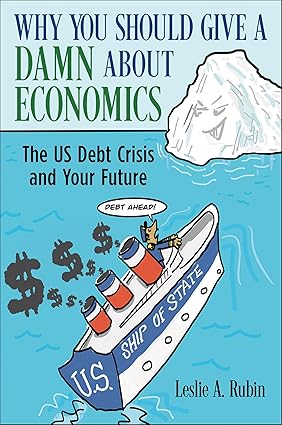

After reading Why You Should Give a Damn About Economics by Leslie A. Rubin, I found it to be a passionate and plainspoken call to action aimed squarely at the average American voter. The book is split into two parts. The first explains foundational economics concepts like supply and demand, fiscal and monetary policy, and different types of economic systems, all in accessible terms. The second half focuses on the United States’ growing national debt, the dangers of inflation, entitlement programs, and governmental inefficiencies. Rubin argues that an uninformed electorate is a key reason behind poor economic policy, and he believes that basic economic literacy is the only way to correct our course.
Rubin is not an academic economist, and that turns out to be one of the book’s strengths. He writes like a concerned citizen, not like someone trying to prove his intellect. The tone is direct and sometimes emotional. There are moments when the fear of economic collapse feels almost like a doomsday warning, but Rubin keeps it grounded with historical context and real-world examples. He even manages to inject humor through little sidebars and “KISSEs” (Keep It Simple, Stupid Examples), which made me smile more than once.
Rubin clearly emphasizes concerns about government overreach, and he makes an effort to stay nonpartisan. His perspective brings a clear and focused argument, though readers from different viewpoints might see things differently. His tone throughout carries a strong sense of urgency, especially when discussing the national debt and entitlement spending. At times, it feels intense, but it comes from a place of concern and care for the country’s future. His passion is clear, and his message is meant to prompt action.
I’d recommend this book to anyone who feels left out of economic conversations or overwhelmed by jargon-filled debates on fiscal policy. It’s especially helpful for young adults, new voters, or anyone who wants to understand how government spending and economic principles shape their daily lives. If you’re someone who’s been tuning out because economics sounds boring or too complicated, this book might change your mind.
Pages: 202 | ASIN : B0CY2W2J6H



