Blog Archives
A Quest To Reconstruct Edison

Thomas Edison and the Lazarus Vessel follows the former mentee of Edison, who is given a device that grants him the ability to speak with the dead. What was the inspiration for the setup of your story?
The two key historical facts that anchored the first book (Thomas Edison and the Purgatory Equation) were Edison’s obsession to create a machine that would communicate with the dead, and his never-explained disappearance for the entire month of February in 1918. The sequel takes place in 1933, two years after Edison’s death, and the historical lynch pins are the ‘business plot’ a coup hatched against Franklin Roosevelt during the first year of his presidency – and Edison’s decade-long exploration of the applications of hybridized rubber. The imagined result is his final invention: the simu-dermis – a synthetic vessel of skin capable of housing a soul and allowing the dead to walk again. When the ‘Resurrector’ device re-activates after several years of slumber, it propels Edison’s protege, John Dawkins, on a quest to reconstruct Edison and save the world.
With so many interesting characters in this novel, who was your favorite character to write for and why? Was there a scene you felt captured the characters’ essence?
Besides Mr. Edison, my favorite character is Groucho Marx. He’s an iconic comedian and I was both thrilled and daunted by the challenge of creating an honest portrayal of him within this fantastical, fictional setting. If Purgatory Equation was more of a traditional adventure, Lazarus Vessel is fueled by elements of a 1930’s screwball comedy, and Groucho is the ringmaster. But he’s also the unexpected soul of the novel and has a scene on the promise of America that’s one of my favorite moments in the entire trilogy. In ‘writing’ Groucho, I was able to realize one of my life’s ambitions: not just to meet him but, in a strange way, to work with him. I only hope it proves as rewarding a collaboration for Groucho as it was for me.
Within this book, you flawlessly blend historical fiction and science fiction/fantasy. It takes exceptional talent to blend the two genres together. How did you go about blending the two genres without disrupting the story?
The secret to this wild ride of a genre mash-up is that it’s anchored in fact. It requires an enormous amount of research to make sure every real-life character or incident blends seamlessly with the science-fiction/fantasy elements. One surprising reason they mesh so well is that the facts often trigger the fiction. Examples? The Chicago World’s Fair really DID feature an exhibit dedicated solely to Thomas Edison. Sally Rand, an exotic fan dancer, really DID help pull the country out of the depression by performing sixteen sold-out shows a day at the fair. Major General Smedley Butler really DID expose a cabal of big business titans who planned to stage a coup against President Roosevelt. And on it goes. As Harry Truman often said, “The only thing new in the world is the history you don’t know.”
Where does the next book in the series take the characters?
Book III takes place during the final days of World War II. John Dawkins has married Sophie Erskine, a former hot-shot newspaper reporter, and they’ve moved to Bucks County, Pennsylvania to raise their eleven-year-old son, Josh. Everything seems perfect – until it’s not – and the spirit of Thomas Edison is summoned one final time. Together, they embark on an expedition to London, Germany and Hell itself – and are joined on their quest by Winston Churchill, Aleister Crowley, the dark-arts magician, and theatrical playboy (and secret agent), Noel Coward. While the finale features derring-do action sequences and comic interludes, the stakes are higher and the tone more somber. For the endgame of the Edison Trilogy doesn’t so much address ‘what country will win the war?’ but rather, ‘which world will rule?’ The adventure continues!
Author Links: Website | GoodReads
Thomas Edison and the Lazarus Vessel
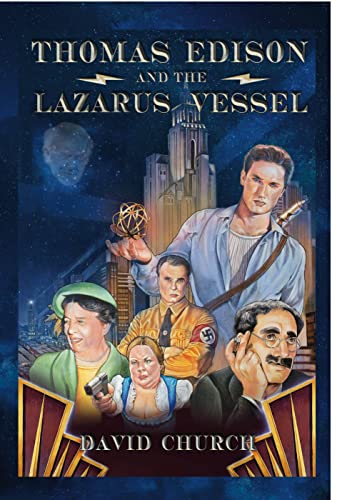

Thomas Edison and the Lazarus Vessel by David Church is a gripping page-turner. The main story follows John Dawkins, a man who, following the death of his former mentor Thomas Edison, is given a mysterious device that seems to grant him the ability to speak with the dead when he first activates it.
Two years pass, and the device never offers such a display again, leading John to think it was all in his head. That is until one day, when it unexpectedly begins to move, carving out a message telling John to find a former associate of Edison’s who has been kidnapped. This leads John on a thrilling journey to discover the secrets Edison left behind before they fall into the wrong hands.
This creative historical fiction book offers an entertaining alternate history starring many of the big names of the 1930s. Edison is, of course, a major character, but we’re also introduced to such memorable personalities such as George Gershwin, Groucho Marx, (both of which I feel don’t show up enough, if at all, in historical fiction novels) and the Roosevelts.
I would call this a historical thriller with some sci-fi and fantasy here and there that twist the story in fascinating directions, but so much is encompassed that it frankly seems to defy the traditional genre. The comedic moments sprinkled throughout earned a fair amount of chuckles from me, and there were even a few scenes I would classify as being genuinely effective horror. This occasionally creates some tonal issues, but nothing that diminishes the quality. I appreciate the writer’s ability to move between those moments and include them in one story.
The characters were written in such an engaging way that I wish we had gotten to spend more time with a few of them, which I think would have helped eliminate any trace elements of tropes and alleviate any issue with ‘fridging’ readers might notice. This is a sequel, but the story definitely stands on its own. The author also included just enough background information that readers will be able to follow the general setup, though not in a way that would be intrusive to anyone who has followed the series from the first amazing book.
I highly recommend Thomas Edison and the Lazarus Vessel to anyone looking for a fun and action-packed romp through 1930s America.
Pages: 270 | ASIN : B0BT4874XW




 LITERARY TITAN