Blog Archives
Storytelling and Healing

Scarlet Birthright follows a young DJ in Trinidad who falls in love with a dancer who becomes pregnant and flees to America, leaving his daughter with a lifetime of questions and longing. What was the inspiration for the setup of your story?
Scarlet Birthright is deeply personal—it’s autobiographical fiction born from my own experience. I was the love child of teenage parents, and my father left Trinidad when I was just a few months old. I grew up with my loving grandparents in Trinidad and Tobago while my father lived in America with his other family. This novella became my way of weaving together fact and fiction to explore that story, and ultimately, it helped me process and resolve the trauma of growing up with an absentee father. Writing this title was both an act of storytelling and a form of healing.
Were you able to achieve everything you wanted with the characters in the novel?
Mostly, yes. Since Scarlet Birthright unfolds through multiple perspectives, I felt I gave proper depth to the father, daughter, grandparents, and mother—each voice felt authentic and complete. However, I do wish I’d spent more time developing the stepmother’s character. Her story felt unfinished to me, which is why I ended up writing a separate short story dedicated entirely to her perspective. Sometimes characters demand more space than we initially give them.
What were some themes that were important for you to explore in this book?
The central theme became letting go of anger—a gift I didn’t realize I needed when I began writing. Through the process, I also explored the idea that perhaps we all do the best we can in any given moment. We’re imperfect humans making imperfect choices, often with limited information or emotional resources. There’s something both humbling and liberating about accepting that complexity in ourselves and others.
What is the next book that you’re working on, and when can your fans expect it out?
I’m working on “The Other Side of Love and Desire,” which will be the fullest exploration of themes that first emerged in my short story collection, Scarlet Yearnings: Stories of Love and Desire. It’s my way of diving deeper into those emotional territories that readers responded to most strongly. The book is scheduled for publication at the end of 2025 and will be available on Amazon, Barnes & Noble, and from all major book retailers.
Author Links: GoodReads | Website
🔥 A Life-Altering Spark: Witness the impulsive choice that sets Joromi on a collision course with family, identity, and legacy—its aftershocks echoing across decades.
🌴 Vivid Caribbean Setting: Immerse yourself in the lush beauty and folklore of Trinidad, where family legacies run deep as the island’s roots.
💔 Generations of Heartache: Follow Trisha’s poignant struggle to find her place—and finally confront the father she never knew.
✨ Ancestral Magic: Spirits, legends, and cultural traditions weave through every page, reminding us how the past guides our future.
💪 A Story of Hope & Redemption: Watch as one family’s destiny unfolds across decades and oceans, revealing the power of forgiveness and second chances.
Buy now to immerse yourself in a novel where passion transcends distance, heartbreak challenges fate, and one family’s destiny unfolds across oceans and decades.
Read less
Scarlet Birthright: What They Left Behind


Scarlet Birthright is a raw, emotional novella about love, abandonment, regret, and redemption. Set between Trinidad and New York from the late 1960s to the early 1990s, it tells the story of Joromi, a young DJ whose summer romance leads to heartbreak, a hidden daughter, and lifelong consequences. Across shifting seasons and continents, James stitches together the lives of Joromi, Margaret, Trisha, and their families, weaving a tale about choices that echo through generations. It’s messy, real, and haunting in the best way.
One thing that hit me right off the bat was how vivid and alive the writing is. The first chapter, where Joromi meets her at the party, practically sizzled off the page. James doesn’t just tell you that he’s struck dumb; you feel the sweat, the frangipani scent, the pounding heart when the mystery girl with the Afro walks in. That attention to atmosphere is a real strength. It dragged me into the heat of Trinidad’s dry season without mercy. At times, the language was almost overwhelmingly rich, dense, and luxuriant, like indulging in a second slice of chocolate cake despite already being full, but ultimately, it remained deeply satisfying.
Emotionally, this book gutted me. Joromi’s slow-motion car crash of choices, breaking things off, lying to himself, chasing an American dream while abandoning his roots, felt so human it was painful. The scene where he learns about the death of Trisha’s mother broke me. He crumples onto the kitchen floor, and even though he deserves the gut punch, you can’t help but ache for him. James captures grief and guilt in a way that’s too real. It’s messy and selfish and confused, just like real people. That said, there were moments when I wanted to shake Joromi until his teeth rattled. I mean, come on, man, your daughter’s right there!
What stood out even more was the women. Margaret, in particular, was complicated and, frankly, sometimes pretty hard to like. But that’s what made her fascinating. When she tells Joromi, “Just don’t bring her into this house,” after learning about Trisha, my stomach twisted. I hated her. I understood her. James doesn’t try to make any woman a saint or a villain. They’re just…human, battered by life and culture and their own fears. It’s messy in a way that polished, sanitized novels rarely dare to be.
Scarlet Birthright is a story for anyone who knows that love isn’t always enough, that choices leave scars, and that healing takes more than just time; it takes courage. I’d especially recommend it to readers who like intergenerational family dramas, emotionally complex characters, and writing so lush it feels like stepping into another world. Bring tissues, and maybe a little grace for the characters you’ll love and hate all at once.
Pages: 179 | ASIN : B0DYYXKV5F

The Need to Take Risks

In Harm’s Way follows a Colonial sea captain returning home after a year-long voyage only to have his ship confiscated by the British Royal Navy and find more tragedy at home who outfits his own private ship-of-war to seek out enemy merchant ships to oppose their tyranny. What was the inspiration for the setup of your story?
The inspiration was the many times I came home myself from six-month deployments aboard Navy ships. I then coupled it with the history of the Norfolk area, where I was at the time stationed. It was always heartwarming to see the new fathers meeting their children for the first time, and heart-wrenching to occasionally see a young sailor coming home after the death of a close relative. I knew I wanted to write a historically accurate novel set during the Revolution, and it was natural to begin it with a homecoming that turned sorrowful. It sets the mood for the story. The Revolution was not clean, it was not easy, nor was it a fight between “good” and “bad” guys.
What are some things that you find interesting about the human condition that you think make for great fiction?
The struggle each of us has to rise above the events that shape our current circumstances. We can either sink under the weight of what’s happened or happening, or adapt and change. But we must choose; even deciding to do nothing is a choice. Every day, folks around us choose to rise above. Even if they fail, they try and often try again. We should honor that.
What were some themes that were important for you to explore in this book?
Loss, and dealing with it, and the need to take risks in life. Playing it safe is rarely, if ever, successful. Finally, that in every conflict, a person must choose a side, based on their values and principles. Neutrality only works for Switzerland, and only because they can defend themselves.
Where does the story go in the next book, and where do you see it going in the future?
Jonas will return to sea in the next book, this time accompanied by his son, and with vengeance in his heart. But he’ll find that revenge is an insufficient reason to fight, and obtaining it is both unsatisfying and damaging. In the third book, he will again return to the fight, this time with a commission in the Continental Navy.
Author Links: GoodReads | X (Twitter) | Facebook | Website | Amazon
Colonial sea captain Jonas Hawke returns home to Norfolk after a year-long voyage only to have his ship and its valuable cargoseized by the British Royal Navy. As the royal governor further tightens the noose on trade, Jonas is thrust into the chaos of a growing rebellion. Desperate to support his family, he sets out to find work. When he is denied a commission with the newly formed Continental Navy, he outfits his own vessel as a private ship-of-war and voyages to the Caribbean in search of enemy merchant ships he can capture and friends he can trust.
But dangers multiply on the unforgiving sea. The Royal Navy reacts mercilessly to the threat posed by privateers like Jonas. How will Jonas fare now that he has boldly defied the king of Britain to preserve his family? And what will happen to his loved ones while he is away, engulfed in a war to oppose tyranny in the name of freedom?
In Harm’s Way
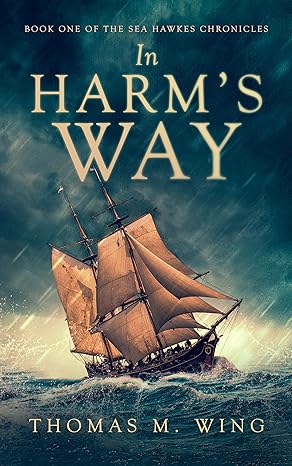

Thomas M. Wing’s In Harm’s Way is a gripping historical novel set during the American Revolution, centering on Captain Jonas Hawke, a privateer navigating the turbulent waters of war and personal loss. When his ship, the Elizabeth, is seized by the British Royal Navy under dubious pretenses, he and his crew are thrust into a battle not just for their freedom but for justice. As Hawke returns home to Norfolk, he finds not only a changed political landscape but also devastating personal tragedy. Wing blends historical accuracy with compelling storytelling, making the reader feel the weight of revolution on ordinary men.
What struck me most was Wing’s ability to bring history to life through vivid and authentic detail. His background as a retired Naval officer shines in the way he captures the rhythm of ship life—sails creaking, the smell of tar and hemp, and the ever-present danger on the high seas. The opening scene, where British forces storm a printing press to suppress rebellious voices, is tense and sets the tone for the book’s theme of resistance against oppression. He delivers a story that feels raw and real, making the reader feel every injustice and triumph.
Jonas Hawke is a protagonist who carries the novel with quiet strength and deep emotion. His return home to find that his infant twins have died is a gut punch that lingers. Wing makes us feel the grief through Mary, Hawke’s wife, whose simmering resentment toward his long absences cuts deep. Their exchange—her quiet fury, his helpless sorrow—was one of the most emotionally impactful moments in the book. The revolution is personal, fracturing families and reshaping lives. Hawke’s struggles reflect the larger battle for independence, making his journey all the more compelling.
The pacing of the novel balances naval battles with quieter moments of introspection. The scenes aboard the Otter, where Hawke and his men are treated as criminals rather than citizens, are particularly enraging. The arrogance of the British officers, especially Captain Squire, is infuriating yet believable, reinforcing the stark divide between colonists and their so-called rulers. The way Wing builds tension, especially during the naval confrontations, had me holding my breath. The book immerses you in history, making the reader experience the frustration, fear, and determination of those who fought against British rule. At times, the historical details, while fascinating, slow the pacing just a bit, especially for readers less familiar with naval terminology or Revolutionary War politics.
In Harm’s Way is an outstanding read for anyone who enjoys historical fiction, particularly those fascinated by naval warfare and the Revolutionary War. Fans of Patrick O’Brian’s Master and Commander series or Bernard Cornwell’s Revolutionary War books will find much to love here. Wing’s storytelling is rich, emotional, and historically grounded, making this book both educational and deeply engaging.
ASIN : B0F1W6GTC4

Consequences of Choice

A Tuft of Thistledown follows a white man and a Cherokee woman in the early 1800s who grew up together as their mothers were like sisters, and now as adults are rivals each fighting for different things. What was the inspiration for the setup of your story?
I dreamt it all many years ago but forgot how it ended. It wasn’t until a few years later that I remembered the ending thanks to a very special horse and a horse whisperer from Scotland, UK.
There was a lot of time spent crafting the character traits in this novel. What was the most important factor for you to get right in your characters?
I wanted to not insult/portray badly/misrepresent the Cherokee and Africans of those times along with everyone else who lived there first.
What were some themes that were important for you to explore in this book?
I guess, thinking about it, there could be a few really; when to trust, the sometimes never-ending consequences of choice, the pain of a love or a life that can’t be had, and what the terrible want of always more can make people do.
Our hard-wired will to survive is also a theme, unless like one of the characters, too much has been seen or happened, then that will can spill away.
But for me, one of the major themes is the absolute need to sometimes go with what all you feel inside, no matter what others say.
What is one thing that people point out after reading your book that surprises you?
I think the one biggest thing that surprises me is when some people say they think about it after they have finished reading it.
Author Links: GoodReads | Amazon
In the early 1800s, a time when people in parts of the world did things that their souls wouldn’t want them to, John Lucas Jnr. and Horse Song, the children of two women raised as sisters in England, find themselves caught up in the brutal western expansion of America; a place where for some to live and survive was all in the undying consequences of choice.
Later, in 1839, after being officially tasked to clear all Cherokee still living in hiding east of the Mississippi, John Lucas Jnr. finds Horse Song, the woman whose hands he once wanted to hold forever. Torn by their shared past and love that couldn’t be had, Horse Song and the Cherokee she is hiding with are forced into deciding that when it comes to duty, land, and the right way to be, can John Lucas Jnr. be trusted or not.
Dread Tribunal of Last Resort

Decker Brown is a man with clear aspirations. Born in Virginia and educated in Boston, he envisions a future rooted in business success, family life, and societal contribution. But history has other plans. As the Civil War looms, the idyllic life he hopes to build with Paula Crane, the woman he loves, comes under threat. While Decker clings to the ideals of the Republic, Paula recoils at the idea of countrymen warring against one another. Together, they must confront a stark question: can their love and shared dreams endure the upheaval of a nation in turmoil?
In Dread Tribunal of Last Resort, Brian Kaufman crafts a sweeping work of historical fiction that captures both the years leading to the Civil War and its turbulent aftermath. Readers familiar with works like Cold Mountain or Gone with the Wind will find echoes of those classics here. The narrative centers on Decker and Paula, two privileged young individuals who find their lives upended as war reshapes everything they once took for granted.
Kaufman’s novel stands out not only for its meticulous attention to historical events but also for the humanity he breathes into his characters. Through their eyes, readers experience pivotal moments like the Richmond Bread Riot and the Battle of Shiloh. Interwoven with these personal struggles are encounters with towering historical figures such as Robert E. Lee and Abraham Lincoln, grounding the narrative firmly in its historical context.
What truly sets this novel apart is its emotional resonance. Kaufman delves deeply into the inner lives of Decker and Paula, portraying their struggles with a poignancy that is both heartrending and authentic. Their longing for a peaceful life is starkly juxtaposed with the relentless challenges of war, making their losses all the more intense. Kaufman’s commitment to historical accuracy amplifies the weight of these moments, while his vivid, unflinching prose captures the grim realities of a conflict that forever altered the fabric of the nation.
Dread Tribunal of Last Resort is more than a historical novel—it’s a story of love, resilience, and the enduring human spirit amidst the chaos of history. Kaufman’s masterful blend of compelling characters and rich historical detail ensures this book will linger in the minds of readers long after they turn the final page.
Pages: 354 | ASIN : B0CXYJ62Y1
A Figurative Shadow

Zephyr Trails follows a young woman living in Southern Missouri in 1866 who finds herself grappling with her own burgeoning interests, a developing epidemic, and rumors that her father, thought to be lost, may still be alive. Where did the idea for this novel come from?
I have always loved Westerns: books, movies, TV shows. I wanted to write a Western with a strong female protagonist who knew her horsemanship. There weren’t a lot of those around. I came to realize most Westerns were based in or around the Civil War. I was not a Civil War buff, but my research uncovered so many interesting and obscure facts about the war: women’s roles during and because of the war, the times leading up to the war, families separated by war, and the reconstruction era. The simple Western I meant to write took on a more literary bent. Though it’s technically Historical Fiction, I like to call it a “Literary Western.” Zephyr Trails is the second book in the Ellis River trilogy. The protagonist, Ellis Cady, started her journey in Tennessee. Life at the time could be very different from one side of the Mississippi River to the other. The more I learned, the more I became involved with my characters and their stories and how war affects people and families. At some point, the characters led the way.
Why choose this place and time for the setting of the story?
A lot was happening historically in this setting. During the Civil War, Missouri was considered a “border state.” It never officially took sides in the war. This statewide internal conflict added to my character’s internal conflict. Ellis was raised in a Quaker community (in Tennessee) that taught patience, peace, and acceptance. I imagined the difficulty of reconciling those beliefs with the reality of slavery and war. The setting of post-Civil War Missouri contributed a figurative shadow over the characters and their attitudes and loyalties. I think it helped provide an interesting tension. Also, I was born in St. Louis, raised across the Mississippi River in Illinois, and stumbled upon so much of that area’s history never taught in school. At least it wasn’t taught while I was listening. St. Louis, Missouri, was the starting point for much of the migration west, so it had to play a major role in this story. There were actually two cholera pandemics that hit the area because of the influx of people and inadequate water and sewage systems. One hit in 1849 and one in 1866 when Zephyr Trails takes place. The Pony Express originated in St. Joseph, Missouri, and though it had been out of service for four years by the end of the war, it made sense that its fictional re- establishment might start there.
What character did you enjoy writing for? Was there one that was more challenging to write for?
Picking a favorite character is a bit like picking a favorite child. I enjoy writing them all for different reasons. I’ve always had a love for horses and have been lucky enough to own and work with them through the years. They are characters in my books, and I thoroughly enjoy writing for them. All the horses in Zephyr Trails are based on actual horses I’ve known. I truly believe writing a character-driven novel is a collaboration with the characters, whether horse or human. I birth them, and they take on a life of their own. I try to guide them, but they sometimes come up with their own ideas. The more challenging ones to write for are those who don’t open up to me as much or need more coaxing to do so. Lou and Tory are rather quiet but complex men. They may have been more affected by traumatic life experiences than some, and I wanted to be as respectful as possible to their Indigenous heritage, as well.
I find a problem in well-written stories, in that I always want there to be another book to keep the story going. Is there a second book planned?
I’m delighted that Zephyr Trails can be read and enjoyed as a stand-alone, though it is the second book of the Ellis River trilogy. And, yes, there is a third book in the works. The first book, Ellis River, was meant to be a one-off, but it developed into more. Not until I finished Zephyr Trails did I know it would be a trilogy.
Author Links: GoodReads | Facebook | Website | Amazon
After waiting out winter at the Cady ranch in southern Missouri, hope blooms in the Spring of 1866. Ellis receives news of a mysterious man arriving in St. Louis. Will she find her father alive and well, or finally put his memory to rest?
Grasping at the illusive promise of her father’s whereabouts, Ellis is distracted by the intrepid trick rider, Jimmie, a woman who rides with Levi Jack’s Wild West Exhibition. Then, talk of reinstating a messenger service akin to the Pony Express rekindles a faded dream. Since the war’s devastation, important letters and messages still need to get through a Western landscape governed by Indians and outlaws. When an untimely epidemic threatens, Ellis finds herself back in the saddle, a young woman and her horse on a perilous trail.
What Once Was Promised
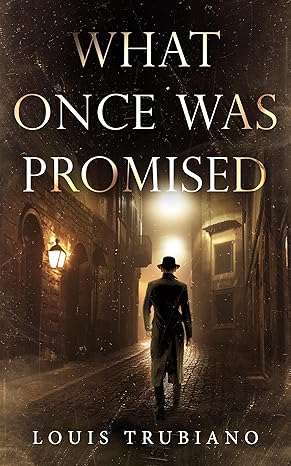
Set in 1914, What Once Was Promised by Louis Trubiano opens with sixteen-year-old Domenic Bassini, who boards the Cretic, bound for America and a future filled with unknowns. Leaving his family behind in Italy, Domenic’s journey across the Atlantic is one of hope and uncertainty. Aboard the ship, he meets Cologero and Francesca, a young married couple brimming with dreams of a new life, and Ermino, a stowaway searching desperately for his father. Together, they envision a land of promise and opportunity, unaware that the paths they embark on will twist and bind them together for decades in ways they could never have foreseen.
What Once Was Promised is a rich, multigenerational saga that vividly portrays the Italian immigrant experience in early 20th-century Boston. Trubiano masterfully blends themes of love, loss, family, and survival with the gritty realities of politics and organized crime. The setting bursts to life with meticulous detail, drawing readers deep into the vibrant world of Boston’s North End. Every corner of the city pulses with authenticity, from its cramped tenements to its bustling markets, without ever bogging down the narrative with overwrought descriptions. Instead, the immersion feels effortless, making you experience the hardships, the joys, and the perseverance of a community bound by heritage and resilience. What keeps this novel so captivating is the powerful sense of family that courses through its pages. The characters’ struggles against racism, punishing labor conditions, and the challenges of tenement life are rendered with empathy and depth. Trubiano weaves a story where survival isn’t just about overcoming obstacles but about the bonds that sustain and uplift. In a world battered by the flu epidemic, the Great Depression, and World War II, the lesson is clear: everything starts and ends with family, a timeless truth passed down through generations. The novel’s characters are unforgettable. Domenic, Ermino, Cologero, Francesca, and the many others who populate this story feel achingly real. Trubiano’s gift for character development ensures that each person leaves an indelible mark on the reader. Their choices shape their destinies in unexpected ways, and witnessing how their lives unfold is as rewarding as it is heart-wrenching.
The narrative evokes a spectrum of emotions, moments that made me laugh out loud, passages that brought tears, and scenes that left me gasping in shock. I found myself so engrossed in their world that I often paused to look up real events and figures from history, eager to know more. What Once Was Promised is a triumph of historical fiction that offers a deeply moving glimpse into the past. It’s a story of dreams, survival, and the enduring power of family, one that lingers long after the final page. Truly, I never wanted it to end.
Pages: 314 | ASIN : B0D57JJRJJ


