Blog Archives
The Old Road


The Old Road, by Jimmy D. Whitt, is a portal fantasy with its boots planted firmly in Appalachian soil. Pete begins as a young man from coal country who has already made a few bad choices and isn’t sure what comes next. Then an ordinary walk past an abandoned mine drops him into the Below, a vast underground world of Goblins, Kobolds, Elves, Dwarves, ruined civilizations, strange creatures, and a force simply called the Power. Whitt gets the adventure moving quickly, but the real hook is Pete himself. He carries the hollers, his mother, his humor, his regrets, and his way of looking at people into every strange encounter. Even when the world around him becomes increasingly fantastic, Pete remains recognizably the same kid who started out wondering whether his life was going anywhere.
The Below is built through discovery, and that makes exploring it with Pete a lot of fun. Glowing moss, enormous caverns, ancient roads, bags of holding, glyph-powered tools, underground settlements, strange mounts, lost cities, and competing peoples arrive as things Pete has to understand if he wants to stay alive. The Power gives the story a satisfying progression-fantasy engine, rewarding experience, intent, will, and hard-earned Milestones, but Whitt connects that system directly to character. Pete becomes more capable because he’s learning to pay attention, work, endure, and make better choices. His training under Keres turns those ideas into the backbone of the book. Their relationship grows from wary necessity into trust and affection, with Keres’s relentless lessons in observation and survival becoming as important to Pete’s development as any supernatural ability.
As the story opens up, The Old Road becomes more than a journey through an exotic underground world. Pete’s arrival intersects with missing scouts, mysterious gateways, Elven activity, old abuses of the Power, institutional politics, and dangers that increasingly suggest his presence in the Below matters. Brannick and Lirissa broaden the cast without stealing the story away from Pete, while Pete’s eventual entry into Scout training gives him something he has rarely had before: a place where effort, discipline, friendship, and ability might actually lead somewhere. Whitt also keeps Pete’s sense of humor alive through all of it. His Earthbound comparisons, awkward reactions, running commentary, and occasional inability to leave well enough alone give the book an easy conversational energy even when assassins, political maneuvering, and ancient threats begin closing in.
What stays with me most is the way The Old Road treats transformation as a series of choices. Pete gains extraordinary abilities, but the more important change is that he begins taking responsibility for what kind of person he’ll become. That gives the book’s adventure real emotional weight and makes its cliffhanger ending feel like the opening part of a much larger story. Whitt has created a fantasy world with plenty to explore, but he’s also given readers a protagonist worth following down every dark passage ahead. The Old Road turns an Appalachian kid’s search for a future into a gripping journey through another world, and makes every hard-won step feel like it matters.
Pages: 183 | ASIN : B0DS2Q2PR4

When Darkness Falls: The Trilogy

When Darkness Falls, by Alliie McCormack, is an expansive romantasy trilogy built around one irresistible idea: a young woman who has spent her life simply surviving arrives in a desert city determined to make a home for herself, only to discover that she’s connected to powers far older and stranger than she ever imagined. Alyssa’s arrival in Al Khair sets everything in motion, from her unlikely appointment as Royal Scribe to the Sultana to the awakening of Damien, the ancient vampire and demon known as the Dark Lord. What makes the story so inviting is that McCormack gives Alyssa time to fall in love with her new life before the larger supernatural story closes around her. We experience the markets, baths, palace, Library, oasis, and crowded streets through someone who’s genuinely delighted to have a room of her own, money in her pocket, meaningful work, good food, books to read, and people who care whether she comes home safely. That simple hunger for belonging gives the entire trilogy its emotional foundation.
Al Khair is wonderfully suited to this kind of story because it feels like a place where the ordinary and fantastic have learned to live next door to each other. Vampires inhabit the Catacombs beneath the mountains. Magi study and advise the Sultana. Demons, Djinn, shapeshifters, healers, gypsies, merchants, guards, craftspeople, servants, and courtiers all become part of an increasingly interconnected community. McCormack has fun with the practical side of that world, too. Supernatural beings have laws, rivalries, customs, prejudices, political responsibilities, and domestic routines. A Dark Lord who inspires terror can also find himself worrying about furniture, horses, libraries, shopping trips, and whether Alyssa is happy. Those contrasts give the trilogy much of its personality. There’s plenty of magic and danger here, but there are also friendships, teasing conversations, shared meals, palace gossip, books being shelved, carpets being coveted, and a memorably ill-tempered peacock named Alphonse.
At the center, though, is the evolving relationship between Alyssa and Damien. It begins in fear and misunderstanding, with Damien hunting for the mysterious power disturbing his domain and Alyssa having no idea that she’s the person he senses. Their relationship changes substantially over the three books as fascination becomes attachment, protectiveness, desire, trust, and eventually love. Damien is possessive, imperious, ancient, and frighteningly powerful, while Alyssa has a stubborn moral center that keeps her from being swallowed by the force of his personality. Some of their best moments come when she simply refuses to be intimidated by the Dark Lord everyone else fears, scolding him, teasing him, questioning his assumptions, and quietly forcing him to reconsider what he thinks he knows about humans and Others. Their romance works alongside Alyssa’s own awakening, because falling in love with Damien is only one part of her transformation. She’s also uncovering the truth about herself, her lost family, her unusual magic, and why fire has always held such a complicated place in her memories.
The trilogy grows naturally in scope as those personal mysteries become political ones. What begins with one impoverished traveler seeking employment eventually encompasses vampire law, human and Other relations, conspiracies, refugees, rogue vampires, a threatening army, an ancient prophecy, and the revelation of Alyssa’s Djinn heritage. The supporting cast gives that widening story real warmth. Zahira is a capable Sultana whose responsibility to her people feels personal. Nicholas becomes teacher, protector, investigator, and friend. Kayja brings sharp humor and a delightfully unsentimental demon perspective. Remi is chaotic, affectionate, and impossible to forget, while characters such as Aleksei, Kaylee, Azim, Melisande, Jamal, Malikai, Salima, and Aseel gradually make the world feel populated by relationships. By the time the Great Horde approaches Al Khair, the coming battle matters because the trilogy has spent so much time showing exactly what these characters are fighting to preserve.
What stayed with me most is the way When Darkness Falls keeps returning to the idea of chosen home. Alyssa comes to Al Khair believing that a job and a room might be enough to give her a life, then discovers something far larger: friendship, purpose, love, family, power, and a community broad enough to include humans and supernatural beings alike. Even the prophecy ultimately feels less like a mechanism of fate than a recognition of what Alyssa and Damien have already accomplished by bringing different worlds together. McCormack blends fantasy adventure, paranormal romance, court life, found family, humor, and supernatural politics into a trilogy with a generous heart and a heroine whose joy in discovering where she belongs is genuinely infectious. When Darkness Falls is a richly imagined fantasy romance trilogy where darkness has wings, fire has a lineage, and belonging becomes the most powerful magic of all.
Pages: 839 | ASIN : B092T3CFCR
Amber Unscripted (The Scarlet’s Harlots Trilogy Book 3)


Amber Unscripted, by Kirsten Pursell, is a contemporary women’s fiction novel with a strong romantic thread, following Amber as she returns to Sullivan’s Island after divorce and begins sorting through the stories she has told herself about love, family, regret, and identity. As the third book in The Scarlet’s Harlots Trilogy, it centers on friendship, second chances, and the brave, messy work of choosing a life that actually feels like your own. Amber’s past includes reality TV fame, a painful marriage, family secrets, and a lost love named Christian, but the heart of the book is really about her learning to stop living by old scripts.
What I appreciated most was how the book balances humor with emotional weight. Amber could easily have been written as a glossy former television personality with a predictable comeback arc, but Pursell gives her more texture than that. She is funny, wounded, sometimes guarded, and often more self-aware than she gives herself credit for. I liked the way the women around her, especially the Harlots, create a kind of chosen family that lets the story breathe. Their conversations are sharp, warm, and occasionally ridiculous in the best way. The book understands that friendship between adult women can be both a lifeline and a mirror, and that sometimes the people who tease you the hardest are also the ones who will sit with you when the truth gets heavy.
The story moves between Amber’s personal reckoning, Audrey’s late-blooming romantic awakening, the group’s book club discussions, and the pull of old mysteries. At times, it feels packed. There are family secrets, past trauma, divorce, grief, fame, lost love, and a trip to Greece, all woven into one emotional arc. That could have become too much, but for me, the abundance fits the story. Women’s fiction often works best when it honors the full clutter of a life, and this novel leans into that. I especially liked how books within the book, from The Bridges of Madison County to the club’s other reads, become quiet pressure points for the characters. They are not just talking about stories. They are using stories to figure out what they still want.
I would recommend Amber Unscripted to readers who enjoy contemporary women’s fiction about reinvention, female friendship, and romance after heartbreak. It will especially appeal to anyone who likes emotionally reflective stories with humor, coastal settings, and characters who are old enough to know better but still brave enough to want more. This is a thoughtful, candid, and ultimately hopeful novel about stepping out of the role other people handed you and finally writing the next scene yourself.
Pages: 254 | ASIN : B0GX2RYWQ9
When Mercy Died

Peter Van Oossanen’s When Mercy Died is a science fiction thriller that blends crime drama, superhero fiction, and romantic suspense into a story about grief, justice, and renewal. As the second book in a trilogy, it follows Sam Stanton, an extraterrestrial raised on Earth, after the murder of Michelle Bennett, her children, and her mother. The tragedy sends Sam into a deep emotional collapse, and the novel begins with a powerful focus on loss before widening into a larger story of purpose, revenge, and moral choice.
Sam is the emotional center of the book, and his grief gives the novel its strongest dramatic weight. His abilities, advanced technology, invisibility suit, and aircraft make him a compelling science fiction hero, but the story is equally interested in his vulnerability. Van Oossanen presents Sam as a man shaped by extraordinary power and profound sorrow, which gives the action-thriller elements a personal foundation. His struggle to move forward after Michelle’s death adds depth to the familiar themes of crime-fighting and secret identity.
The book’s worldbuilding expands through Prime-Even, Sam’s extraterrestrial home world, and through the contrast between that advanced society and the violence he faces on Earth. These scenes bring a strong science fiction element to the novel while also giving Sam space to recover, reconnect with family, and reconsider the mission he was born to fulfill. The combination of alien civilization, futuristic technology, and grounded emotional stakes helps the story move between intimate drama and large-scale adventure.
As Sam returns to Los Angeles, When Mercy Died becomes a crime thriller driven by kidnappings, corruption, and the search for those responsible for the attack that destroyed his future with Michelle. His relationship with Leona Martin adds a romantic suspense thread that brings warmth and momentum to the second half of the novel. Their partnership gives Sam a new emotional anchor, and it also reframes his mission as something larger than vengeance.
When Mercy Died is a heartfelt science fiction crime thriller about a hero trying to rebuild himself after a devastating loss. Van Oossanen combines action, romance, alien technology, and questions of justice in a story that’s focused on resilience and the difficult path back to hope. Readers who enjoy superhero fiction with emotional stakes, futuristic adventure, and a strong moral conflict will find Sam Stanton’s journey engaging and sincere.
Pages: 429 | ASIN : B0GKC5XBPL
A Strength and a Flaw

The Extraterrestrial follows a boy from another world raised by loving Earth parents, as he grows into a secretive hero using alien technology to battle criminals while fighting to hold on to family, love, and his humanity. What were some sources that informed this novel’s development?
I was a scientist long before becoming an author in 2013, and much of my scientific background naturally found its way into the Sam Stanton trilogy. My work and research in areas such as invisibility, advanced propulsion, and high-speed aircraft exposed me to concepts that are far less science fiction than many people might assume. Those ideas became the technological foundation upon which the trilogy was built.
Rather than place such advanced capabilities in the hands of an ordinary human being, I chose to make Sam originate from Prime-Even, a highly advanced world associated with the exoplanet Kepler-452b, which has been studied by NASA because of its Earth-like characteristics. That decision allowed me to explore not only advanced technology, but also the cultural, moral, and philosophical consequences of a civilization far older and more advanced than our own.
Beyond the scientific aspects, the trilogy was also shaped by my concern about modern geopolitics, political polarization, and the fragility of democratic institutions. The broader storyline required a setting in which extraordinary events could plausibly unfold—particularly in Part 3, where the failed impeachment of the U.S. President and Vice President ultimately, leads to their abduction and appearance before a tribunal of the galaxy’s most advanced society.
That tribunal becomes far more than a science-fiction device. It is used to examine power, leadership, ideology, and the consequences of political extremism. The President’s “One & Only” policy is dissected before an impartial civilization capable of viewing humanity from an outside perspective, with the possibility that the outcome could trigger a new Cold War—or something even more dangerous.
At its core, however, the trilogy is not really about futuristic technology. It is about identity, secrecy, responsibility, love, and what it means to possess human-like feelings while carrying abilities and burdens that separate Sam from everyone around him. My scientific background provided the framework, but the emotional and moral conflicts of the characters ultimately became the heart of the story.
How did you balance the novel’s technical details, such as Sam’s aircraft, training, and medical knowledge, with the story’s emotional and romantic elements?
I always wanted the technical descriptions to remain concise, while still being convincing enough for readers to accept the world in which the story unfolds. My scientific background helped me create technology that feels plausible rather than purely fantastical, but I never wanted the novels to become technical manuals. The emotional journey of the characters always came first.
The storyline of each of the three books was developed before I worked out the details of the technology itself. Once I understood what the story required emotionally and dramatically, I then created the technological framework needed to make those events believable.
For example, invisibility was an essential attribute. Without it, the abduction of the President and Vice President in Part 3 would simply not have been possible. Likewise, Sam’s ability to protect Michelle in Part 1 against the full might of the Scorpion cartel depended on technology far beyond human capabilities. His extraordinary aircraft and advanced medical knowledge also allowed him to operate outside the limits of ordinary society.
At the same time, I wanted those abilities to deepen the emotional and romantic dimensions of the story rather than overwhelm them. Sam’s powers isolate him as much as they empower him. He is constantly forced to balance secrecy, responsibility, love, loyalty, and the desire to live as a normal human being. In many ways, the emotional conflicts became more important to me than the technology itself.
The technical elements therefore, serve mainly as the backdrop against which the human story could unfold. Beneath the aircraft, invisibility, and advanced science, the trilogy is ultimately about identity, relationships, sacrifice, and the struggle to remain human while possessing abilities no human should have.
Sam often believes secrecy is the best way to protect the people he loves. Do you see that as one of his strengths, his flaws, or both?
Sam was instructed from childhood to maintain absolute secrecy about both his origin and his mission. He was even told never to show his face to anyone if doing so could lead to his discovery. That conditioning became deeply rooted in who he was and shaped nearly every important relationship in his life.
In Part 1, secrecy ultimately leads to his breakup with Michelle because he chooses not to reveal who he truly is. His biological father had taught him that secrecy was essential for survival and for the protection of those he loved. Yet later, he deeply regretted not warning Sam that love changes the equation—that withholding the truth from someone you truly love can become destructive rather than protective.
When I created Sam as a character, I always intended secrecy to function as both a strength and a flaw. On the one hand, it is essential to his survival and to the safety of the people around him. If hostile governments, criminal organizations, or intelligence agencies were to fully discover who and what he is, not only Sam but everyone close to him would be in danger. In that sense, secrecy is a discipline, a responsibility, and even a form of sacrifice.
On the other hand, secrecy isolates him emotionally. It prevents complete trust, damages intimacy, and creates loneliness. Sam constantly carries the burden of protecting others while knowing that doing so may push them away. The very thing that makes him effective also prevents him from fully sharing his life with the people he loves.
So the answer is definitely both. Secrecy is one of Sam’s greatest strengths, but also one of his deepest personal flaws. Much of the emotional tension throughout the trilogy comes from that conflict.
What do you hope readers take away from Sam’s journey as a hero who is powerful but still vulnerable?
I have occasionally been criticized for creating a protagonist reminiscent of a Superman-type figure—the Kirkus Reviews, in particular, made that comparison. But I believe that interpretation misses the essence of who Sam Stanton and Junior truly are.
My protagonists are not invulnerable superheroes. They are realistic, emotionally complex, and deeply vulnerable human-like beings who happen to possess access to advanced technology that, in my view, is not entirely beyond scientific reach. They do not perform impossible feats through magical powers. Their abilities stem from technology, training, intelligence, and the responsibilities placed upon them.
More importantly, both Sam and Junior possess very human flaws. They hesitate, doubt themselves, struggle with moral choices, and suffer emotionally in ways that any ordinary person would. Compassion, loyalty, grief, fear, and love shape their decisions far more than their technological advantages do. Throughout the trilogy, I deliberately explored the moral ambiguity surrounding vigilantism—the question of whether individuals who possess extraordinary capabilities have the right to stand above the law when confronting evil. Their antagonists are equally grounded in reality. Rather than battling fantastical monsters or alien invaders, they confront recognizable threats from our own world: ruthless drug cartels, corruption, political extremism, abuse of power, and ultimately individuals occupying the highest offices in the United States government. That realism was important to me because it keeps the emotional stakes believable and immediate.
Another central thread running through all three books is the tension between secrecy and intimacy. Sam’s and Junior’s need to conceal who they are complicates every meaningful relationship they attempt to build. Their ability to love becomes both a source of strength and a source of pain. The secrecy required to protect others simultaneously prevents them from fully sharing themselves with the people they care about.
As a result, the emotional consequences of the story became just as important to me as the science-fiction elements. When Michelle, her children, and her mother are brutally murdered, Sam’s grief is not superhuman grief — it is profoundly human grief. Likewise, when Sam believes Junior has been killed in Part 3, the pain, despair, and emotional collapse he experiences are intended to feel completely real.
Ultimately, I would like readers to come away from the trilogy not with the feeling that they have read a conventional superhero story, but that they have experienced an emotional and morally complex human drama—one involving love, grief, sacrifice, political intrigue, moral dilemmas, and the psychological burden of carrying responsibilities no ordinary person should have to bear.
Author Links: GoodReads | Atmosphere Press | LinkedIn | Facebook | Peter Van Oossanen | Instagram | X (Twitter) | Website | Amazon
Delivered to Earth as an infant and adopted by loving parents, Sam grows up unaware that he is the product of a distant civilization’s desperate experiment—an experiment designed to confront humanity’s growing descent into crime and corruption. On his eighteenth birthday, the truth is revealed: Sam has been chosen as a guardian, trained and tested for a mission that will one day place the fate of countless lives in his hands.
Sixteen years later, deemed ready by his creators, Sam is granted extraordinary abilities—including invisibility and an advanced aircraft capable of breathtaking speed. As disasters strike across the United States, a mysterious savior emerges. The public knows him only as Guardian—a faceless hero, a symbol of hope, and a national legend.
But Guardian’s greatest challenge lies not in natural catastrophes, but in the shadows of Los Angeles. When Sam witnesses a brutal drug transaction near the Bel-Air Country Club, his mission collides with human consequence. A woman wanders into the crime scene and is gravely injured—then saved by Guardian. Now a target of ruthless criminals, she becomes someone Sam must protect… and someone he never meant to care for.
As danger closes in and emotions deepen, Sam is forced to confront the ultimate conflict: can a man sworn to secrecy, born for duty, afford to follow his heart?
A gripping blend of science fiction, suspense, and forbidden romance, this novel asks what it truly means to be human—when saving the world may cost everything.
The Phoenix CODEX: 138 Palindromic Mirror Edition Complete Phoenix Chronicles: Complete Phoenix Chronicles: A Trilogy of Trilogies
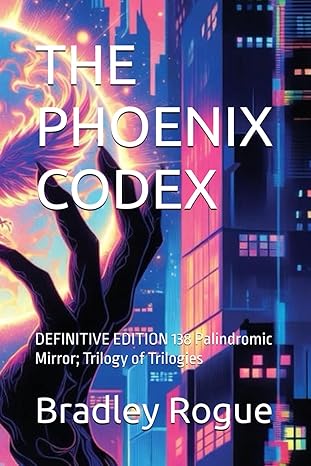
The Phoenix Codex is a theatrical metaphysical thriller that treats structure as part of the story, not just a container for it. Bradley Rogue builds the book as a “palindromic mirror” with ascending and descending arcs wrapped around a central point, and that design gives the whole thing a ritualized, incantatory feel rather than a straightforward adventure-novel rhythm. The opening makes its intentions clear right away: “It’s also a novel. Also a seed. Also a key.” That line captures the book’s whole personality. It wants to be read as fiction, transmission, puzzle box, and initiation text all at once.
At the center of it all is Dr. Natori Saira Evren, who isn’t just a protagonist so much as the book’s tuning fork. Her synesthesia, her academic outsider status, and her role as a traveler through patterns of recurrence make her the ideal guide for a world built on hidden frequencies, ancient architectures, and repeating catastrophes. The book follows her through interrogations, prequels, secret histories, temporal jumps, and revelations about the Phoenix cycle, and it does so with total conviction. Rogue writes like someone fully committed to the reality of his invented cosmology, and that commitment gives the novel its distinctive heat.
The book wants myth, conspiracy, sacred geometry, speculative archaeology, simulation theory, apocalypse, and spiritual transformation all in the same breath. Sometimes that makes the prose feel deliberately overwhelming, but that excess is also part of the reading experience. This is a book that likes pressure, repetition, symbols, and declarations. It keeps returning to numbers, mirrors, cycles, names, and encoded meanings until the language starts to feel ceremonial. Even the narrative instructions invite readers to treat the novel as an object with multiple valid pathways, which is a pretty revealing choice. The Phoenix Codex isn’t shy about asking the reader to participate in its pattern-making.
The most interesting thing about the novel is how openly it explains its own method. In the author’s note, Rogue says, “The Phoenix Chronicles make no claims to historical accuracy. They are mythology—but mythology that is aware of its own mythological status.” That self-description is useful because it points to what the book is really doing. It isn’t just telling a story about a hidden truth. It’s dramatizing the human urge to arrange history, fear, destiny, and transcendence into one giant meaningful design. That gives the novel a strange double quality. It’s earnest and self-conscious at the same time, immersive but also always nudging readers to notice the architecture holding it together.
The Phoenix Codex is less a conventional novel than a designed experience, and that’s what makes it memorable. It reads like a fusion of esoteric manifesto, sci-fi myth cycle, and visionary character saga, all organized around symmetry and recurrence. Readers who click with its wavelength will probably admire the sheer audacity of the construction and the intensity of its voice. Even when it gets wild, it knows exactly what it’s trying to summon: a story where reading becomes a form of initiation, and where narrative structure itself becomes part of the spell.
Pages: 550 | ASIN : B0GF7YTNQ8
Red Ghost Trilogy: The Complete Series

Red Ghost Trilogy is a big, pulpy, wide-angle genre mashup in the best sense. It opens with a sixteenth-century sea disaster, swings into modern criminal conspiracies and cosmic horror, and keeps expanding until it becomes an apocalypse story with time travel, myth, telepathy, pirates, and spacefaring war. What makes it hang together is that author Gerry Eugene writes like he genuinely enjoys every strange ingredient he’s tossing into the pot. The book isn’t shy about being large, dramatic, and weird, and that confidence gives it a real charge.
What the trilogy really is, though, is an ensemble adventure built around people with mythic nicknames and very human grief. Anders Benson, Emerson Beekman, Anne Forcetti, Fred Collier, and especially Genevieve Cocklin all arrive with outsized abilities, but the story keeps grounding them in loss, loyalty, and stubbornness. Genevieve ends up being the emotional center of a lot of the book, which surprised me in a good way. She’s introduced with the blunt, perfect line, “Genevieve was a pirate,” and Eugene spends a lot of time proving how many shades that can hold: strategist, lover, killer, commander, and eventually something close to legend.
The thing I liked most was the book’s scale. Eugene doesn’t think in narrow lanes. He thinks in collisions: old Spain and future war, organized crime and folklore, fungal plague and sacred cure, helicopters and demons. Even the diction likes to leap upward. Early on, one of the villains offers a string of clues that sounds like a thesis statement for the whole trilogy: “Cosmology. Cosmic vortices. Conical wormholes. Triggering megahertz. Auditory mandalas.” That line tells readers exactly what kind of ride this is. It’s not interested in staying tidy. It wants to be vivid, maximal, and just a little feverish.
Eugene likes ornate prose, formal phrasing, dramatic entrances, and chapter-to-chapter momentum, and that gives the book an old-school storytelling energy. He also has a gift for giving emotional pain a clean, memorable shape. One of the strongest stretches in the first book is Genevieve’s rush toward Seattle after the world has started collapsing around her. That whole sequence works because the action never floats free of feeling. For all the telepathy, monsters, and battlefield planning, the trilogy keeps coming back to what catastrophe does to love, friendship, and chosen family.
Red Ghost Trilogy is a sprawling speculative epic that runs on sincerity, imagination, and momentum. It’s the kind of book that wants to entertain generously. It gives readers haunted history, end-of-the-world stakes, magical combat, and a found-family core sturdy enough to carry all that spectacle. Anyone who likes fiction that blends science fiction, fantasy, horror, and adventure, this collection has a lot to offer. It feels less like a neatly engineered machine and more like a huge, eccentric saga told by someone who loves stories too much to keep them small.
Pages: 748 | ASIN : B0GKXKF9Z6
Oral Histories

Coal Dust on Purple Asters is a trilogy of short fiction centered around the hardship and hope found in the coal country of rural Kentucky. What was the inspiration for the setup of your story?
My mother grew up as a coal miner’s daughter in Knott County, Kentucky, during the 1930s and 40s. While her family’s reality was often defined by hardship and poverty, my grandmother’s stories also sparkled with the resilience of people who found dignity and contentment despite those struggles. As a writer, I felt a natural pull toward those memories. While the stories in this collection are fictionalized, there is a deep kernel of truth in each one that honors my family’s history.
Coal is both a livelihood and a threat throughout the book. What conversations or research influenced how you portrayed the tension between pride in mining and its human cost?
It is a profound contrast. In the 1920s and 30s, the mines were treacherous — thick with dust and the constant threat of roof collapses. Yet, for many, the mines offered a “decent” living that farming or blacksmithing simply couldn’t provide. There is a specific kind of pride in doing a dangerous, difficult job well, and the men who entered those tunnels with pickaxes felt that deeply. My portrayal of this tension was heavily influenced by the oral histories passed down through my mother’s family, capturing both the physical toll on the land and the quiet pride of the workers.
Despite loss and hardship, the book keeps returning to hope. How do you balance darkness and grace in your storytelling?
I believe the human spirit naturally gravitates toward the light. The mining families of that era faced immense obstacles, but they didn’t face them in isolation; they lived in tight-knit, fiercely supportive communities. By focusing on that communal strength, the “grace” emerges naturally. It’s about showing how people cling to one another in the dark, how the sun still manages to break through a cloud of coal dust.
What is the next book you are working on, and when will it be available?
I enjoyed the short story format so much that I am currently completing another trilogy of fiction. This new project remains in the same time period but shifts the setting to the farmlands of Northeast Tennessee. There isn’t a firm release date yet, but I’ll share more updates soon!
Author Links: GoodReads | Facebook | Website | Amazon
In “Rain on Chinquapin Holler,” Wiley Hicks’ heart is torn between his mountain-bred wife and a perfumed city woman who represents everything he both desires and despises. Meanwhile, bootleg whiskey offers both escape and enslavement. A devastating flood forces impossible choices that leave no one unscathed.
“A Sprig of Purple Asters” follows May Owens, whose unemployed miner husband vacillates between pride and despair while their sons’ bellies grow hollow. When her opportunistic brothers arrive, May’s desperate gamble saves her family by nearly destroying it.
The final story — “Red Snow in the Kentucky Woods” — follows young James Herald Gibson who, after losing his father and brother to a mine collapse, vows never to descend below ground himself, whatever the cost. His choice spirals into a decades-long mystery of family secrets and unbearable guilt.
Throughout, characters speak in the lilting cadence of mountainfolk whose poetic speech preserves the rhythms and phrases of their Elizabethan ancestors.


