Blog Archives
The Environment Leaders Create

Helm & Horizon is a yearlong leadership guide organized as a progression from self-leadership to team leadership, strategic thinking, and legacy, treating leadership as a daily practice. Why was this an important book for you to write?
Throughout my career, I spent countless hours reading some of the greatest leadership books out there and listening to leadership podcasts and audiobooks while running along the California coastline. I filled notebooks with ideas from military leaders, historians, philosophers, psychologists, coaches, and business executives. Every author offered another piece of the puzzle. Over time, I noticed the principles were remarkably consistent. The source didn’t matter. Marcus Aurelius, Admiral Chester Nimitz, John Maxwell, Admiral Arleigh Burke, Sun Tzu, Simon Sinek, to Brené Brown- they all pointed toward the same timeless truths about leadership.
I wanted to bring those ideas together in one place and make them practical. So instead of writing another leadership framework, my goal was to create a guide that distilled the best ideas into something people could apply every single day. The examples come from U.S. naval case studies because that’s the world I know best, but the principles are universal. Trust, humility, accountability, resilience, communication, and service aren’t military concepts. They’re human ones. My hope is that a teacher, business owner, healthcare professional, coach, parent, or military leader can all open the same page and find something meaningful.
The book emphasizes that leadership is a daily habit rather than something earned with rank or position. When did that philosophy first become important to you?
I don’t think there was one defining moment, but I will say that one experience shaped my leadership philosophy more than any other.
During my first tour as a surface warfare officer, my ship went through six commanding officers in less than three years. Some departures were routine, while others followed highly publicized incidents. Every transition brought a different leadership style, different priorities, and a different command climate. As a junior officer, I watched firsthand how dramatically one leader could influence the morale, trust, and effectiveness of an entire crew.
Then I transferred to my next ship, and the contrast couldn’t have been greater. We had a commanding officer who deliberately pushed decision-making down to the lowest levels and encouraged initiative instead of demanding compliance. People weren’t afraid to speak up, solve problems, or take responsibility because they knew they were trusted to do so. The culture was fundamentally different, and so were the results.
Experiencing those two commands back-to-back completely changed how I viewed leadership. I realized that leadership is reflected in the environment leaders create and the way they bring out the best in the people around them. Every conversation, every decision, and every action either strengthens trust or weakens it. That comparison stayed with me throughout the rest of my career, and it became one of the central ideas behind Helm & Horizon. Leadership isn’t a rank, title, or position. It’s a mindset. It’s the accumulation of hundreds of ordinary decisions that shape a culture, influence people, and ultimately define the legacy we leave behind.
Writing 366 entries is an enormous undertaking. How did you keep each day’s lesson fresh while maintaining a consistent voice throughout the book?
There were definitely days when I wondered if I’d ever reach Day 366. Fortunately, I wasn’t starting with a blank sheet of paper. For several years I’d been reading, highlighting, taking notes, and collecting ideas from leadership books that changed the way I thought about leading people.
The challenge was deciding what deserved to be included. Every principle had to earn its place. I kept asking myself two questions. Is this timeless? Can someone put this into practice tomorrow? The consistent voice came from looking at every lesson through the same lens. Every entry had to help someone become a better leader today. That’s why each day follows the same format. A leadership principle. A practical application. Two actions to put into practice. One final thought to carry forward.
In the military, we have a term called BLUF, which stands for Bottom Line Up Front. That’s what I wanted Helm & Horizon to be. A collection of concise, accessible leadership principles that deliver value quickly, especially when your time to read is limited.
Although the book is written for Sailors, many of the principles seem applicable beyond the military. What do you think civilian leaders can take away from Helm & Horizon?
One of the most rewarding parts of publishing Helm & Horizon has been discovering who is reading it. Although I wrote it through the lens of a Navy Sailor, I never intended it to be just a military leadership book. Leadership is ultimately about people, and people face many of the same challenges no matter where they work. That’s been reinforced by the feedback I’ve received.
Physicians have shared that they’re giving the book to every new medical resident joining their program. Financial executives have told me they’re using it to develop leadership within their organizations. I’ve used it myself to lead discussions with an eighth-grade classroom, where the conversations quickly moved beyond the Navy and into character, teamwork, and personal responsibility. Today, those same principles form the basis of a professional leadership course I’m developing with the University of Michigan, with Helm & Horizon as its primary resource.
Experiences like those have been incredibly rewarding because they confirm something I believed from the beginning. The stories may come from ships, deployments, and naval history, but the lessons don’t belong to the military. A school principal may never command a destroyer, and a physician may never stand watch on the bridge, but both are responsible for earning trust, developing teams, making difficult decisions, and creating a culture where people can succeed.
If Helm & Horizon helps readers recognize that leadership isn’t defined by a title or profession, but by the choices they make every day and the impact they have on others, then I’ve accomplished exactly what I set out to do.
Author Links: GoodReads | LinkedIn | Facebook | Website | Amazon
Every day is an opportunity to lead. Helm & Horizon: Daily Leadership Principles for the Motivated Sailor is a 365-day leadership guide built for serious professionals committed to continuous growth. Designed for leaders balancing demanding schedules, each concise daily entry delivers practical wisdom drawn from proven leadership works, naval history, and real-world operational experience.
Recognized as the official partner publication of DODReads, a leading platform dedicated to military leadership, professional reading, and lifelong learning, Helm & Horizon stands alongside works trusted by service members, veterans, and defense professionals seeking disciplined leadership development.
This comprehensive year-long guide draws from over fifty of the most influential leadership books ever written. It integrates insights from best-selling authors such as Jocko Willink (Extreme Ownership), Stephen Covey (The 7 Habits of Highly Effective People), Ryan Holiday (The Obstacle Is the Way), L. David Marquet (Turn the Ship Around!), and Sun Tzu (The Art of War), alongside naval case studies featuring leaders like Admiral Chester W. Nimitz, Admiral Hyman G. Rickover, and Medal of Honor recipient Chief Boatswain’s Mate James E. Williams. From Viktor Frankl’s reflections on meaning under hardship (Man’s Search for Meaning) to Angela Duckworth’s research on perseverance (Grit), the book connects timeless principles to the demands of leadership under pressure.
Each of the 365 daily entries teaches a focused leadership principle with immediately applicable insight.
You will learn how to:
• Take ownership and build a culture of accountability
• Make disciplined decisions in high-pressure environments
• Communicate with clarity and moral authority
• Inspire sustained performance through standards and example
• Lead ethically when stakes are high
• Develop cohesive teams capable of operating independently
Read one page a day. Reflect. Apply. Repeat. Over time, you will build the habits, judgment, and professional character required of leaders entrusted with real responsibility.
Whether at sea, in business, or within your community, Helm & Horizon provides a structured framework for daily leadership development.
The leadership journey starts with you.
Lead with Purpose. Take the Helm. Keep Your Eyes on the Horizon.
Helm & Horizon: Leadership Principles for the Motivated Sailor


Helm & Horizon: Daily Leadership Principles for the Motivated Sailor by Steven-Paul Lapid is a yearlong leadership guide built around 366 short daily readings. Each entry draws a principle from an established leadership, history, psychology, business, or military book, then translates it into the language and routines of naval service. The consistent format includes a core principle, a story or operational example, two practical actions under “Take the Helm,” and a closing reflection called “Eyes on the Horizon.” Organized as a progression from self-leadership to team leadership, strategic thinking, and legacy, the book treats leadership as a daily practice rather than an achievement tied to rank.
Lapid’s strongest contribution is his ability to connect broad leadership ideas to situations a Sailor can picture immediately. Concepts such as accountability, humility, emotional intelligence, decentralized command, and moral courage are placed aboard ships, inside watch teams, and amid maintenance, training, personnel problems, and emergencies. Naval history gives the lessons additional weight, with examples ranging from Chester Nimitz and James Stockdale to the crews of the USS Fitzgerald, USS Forrestal, and USS Thresher. Because the readings are brief and concrete, they could work well before quarters, during a Sailor 360 discussion, or as prompts for a division’s professional development.
The book’s steady structure is also central to the experience. Its repetition reinforces the argument that character is formed through habits, though readers moving straight through all 366 entries may notice familiar themes and historical figures returning often. That rhythm makes more sense when the book is used as intended, one reading at a time, with room to reflect and apply the lesson. Lapid writes with conviction and a clear affection for naval service, and his recurring nautical language gives the collection a unified voice. The result feels less like a conventional book to finish and more like a leadership companion to keep nearby, mark up, discuss, and revisit.
This book will be most appreciated by active-duty Sailors, especially junior officers, chiefs, petty officers, and emerging leaders who want practical material they can use with their teams. Veterans, military families, ROTC and academy students, and civilian managers who enjoy service-based leadership lessons should also find value in it. Readers looking for an intensive academic study of leadership will probably use it differently, but anyone who benefits from brief daily prompts, memorable examples, and clear actions will find plenty to carry into the next watch. It’s particularly well suited to leaders who believe professional growth happens through small, repeated choices and who want a structured way to turn that belief into practice.
Pages: 770 | ASIN : B0GHZL6H9N

The Need to Take Risks

In Harm’s Way follows a Colonial sea captain returning home after a year-long voyage only to have his ship confiscated by the British Royal Navy and find more tragedy at home who outfits his own private ship-of-war to seek out enemy merchant ships to oppose their tyranny. What was the inspiration for the setup of your story?
The inspiration was the many times I came home myself from six-month deployments aboard Navy ships. I then coupled it with the history of the Norfolk area, where I was at the time stationed. It was always heartwarming to see the new fathers meeting their children for the first time, and heart-wrenching to occasionally see a young sailor coming home after the death of a close relative. I knew I wanted to write a historically accurate novel set during the Revolution, and it was natural to begin it with a homecoming that turned sorrowful. It sets the mood for the story. The Revolution was not clean, it was not easy, nor was it a fight between “good” and “bad” guys.
What are some things that you find interesting about the human condition that you think make for great fiction?
The struggle each of us has to rise above the events that shape our current circumstances. We can either sink under the weight of what’s happened or happening, or adapt and change. But we must choose; even deciding to do nothing is a choice. Every day, folks around us choose to rise above. Even if they fail, they try and often try again. We should honor that.
What were some themes that were important for you to explore in this book?
Loss, and dealing with it, and the need to take risks in life. Playing it safe is rarely, if ever, successful. Finally, that in every conflict, a person must choose a side, based on their values and principles. Neutrality only works for Switzerland, and only because they can defend themselves.
Where does the story go in the next book, and where do you see it going in the future?
Jonas will return to sea in the next book, this time accompanied by his son, and with vengeance in his heart. But he’ll find that revenge is an insufficient reason to fight, and obtaining it is both unsatisfying and damaging. In the third book, he will again return to the fight, this time with a commission in the Continental Navy.
Author Links: GoodReads | X (Twitter) | Facebook | Website | Amazon
Colonial sea captain Jonas Hawke returns home to Norfolk after a year-long voyage only to have his ship and its valuable cargoseized by the British Royal Navy. As the royal governor further tightens the noose on trade, Jonas is thrust into the chaos of a growing rebellion. Desperate to support his family, he sets out to find work. When he is denied a commission with the newly formed Continental Navy, he outfits his own vessel as a private ship-of-war and voyages to the Caribbean in search of enemy merchant ships he can capture and friends he can trust.
But dangers multiply on the unforgiving sea. The Royal Navy reacts mercilessly to the threat posed by privateers like Jonas. How will Jonas fare now that he has boldly defied the king of Britain to preserve his family? And what will happen to his loved ones while he is away, engulfed in a war to oppose tyranny in the name of freedom?
In Harm’s Way
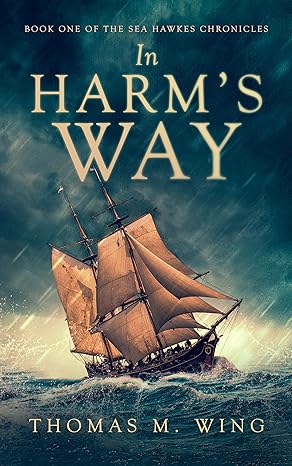

Thomas M. Wing’s In Harm’s Way is a gripping historical novel set during the American Revolution, centering on Captain Jonas Hawke, a privateer navigating the turbulent waters of war and personal loss. When his ship, the Elizabeth, is seized by the British Royal Navy under dubious pretenses, he and his crew are thrust into a battle not just for their freedom but for justice. As Hawke returns home to Norfolk, he finds not only a changed political landscape but also devastating personal tragedy. Wing blends historical accuracy with compelling storytelling, making the reader feel the weight of revolution on ordinary men.
What struck me most was Wing’s ability to bring history to life through vivid and authentic detail. His background as a retired Naval officer shines in the way he captures the rhythm of ship life—sails creaking, the smell of tar and hemp, and the ever-present danger on the high seas. The opening scene, where British forces storm a printing press to suppress rebellious voices, is tense and sets the tone for the book’s theme of resistance against oppression. He delivers a story that feels raw and real, making the reader feel every injustice and triumph.
Jonas Hawke is a protagonist who carries the novel with quiet strength and deep emotion. His return home to find that his infant twins have died is a gut punch that lingers. Wing makes us feel the grief through Mary, Hawke’s wife, whose simmering resentment toward his long absences cuts deep. Their exchange—her quiet fury, his helpless sorrow—was one of the most emotionally impactful moments in the book. The revolution is personal, fracturing families and reshaping lives. Hawke’s struggles reflect the larger battle for independence, making his journey all the more compelling.
The pacing of the novel balances naval battles with quieter moments of introspection. The scenes aboard the Otter, where Hawke and his men are treated as criminals rather than citizens, are particularly enraging. The arrogance of the British officers, especially Captain Squire, is infuriating yet believable, reinforcing the stark divide between colonists and their so-called rulers. The way Wing builds tension, especially during the naval confrontations, had me holding my breath. The book immerses you in history, making the reader experience the frustration, fear, and determination of those who fought against British rule. At times, the historical details, while fascinating, slow the pacing just a bit, especially for readers less familiar with naval terminology or Revolutionary War politics.
In Harm’s Way is an outstanding read for anyone who enjoys historical fiction, particularly those fascinated by naval warfare and the Revolutionary War. Fans of Patrick O’Brian’s Master and Commander series or Bernard Cornwell’s Revolutionary War books will find much to love here. Wing’s storytelling is rich, emotional, and historically grounded, making this book both educational and deeply engaging.
ASIN : B0F1W6GTC4


