Blog Archives
Emotional Fabric

When the World Held Its Breath follows a family whose comfortable day-to-day lives are turned upside down when COVID rears its ugly head and threatens everything they hold dear. Did you begin with the idea of a pandemic novel, or with the emotional arc of a family under pressure?
I began with the emotional arc of a family under pressure rather than the idea of writing a pandemic novel. The pandemic was the circumstance — the crucible — but the heart of the story has always been about family. I have always believed deeply in the strength of family bonds. In my experience, when love within a family is genuine and resilient, it becomes a shield against even the harshest crises. That strength is not accidental; it is nurtured daily, often quietly, and very often by wives and mothers who hold the emotional fabric of the household together.
When my wife and I contracted COVID-19, we experienced firsthand how fragile life can suddenly feel. Those were frightening days. Yet what stands out most in my memory is not only the illness, but the way our family rallied around us — offering encouragement, support, and unwavering presence. Their strength carried us through. That lived experience shaped the novel. I used the pandemic as the backdrop, but the true focus of When the World Held Its Breath is what happens inside a family when external forces threaten to tear it apart — and how love, when it is strong enough, can hold everything together.
What was the most challenging part of writing Laura’s ICU storyline?
The most challenging part of writing Laura’s ICU storyline was balancing medical accuracy with emotional authenticity. I spent a great deal of time researching the progression of severe COVID cases — the stages of respiratory decline, the medical interventions, the terminology — because I wanted the portrayal to feel real without becoming clinical or detached.
But research was only one part of the challenge. The deeper difficulty lay in writing the scene where the doctor explains Laura’s worsening condition and prepares Harrison for the possibility of losing her. That conversation had to carry immense emotional weight. It needed to feel devastating, yet restrained. Honest, yet not melodramatic. David’s reaction in that moment was especially complex to write. I rewrote those passages many times because I did not want the medical explanation to interrupt the narrative flow or feel like an informational pause. It had to remain part of the story’s emotional current — not a break in it.
Ultimately, the challenge was ensuring that the ICU scenes did not simply describe illness but conveyed what it feels like when hope begins to slip and a family is forced to confront the unimaginable.
What conversations are you hoping to spark about misinformation and trust during trying times?
One of the conversations I hope to spark is about how fear alters the truth. During times of crisis, uncertainty creates a vacuum, which is often filled by speculation, misinformation, and narratives that promise simple answers to complex realities and sometimes, made-up narratives.
In 2020 and 2021, when fear was widespread and information was evolving daily, many people turned to social media not just for updates but for reassurance. Unfortunately, it was and is fertile ground for doubt, rumor, and conspiracy theories. What fascinated me — and concerned me — was how quickly these narratives spread and how deeply they influenced trust: trust in institutions, in science, and even within families.
The novel touches on these tensions because misinformation does not remain abstract. It enters homes. It shapes decisions. It strains relationships. I hope readers will reflect on how we determine what to believe in moments of uncertainty — and how we can protect both truth and human connection when they are under pressure. The book is not about judging anyone; it is about examining how fragile trust can become when fear dominates the atmosphere.
Can we look forward to more work from you soon? What are you currently working on?
Yes, I am currently working on my next novel, and I’m deeply excited about it. While it is still taking shape, it explores a timely and thought-provocative theme that reflects the complexities of the world we live in today. Much like When the World Held Its Breath, it will focus on human relationships, emotional resilience, and the choices people make under pressure.
Without revealing too much, I can say that it examines differences that divide us — and the deeper commonalities that ultimately bind us together. I believe it will spark meaningful conversation and, I hope, resonate strongly with readers across cultures and generations.
Author Links: GoodReads | Amazon

As COVID-19 transforms from distant news to deadly reality, the Harrisons retreat behind their doors, believing caution will keep them safe. The lockdown forces them into unprecedented proximity—four people confined together, stripped of their escape routes to work, school, and social life. Tensions simmer as David’s work pressure intensifies, and Laura must balance her work with the family’s well-being. The teens chafe against restrictions, and small irritations magnify into explosive conflicts. The question was not whether they could survive the virus. The question was whether they would survive each other.
But then Laura catches the virus, and within days, she’s fighting for her life on a ventilator, her family separated by a glass partition, helpless to reach her.
David faces immense pressure and impossible choices: saving his company versus his wife in the hospital, maintaining his ethics versus corruption that offers easy solutions, and being a father, taking care of the children, when he’s barely holding himself together. Ultimately, David broke down. Seventeen-year-old Ethan and fourteen-year-old Sophie watch their invincible parents crumble, growing up overnight as their world collapses around them.
But their ordeal has just begun. When Laura finally wakes up, she doesn’t recognize her family. Her memory is gone, scattered like puzzle pieces, and she must painstakingly reassemble it. In this crisis, it’s the family bond that keeps them together.
“When The World Held Its Breath” is an intimate portrait of one family’s journey through COVID-19, America’s darkest modern crisis. This story explores love tested by unimaginable circumstances, highlighting a nation discovering its capacity for indifference, selfishness, and extraordinary generosity. It also shows ordinary people learning that resilience isn’t about being unbreakable, it’s about helping each other in crises.
Rich with authentic detail and emotional depth, this novel captures not just what we endured during the pandemic, but why and also who we became because of it. For anyone who lived through those terrifying months, this is the story of how we found our way home—and how America, despite losing more than a million lives to initial missteps, ultimately rose to the occasion and helped the world control the pandemic.
When the World Held Its Breath
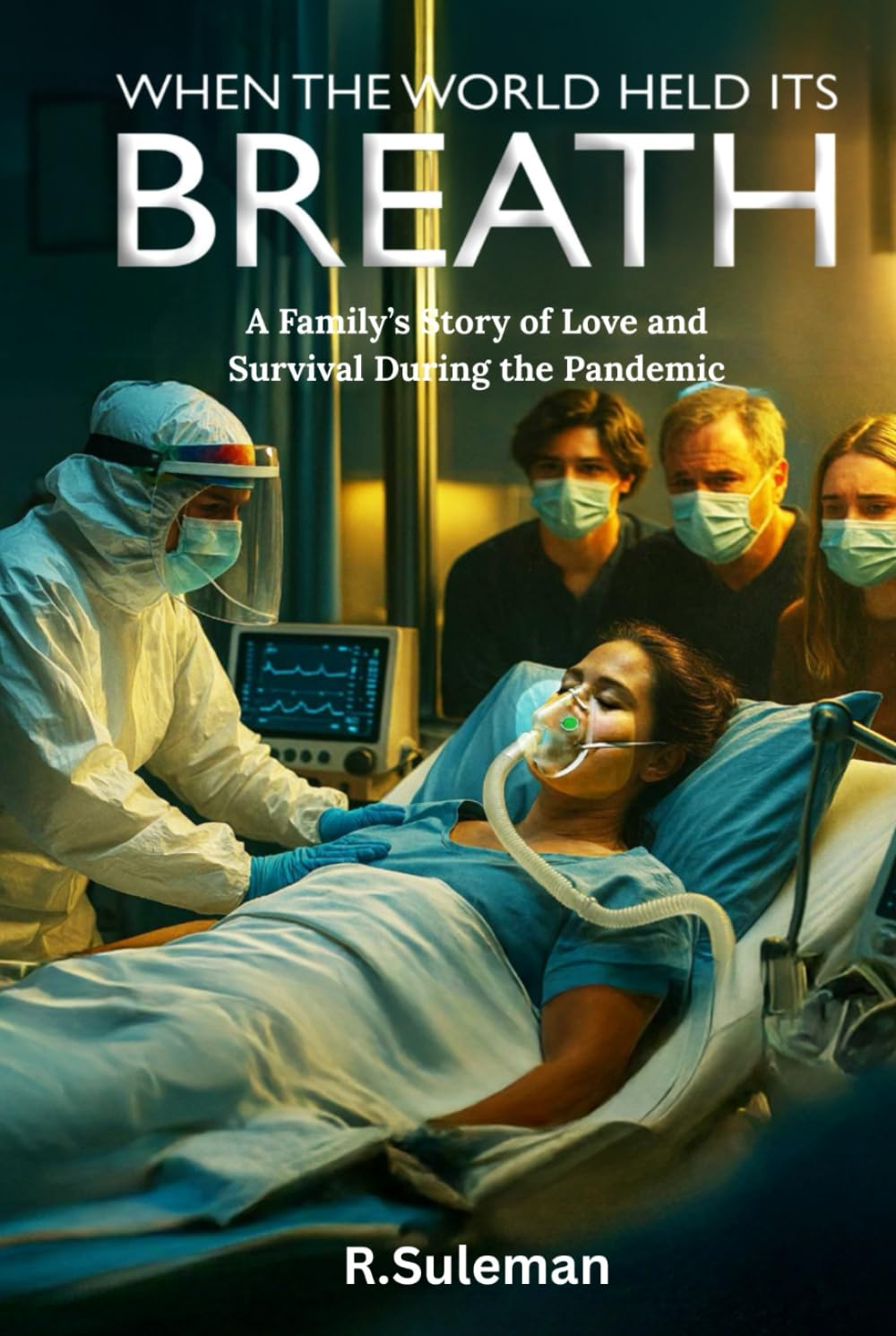

In When the World Held Its Breath, author R. Suleman tells a sweeping, close-to-home story about the Harrison family as COVID moves from distant headlines to a force that reshapes everything they thought was stable. We start with their comfortable suburban rhythm, work pressures, teenage drama, and the sense that life is busy but manageable, and then we watch that “manageable” feeling crack under lockdowns, fear, and the slow grind of uncertainty. The plot tightens around the family’s hardest stretch when Laura’s illness turns severe and she ends up in the ICU on a ventilator, leaving David and the kids in a kind of suspended, breath-held waiting room of dread and hope. By the end, the book moves toward recovery and aftermath, asking what “back to normal” even means when normal has been burned down and rebuilt. Genre-wise, this sits in contemporary family drama (pandemic fiction with a literary-leaning, emotionally driven core), and it will likely appeal to readers who liked the intimate, relationship-first approach of Wish You Were Here more than the big-society lens of Station Eleven.
I liked how committed the narration is to the day-to-day texture of a family under strain. It’s not chasing shock for shock’s sake. Instead, it keeps returning to small moments, arguments over school and responsibility, the way parents try to “be steady” even when they are scared, the way kids act tough until they don’t. There’s a steady, almost cinematic clarity in the opening domestic scenes, and that groundwork matters because later, when the world narrows to hospital glass and medical updates, you already know what’s at stake. The book sometimes leans into explanation, especially when it steps back to name what a moment “means” for society or history. That did not ruin it for me, but I did notice it. I found the story strongest when it trusted the characters to carry the emotion without summarizing it for me.
I also appreciated the author’s choices about what the book is and is not trying to do. It’s upfront that the Harrison family is fictional, and that the goal is the human response to crisis, not a clinical chronicle of the pandemic. That framing helps, because the novel keeps circling themes that feel painfully familiar: the illusion of control, the way privilege can soften the edges of life until something comes along that ignores status, and the way fear spreads faster than facts. I was especially struck by the recovery arc, not as a neat victory lap, but as a long, uneven rebuilding, with memory gaps, “brain fog,” and the strange tenderness of learning your own life again. And I liked that the book doesn’t dodge social fractures either, like vaccine distrust and misinformation, but it keeps those debates grounded in dinner-table conversations and personal consequences.
I felt the book had earned its quieter ending: a house full of people, a Thanksgiving gathering, a sense of gratitude that is not naive because it remembers exactly what it cost. I’d recommend this most to readers who want a family-centered, emotionally direct pandemic novel, especially anyone who lived through those years and is ready to look at them with clear eyes, or anyone who enjoys contemporary family dramas where the biggest battles are love, fear, and the effort it takes to keep showing up for each other. If you want a grounded story about how a crisis breaks a family open and then, slowly, helps stitch them back together, this one will land.
Pages: 380 | ISBN : 978-9699896361



