Blog Archives
The Most Powerful Force

Different Values presents a series of reflections on what the pandemic, climate strain, gun violence, and the Israel-Gaza conflict reveal about what we choose to value. Why was this an important book for you to write?
During COVID, when we were “isolating at home,” several issues shifted to center stage in people’s thinking–such as their dissatisfaction with work and stay-at-home parents’ realization that children do not learn better with screens.
I thought what had shifted center stage was a way to connect changes we hoped would lead us out of the suffering caused by the pandemic into a “new normal.”
The book spans pandemic life, political division, climate strain, and war—when did you realize these threads belonged in one narrative?
I’m not sure they do, other than the reason given above–how we might make a society emerging from the pandemic a better “new normal.” In that regard, there is an attempt to realize our best efforts along the way, but that “thread” was really strained by political divisions, then the Israel-Hamas war, and the United States’ failure to uphold the United Nations.
Another “thread” that I see is informed by my teaching experience, i.e., a lack of critical thinking in making decisions–such as listening first and not stereotyping/profiling, and providing evidence for claims made—-despite that being what we teach our college students to do.
The imagery of natural forces—like volcanic eruptions—adds a sense of humility to the book. What role does nature play in your moral framework?
Nature makes us aware that humanity is not the most powerful force in the universe! We strive to subdue it, but it rebounds, making us keenly aware of our smallness and thus the humility that is critically needed to counter hubris. Indigenous people and many farmers who work the soil seem to grasp this intuitively, whereas industrialites-and now technocrats-often interpret its power as challenges in need of conquest.
Are you planning to continue exploring these themes in future projects?
I’m not sure yet. They are certainly still with us, but perhaps rather than writing about them, we need more political motivation? I thought of a new title, Death by Propaganda Goes Viral. The problem is, Orwell and others have already alerted us to these dangers. It seems humans have to exercise their freedom, i.e., to choose to change from within, and that’s hard work!
Author Links: GoodReads | Kayelksong.com | Amazon
Emotional Fabric
When the World Held Its Breath follows a family whose comfortable day-to-day lives are turned upside down when COVID rears its ugly head and threatens everything they hold dear. Did you begin with the idea of a pandemic novel, or with the emotional arc of a family under pressure?
I began with the emotional arc of a family under pressure rather than the idea of writing a pandemic novel. The pandemic was the circumstance — the crucible — but the heart of the story has always been about family. I have always believed deeply in the strength of family bonds. In my experience, when love within a family is genuine and resilient, it becomes a shield against even the harshest crises. That strength is not accidental; it is nurtured daily, often quietly, and very often by wives and mothers who hold the emotional fabric of the household together.
When my wife and I contracted COVID-19, we experienced firsthand how fragile life can suddenly feel. Those were frightening days. Yet what stands out most in my memory is not only the illness, but the way our family rallied around us — offering encouragement, support, and unwavering presence. Their strength carried us through. That lived experience shaped the novel. I used the pandemic as the backdrop, but the true focus of When the World Held Its Breath is what happens inside a family when external forces threaten to tear it apart — and how love, when it is strong enough, can hold everything together.
What was the most challenging part of writing Laura’s ICU storyline?
The most challenging part of writing Laura’s ICU storyline was balancing medical accuracy with emotional authenticity. I spent a great deal of time researching the progression of severe COVID cases — the stages of respiratory decline, the medical interventions, the terminology — because I wanted the portrayal to feel real without becoming clinical or detached.
But research was only one part of the challenge. The deeper difficulty lay in writing the scene where the doctor explains Laura’s worsening condition and prepares Harrison for the possibility of losing her. That conversation had to carry immense emotional weight. It needed to feel devastating, yet restrained. Honest, yet not melodramatic. David’s reaction in that moment was especially complex to write. I rewrote those passages many times because I did not want the medical explanation to interrupt the narrative flow or feel like an informational pause. It had to remain part of the story’s emotional current — not a break in it.
Ultimately, the challenge was ensuring that the ICU scenes did not simply describe illness but conveyed what it feels like when hope begins to slip and a family is forced to confront the unimaginable.
What conversations are you hoping to spark about misinformation and trust during trying times?
One of the conversations I hope to spark is about how fear alters the truth. During times of crisis, uncertainty creates a vacuum, which is often filled by speculation, misinformation, and narratives that promise simple answers to complex realities and sometimes, made-up narratives.
In 2020 and 2021, when fear was widespread and information was evolving daily, many people turned to social media not just for updates but for reassurance. Unfortunately, it was and is fertile ground for doubt, rumor, and conspiracy theories. What fascinated me — and concerned me — was how quickly these narratives spread and how deeply they influenced trust: trust in institutions, in science, and even within families.
The novel touches on these tensions because misinformation does not remain abstract. It enters homes. It shapes decisions. It strains relationships. I hope readers will reflect on how we determine what to believe in moments of uncertainty — and how we can protect both truth and human connection when they are under pressure. The book is not about judging anyone; it is about examining how fragile trust can become when fear dominates the atmosphere.
Can we look forward to more work from you soon? What are you currently working on?
Yes, I am currently working on my next novel, and I’m deeply excited about it. While it is still taking shape, it explores a timely and thought-provocative theme that reflects the complexities of the world we live in today. Much like When the World Held Its Breath, it will focus on human relationships, emotional resilience, and the choices people make under pressure.
Without revealing too much, I can say that it examines differences that divide us — and the deeper commonalities that ultimately bind us together. I believe it will spark meaningful conversation and, I hope, resonate strongly with readers across cultures and generations.
Author Links: GoodReads | Amazon

As COVID-19 transforms from distant news to deadly reality, the Harrisons retreat behind their doors, believing caution will keep them safe. The lockdown forces them into unprecedented proximity—four people confined together, stripped of their escape routes to work, school, and social life. Tensions simmer as David’s work pressure intensifies, and Laura must balance her work with the family’s well-being. The teens chafe against restrictions, and small irritations magnify into explosive conflicts. The question was not whether they could survive the virus. The question was whether they would survive each other.
But then Laura catches the virus, and within days, she’s fighting for her life on a ventilator, her family separated by a glass partition, helpless to reach her.
David faces immense pressure and impossible choices: saving his company versus his wife in the hospital, maintaining his ethics versus corruption that offers easy solutions, and being a father, taking care of the children, when he’s barely holding himself together. Ultimately, David broke down. Seventeen-year-old Ethan and fourteen-year-old Sophie watch their invincible parents crumble, growing up overnight as their world collapses around them.
But their ordeal has just begun. When Laura finally wakes up, she doesn’t recognize her family. Her memory is gone, scattered like puzzle pieces, and she must painstakingly reassemble it. In this crisis, it’s the family bond that keeps them together.
“When The World Held Its Breath” is an intimate portrait of one family’s journey through COVID-19, America’s darkest modern crisis. This story explores love tested by unimaginable circumstances, highlighting a nation discovering its capacity for indifference, selfishness, and extraordinary generosity. It also shows ordinary people learning that resilience isn’t about being unbreakable, it’s about helping each other in crises.
Rich with authentic detail and emotional depth, this novel captures not just what we endured during the pandemic, but why and also who we became because of it. For anyone who lived through those terrifying months, this is the story of how we found our way home—and how America, despite losing more than a million lives to initial missteps, ultimately rose to the occasion and helped the world control the pandemic.
When the World Held Its Breath
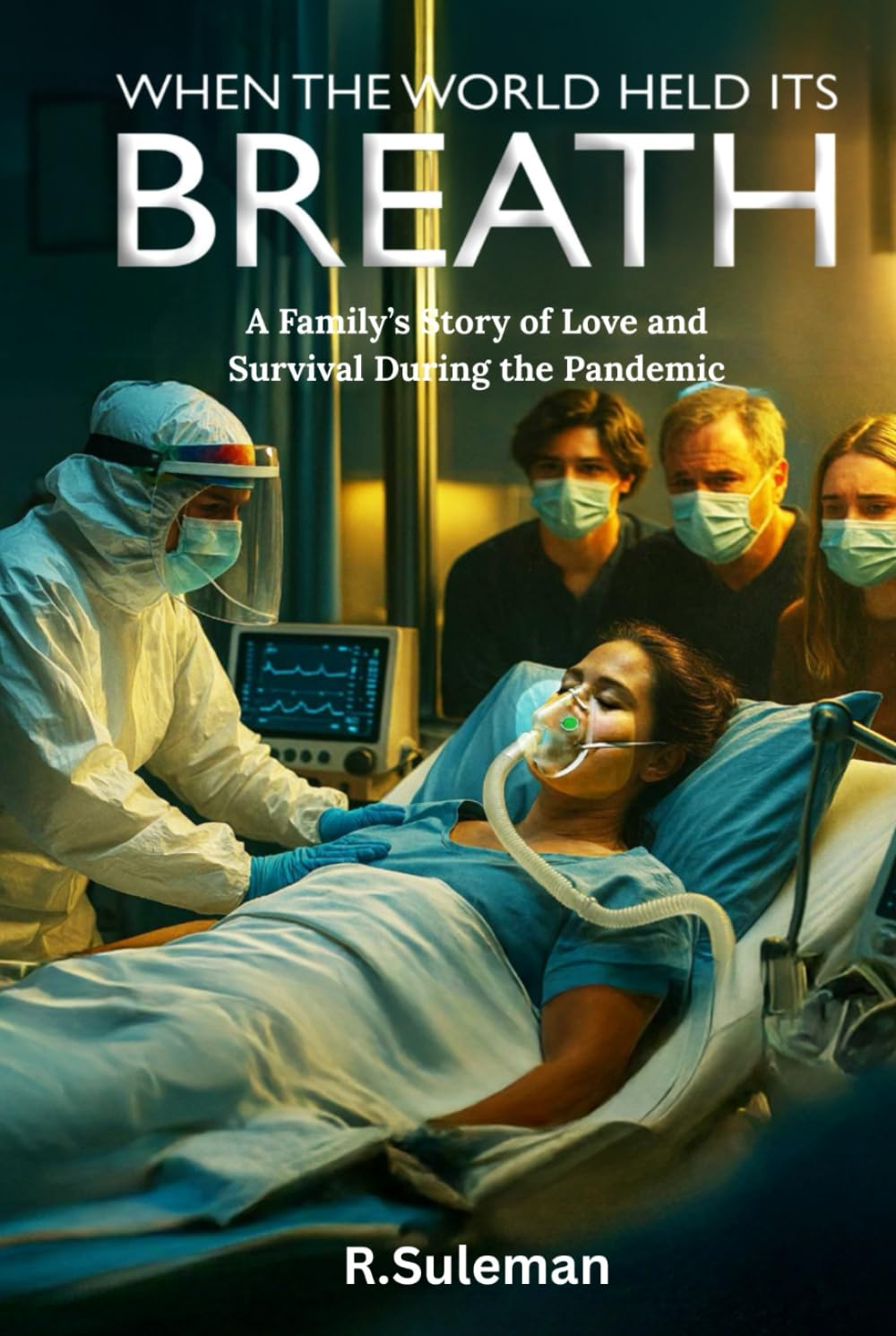

In When the World Held Its Breath, author R. Suleman tells a sweeping, close-to-home story about the Harrison family as COVID moves from distant headlines to a force that reshapes everything they thought was stable. We start with their comfortable suburban rhythm, work pressures, teenage drama, and the sense that life is busy but manageable, and then we watch that “manageable” feeling crack under lockdowns, fear, and the slow grind of uncertainty. The plot tightens around the family’s hardest stretch when Laura’s illness turns severe and she ends up in the ICU on a ventilator, leaving David and the kids in a kind of suspended, breath-held waiting room of dread and hope. By the end, the book moves toward recovery and aftermath, asking what “back to normal” even means when normal has been burned down and rebuilt. Genre-wise, this sits in contemporary family drama (pandemic fiction with a literary-leaning, emotionally driven core), and it will likely appeal to readers who liked the intimate, relationship-first approach of Wish You Were Here more than the big-society lens of Station Eleven.
I liked how committed the narration is to the day-to-day texture of a family under strain. It’s not chasing shock for shock’s sake. Instead, it keeps returning to small moments, arguments over school and responsibility, the way parents try to “be steady” even when they are scared, the way kids act tough until they don’t. There’s a steady, almost cinematic clarity in the opening domestic scenes, and that groundwork matters because later, when the world narrows to hospital glass and medical updates, you already know what’s at stake. The book sometimes leans into explanation, especially when it steps back to name what a moment “means” for society or history. That did not ruin it for me, but I did notice it. I found the story strongest when it trusted the characters to carry the emotion without summarizing it for me.
I also appreciated the author’s choices about what the book is and is not trying to do. It’s upfront that the Harrison family is fictional, and that the goal is the human response to crisis, not a clinical chronicle of the pandemic. That framing helps, because the novel keeps circling themes that feel painfully familiar: the illusion of control, the way privilege can soften the edges of life until something comes along that ignores status, and the way fear spreads faster than facts. I was especially struck by the recovery arc, not as a neat victory lap, but as a long, uneven rebuilding, with memory gaps, “brain fog,” and the strange tenderness of learning your own life again. And I liked that the book doesn’t dodge social fractures either, like vaccine distrust and misinformation, but it keeps those debates grounded in dinner-table conversations and personal consequences.
I felt the book had earned its quieter ending: a house full of people, a Thanksgiving gathering, a sense of gratitude that is not naive because it remembers exactly what it cost. I’d recommend this most to readers who want a family-centered, emotionally direct pandemic novel, especially anyone who lived through those years and is ready to look at them with clear eyes, or anyone who enjoys contemporary family dramas where the biggest battles are love, fear, and the effort it takes to keep showing up for each other. If you want a grounded story about how a crisis breaks a family open and then, slowly, helps stitch them back together, this one will land.
Pages: 380 | ISBN : 978-9699896361

Kit Wilson, RN: Treading Water


In Kit Wilson, RN: Treading Water, author Beth E. Heinzeroth White crafts a narrative that delves into the harrowing experiences of healthcare professionals during the COVID-19 pandemic. Kit, a nurse based in the US Midwest, initially receives reassurances about the nation’s pandemic preparedness. However, the reality she confronts is vastly different. Thrust onto the front lines, Kit navigates an inundated healthcare system, striving to provide care amidst an unprecedented crisis.
White adeptly portrays the psychological toll of the pandemic on healthcare workers. The reader is drawn into the emotional landscape of Kit’s life, witnessing her struggles with isolation and the incredible stress of her duties. Yet, it’s not just a story of hardship. The narrative is punctuated with moments of levity and warmth, particularly in the interactions Kit has with colleagues and patients, offering a well-rounded exploration of her world.
The novel shines in its attention to detail, particularly in depicting the daily realities faced by nurses during the pandemic. From the physical discomforts of prolonged mask-wearing to the adoption of unconventional remedies for relief, White’s background as a nurse lends authenticity to these descriptions. These elements are not just informative but also deeply immersive, giving the reader a palpable sense of the characters’ experiences.
Kit Wilson, RN: Treading Water is more than a fictional tale; it’s a poignant reflection of the real challenges and resilience witnessed during the pandemic. The book balances its serious themes with humor and heart, creating a tapestry of human experience that is both engaging and enlightening. It’s a recommended read for those who appreciate medical fiction and anyone seeking to understand the personal impacts of the COVID-19 pandemic on individuals and communities.
Pages: 198 | ASIN : B0BMB6DCT3
Survival At All Costs
The Wanderer’s Quest takes readers on a journey to a bleak and devastated future Earth along with Raydr and Madan, both escaping their own horrors. What was the inspiration for the setup of your story?
The inspiration comes from my own bleak outlook of the future, if humanity persists in its destructive ways. Climate change is happening at an alarming pace, whether people acknowledge it or not – or want to acknowledge it. In the novel, a pandemic destroys most of mankind, and the industries that we have created run amok, as they would if there no longer were human tenders to see to nuclear power plants and nuclear waste as well as chemical plants. What we do, what we have done, what we will do, has consequences. We must learn to think in sustainable terms, renewable terms, rather than think of profit because, in the long run, money might just become completely irrelevant.
There was a lot of time spent crafting the character traits in this novel. What was the most important factor for you to get right in your characters?
The most important factor of the personality of my characters was to show their inner dilemma. Survival at all costs has a cost: the loss of belief in oneself. I wanted to show how people who have been shattered by inconceivable pain can rise back up from the depths of their misery.
When you first sat down to write this story, did you know where you were going, or did the twists come as you were writing?
I develop a story in my head first. When I started writing, I knew the general outline of the plot, but a lot of details were added after. It’s a long process to craft a novel!
What is the next book you are working on, and when will it be available?
I am currently working on a new project called Pioneer: The Volunteer. I expect it to be done in the next 6 months. Hopefully available soon after that. I have also written a children’s book, which I hope to make available soon. And I sent some of my poetry to a few contests, crossing fingers that it could be available to readers soon.
Author Links: Goodreads | Twitter | Instagram | TikTok | Facebook | Amazon

Disease, radiation, and violent storms have ravaged the earth, laying waste to all that was civilised and good. Now, it is every man for himself in the struggle for survival against tyrannical despots who would exploit the innocent and vulnerable for their own gain.
Madan, fifteen years on the run after the death of his family and collapse of his city, is growing tired, and desperate.
Raydr, eight years escaped from horrific captivity, has learned the hard way the sacrifices it takes to survive in this world.
Thrown together by circumstance and a shared need for vengeance, can these two learn to trust each other in a kill-or-be-killed world? As they begin to open themselves up to the possibility of hope – hope for revenge, for the chance of a real future – they will find out just how important the actions of two people can be, and what the cost of vengeance really is.

Stories Should Provoke Questions
The Boy Who Loved Boxes is a whimsical tale that teaches readers that we can’t control everything in life no matter how hard we try. Why was this an important book for you to write?
It was important to write this book because one, it came fully formed and downloaded to me during a walk in the woods. I was thinking a lot about how we lose our childlike wonder as adults and, as adults, how we live in a constant illusion of control. I started working on the book, which started off very differently than it ended, as these things do. During the middle of it, the pandemic hit and the very thing I was writing about strangely paralleled my own reality. My anxiety, the illusion of control I had in my life, how things fell apart despite how ordered my life was oddly similar to The Man in the book. I conceived this as a picture book for adults to hopefully recapture the wonder of childhood.
What is one piece of advice someone gave you that changed your life?
I was having coffee in Los Angeles many years ago with my friend, Denise Spatafora. She told me that I can design my life on my terms. And for some reason, at the moment in time, it really resonated. And I began to explore what that actually looked like. Intentionality, saying no to things and people that didn’t support my goals, eliminating toxic situations, being bolder and clearer in what I wanted, etc. It’s a lifelong process, but it’s been transformative.
What do you hope is one thing readers take away from your story?
If they get the intent and spirit behind the book – and some do not, and that’s okay – I hope they realize that peace is not found in the things we own, build or obtain and that they ask themselves what the last box means to them. I know what it means to me personally, but I believe that stories should provoke questions instead of giving answers. So, my ultimate hope is that the story raises some meaningful questions and discussions.
What is the next book that you are working on and when will it be available?
My next book is a picture book (this one is actually for children) about two sylvan creatures and their fun-loving adventures. I am collaborating on it with my wife. It’s a story we actually wrote before we had children. We hope it’s the start of a series, but it will be about kindness and not judging others by their appearance. It will be available in the fall of 2022.
Author Links: GoodReads | Website
Written and illustrated against the backdrop of the global pandemic, this children’s book for adults is a modern-day allegory exploring the illusion of control and the pursuit of peace. Join our hero and discover that happiness is not always found in the places we expect.
The Boy Who Loved Boxes

The Boy Who Loved Boxes: A Children’s Book for Adults tells the story of a boy who stores everything he owns in nice organized boxes. As he grows, he learns to sort all the parts of his life into compartmentalized boxes like work, emotions, faith, money, and relationships. Then one day, all the boxes fall apart and he is unable to repair them or replace them. All of his things are a mess, broken, or lost. He doesn’t know what to do as his stuff sits in a pile. He is too overwhelmed to sort through or try to fix. Will he ever be able to find a box to hold everything he cherishes?
Author Michael Albanese has written a heartfelt picture book for adults. Choosing to use this format to get his message across adds weight to what he says. This modern-day allegory about trying to control your life and keep everything organized and running smoothly is a common mindset for adults these days. When the pandemic hit, all our boxes fell apart, school, work, relationships, everything around the world changed fast.
The simple verbiage combined with Tod Wilkerson’s artwork really brought the message home. Seeing The Man’s expressions as everything of his falls apart and sits in a pile reminds me of how I felt in those first few weeks that stretched into months. The hopelessness and the joy and acceptance that followed. All the emotions that people worldwide felt can be seen in the pages of this thought-provoking children’s book.
The Boy Who Loved Boxes: A Children’s Book for Adults explores the illusion of control and helps readers gain peace by finding it within themselves. This captivating and poignant book can be shared with children and adults. Adults will understand what The Man was going through, and children can learn that controlling every part of their life and separating it all out will only end with a mess.
Pages: 36 | ISBN : 1732898731
There Will Be Another Pandemic

COVID-19 AFRICA, HAITI, AND THE U. S. VIRGIN ISLANDS helps separate the truth from myth and misinformation that has been rampant since the onset. What were your goals in writing this book?
The goal of writing this book was to start a conversation about the negative impact the denials and distortion of the COVID-19 deadly virus had on populations and countries at large. The COVID-19 outbreak will not be stopped for one fraction of a second by delusional denials, distortion, or ruse; instead, it will only be defeated by strictly unbiased measures that prevent its spread while at the same time allowing people to live productive lives.
China and some other more developed countries have been able to slow the spread of COVID-19 by acting objectively and enforcing proven effective measures such as lockdowns of homes and enforced closures of city and regional borders (known as cordon sanitaire). These measures, although stringent, are highly effective.
What are some takeaway you hope readers leave with after finishing this book?
The hard-core reality is that even if COVID-19 eventually goes dormant or the world’s populations reach protective herd immunity levels, there will be another pandemic, another epidemic that will rage out-of-control crosses borders, is spread by travelers, and becomes a pandemic. Epidemics and pandemics are part of our world. Travel and the transport and domestication of animals keep disease and vermin spreading throughout the world.
This means:
First, the only pragmatic solutions are to learn from past incidents, cull best practices from other countries, adopt them, and share knowledge, techniques, methodologies, and strategies.
Second, increase and guarantee funding (with accountability measures and enforcement processes) for PPE and medical equipment must be available.
Third, establish accountability measures to make sure data is gathered, reported, and corroborated honestly both within the country and with other nations.
Also, Africa, Haiti, and USVI must put aside false pride in reporting data that makes them look good. Such reporting is to the detriment of their people, as inaccurate reporting stymies any aid for which they may qualify from international sources.
Last but not least, if governments in African nations, Haiti, and the USVI will use the suggestions made herein along with others that are equally viable, the problems with delusional myths and denial of disease existence and transmission will be controlled and have less of an effect on population compliance with public health prevention measures.
They will be better prepared to respond to and survive the next pandemic; such as the omicron virus.
What is the next book that you are working on and when will it be available?
The books I am writing now are the responses to the urgent need to provide a comprehensive overview of cancer and contagious diseases impact within the African population.
The two books offer an analysis of the diseases, specifically cancer diseases in African countries, with the awareness that even though there may have many correlates, there are also discrepancies in the prevailing cancer disease conditions.
Africa is home to 54 recognized sovereign states and countries, 9 territories, and 2 de facto independent states with the second largest population in the world with 1.29 billion (after Asia), scattered over the vast Africa land, and presently, 60% more Africans die from cancer diseases than succumb to malaria, and the number of cancer deaths is widening at an awful pace.
The information laid down on those forthcoming books will be a step toward self-awareness and will also present a foundation for informed improvement in the current health sector systems along with an approach by which African countries may learn from more in reciprocal action to the need for proper knowledge of disease and improvement prevention process.
It’s hoped that these approaches will give the reader an attitude towards cancer and infectious diseases that will be relevant whatever the nature of an agent and the type of contagious disease could occur.
Author Links: GoodReads | Twitter | Facebook | Website | LinkedIn


