Blog Archives
The Savior and the Shadow Queen: A Fantastical Tale Told Through Sequential Poems


The Savior and the Shadow Queen is a story told through poetry, unfolding in layers that mix fantasy and raw human emotion. It begins as a mythic tale of Eselli and Nabseatsi, two friends who set out to defeat a terrible enemy called the Shadow Queen. Their world feels ancient and mystical, full of prophecies, weapons, and dark magic. But as the story progresses, that fantasy begins to fade, and the truth emerges. Eselli is Leslie, a young woman living in the real world, grappling with grief, guilt, and the haunting weight of loss. The Shadow Queen becomes something much deeper than an external enemy; she is the darkness inside us all, the reflection of our pain and self-hatred.
McAfee writes with such openness that it’s hard not to feel what Leslie feels. Her pain, her confusion, her desperate hope for healing, it all comes through in the rhythm of the poems. The fantasy world works beautifully as a metaphor for mental illness and self-discovery. I loved how the story shifts from myth to memory, from sword and prophecy to hospital rooms and recovery. That transition hit me hard. The writing itself is simple, almost deceptively so, but it carries deep emotion. It’s the kind of poetry that doesn’t need fancy words to make you feel something, it just does. The pacing feels natural, the imagery vivid, and the emotions raw enough to make you pause and sit with them.
I could feel the compassion in McAfee’s voice. The book doesn’t wallow in sadness, even though it’s born from it. It offers forgiveness, for oneself, for others, for the past. I appreciated that McAfee didn’t sugarcoat the pain, yet she gave it meaning. The real-world sections are written with quiet strength. There’s hope tucked between every line, and I found myself rooting for Leslie as if she were someone I knew. The author’s choice to end the book with a direct message to the reader was perfect. It felt intimate, like a friend reaching out to say, “You’re not alone.”
I’d recommend The Savior and the Shadow Queen to readers who loved The Alchemist by Paulo Coelho. Both books explore inner transformation through journeys that seem external at first but reveal themselves as deeply personal. Like Santiago’s search for his treasure, Leslie’s quest to defeat the Shadow Queen becomes a metaphor for finding meaning after loss. But where Coelho’s story leans on destiny and spiritual discovery, McAfee’s feels more grounded in real emotion like grief, guilt, and the slow rebuilding of self-worth.
Pages: 102 | ASIN : B0CH411ZSP

Reflections: Earth, Heart, Light, Dark
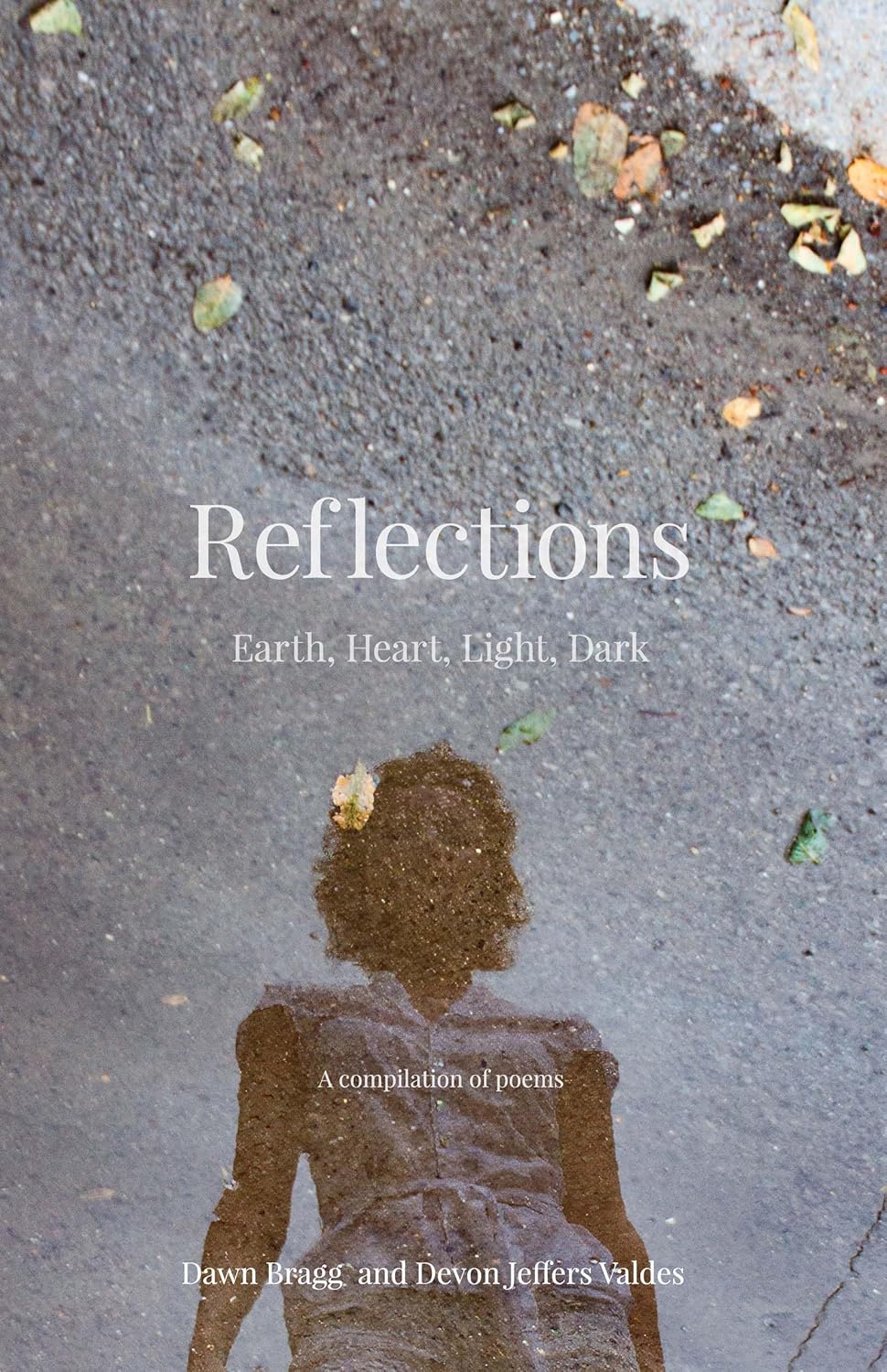
Reflections: Earth, Heart, Light, Dark is a mother-daughter collaboration that explores the intertwined themes of Earth, Heart, Light, and Dark through poetry. The book flows like a seasonal cycle, beginning with poems rooted in nature, moving through love and memory, then toward hope and illumination, and finally into grief, loss, and shadows. Each section feels distinct, yet they all circle back to a shared sense of searching for meaning in both beauty and pain.
Poems like Transition pulled me in with their intimacy, especially the image of a mother’s hands rebuilding a new world after a storm. It felt deeply personal but also universal, the kind of moment that made me stop and think about my own family. I’ll admit, Grandmama caught me off guard with its questions, “What thoughts did you have? Did you think them deserving?” and left me feeling both unsettled and comforted at the same time. That’s what I liked most, the poems didn’t tie everything up neatly. They lingered.
From Ash to Light carried a strong sense of resilience, and I couldn’t help but feel buoyed by its journey from despair to joy. It had this rhythm of stumbling and rising that felt human and raw. On the other hand, Dawn of Forty-Nine leaned more toward classic imagery, almost old-fashioned in its rhymes, which at first jarred me but eventually worked because it added texture to the collection. I found myself rereading those lines about waterfalls and winds, almost like I was letting the words wash over me instead of trying to decode them.
Then there’s the “Dark” section. This is where the book hit hardest for me. You Left Me was plainspoken, almost brutally so, and that stripped-down honesty made it sting. The Waves had this hypnotic pull with its repetition, “Rising above, wave after wave,” that felt like drowning in grief and memory. I could feel the authors letting themselves go to heavier places, and I appreciated that they didn’t shy away. It made the hopeful poems earlier in the book feel more earned, less naïve.
Reflections: Earth, Heart, Light, Dark is for readers who like their poetry to sit somewhere between personal diary and universal myth. It’s not heavy with academic wordplay, but it’s not fluff either. If you enjoy quiet evenings with a book that makes you pause, maybe even tear up, this one is a must-read. Personally, I closed it feeling like I had sat down with two voices who weren’t afraid to be vulnerable, and that’s something I’ll always admire in poetry.
Pages: 38 | ASIN : B0FFNGQ15P
On the Verge

Marie Rickmyer’s On the Verge is a delicate, unflinching collection of poems exploring life, trauma, and family. Each piece drips with nostalgia, capturing the quiet fragility of memory—like a glass pane trembling under the weight of lived experience. Rickmyer invites readers into intimate spaces: kitchens brimming with warmth and chaos, childhoods that linger like faint scars, and moments suspended between joy and sorrow. Here, nostalgia and trauma are not at odds but intertwined, stitched together by subtle, aching beauty—a weight of sunlight, the quiet despair of witnessing your mother as both parent and person.
Reading these poems feels like overhearing deeply personal conversations—tender, raw, and unfiltered. Rickmyer’s words evoke the weariness of her mother, the emptiness left by absence, and the heavy silence of unspoken longings. It is not a collection concerned with life’s grandeur but with its endurance: the sacred moments hidden within the mundane.
From the start, On the Verge captivated me with its thematic focus on memory, trauma, and fractured families. Admittedly, I hesitated at first—the poem structure and style felt unconventional—but the writing quickly grew on me. Each piece unfolded like a film, vivid and visceral, with no pretense or grandiosity. Rickmyer’s simplicity is piercing. Her lines feel less like crafted poetry and more like confessions, whispered truths, or rants from someone intimately familiar. For a moment, you are there—in her mother’s kitchen, at the edge of her grief, alongside flowers bathed in memory—transported not just into her life but, uncannily, into your own. The poems “Pantoum on Mother” and “Elegy for My Brother” are especially powerful, confronting the quiet burdens we carry and the losses we never fully release. Rickmyer captures what we inherit and what we endure, often at the same time. Her language is so personal, her imagery so immediate, that the connection feels inevitable. It resonates deeply, like a shared ache you never realized existed.
Marie Rickmyer’s On the Verge holds a quiet power, subtle yet relentless, like a stream carving its path through stone. By the final poem, I felt as though I had lived through a lifetime of someone else’s struggles and small victories. It is a book I will return to—a companion for moments when I need to be reminded of the quiet beauty of endurance. On the Verge is intensely personal yet strangely familiar, as though Rickmyer isn’t just telling her story but yours, too. It is a testament to the weight of memory and the tenderness of survival—an unforgettable offering of truth, nostalgia, and fragile beauty.
Pages: 74 | ASIN : B0DFMVG9DD




 LITERARY TITAN