Blog Archives
Rhythm and Flow

Ceylon Moon is a reflective poetry collection exploring memory, dreams, aging, identity, nature, and the search for meaning in a finite life. You organize the collection into five sections exploring childhood, dreams, sanity, nature, and aging. How did you decide on that structure?
I approach organizing how my poems are presented once I reach ~ 30 publishable poems. The organization is based largely on how the poems were written: as part of a project based on my interests, or those arising spontaneously based on an impression or mood. For example, in Ceylon Moon, the poems of “With [In] Sanity” and “The Voices” were projects in which the poems were created after months of study or observation. In contrast, the poems in “What The Night Holds” were more spontaneous in nature: triggered by an image, an idea floating through my mind, or my infatuation with another poet’s work. For example, “The Owl in Our Dreams” was prompted by Philip Lamantia’s enigmatic poem “The Owl.” When enough poems are written, they often coalesce around a common theme. When poems don’t fit into a specific theme, I categorize them under a vague title (eg., “Moods and Musings”).
Dreams are a recurring theme throughout the collection. How do your dreams influence your writing and understanding of yourself?
It’s important to understand that dreams emanate from the emotional (“mammalian”) centers of our brain (ie., the Limbic system). Our animal nature models our world and lets loose neural phantoms inside our mind. These phantoms speak through our higher (cerebral) functions of symbolism, language, vision, and explicit event memories. This is what stirs our sleep with important shards of meaning, as well as insights that evade our waking life. Such insights are not pronouncements about who we are. Rather, they reflect our unfiltered feelings, concerns, and struggles. And sometimes, they provide lucid insights into others we evade through rationalizations. Ones created to maintain a tenuous relationship.
I’ve studied my dreams for 40 years, and have come to know myself with greater clarity by doing so. I believe dreams and poetry travel the same pathways in the mind: one by night and the other by day.
Music, paintings, landscapes, and memories often intersect in your poems. How do different art forms influence your poetry?
Rhythm and flow are dominant in how I write poetry because I’ve been a drummer since I was 10 years old, and rhythm pervades my daily life. Poetry and song have had an intimate relationship since antiquity, and as a lifelong musician, that’s where I belong as a poet.
In terms of the visual arts, I’ve loved paintings since I was a child, implicitly recognizing them as W.H. Auden’s Secondary Worlds (our enchanted, sacred world of imagination). I began to notice the relationship between poetry and painting after years of discussing art with my friend, the artist Martha Diaz (who created the artwork for Ceylon Moon: Martha Diaz Fine Art).
Both painting and poetry attempt to induce a sense of immediacy for the experiencer. Both forms draw us into their world without necessarily understanding why. Only that their immediacy exudes something that is deliciously enticing, finally, it’s important to spend time with an image as well as a poem. To look at an image is an activity, rather than seeing (a physiological perception) and walking by. Similarly, glancing through a poem is like walking past a painting. We (including myself) need to spend time with a poem. Coming back to it again and again. Often there are layered meanings to be discovered and coveted.
If you could have readers carry one idea from Ceylon Moon into their own lives, what would it be?
I would simply say take to heart D.H. Lawrence’s observation: An act of pure attention brings its own answer. That has been the foundation of every poem in this collection. It’s how I struggle to evade my chattering mind. To dwell for a moment or two or four on all the beauty and richness of life that surrounds us and sometimes passes by¾like the smiling toddler without his stroller who turned around my hollow day (the poem “Becoming”).
Author Links: GoodReads | Website | Amazon
What the Night Brings are a series of poems delving into the nature and vagaries of our dreams. The many unsettled aspects of dreaming is extended into the next section “With Insanity” (or “Within Sanity”) explores” the near thin edge” that separates our uncomfortable ideas about what actually constitutes sanity, insanity, and what lies in between.
The Voices are six Rilkean poems in which Gedaliah assumes the personas of non-sentient nature (eg. clouds, mountains, trees, etc.) to explore what it is that resonates within us that draws us to them. The collection closes with All That is Worn and Torn (from the last poem in Rilke’s The Sonnets to Orpheus) explores the inevitable decline and closing of our own life and what solace and wisdom we might take away at the end.
The series of poems rises above the fear and despair it describes to reach for a higher position or acceptance, gratitude and love for the journey we’ve taken. Even for those who believe (like the author himself) that there is nothing more than what we hold no longer. The poetry of Ceylon Moon is consistent with his previous books in that they confront the darkness and chaos but do not wallow in despair, but shines a light upon all that makes life worthwhile that is found in the closing poems Because My Time is Limited and What is Life?
Moondust: A Collection of Poems


In Moondust, author Kahlani B. Steele gathers a wide-ranging collection of poems that move from nature’s intimate theatre to childhood memory, grief, love, mental anguish, self-reflection, and finally the strange tenderness of people and places. The book begins with trees, birds, weather, moonlight, and water, then slowly turns inward, letting the natural world become a language for loneliness, desire, inheritance, and survival. I felt the collection’s emotional center most strongly in pieces like “Photograph of Pop,” “Trigger,” “The House of Me,” and “Mabel,” where ordinary images, a fishing line, a daisy, a cracked body-as-house, a lipstick mark on a child’s cheek, carry more ache than any grand declaration could.
Steele notices the world with a patient, almost devotional eye: the old tackle box, the mud on gumboots, the willy wagtail singing before rain, the park bench left alone after the stars depart. The poems are often at their best when they trust those concrete details to do the emotional work. There’s a warmth in the childhood poems that stayed with me, especially the quiet companionship with Pop, because the restraint makes the love feel authentic. I also liked how the book keeps returning to nature without making nature merely pretty. It consoles, yes, but it also bites, drenches, burns, withholds, and witnesses.
Steele’s writing is lush, and sometimes the collection occasionally leans into ornate metaphor. Still, I found that excess part of the book’s sincerity. These poems don’t pretend to be cool or detached. They ache openly. The ideas are familiar in the deepest human sense: grief, memory, heartbreak, aging, disconnection, the need to return to something elemental, but Steele gives them a distinctly tactile shape. Pain becomes frostbite, the body becomes a damaged house, memory becomes a locked room, and loneliness sits like a bench under thinning light.
I finished Moondust feeling that I’d been walking beside someone who pays close attention because attention itself is a form of care. It’s an earnest, textured, emotionally generous collection. I’d recommend it to readers who enjoy accessible contemporary poetry with a reflective heart, especially those drawn to nature writing, family memory, grief, and poems that speak plainly but still reach for beauty.
Pages: 110 | ASIN : B0GRHSKLK3

Unconventional Narrative

All Told gathers a lifetime of poems shaped by place, memory, travel, politics, and aging, offering a wide-ranging portrait of one life lived across the American South, distant countries, and the quiet rooms where reflection settles in. Did you view the book as a kind of life story while putting it together?
Yes, in a sense, it’s a life story, or at least a story of my last 55 or so years on Earth. I think of it, along with Rites of Passage, as a personal legacy created from a large backlog of work reaching back to the 1970s. It’s a compendium of my poetry that I would like to live on after me, even if it lacks a wide circulation and serves only as a means of preserving a significant amount of my work for anyone who enjoys reading poetry and might find it interesting. It also gave me an excuse to dig through the whole body of unpublished work I’d saved over the years and organize it in a way that I felt would be aesthetically pleasing and offer its readers a perspective on my life and my struggle to create a sort of unconventional narrative that would reflect the changes in my life and my development as a poet.
Your poems often use plain, conversational language. Why does that style appeal to you?
I think the sort of plainspoken style of much of my work came about firstly through the influence of such modernist poets as Ezra Pound, H.D., e.e. cummings and William Carlos Williams, and the post- modernists, especially those in the New York School — O’Hara, Koch, Ashbery, Ignatow, et al. — who were attempting to break away from strictly metrical verse and traditional forms and appeal to readers who were highly literate but not necessarily steeped in literary history or the kind of verse taught in most university English courses back then. On the contrary, I followed many other poets of the time in taking the lead of Ezra Pound, who, around the beginning of the last century, envisioned a new style of writing that “will be as much like granite as it can be, its force will lie in its truth, its interpretive power… I mean it will not try to seem forcible by rhetorical din, and luxurious riot. We will have fewer painted adjectives impeding the shock and stroke of it. At least for myself, I want it so, austere, direct, free from emotional slither.” Secondly, when I moved to Türkiye in 1993, I soon discovered a school of poetry that illustrated this modernist dictum in the movement called “The First New,” headed by Orhan Veli Kanık, who dreamed of writing a poetry so stripped down that it even “dumped words.” This movement arose most significantly as a result of the change of the Turkish script from Arabic characters to the romanized alphabet most commonly used in Europe and the Americas. It also brought European influences into the sphere of Turkish writing, with translations by Veli and other poets of foreign poetry, such as that of the Surrealists. Along with my reading of 20th-Century Turkish poetry that followed The First New, I became aware of the provincial nature of American poetry, which showed little influence of Surrealism and other important developments in Europe that had strongly influenced contemporary Turkish poets. So my view of modern poetry changed radically after I moved to Türkiye, and my own writing began to reflect this change as well. I was elated when the poet Güven Turan, who edited my bilingual collection Galata’dan: the View from Galata, noted on its back cover that I was really as much an Istanbul poet as Orhan Veli, even though I wrote my poems in English. This direct, conversational style of writing came to define my own work, even as I tried to incorporate other aspects of modernism and postmodernism into the poetry I was writing then.
Many poems reflect on aging and reflection. How has your perspective changed over time?
I’ve tended to measure the course of my life in phases. This can be seen as well in the course of my poetic experience, wherein the dominant “themes” change from one phase to the next. For example, in my twenties the principal idea that directed my writing was that of a “Muse,” gleaned largely from the writings of Robert Graves, and this idea changed, or evolved, into a Jungian vision of psychic forces that replaced the Muse figure with a spiritual “you” that for several years animated my poems and infused them with a “meaning.” Other phases reflected my discovery of Taoism and Sufism, philosophies whose main principles I’ve adopted and tried to apply to all aspects of my life. I found that I could trace the movement of my life through these phases that have determined the nature of my development as a human being and writer. I can’t clearly articulate the phase I’m in now except to say that it seems to concern my present role as an elder in my “tribe” and involves a further consolidation of the ideas and experience that form the basis of the ongoing questioning and quests in my work and life.
Looking back over this collection, what surprises you most about your own journey?
I’m newly surprised almost every day by my incredible luck at being who I am and to have survived and, for the most part, enjoyed my life’s journey up to this point. I think the poems in All Told express this feeling in both direct and indirect ways. I’m not religious in a conventional sense, but I can’t help feeling that I’ve somehow been guided and protected by forces that exist somewhere beyond my individual perception or understanding.
Author Links: GoodReads | Amazon
All Told

All Told is a big, loose, lived-in gathering of poems that tracks a whole life, not in a straight line, but in loops of memory, travel, politics, love, and aging. Kenne starts by greeting the reader in a plain kitchen where “the beans are simmering in the pot” and cornbread is in the pan, then moves through childhood on the Gulf Coast, work on farms and in gins, long nights in bars, years in Mexico and Turkey, and into late-life classrooms and quiet rooms where the poet waits for the phone to ring. Sections like “South,” “The Scene Today,” “In a Country of Cars,” “The Art of Facing Oneself as a Ghost,” “The Way of the Fool,” “All Told,” and “I’m in Your Hands” give the book a loose arc from place and family toward wider public life and finally back to intimate friendships and love. The whole thing feels like a story told over many long evenings.
I enjoyed how sturdy and grounded the writing feels. Kenne likes real rooms, real weather, real work. In “This House” he watches the “gray ghost” of his father ride a lawnmower past mesquite and blue norther wind, then lets time jump so the same house lifts and settles in summer heat. The language stays simple. The images do the heavy lifting. A poem about a timing chain in a car, a night shift, or a mechanic’s bad news turns into a little parable about fear and delay without any fuss. His long piece “Smitty, Wallace and Me” circles around a neighbor rewiring his stereo and Wallace Stevens on the bookshelf, and somehow it becomes a quiet essay on communication, performance, and the way our “systems” of living barely touch each other. I liked the relaxed, talky tone. It never felt like the poems were trying to impress me. They just kept showing me things until I started to care.
I also liked how wide the book opens out into the world. Kenne writes beautifully about Istanbul, standing at his window over the Bosporus while birds spin like white confetti and traffic roars across the bridge, and he slides from that scene into music, Turkish poets, and the weird parade of late-century life. The poems in “The Scene Today” and “In a Country of Cars” keep running this line between wonder and annoyance, affection and disgust, as he watches consumer culture, car culture, war memorials, and election years roll past. There is real bite in titles like “America, You Son-of-a-Bitch,” “Election Year,” and “Against Monotheism,” yet the poems almost always come back to one human voice, tired and worried, trying to stay honest inside all that noise. The long sequence about “The Fool” lets him poke fun at himself and at power in mythic language, but underneath the jokes I heard real loneliness, a man who says his main power now is to sit, wait, and be “an empty room / waiting for you to walk in,” and I felt that in my gut.
Under the craft and the travel and the politics, the book feels tender. The early section “South” holds family ghosts, drought, letters from his mother, and awkward boyhood memories. Later on, in “I’m in Your Hands,” he turns toward teaching, old students, old friends, love poems, and a cat named Kestane who becomes a way to think about God. The tone softens without losing edge. I felt a steady ache running through these later poems, but also a kind of rough gratitude. The book accepts confusion and keeps talking anyway. I found that comforting.
All Told is better taken in sections, like a long road trip with stops in little towns, diners, and old neighborhoods. I would recommend it to readers who like narrative, place-rich poetry, to people who grew up in or around the American South, to anyone who has lived abroad and still feels torn between worlds, and to teachers and writers thinking about their own long haul. If you want clear, humane, often funny, often bruised poems that let you sit in the room with a working poet and see what a whole life looks like from the inside, this book is worth your time.
Pages: 193 | ASIN : B0FRB1W1WD
When the Light Is Mine

When the Light Is Mine is a raw, messy, and relatable collection of poems about growing up poor, tangled in fundamentalist religion, and tangled inside your own head. Chaz Holesworth moves through shame, faith, politics, love, self-loathing, and music, talking to God, to America, to exes, and to himself, often all at once. The book feels like a long late-night monologue where the speaker keeps circling the same wounds, trying to get them to finally bleed clean.
The poems lean into repetition, riffs, and a kind of rambling rhythm that feels very close to song lyrics. The intro even calls out that influence, and I could feel it in pieces that read like verses in a track that never quite resolves. The language is blunt and sometimes crude. Religion and American culture get hit hard, with jabs at whitewashed Jesus, televangelist greed, the KKK, and lazy patriotism. At the same time, the voice turns on itself just as sharply, poking at OCD habits, body image, sexual shame, and the urge to disappear. I liked that refusal to let anyone off the hook, including the speaker. It gave the collection an honest, slightly scorched tone that stuck with me.
I also found moments of softness peeking through all the yelling, and those were the ones that hit me the most. When the poems shift toward love and connection, the voice loosens, gets playful, even hopeful. The pieces about music and favorite songs feel like little altars, the one place where belief is allowed without sarcasm. I felt a real ache in the tension between wanting to burn everything down, and wanting to be held, to be seen as beautiful, to believe that there is a version of life that is not just trauma on repeat. Sometimes the book leans into rant and self-mockery that I felt the emotional impact blur under volume. But there are many lines and images that land hard, and when they do, they feel earned.
This is not a neat or balanced collection, and I don’t think it wants to be. It’s chaotic, angry, funny in a bitter way, and often uncomfortable, especially around faith and sex. If you live with religious trauma, class struggle, or obsessive self-talk, and you like work that spills its guts without cleaning the floor first, this book will likely feel familiar in a deep, strange way. I would recommend When the Light Is Mine to readers who love lyric, stream-of-consciousness poetry, who do not mind strong opinions about religion and politics, and who are looking for company in the darker corners of their own thoughts.
Pages: 128 | ASIN : B0FPZHK1VR
A Revolution of One

A Revolution of One gathers the poems, prose, fragments, and messages of James Munro Leaf into a raw and startling portrait of a mind fighting to stay open to beauty while battling its own darkness. The book moves through friendships, love affairs, political fire, theatre, travel, and long stays in psychiatric institutions. It circles again and again around one central idea. That art and courage might hold back despair for a moment, even if they cannot defeat it for good. The pieces feel found rather than polished, scattered like notes left on a desk after a long night. They come together into a kind of memoir told sideways. A life seen in shards.
The writing has this mix of clarity and frenzy that left me wide awake. Some lines felt soft and tender. I kept feeling pulled between admiration and sadness, almost like watching someone run full speed into a storm because they refuse to bow their head. Leaf’s honesty is so bare that I sometimes had to pause just to take a breath. He writes about love like it is a lighthouse. He writes about mental illness like it is a hunt he must survive. And he writes about ordinary people with such respect that even a stranger on the subway feels illuminated. His voice has a kind of youthful fire that doesn’t feel young at all. It feels ancient and worn at the edges.
I also found myself moved by his beliefs about art. He refuses to treat it as decoration. He wants it to matter. He wants it to change something inside a person. And I felt a kind of ache too. His desire for meaning often bumps up against a world that shrugs back. His political anger hits the page with a force that made me nod one moment and wince the next. His love poems feel fragile and wild at the same time. His pieces from psychiatric wards hit with an honesty that left me quiet for a while. Nothing here feels moderated or smoothed. It is all edge and pulse and longing.
A Revolution of One is messy in the way real lives are messy. It left me grateful. I think this collection will speak to readers who have struggled with mental illness, to artists who feel trapped between idealism and daily life, to anyone who has ever tried to hold onto hope while the world shakes under their feet. If you want something that feels alive, frightened, brave, and stubbornly human, then this book will be perfect for you.
Pages: 167 | ASIN : B0G8KJ7Q9F

From the Shallow End to the Deep End
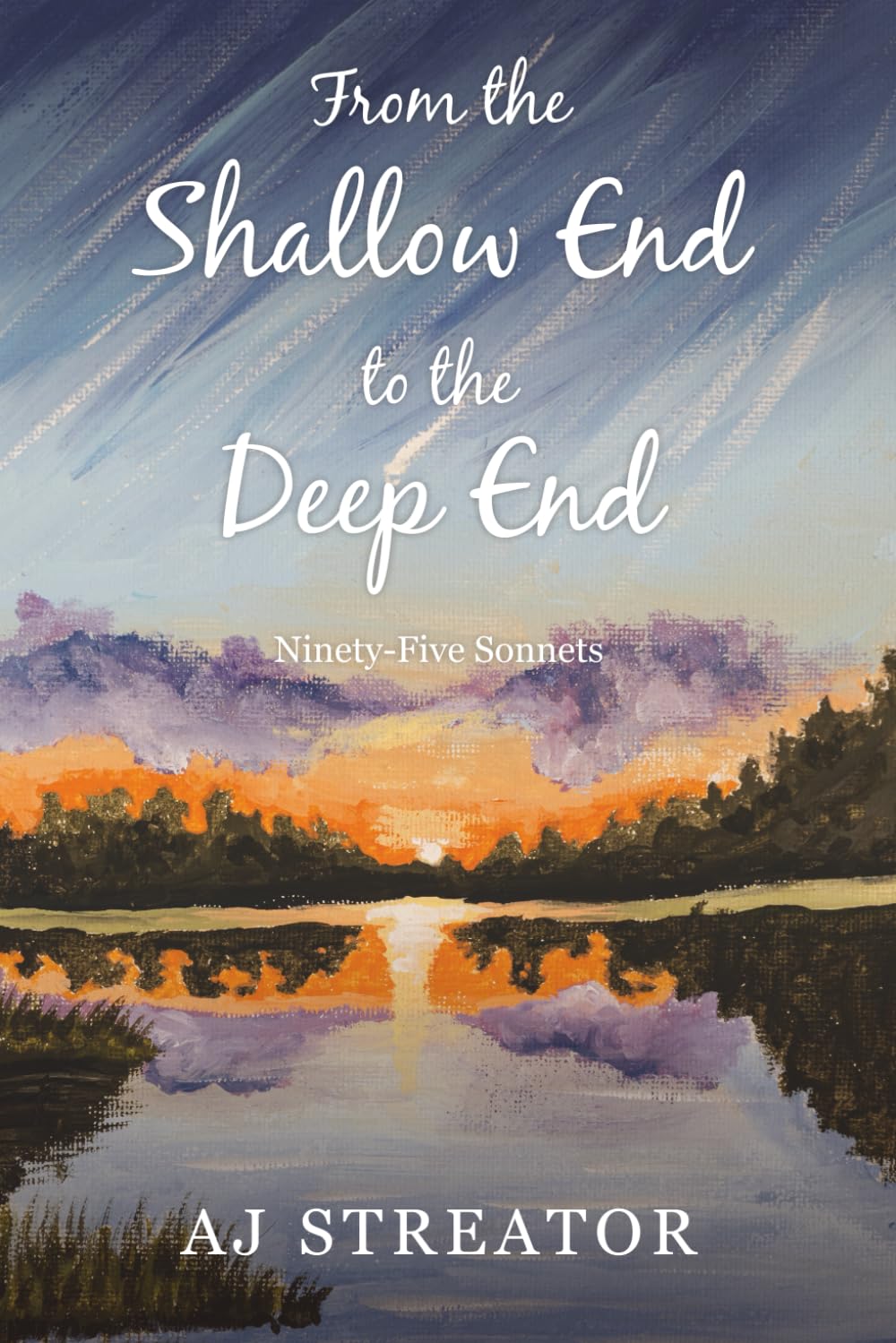
From the Shallow End to the Deep End is a rich and deeply personal collection of ninety-five Shakespearean sonnets that moves through childhood memories, family histories, heartbreaks, faith, despair, and redemption. The book travels in a steady descent from innocence to complexity and then rises again toward clarity and grace. Its structure mirrors the stages of a life that has been lived with open eyes and a bruised but persistent heart, and each section lays bare a different layer of the poet’s world. Streator uses the traditional sonnet form to anchor experiences that feel modern, messy, and often raw, and the tension between old structure and new emotion is one of the book’s strongest features.
I was surprised by how quickly the writing pulled me in. The language is formal on the surface, but beneath it flows a current of sincerity that feels warm and human. I kept pausing at lines that carried a punch not because they were fancy but because they were honest. The poems about childhood felt especially sharp. Scenes of brothers growing apart, parents missing from the stands, and friendships fading hit harder than I expected. They had this way of stirring old memories in me, making me nod along and think, yes, I’ve been there, too. The sonnets in the middle section became heavier and darker, and I admit they made my chest tighten. When the poet spoke about loss, depression, and the desperate quiet of survival, the writing felt intimate. I appreciated that. It made the collection feel alive.
Sometimes the rhyme scheme amplified the weight of the words and made the pain or the joy ring louder. I caught myself smiling at the poems about his children because they warmed the whole book. They softened the darker stories without pretending everything is fixed or simple. That mix of light and shadow felt real to me, and I found myself admiring how Streator holds both without flinching. The shift toward faith in the later sonnets felt authentic, not preachy, more like a man trying to keep his footing after being tossed by life one too many times. It gave the final stretch of the book a quiet sense of hope.
I walked away from this collection feeling both moved and grateful. I’d recommend From the Shallow End to the Deep End to anyone who loves poetry that speaks plainly about life’s messiness while still finding beauty in it. I think it’s well-suited for readers who appreciate traditional forms but want the content to feel fresh, personal, and unguarded. It’s also a meaningful pick for anyone who has lived through family storms, heartbreak, or the slow rebuilding of a life. The book isn’t afraid to wade into deep water, and it invites you to step in with it, one sonnet at a time.
Pages: 109 | ASIN : B0GCPRF4RD
Is There Not A Cause? (2014-2025)

Reading Is There Not a Cause? felt like diving into eleven years of someone’s life all at once. The book moves through storms, heartbreak, faith, rage, pride, fear, temptation, joy, reflection, and rebirth. The poems hit like quick flashes of memory, then long moments of confession, then hard truths about a broken world. The author brings God, struggle, trauma, race, desire, loyalty, and self-accountability into view and spins them around until they blur into something raw and human. I finished it feeling like I had witnessed someone fight through their own darkness and keep getting back up, no matter how messy the fall.
As I worked through the poems, I kept feeling this heat in my chest. The writing is straight from the gut, no filter at all, and sometimes it shook me because the voice is so exposed. There are moments when the author talks about faith with steady hope, then in the next breath, he crumbles under frustration. That mix felt real to me. Life flips like that. I appreciated how he never pretended to be perfect and never tried to make his pain sound pretty. Some poems burned hot with anger. Others were soft in a way that caught me off guard. I liked that unpredictability. It made the book feel alive.
The book hits you with one emotion after another. I admired that intensity. It felt like the writer refused to hold anything back. The honesty gave the work its power. I also enjoyed the wide swing between personal reflection and social commentary. One page dives into relationships that fell apart. Another page calls out violence, corruption, and spiritual decay. It is chaotic at times, but the chaos felt intentional. It mirrors the world we live in.
I walked away feeling like this book is for readers who want truth more than comfort. It is for anyone who has battled themselves, prayed for change, fallen hard, gotten back up, and kept moving even when life hit them from every angle. If you like poetry that talks plain and feels heavy and relatable, this book will speak to you. And if you are in a season where you need to feel seen, this collection has plenty to offer.
Pages: 128 | ASIN : B0FP76VCCM


