Blog Archives
My Eureka Moment

Mastering Your Scenes: Your Blueprint for Success is a book that assists writers in overcoming writer’s block and enhancing their creative skills, presented in a workbook style, encouraging readers to actively engage with its content. Can you tell me more about the inspiration behind this book?
In truth, the inspiration for this book came from the need to make headway in my sci-fi work in progress Fulfilling a Vow: Searching for Answers. After I had succumbed to the idea of learning about outlining and making some progress, things came to a screeching halt once more. It was at that point that I began to question where the real disconnect was. My eureka moment was, “the scene.” I pondered what it really took to create a scene. I started delving into the works of great teachers such as Rayne Hall and reading her various input on different types of scenes. While he doesn’t know I considered R.A. Salvatore my unrequited mentor for writing good fight scenes.
When it all came down to it, I felt that there was still something missing from all the information I was taking in. My conclusion was that the fundamentals of what a scene really was and what it took to create it were not much of a focus. As I explored this through recalling movies, personal experiences, and other writings it gave me the breakthrough that I needed. It also provided me with a rinse-and-repeat process that could be applied to every scene from romantic, to thriller, horror, and such. The basic elements do not really change much.
The funny thing is that I got so excited about how much progress Mastering Your Scenes allowed me to make that I was eager to get it out there before I completed Fulfilling A Vow. It was meant to go out along with it. Then you add some life circumstances to the mix, and I am still working on my work in progress but nearly finished.
What were some ideas that were important for you to share in this book?
I suppose the greatest idea was that I wanted to help other writers understand what goes into a scene and how to create a masterpiece every time.
What experience in your life has had the biggest impact on your writing?
In a word the experience that has had the greatest impact would be “hardship.” The struggles, painful moments, and failures have been the whetstone to sharpen my literary blade. At the heart of all of that is my faith in God, who has never thrown me away or forsaken me no matter how many times I have fallen. It has yielded a burning desire to help others succeed and avoid some hardship along the way, should they be willing to receive it.
What is one thing that you hope readers take away from Mastering Your Scenes?
The one thing that I hope readers take away is the confidence to deliver to their readers an unforgettable page-turning experience that will be recalled for years to come.
Author Links: GoodReads | Twitter | Facebook | Website | Amazon
This book was written with one main purpose: to help give authors a creative boost in their scene writing and toss writers’ block into the oblivion of the abyss. In order to accomplish this, each chapter is written in a workbook-like format so that the steps provided can easily be implemented after they are explained. For each element of scene writing that is presented, J.A. Cox explains the How, Why, and When of its use along with his own description so that the information is easy to assimilate. He provides copious examples from his own writing of these elements in action as well as from shows and movies.
Here are the elements that you will be learning about:Sketching
Location
Time
Characters
Perspective
Resistance
Objective
No new-fangled way of writing is about to be forced on you, but advice offered to help you realize things you are likely not seeing as you struggle to come up with ideas. As you make your way through these pages and consider these elements, you will end up in a state where it is difficult to shut down the tsunami of ideas that will come your way.
Finally, there is a completed outline format that can be used over and over for every scene you write to keep that creative pump primed. Therefore, you will no longer have to fuss over figuring out what prompts or hooks to use to start a chapter as your answer will come to you as you outline your scenes from the various questions provided for you to ask with each element.
This book will revolutionize the way you look at your scenes in the future…
The Author’s Little Red Guide to Editing
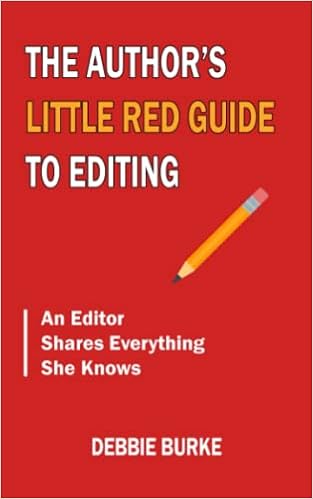

The Author’s Little Red Guide to Editing is every author’s dream book. Debbie Burke compiled writing, editing, and publishing fundamentals in this short and well-written book. Every topic in every chapter has critical information that aspiring authors and editors need.
Writing is an old, beautiful art that will stay with humanity forever. If you want to stand out from your peers, you need people like Debbie Burke, who have done it and even gone further to document the experiences, challenges, tricks, tips, and good and bad aspects of writing. The Author’s Little Red Guide to Editing is an evergreen book and ideal for all who want to be the best writers and editors in their spaces.
I like that the author starts the book by sharing her experience getting edited. The author writes about her first book, her pioneer roles, the rookie mistakes she made, and the learning process, and she even includes some personal incidents. I also appreciate the author for the questions that she infused in her narration. Burke had a few questions in writing, which she comprehensively answered as she told her story. The author brilliantly responded to questions like how to tell your editor not to change your essay, how to write fantasy, how to use tenses, and more.
The first chapter in the book was my favorite, but I also had multiple other topics that I enjoyed. Throughout the book, the author tackles various literary areas. Topics range from editing to basing writing skills from how to choose an editor, writing regionalisms, proofreading, tips that can guide your writing journey, taking from other authors, different ways of publishing, and other related subjects. As a reader, you are assured that you have all the required information gently shared with you.
The Author’s Little Red Guide to Editing is the perfect companion for anyone in the literary field looking for information on publishing and editing. This handy reference guide will answer many questions and those you didn’t even think to ask.
Pages: 73 | ASIN : B09Y4TFP63




 LITERARY TITAN