Blog Archives
The Thread Of Life

White Cat unveils the intricate life of a centenarian through letters and artifacts, weaving a tapestry of history, emotion, and mystery across eras like World War 2 and the approach of apartheid-era South Africa. Why was this an important book for you to write?
Initially, a family connection made it important: Barbara was my aunt and the last of her generation, and, during her last years, shared with me a lot of family history and anecdotal material which, I suspected, no other family member had been aware of. The instigation for the actual writing was her disclosure of her extra-marital relations with the army spy whom I have called Hugh in the book. In fact, she refused to tell me his real name, which I put down to the unwavering wartime sense of duty of her generation. She suffered for this relationship and it became important to me to witness to the resilience and courage – evidenced also by her own wartime actions – of the person she was. Then my therapist persona jumped in and I realised that I had the material for a favourite theme of mine, namely, the passage of our lives through our heredity mixed with our contacts with others, the strands from which the thread of life is spun.
Can you elaborate on the real events that inspired “White Cat” and how you balanced historical accuracy with creative storytelling?
Wars, in this case, the Boer War in South Africa and World War 2, provide grand tableaux which, if we are not careful, distract us from the reality that it is the lives of the people which make up the picture. I knew that my grandfather lost a leg in an engagement in the Boer War, that a granduncle drowned in South Africa in undocumented circumstances and was ‘disappeared’ by his family, and that Barbara’s paramour, the military spy, vanished in Vienna. The great events provided a stage on which to play this out, but the real drama was about the lives of individuals. I had considerable material from my firsthand acquaintance with many of the individuals. I also had family anecdotal evidence of the personalities of the generation before, enough to be able to ‘write back’ some family traits which I knew of from my own day. So the narrative of the story grew also from what I could believe or impute for the characters concerned. This formula, such as it was, gave me enough scope for creativity in storytelling. The one enigma was Harry, my granduncle, and, whilst I offer a therapist perspective on his death, I leave it for the reader to decide.
The book’s narrative structure, weaving together elements of historical fiction, memoir, and mystery, is unique. What challenges did you face in crafting this multi-layered story, and how did you overcome them?
This was a challenge. I knew how I was going to start and I knew where the book was going to end. In fact, I wrote the final chapter not long after the first and I changed it very little. I knew I had two main storylines, the love story of Barbara and Hugh, and the tragedies of the family in South Africa: they were roughly 50 years and 10,000 miles apart. That in itself intrigued me. It was the letters that gave me the answer. Within my cast of characters over four generations, there were enough people who either did, because I had some letters, or plausibly could have, written to each other across the generations, for this to provide the continuity and create for Barbara the pivotal role in the overall drama.
What is the next book you are working on, and when will it be available?
The first sequel to White Cat is already out. It is called And Then There Are The Stories. It follows the fortunes of Hugh and Nobomi, starting in Vienna and then moving back to South Africa, ending in the Drakensberg mountains on the border between Eastern Cape and Lesotho. It is largely fictional – I was unable to find any trace of a likely Hugh in the National Archives once he moved from his military unit to the FSS. But there is one scene in Vienna for which I found sufficient family material to make possible a reconstruction. I have adopted a different format in this sequel, the main storyline being carried by the accounts given by a series of ‘outside’ characters, whose lives become involved in different ways.
I am now working on the third and final sequel, which is more or less present-day, though with allusions to some material in White Cat, as well as to the two main characters of the first sequel. The two figurehead names of White Cat reappear, though they might not be related to their namesakes there, but they continue my theme of the thread of life. This final sequel is called River.
Author Links: Goodreads | Facebook | Website | www.life-counselling.co.uk
This family saga begins at an end, with the death of Barbara at 104, the last of her generation, and the end of an era. She was the custodian of memories and memorabilia from four generations – her larger-than-life grandfather converted by a Quaker nurse, a father in the Boer War in South Africa, an uncle who mysteriously drowned in the Indian Ocean, his African girl-friend and the child he never saw, Barbara’s own paramour a spy in post-war occupied Vienna…and her own heroism in that war.
The reader passes through the abandoned rooms of her house, as the story unfolds by way of narrative and letters which create an immediacy, even intimacy, with the various players in the drama.
“… a confusion of sets and settings when the action moved, sometimes you could see it but sometimes it was offstage and reported, and then you have to trust the word passed down across the terraces of history, the hardships, the joys, the resentments, the hopes, the terror, the humanity, the resilience… and somewhere back along the way, still tolling, the bourdon bell which marked the tide of war.”
The White Cat? – no, six in all, and a question left unanswered.
Babylon Laid Waste-A Journey in the Twilight of the Idols
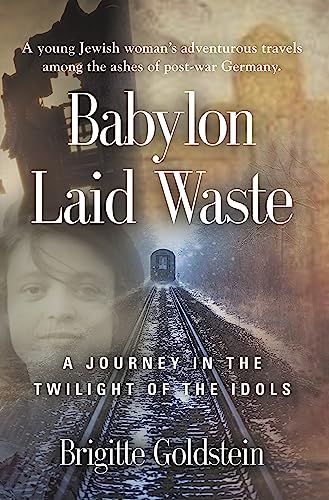

Babylon Laid Waste: A Journey in the Twilight of the Idols, authored by Brigitte Goldstein, masterfully delves into the harrowing saga of a young Jewish woman’s audacious endeavor to locate her long-lost grandmother in the ruins of post-war Berlin.
Set against the backdrop of a world in the throes of convalescence following the devastation of World War II, the narrative unravels in the year 1946. Our protagonist, Artemisia Safran, hailing from New York, receives an unexpected missive hinting at the possible survival of her grandmother, previously assumed deceased. This news prompts Artemisia to defy familial objections and embark on a perilous journey through the scarred streets of Germany. The desperate urgency of her mission forces her to weave a web of deceptions, but her inexperience may inadvertently obscure the real perils lurking along her path. A quagmire of danger engulfs her, and she’s falsely branded as a Nazi, cornered with seemingly no escape. However, salvation emerges in the enigmatic form of Franz Kafka from Prague, who, acknowledging her undeserved plight, meticulously crafts an escape strategy. This unlikely alliance ignites sparks of romance, complicating Artemisia’s original mission, weaving a tangled tapestry of politics, survival, and blossoming love.
Goldstein’s narration is fantastic. She meticulously structures each chapter and segment of the novel to effectively guide the reader through the labyrinth of poignant events that marked the War. The authenticity and precision of the recounted horror scenes invite readers on a journey of recovery and reconciliation, fostering connections and facilitating healing.
The novel’s intricate structure, engrossing plot, and enlightening insights encapsulate the harrowing uncertainties and fears of the era. The diverse perspectives offered through an array of well-developed characters craft a provocative milieu, compelling readers to reflect on historical events and vicariously experience the trials of those who bore witness to some of mankind’s darkest hours.
Babylon Laid Waste: A Journey in the Twilight of the Idols stands as a riveting historical novel imbued with unexpected plot twists and resolute characters that enrich the reader’s engagement. This highly recommended literary piece succinctly encapsulates significant moments of Jewish history with a deep reverence for past events and a tribute to the countless lives tragically extinguished during this catastrophic epoch.
Pages: 368 | ASIN : B07VV6F4KW



