Blog Archives
A Sense of Agency

In We Are as Gods, you present the idea that technological advancements have given ordinary people godlike powers and offer a psychological survival guide. Why was this an important book for you to offer readers?
For the past decade, Pete and I have been writing about exponential technologies and the massive opportunities they create. What became clear over time is that the story isn’t just technological, it’s psychological. The tools we now possess are extraordinary. AI, robotics, biotech, advanced materials, planetary-scale sensors—these are capabilities that, even a few decades ago, would have sounded like mythology. Yet despite living through an era of unprecedented progress, many people feel overwhelmed, anxious, and powerless.
That gap fascinated us. The problem isn’t that the future lacks opportunity; it’s that our brains didn’t evolve for the speed and scale of this moment. So the book became a kind of survival guide for the age of exponential change. We wanted to show readers both sides of the equation: first, the incredible breakthroughs happening around us, and second, the cognitive tools we need to stay grounded, resilient, and effective while navigating them. In short, the goal was to help people move from feeling like victims of the future to active participants in shaping it.
What inspired you to frame modern technology in such mythic or almost biblical terms?
Partly, it’s just the simplest way to describe what’s happening. If you look at the capabilities we now have: curing diseases with gene editing, speaking instantly across the planet, creating intelligence in machines, manipulating the climate system, those are powers that ancient cultures would have described as miracles.
Myth and religion have always been humanity’s way of grappling with forces that feel larger than us. By framing modern technology in those terms, we’re not being poetic for its own sake; we’re trying to help people feel the magnitude of the shift we’re living through.
But there’s another reason. Myths are also about responsibility. In almost every mythic tradition, when humans gain extraordinary power, the real question becomes: do we have the wisdom to use it well? That’s exactly the moment we’re in right now. Technology is accelerating incredibly fast, and the real challenge is making sure our judgment, ethics, and emotional maturity keep pace.
Do you think the biggest opportunity of this era is technological or psychological?
Technologically, the opportunity is enormous. The convergence of AI, biotechnology, robotics, and advanced energy systems is unlocking solutions to problems that have plagued humanity for centuries: poverty, disease, energy scarcity, and access to information. The tools are extraordinary.
But psychologically, we’re not fully prepared for them.
Our brains evolved to survive in small tribes on the savannah. They’re optimized for short time horizons, local threats, and limited information. Today we’re navigating a world of global networks, exponential change, and constant cognitive stimulation. That mismatch creates confusion and fear.
So the real opportunity of this era is psychological adaptation. Can we train attention? Can we regulate emotion? Can we cultivate curiosity instead of anxiety when faced with change? If we can upgrade our mindset to match the tools we’ve built, the possibilities are extraordinary. If we don’t, we risk mismanaging the very breakthroughs that could make the world better.
The final section shifts toward practical tools for resilience, attention, and meaning. Why was it important to end the book with personal strategies rather than just big ideas?
Because ideas alone don’t change behavior.
You can fill a reader’s head with amazing stories about AI breakthroughs or revolutionary technologies, but if they close the book and still feel overwhelmed, you haven’t really helped them. We wanted to leave readers with a sense of agency.
That’s why the final section focuses on tools: things like attention management, cultivating awe, pursuing grand challenges, and building resilience. These are not abstract concepts. They’re trainable skills rooted in neuroscience and psychology.
The larger message is simple: you don’t get to sit this era out. The future isn’t something that happens somewhere else. It’s being built right now by entrepreneurs, scientists, artists, and citizens all over the world. If we want that future to be wise, fair, and meaningful, we need people who are psychologically equipped to participate.
So we end the book where the real work begins, with the reader.
Author Links: GoodReads | X (Twitter) | Facebook | Website | We Are As Gods | Amazon
In 1968, Stewart Brand declared: “We are as gods—and we might as well get good at it.” Half a century later, that prophecy has come true.
We can rewrite genes, edit embryos, build artificial minds, extend life, and terraform worlds. The old miracles—omniscience, omnipresence, even resurrection—are becoming standard operating procedure. But the real question isn’t whether humanity can play god. It’s whether we can do it wisely.
In We Are As Gods: A Survival Guide for the Age of Abundance, Peter H. Diamandis and Steven Kotler—bestselling authors of Abundance and Bold—return with a sweeping exploration of our species’ next great transformation. Blending hard science with vivid storytelling, they chart humanity’s ascent from scarcity to superabundance—and the psychological, ethical, and existential challenges that come with it.
Across breakthroughs in AI, robotics, genetics, longevity, and consciousness research, they reveal a paradox at the heart of progress: as our external power expands, our inner resilience must evolve to match. Abundance without meaning leads to collapse. Intelligence without wisdom leads to extinction. To thrive in a world of everything, everywhere, all the time, we must learn to wield our godlike powers with humility, creativity, and flow.
Equal parts warning and invitation, We Are As Gods is a map for flourishing in the exponential century. Because the future won’t be built by those who fear what’s coming, but by those who know how to turn chaos into creation.
Abundance is here. Are you ready?
We Are as Gods: A Survival Guide for the Age of Abundance


We Are as Gods argues that we now live in a world where technology has quietly given ordinary people godlike powers, from AI and robotics to biotech and planetary-scale climate tools, and that the real bottleneck is not the tech itself but our ability to think clearly, emotionally regulate, and act wisely at this new speed. The book walks through how exponential technologies created real material abundance, how our Stone Age brains mis-handle this flood of power and information, and then offers a psychological survival guide that mixes neuroscience, game design, and grand challenges to help readers build agency, meaning, and resilience in what the authors call an age of abundance.
The book is energizing. The stories are vivid and sticky. The opening riff that compares modern breakthroughs to biblical miracles lands hard, and it actually made me pause and look at my phone with fresh eyes. The structure is clear. Part 1 sets the stage, Part 2 shows real companies and projects surfing the waves, and Part 3 shifts into a self-help gear that feels more intimate and practical. I liked the way authors Diamandis and Kotler weave myth, cognitive science, and startup lore. The analogies help. Comparing information overload to a wrecking ball hitting our nervous system is simple, and it rings true. Their explanation of bias and attention feels grounded, and it helped me name things I only had a fuzzy feeling about before.
I enjoyed how bold the style is. The prose comes at you fast, like a live keynote talk poured straight onto the page, and it keeps the energy high. The constant drumbeat of examples gives the book a sense of momentum. Miracle after miracle, chart after chart, and it all adds to this feeling that you are racing through a highlight reel of the future. I still found myself curious to explore a few of the tougher stories, especially in the darker chapters where surveillance, bio risk, and inequality show up and then get lifted by the next hopeful case study. Their strong faith in entrepreneurs and incentive prizes comes across as a clear, confident stance, and while I could imagine an even deeper dive into policy and power, I liked that those themes are at least present, even if they stay mostly in the wings. I finished those sections impressed by the ingenuity on display and energized by the big questions that remain about who benefits, who pays the price, and how we can guide abundance so it feels intentional, fair, and shared.
The discussion of learned helplessness, attention collapse, and victim mindset resonated with me personally. I recognized my own doom scrolling, my own habit of telling myself the future is something that just happens to me. The tools they offer in the final chapters are not completely new, but the way they frame them inside this huge story of accelerating change gave them more weight for me. Agency, awe, and grand challenges sound like big abstract words. Here they come with clear explanations, concrete examples, and a kind of gentle shove that says: you do not get to sit this era out.
I would recommend We Are as Gods to readers who sit at the intersection of technology, leadership, and personal development, and who want a hopeful but not naive story about the next few decades. If you are a founder, an executive, a policy thinker, or simply someone feeling overwhelmed by AI and nonstop change, this book will give you language, metaphors, and mental models that can help you feel less like a victim of the future and more like an active participant. If you want a big, loud, data-heavy pep talk wrapped around some solid psychological advice, this is a very timely read.
Pages: 320 | ISBN : 978-1668099544

Be Clear and Intentional

Communicate Like a Champion provides straightforward advice for enhancing professional communication, along with strategies that emphasize clarity and empathy. Why was this an important book for you to write?
This book was important for me to write because I’ve seen time and again that the success or failure of projects, teams, and even careers often comes down to communication. As a leader in telecommunications and during my doctoral studies, I recognized how often components of communications, such as clarity and empathy, were missing in professional exchanges. I wanted to create something concise, practical, and easy to use, something people could apply immediately in their workplace, whether they’re leading teams, collaborating across departments, or simply trying to be better understood.
What is one misconception you believe many people may have regarding effective communication in the workplace?
One of the biggest misconceptions is that communication means more words. People often think that long emails or detailed presentations equal effectiveness. In reality, effective communication is about being clear and intentional, saying the right thing, not everything. Another misconception is assuming silence means agreement. “No questions” doesn’t always mean understanding or alignment, and that’s where leaders need to confirm, follow up, and create space for feedback.
Did you learn anything that surprised you while you were researching and writing Communicate Like a Champion?
What surprised me most was how consistently small actions can create significant results. It wasn’t the grand speeches or high-stakes presentations that made the most significant difference; it was the everyday habits that mattered most. Things like summarizing a meeting in a single clear sentence, asking one good clarifying question, or pausing to reflect before responding. Those small, consistent habits are what transform someone into a “champion communicator.”
What is one thing you hope readers take away from this book?
If there’s one thing I want readers to take away, it’s that communication is a skill you can practice and improve. It’s not just for extroverts, executives, or “natural speakers.” With small, intentional steps clarifying intent, listening actively, and following up, you can become the kind of communicator who builds trust, fosters collaboration, and leads with confidence. That’s what “communicating like a champion” is all about.
Whether you’re a new professional, a seasoned leader, or someone navigating the complexities of hybrid teams, Communicate Like a Champion offers practical, proven strategies for improving your connection, leadership, and collaboration in the workplace.
This concise and actionable guide walks you through the core elements of strong communication—from clarifying your intentions to using empathy and follow-up effectively. With relatable examples, reflection prompts, and a 28-day challenge to build habits over time, this book helps you go beyond just “getting your point across.”
You’ll learn how to:
Communicate clearly across departments, hierarchies, and mediums
Recognize internal and external factors that influence every message
Use tone, clarity, and follow-up to earn trust and foster collaboration
Apply tools and tech that elevate your tone and clarity
Lead conversations with empathy, even when conflict is unavoidable
Whether you’re sending an email, running a meeting, or managing change, this book provides a reliable framework for ensuring your message lands and builds stronger relationships.
Communicate Like a Champion
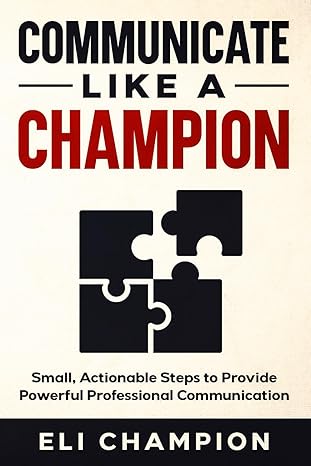
Eli Champion’s Communicate Like a Champion is a straightforward, practical guide to improving professional communication. The book breaks down why communication matters, how intentions shape interactions, what factors influence the way messages are received, and how to put strategies into practice with clarity and empathy. It’s full of simple, actionable steps, like clarifying your purpose before a meeting, checking tone in emails, and following up after conversations, that aim to make anyone a more confident and respected communicator.
What stood out to me initially was the book’s emphasis on practical application rather than abstract theory. Champion illustrates this with the example of a manager calling for “a quick meeting” without providing context. As he explains, such ambiguity often leaves employees uncertain and anxious, unsure whether they have erred or whether the meeting is merely routine. I found this example particularly resonant, having experienced the situation from both perspectives as the uneasy employee and as the manager who failed to provide sufficient clarity. The recommended adjustments, such as stating the purpose of the meeting at the outset or clarifying next steps before closing, are deceptively simple yet highly effective. I could immediately envision how these practices would have alleviated unnecessary tension and improved understanding. This emphasis on directness and transparency exemplifies the book’s core message: communicate with precision to minimize confusion and foster confidence.
I found the chapter on the “7 Components of Communication” particularly instructive. While the framework, clarity, confidence, respect, listening, tone, empathy, and follow-up may appear familiar, Champion’s illustrations prompted meaningful reflection on my own communication practices. One example contrasted the response “I don’t think that will work” with the more considerate phrasing, “I see your point, but can I offer another perspective?” The distinction is subtle yet powerful, highlighting how word choice and tone can determine whether a message is received as dismissive or constructive. Confronted with this comparison, I recognized moments when I have defaulted to the blunt response, often unintentionally undermining collaboration. The example served as a useful reminder of the value of consistently striving for a more respectful approach.
Another notable feature of the book is the 28-day communication challenge. Organized around weekly themes, such as clarity, listening, empathy, and follow-up, it provides daily prompts that encourage practical application, including exercises like restating a colleague’s point to confirm understanding or sending a follow-up email after a meeting. I appreciated that this section moves beyond theory to establish a structured practice routine. When I applied one of the suggested exercises, clarifying my intention at the beginning of a meeting, I was struck by how much more effectively the conversation unfolded. The challenge, paired with the book’s approachable tone, created the sense of being guided by a mentor offering encouragement, rather than being instructed by a prescriptive voice.
I found Communicate Like a Champion to be highly practical and accessible. Rather than relying on jargon or overly complex frameworks, it presents straightforward tools and encourages consistent application. I would recommend this book to early-career professionals seeking to develop confidence, to managers aiming to strengthen their leadership presence, and to anyone who has left a conversation feeling uncertain about its outcome. With reflection and deliberate practice, the strategies outlined here have the potential to significantly improve the way one engages in meetings, correspondence, and professional interactions more broadly.
Pages: 65 | ASIN : B0FG71T9MZ
The 20 Hour A Week CEO

The 20-Hour A Week CEO challenges the pervasive narrative that success comes from relentless hustle. Instead, Jess Cassity advocates for a mindset shift—one that prioritizes impact over hours worked. By rejecting traditional hustle culture, the book introduces a transformative model for managing online businesses with efficiency, strategic focus, and work-life balance. Cassity unpacks the key principles behind this shift, addressing topics like overcoming imposter syndrome and fostering a growth-oriented mindset. With step-by-step guides, practical exercises, and detailed checklists, readers gain actionable tools to achieve productivity without exhaustion. The strategies presented help individuals integrate personal and professional responsibilities, enabling them to thrive in both spheres.
Compact yet comprehensive, The 20-Hour A Week CEO serves as the perfect pocket guide. Its brevity ensures accessibility, while its depth covers every critical aspect of the subject. Cassity discusses everything from advanced marketing techniques to scaling strategies, providing valuable takeaways for entrepreneurs at all levels. Each chapter concludes with summary sections, reinforcing key insights and making the book easy to revisit for quick refreshers. The logical structure—beginning with mindset development and progressing to practical business strategies—ensures a clear, sequential flow. Readers can build upon foundational concepts before tackling advanced methods, creating a well-rounded understanding of the content.
Cassity’s writing style further elevates the book’s impact. Her tone is engaging, motivational, and consistently supportive. By blending personal anecdotes with clear, actionable advice, she creates an empowering reading experience. The book prompts reflection throughout, encouraging readers to adapt strategies to their unique circumstances. This balance between theory and practicality keeps readers actively engaged while fostering a sense of accountability and empowerment.
This book offers something for everyone. New entrepreneurs gain a solid foundation for building efficient work habits, while seasoned business owners discover ways to improve their existing processes. Cassity’s thoughtful approach empowers readers to reclaim their time, optimize productivity, and create a sustainable work culture. The 20-Hour A Week CEO is more than a guide; it’s a roadmap for achieving success on your own terms—an essential tool for anyone ready to work smarter, not harder.
Pages: 141 | ASIN : B0DMP9P2T9
La Hoja De Ruta Fiscal Y Financiera Para Los Españoles En EE.UU.

La Hoja De Ruta Fiscal Y Financiera Para Los Españoles En EE.UU. proporciona una exploración profunda del panorama financiero y fiscal para los españoles que viven en los Estados Unidos. Ofrece consejos prácticos sobre cómo navegar por las complejidades de las leyes fiscales y los sistemas financieros de EE.UU., comparándolos con el contexto español. El libro tiene como objetivo ayudar a los expatriados españoles a comprender y gestionar sus obligaciones financieras de manera efectiva, asegurando el cumplimiento y optimizando sus situaciones fiscales. También arroja luz sobre aspectos únicos de la fiscalidad y la planificación financiera en EE.UU. que podrían ser desconocidos para los recién llegados.
Una de las fortalezas del libro radica en su cobertura exhaustiva de los temas. Por ejemplo, profundiza en las diferencias entre los enfoques de ahorro para la jubilación en España y EE.UU., destacando la mayor variedad y los límites de contribución más altos disponibles en EE.UU. Esta comparación no solo informa, sino que también empodera a los expatriados españoles para tomar mejores decisiones financieras. La explicación detallada de herramientas como el Foreign Tax Credit y el Foreign Earned Income Exclusion es particularmente útil, ofreciendo una guía clara sobre cómo evitar la doble imposición.
El estilo de escritura es claro y atractivo, haciendo accesibles temas financieros complejos. El uso de analogías, como comparar el usufructo con disfrutar de una taza de café mientras se posee la taza, ayuda a desmitificar conceptos intrincados. Además, la inclusión de ejemplos de la vida real y consejos prácticos mejora la practicidad del libro. Un aspecto destacado es la discusión sobre las peculiaridades del sistema fiscal de EE.UU., como el Impuesto Mínimo Alternativo (AMT). El libro explica de manera efectiva cómo se calcula el AMT y sus implicaciones, proporcionando valiosos conocimientos para aquellos que no están familiarizados con este mecanismo fiscal.
La Hoja De Ruta Fiscal Y Financiera Para Los Españoles En EE.UU. es un recurso invaluable para los españoles que viven en los Estados Unidos. Ofrece conocimientos esenciales y consejos prácticos para ayudar a los expatriados a navegar por los sistemas financieros y fiscales de EE.UU., que a menudo son confusos. Este libro es particularmente adecuado para aquellos que son nuevos en EE.UU. y necesitan una guía clara y concisa para gestionar sus finanzas y obligaciones fiscales en su nuevo hogar.
Pages: 94 | ASIN : B0D51RP89G


