Blog Archives
One Inch at a Time


One Inch at a Time, by Alyssa Herrera, is a tender children’s book about developmental progress, disability, and the many ways children communicate, move, and grow. Built around the idea of “inchstones,” it treats a wiggle, blink, sign, step, or brave attempt as an occasion worth noticing. The opening contrast between a caped child taking off and a baby taking their time quickly establishes the book’s generous outlook: each child follows an individual path, and each bit of progress carries meaning.
Herrera’s short, rhyming lines make this picture book easy to share aloud. The repeated “some kids” phrasing creates a reassuring rhythm while introducing speech, gestures, communication aids, mobility equipment, and physical support in language young readers can understand. Phrases such as “almosts,” “not yets,” and “nearlys” give families an encouraging vocabulary for the long stretches between milestones. The text gradually expands from individual achievements to a wider invitation for patience, kindness, and inclusion.
Mayssa Kennouche’s bright, softly textured illustrations carry much of the emotional storytelling. Children appear using wheelchairs, braces, orthotics, medical tubing, signs, sounds, and other forms of communication, surrounded by attentive families, classmates, teachers, and friends. Mobility aids and medical equipment are presented as familiar parts of everyday life. Spacious character vignettes focus attention on small actions, while fuller scenes at the playground, pool, track, classroom, and birthday table show the joy of belonging to a community. The varied faces, bodies, cultures, and abilities give the book’s message real visual substance.
One Inch at a Time offers a cheerful and practical way to talk with children about growth that happens at different speeds and in different forms. Its final pages bring everyone together in celebration, then close with a personal note from the parents of Mack and Mila, grounding the idea of inchstones in lived family experience. Parents, teachers, therapists, and caregivers will find plenty here to begin conversations, but children receive the most important message directly: their efforts matter, their way of growing belongs, and even the tiniest win deserves a cheer.
Boost Mental Health

Healthy Relationships presents a thoughtful and approachable exploration of what helps relationships thrive, walking readers through the core ingredients of healthy connection, communication, boundaries, empathy, responsibility, and self-awareness. Why was this an important book for you to write?
Mental health is an important subject for me especially because I work as an inpatient psychiatric nurse. We all could use more help with our journey to stable mental well-being, including myself. I learn things from every Nurse Dorothea® book I write. We plan to produce about 80 Nurse Dorothea® books (currently there are 15 as of April 2026), so it was time to cover this topic.
Relationships are complex, and I appreciate that you covered friendships, family ties, romantic partnerships, and online relationships. How did you approach writing about such a diverse topic, but still presenting meaningful information without being overwhelming?
I practice the skill of synthesis of reading a lot of research-based information and combining it all to create a thorough product. The Nurse Dorothea® books are much harder for me to write than the Nurse Florence® series since I am combining information from many different source documents.
What were some ideas that were important for you to share in this book?
There were many, but one important one discussed by Harvard Health was how a variety of relationships can help boost mental health.
What is the next book in the Nurse Dorothea series that you are working on?
One of the next books to be published is Schizophrenia. We need to play our part to destigmatize mental illness just as Dorothea Dix did in the 1800s.
Author Links: GoodReads | Facebook | Website | Essay Contest | YouTube | Dow Creative Enterprises® | Nurse Florence Project | LinkedIn | Amazon
If society wants something we have never had, we’re going to have to do something that has never been done.
The Strange Tools of Human Communication: The Voice, the Pen, and the Lyre

Ruth Finnegan’s The Strange Tools of Human Communication is a wide-ranging and often unexpectedly intimate meditation on how human beings make meaning through more than language alone. Moving from the voice to writing, music, gesture, number, colour, and finally the hand itself, Finnegan argues that communication is not a single channel but a dense, historical, bodily weave. What stayed with me most was the book’s refusal to let speech monopolize the story of human expressiveness. The chapters on Limba storytelling in Sierra Leone, on pictographic systems and cave art, on music’s possible origins, and on those half-conscious forms of signifying that live in numbers and colours all feed into one large claim: we are tool-making communicators, and our tools are stranger, older, and more various than modern habits of thought usually allow.
What I admired most was the book’s atmosphere of intelligent wonder. Finnegan writes like a scholar who still feels genuine astonishment at her subject, and that astonishment is contagious. I was especially taken by the pages on voice, where she moves from the physical instrument of the larynx to the felt power of hearing poetry aloud, and then into her vivid account of Limba oral performance, with its repetitions, pauses, chorus responses, and the sly drama of “the clever cat.” Those sections have real life in them. They don’t just describe communication, they seem to perform its vitality. I also liked the book’s impatience with easy hierarchies. Her defense of pictograms and non-alphabetic systems, and her skepticism toward grand claims that writing alone transformed humanity, give the argument a welcome steadiness.
At the same time, I found the book more persuasive in its concrete chapters than in its more speculative ones, and that imbalance is part of what makes it feel human rather than mechanically “complete.” When Finnegan is close to lived example, to oral artistry, to scripts and inscriptions, to music as a social and emotional practice, I felt entirely in her hands. When she moves into swarming, unconscious intercommunication, or the more mystical reaches of shared consciousness, I was intrigued. Still, even there, I never felt she was being careless. What she offers is less a hard thesis than a roaming, seasoned intelligence thinking aloud across disciplines. The book has the texture of a learned person laying out a lifetime’s thinking, with all the warmth, digression, and oddity that implies.
I found this a stimulating book that enlarges the reader’s sense of what communication is and where it lives. I finished it feeling more alert to sound, script, gesture, ritual, and the patient labor of the hand. I’d recommend it most strongly to readers of anthropology, linguistics, music, oral tradition, and cultural history, and also to anyone who likes scholarship with personality still beating inside it. This is a thoughtful book for curious readers who don’t mind following an original mind down winding paths.
Pages: 257 | ASIN : B0CXVJB1G3

Live a More Informed & Enriched Life

Down to Earth: Demystify Intuition to Upgrade Your Life is a thoughtful blend of personal stories, practical exercises, and scientific studies showing readers that intuition is not a mystical talent, but an everyday skill that can be honed. Why was this an important book for you to write?
I am convinced that tapping into intuition can help us live more informed and enriched lives. I developed simple ways to tap into intuition and wanted to share these with as many people as possible. Intuition always held a special place in my life, and became more important after a life-altering event that brought moments of deep mental and emotional peace. I talk about this in the Introduction of my book. I often came up with creative ideas and solutions to long-standing problems while I was in this mentally and emotionally calm state which activated my intuition. Curious about this process, I began researching intuition. I studied with various teachers, completed an apprenticeship, and read every book and scientific study on intuition I could find. I started offering intuitive guidance sessions and eventually developed my own approach to help clients access their intuition more effectively. As more people joined as students, I created a curriculum that later became the foundation of my book, Down to Earth: Demystify Intuition to Upgrade Your Life, published on September 15, 2025.
What is a common misconception you feel people have about intuition and a person’s ability to develop it as a life skill?
Some people think that intuition is a special skill that only highly intuitive people have. In reality, it is a readily available skill that we all have and even use without realizing it. Intuition is a form of knowing or a sensation we get about something or someone without any prior conscious thought process. It draws on the knowledge and experiences we accumulate throughout our lives. There are many activities that we engage in without consciously thinking about every move and every step such as playing a sport or cooking. There may be some parts of these activities that require conscious analysis but for the most part, we just go with what we sense and muscle memory. We also use our intuition a lot socially. We sense if someone is tense or relaxed just by noticing their posture or the pace of their breath. All of this is intuition in action. It gives us useful information that can help guide our decisions and actions when we learn how to interpret and combine it with logic and other inputs such as research for due diligence.
I loved that you used neuroscience and psychology research as well as provided readers with examples and exercises to gain a better understanding of intuition. Did you find anything in your research of this book that surprised you?
In many cases, my exercises and guided meditations were inspired by students and clients based on what they needed to figure out. I tried these exercises with others, and if they worked, I included them in my book. I also used slow intuition. This type of intuition is activated when you take a break from trying to solve a problem and do something that calms your mind and emotions. Researchers such as Kenneth Gilhooly have described how nonconscious processing occurs during these break periods as intuition gets activated. It was surprising for me to learn that stepping away for such a break right after being introduced to a problem results in more creative solutions compared to working on the problem for a while then taking such a break when you get stuck. For example, you look at what the problem is, then go for a quiet walk in nature even before making your first attempt at solving it. I talk about this in the last chapter of my book.
What is one thing that you hope readers take away from Down to Earth?
I hope that readers discover ways to tap into intuition that work well for them and combine their intuition with logic and other inputs to make more grounded decisions, improve relationships, and take better care of themselves. As people connect more with their intuition, they can understand themselves and each other more deeply. This can cultivate greater compassion for themselves and others making the world a better place for all of us.
Author Links: GoodReads | Facebook | Website
If you’ve ever wondered how to harness your intuition to make better, more informed decisions, this is the practical guide you need. In Down to Earth, intuition teacher Nil Demircubuk guides you in understanding how to distinguish your conscious thoughts from your intuition, then intentionally combine it with your intellect for everyday decision-making and personal growth.
The book introduces “priming,” a method for tapping into intuition by achieving mental and emotional calmness, offering several techniques tailored to different learning styles. As you practice reaching this state and tuning in, you’ll also learn what makes your intuition come alive through a non-conscious process.
Through easy-to-follow exercises, real-life applications, and client stories, Down to Earth helps you use your intuition to make better decisions, improve relationships, navigate challenges, and enhance self-care.
Illuminating Human Connection

Navigate Family Technology explores the modern family’s dilemma of how to help children thrive without letting technology consume them, focusing on topics such as communication struggles, social media traps, empathy loss, anxiety, and sleep disruption. Did you find anything in your research of this story that surprised you?
I learned so much while researching the book, I’ll try to narrow the answer down to a few!
- That most Modern Tech executives strictly limit their family’s tech-use time and send the kids to low-tech schools
- The number of online predators actively working every day
- The amount of information we take in daily compared to 20 years ago
- The staggering number of hours of screen time displaces connection and well-being activities
What were some ideas that were important for you to share in this book?
My mission is about illuminating human connection in a disconnected modern world. Technology is one of the key drivers of this. We are often alone together on individual devices.
I also found it important to cover technology’s impact on empathy and distress tolerance.
What is one thing that you hope readers take away from Navigate Family Technology?
That overuse of technology is not our fault. Or our kids’ fault. But now that we understand the problem, it’s our responsibility to be intentional about it. And that we can do it – we have so much living to do and real-world connections to make.
Author Links: GoodReads | Facebook | Instagram | LinkedIn | Website | Amazon
Modern tech is an invaluable resource though its rapid development has created downsides. Nora provides accessible strategies to live our tech lives with intention rather than constant reaction mode. The content inspires hope for connection and comfort in knowing we do not face tech challenges alone.
Entertain a quest to level up your knowledge of modern tech’s influence and explore how to navigate its challenges
Navigate Family Technology: A technology roadmap for families with ideas to navigate uncharted waters

Navigate Family Technology is a clear-eyed, heartfelt guide to raising kids in a world ruled by screens. Author Nora Duncan O’Brien lays out the modern family’s digital dilemma: how to help children thrive without letting technology consume them. Through chapters that blend research, personal stories, and practical advice, she explores everything from communication struggles and social media traps to empathy loss, anxiety, and sleep disruption. The book reads like a roadmap for parents who feel lost in the constant hum of notifications and the tug-of-war between connection and control. It’s as much about reclaiming calm as it is about setting boundaries.
I found myself nodding along at every mention of the “magnetic pull” of devices. O’Brien doesn’t wag her finger or preach, she levels with you like a friend who’s been there. I appreciated how she backed her advice with science but kept her tone real and warm. Her writing has rhythm and heart, and you can feel her genuine concern for kids and families in every line. Some chapters, especially those about online predators and the permanence of digital mistakes, made me pause and feel a lump in my throat. She’s not just talking about technology, she’s talking about childhood, safety, and the kind of presence that screens quietly steal from us if we’re not careful.
There’s something brave about the way O’Brien admits she’s learning right alongside us. She owns her mistakes and turns them into lessons without ego. I loved how she weaves humor into serious topics, it makes the heavy stuff easier to sit with. Her practical ideas for setting boundaries, encouraging empathy, and helping kids “embrace boredom” actually feel doable. The mirror she holds up to our tech habits is unflinching.
I’d recommend Navigate Family Technology to any parent, teacher, or even older teen who’s trying to understand why screens feel so irresistible. It’s a wake-up call for families trying to find balance in a hyperconnected world. If you’ve ever found yourself scrolling through your phone while your child talks to you, this book will make you want to put it down and really listen. It’s wise, gentle, and full of heart, a rare mix in a world that’s usually shouting advice at us from every glowing screen.
Pages: 222 | ASIN : B0DZF9VL27
Be Clear and Intentional

Communicate Like a Champion provides straightforward advice for enhancing professional communication, along with strategies that emphasize clarity and empathy. Why was this an important book for you to write?
This book was important for me to write because I’ve seen time and again that the success or failure of projects, teams, and even careers often comes down to communication. As a leader in telecommunications and during my doctoral studies, I recognized how often components of communications, such as clarity and empathy, were missing in professional exchanges. I wanted to create something concise, practical, and easy to use, something people could apply immediately in their workplace, whether they’re leading teams, collaborating across departments, or simply trying to be better understood.
What is one misconception you believe many people may have regarding effective communication in the workplace?
One of the biggest misconceptions is that communication means more words. People often think that long emails or detailed presentations equal effectiveness. In reality, effective communication is about being clear and intentional, saying the right thing, not everything. Another misconception is assuming silence means agreement. “No questions” doesn’t always mean understanding or alignment, and that’s where leaders need to confirm, follow up, and create space for feedback.
Did you learn anything that surprised you while you were researching and writing Communicate Like a Champion?
What surprised me most was how consistently small actions can create significant results. It wasn’t the grand speeches or high-stakes presentations that made the most significant difference; it was the everyday habits that mattered most. Things like summarizing a meeting in a single clear sentence, asking one good clarifying question, or pausing to reflect before responding. Those small, consistent habits are what transform someone into a “champion communicator.”
What is one thing you hope readers take away from this book?
If there’s one thing I want readers to take away, it’s that communication is a skill you can practice and improve. It’s not just for extroverts, executives, or “natural speakers.” With small, intentional steps clarifying intent, listening actively, and following up, you can become the kind of communicator who builds trust, fosters collaboration, and leads with confidence. That’s what “communicating like a champion” is all about.
Whether you’re a new professional, a seasoned leader, or someone navigating the complexities of hybrid teams, Communicate Like a Champion offers practical, proven strategies for improving your connection, leadership, and collaboration in the workplace.
This concise and actionable guide walks you through the core elements of strong communication—from clarifying your intentions to using empathy and follow-up effectively. With relatable examples, reflection prompts, and a 28-day challenge to build habits over time, this book helps you go beyond just “getting your point across.”
You’ll learn how to:
Communicate clearly across departments, hierarchies, and mediums
Recognize internal and external factors that influence every message
Use tone, clarity, and follow-up to earn trust and foster collaboration
Apply tools and tech that elevate your tone and clarity
Lead conversations with empathy, even when conflict is unavoidable
Whether you’re sending an email, running a meeting, or managing change, this book provides a reliable framework for ensuring your message lands and builds stronger relationships.
Down to Earth: Demystify Intuition to Upgrade Your Life
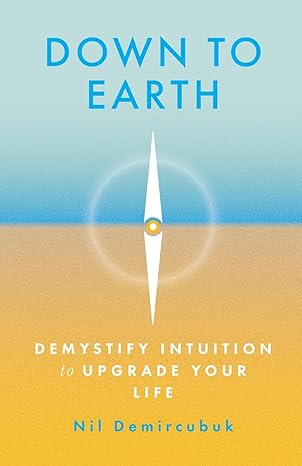
Down to Earth: Demystify Intuition to Upgrade Your Life is a thoughtful blend of personal stories, practical exercises, and scientific studies. Author Nil Demircubuk lays out intuition not as a mystical talent but as an everyday skill, one that we all carry yet often forget to use. The book moves step by step, first explaining what intuition is and how it shows up in daily life, then offering exercises to tune into it more deliberately. She mixes neuroscience and psychology research with approachable examples and even playful assignments, which makes the book read less like a lecture and more like a conversation with a wise friend.
Reading this book, I felt both reassured and challenged. I liked the way Demircubuk stripped intuition of its usual mysticism and treated it as something practical. Her writing has warmth, and the personal stories sprinkled throughout made the concepts come alive. I found myself nodding when she talked about ignoring gut feelings and regretting it later, because who hasn’t done that? At times, the research examples slowed me down, yet I appreciated that she backed up her claims with evidence rather than relying only on personal testimony. The mix of science and storytelling struck a nice balance, though occasionally I wished she had leaned harder into her own experiences, which were some of the most compelling parts.
What really surprised me was how usable the exercises were. I tried a couple of her journaling prompts, and to my surprise, they worked. I caught small flashes of intuition that I usually dismiss. The tone of the book is encouraging without being pushy, and it never once felt like she was talking down to me. The book reiterates the idea that intuition is accessible to everyone. The honesty of her voice and her clear care for the reader softened the delivery. It felt less like she was preaching and more like she was reminding me of something I already knew but had buried.
I’d recommend Down to Earth to anyone who feels stuck in overthinking or who second-guesses every decision. It’s especially suited for people who like a mix of science and spirituality but don’t want anything too airy. If you’re curious about intuition yet skeptical of mysticism, this book bridges the gap with warmth, practicality, and an open mind. It’s not a book to skim. It’s one to sit with, dog-ear, and revisit when you need a nudge back to yourself.
Pages: 205 | ASIN : B0FHX85T4J


