Blog Archives
Clarity

In Writing in the Wound, you share with readers what it means to be shaped by academia, gendered power, and migration, and how your reliance on music proved to be a method of rescue. Why was this an important book for you to write?
I began writing Writing in the Wound at a moment of profound emotional and political intensity in my life. After years of navigating the Canadian immigration system, I found myself confronting not only institutional barriers but also the deeper psychological and embodied impact of living within them.
Initially, I considered writing a more overtly critical, policy-driven book—one that directly addressed the failures and frustrations of the immigration system. But I realized that such a project would take me away from my core as an artist.
What felt more urgent was to write from within my own lived experience—through sound, memory, and relationship. This book became a way of tracing how I endured, and what allowed me to stay. In that sense, it is not only a story of struggle, but of artistic becoming.
In its early drafts, the manuscript was expansive and uncontained. Over time, it found its center—particularly through my relationship with my mentor, which offered a space of care, listening, and growth. That relational grounding became essential to shaping the narrative.
Ultimately, this book created a new path for me—a path where I was no longer masking who I am or what I am enduring within this system. It allowed me to situate myself clearly as an artist, while also naming the conditions I was navigating.
I wrote this book not just to document what happened, but to understand how one continues to create, even within systems that constrain and wound.
Music appears as discipline, refuge, and language—when did it become central to your survival?
Music became central to my survival during the uncertainty of the COVID-19 period. After serving as Music Faculty for Semester at Sea, I travelled to Karachi due to the pandemic and found myself unexpectedly unable to return to Canada for nearly two years, at a time when institutions were largely closed and opportunities had disappeared.
In that period of precarity, when academic institutions had stopped hiring faculty, and it was difficult to teach remotely from where I was situated, music shifted from being a practice of expression to a practice of sustenance. Earlier compositions, like Anticipating and Living with Purpose, had received recognition on international charts and in competitions, which gave me the confidence to continue applying for opportunities. Then, Perils of Heavy Rainfall received Second Prize in Listening during COVID contest (2020).
Gradually, commissions and invitations followed, including from organizations such as New Music Edmonton and New Music Calgary, as well as from the International Women’s Day festival and the Canadian Music Week platform. What began as a fragile thread of continuity became, over time, a means of survival—both materially and emotionally.
Was there a moment when you felt your voice shifting—from survival to assertion?
Yes—there was a moment when everything I had been experiencing condensed into a single, clear sentence: that after 17 years in Canada, I still did not have permanent residency, and that this was not incidental, but tied to the structural limitations of the immigration system.
This clarity came to me in July, during a later stage of working on Writing in the Wound. By that point, the writing had begun to settle, and I was able to see my experience not only as something I had lived through but as something I could name with precision.
Being able to name that so directly marked a shift for me. Until then, much of my writing had been about processing and surviving. But that sentence became a position—it allowed me to see my experience not as an individual struggle, but as part of a broader systemic pattern.
Around that time, I also began to explore new pathways within the immigration system, including applying on humanitarian and compassionate grounds. That process required me to articulate my story not only as narrative, but as a formal claim—something that could be recognized within institutional frameworks. In that sense, my voice was no longer only expressive; it became strategic and assertive.
This shift was also reflected in how my work moved into public space. My writing on the undervaluation of artistic labour was published in Canadian Dimension, and I began sharing my story in community settings, including an event with Action Dignity. Speaking in those spaces—where these issues are often not centered—felt like an important act of bringing lived experience into public discourse.
That momentum continued with invitations to speak at larger gatherings, including a Labour Day event, where my story was witnessed by a wide network of community organizations.
In that sense, assertion was not a single moment, but a series of acts—each one moving my voice from private endurance toward public articulation and advocacy.
What is one thing you hope readers take away from Writing in the Wound?
At its heart, the book asks: what happens when our scars begin to speak?
I hope readers come away with a deeper recognition that the wound is not only personal, but structural. Experiences of migration, racialization, and institutional struggle are not simply endured—they also carry strength, insight, and endurance. They shape ways of seeing, feeling, and creating that are often overlooked or undervalued.
For those navigating migration and racialization, these experiences are frequently internalized, fragmented, or rendered invisible. This book is an attempt to give them form—to show that what is carried in the body and in memory can become voice.
If there is one thing I hope readers take away, it is that these experiences are not only sites of injury, but also sites of knowledge. When scars begin to speak, they do more than tell a story—they begin to name the structures that produced them, and in doing so, open the possibility of shifting those systems—and one’s positionality within them.
Author Links: GoodReads | X (Twitter) | Facebook | Website | Amazon
For Dr. Shumaila Hemani, music began as a calling. It unfolded into a life path through a rare human connection with eminent ethnomusicologist Professor Regula Burckhardt Qureshi, whose faith in her awakened the courage to risk everything for the artist’s path.
Spanning nearly two decades — from 2006 to the present — across the academic corridors of Harvard and the University of Alberta to the soundscapes of London, Boston, Chicago, Edmonton, Mumbai, Karachi, Calgary, Banff, and Toronto, and a world odyssey aboard a floating campus, Writing in the Wound is a story of resilience and fragile belonging, of visibility and erasure, and of the power of art — in particular Sufi music — to transmute pain into wisdom.
It is an intimate testament to truth and vulnerability in the face of institutional silencing, immigration precarity, and the long endurance toward permanent belonging.
Writing in the Wound: Acculturation, Trauma, and Music
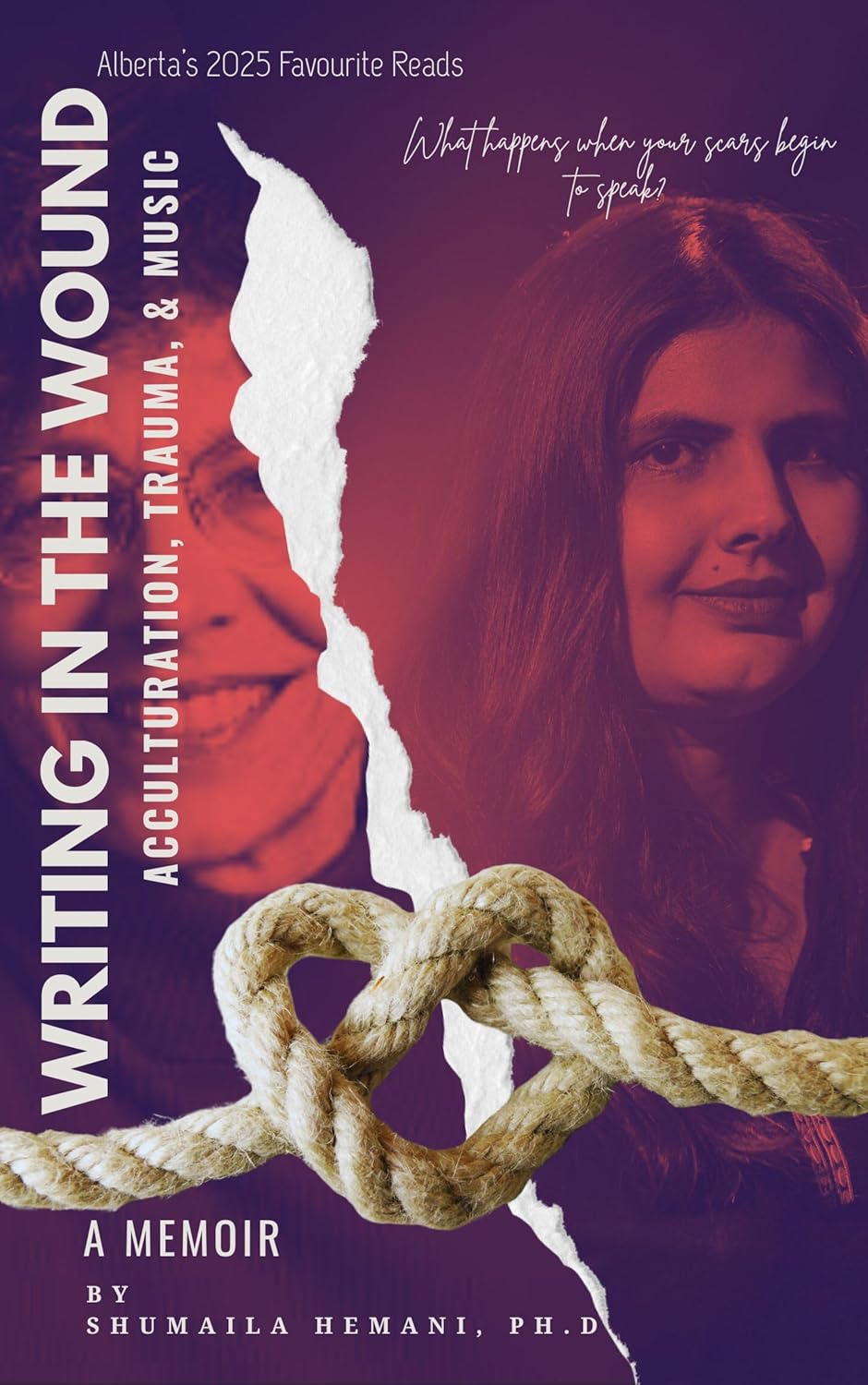

Writing in the Wound is a memoir about what it means to be shaped and repeatedly injured by migration, academia, gendered power, and the long bureaucratic violence of immigration precarity, while still refusing to let art go mute. Author Shumaila Hemani traces that struggle across Karachi, London, Edmonton, Harvard, Banff, Calgary, and beyond, returning again and again to music as both discipline and rescue. What stayed with me most was the book’s insistence that the “wound” is not just a private sorrow but a structural fact, something lived in the body and sharpened by institutions, and that song can become not a cure exactly, but a way of bearing truth without surrendering to it. Scenes like the freezing Alberta night when she seeks refuge in a restaurant lobby, her charged decision between Chicago and Harvard, and the later episodes of artistic endurance under precarity give the memoir a real narrative pulse beneath its reflective surface.
What I admired most was the book’s emotional candor and the seriousness with which it treats art. Hemani writes as if sound were breath, shelter, lineage, prayer, argument, and last defense all at once. I found that deeply moving. Some of the strongest passages are the ones where sensory memory and intellectual reflection fuse cleanly: Karachi’s street sounds and household textures, the strange thrill of hearing the theremin in London, the feeling of Cambridge as a place that “held” her differently, the sea storms aboard the World Odyssey, the pink-moon stillness that arrives after so much psychic abrasion. The prose can be overtly lyrical, but for me, that ambition is mostly earned because it rises from lived intensity rather than decorative flourish.
Its ideas are forceful and, at their best, unsettling. Hemani’s central claim that exclusion is often discussed in abstract policy language while its damage is absorbed by actual bodies felt painfully persuasive. The memoir is strongest when it shows that argument rather than merely stating it: in the humiliations of school and class performance, in the uneasy academic encounters where she feels reduced to a gap to be filled rather than a mind to be met, in the grinding absurdity of years of achievement that still do not translate into belonging. There were moments when I wanted a bit more compression, because the book sometimes circles its pain. But even that repetition began to make sense to me as part of the memoir’s design. Trauma here is not tidy, and Hemani refuses to fake tidiness for the reader’s comfort. I respected that.
I found Writing in the Wound arresting, thought-provoking, and fiercely alive. It’s a memoir that believes art can carry knowledge that institutions cannot properly hear, and that belief gives the whole book its tensile strength. It keeps faith with fracture while still making room for beauty, devotion, and survival. I’d recommend it especially to readers drawn to memoirs of migration, music, trauma, and intellectual becoming, and to anyone interested in how a life in art can be both exalted and terribly precarious.
Pages: 290 | ASIN : B0FVQB8XGV



