Blog Archives
Held in the Vanishing


Ti Mougne’s Held in the Vanishing is an intimate memoir about caring for two parents whose lives are being altered by different forms of dementia. Her father has Alzheimer’s disease, while her mother has Primary Progressive Aphasia, which gradually takes away her ability to understand and use language. Mougne writes from the complicated middle of this experience, where caregiving, marriage, parenting, work, and grief all occupy the same crowded space. Early in the book, she explains its purpose with striking simplicity: “Stories don’t offer maps. They offer companionship.” That idea shapes everything that follows.
The memoir begins with the lively multigenerational home Mougne created with her husband, son, and parents. Holiday dinners, elaborate parties, piano lessons, bad jokes, pets, and familiar household sounds give the reader a clear sense of what the family shared before dementia began changing its rhythms. This attention to ordinary life matters because it gives every later loss a history. Her parents aren’t presented only through their diagnoses. They’re a devoted couple who dance at their fiftieth-anniversary celebration, a mother who loves Halloween, and a father whose trusting nature becomes dangerous when Alzheimer’s damages his judgment. The warmth of these memories keeps the story grounded in people rather than conditions.
Mougne is especially perceptive about the work of caregiving that happens beyond public view. She describes the constant calculations involving medications, finances, safety, housing, dignity, and medical care, along with the guilt that seems to attach itself to every decision. She also examines how that responsibility affects her husband and son, and she’s candid about the anger, numbness, resentment, and exhaustion she carries. One of the book’s most honest insights is that “Sometimes love is nothing more than showing up again tomorrow.” Here, love often takes the form of gluten-free toast, a corrected television setting, a difficult phone call, or another visit after an emotionally bruising day.
The book’s short chapters and spacious, line-broken prose give it the feel of a memoir written partly through poetry. That style suits Mougne’s subject because dementia rarely unfolds as a smooth narrative. It arrives through fragments, repetitions, silences, brief recoveries, and sudden recognitions. Concrete images, including vanished ducklings, clouds admired from a car window, weekly margaritas, lightning bugs in a jar, and an empty road across the prairie, carry much of the emotional meaning. The later chapters turn inward as Mougne considers the identity she built around being a “good daughter” and begins finding a version of care that allows her to remain present without erasing herself.
Held in the Vanishing is a memoir about how love changes when memory, language, independence, and familiar family roles begin slipping away. It holds tenderness and frustration together without forcing either into a comforting conclusion. Mougne’s parents continue to decline, difficult choices continue to surface, and her understanding of herself continues to evolve. What gives the book its power is its close attention to what remains: humor, ritual, touch, shared meals, flashes of recognition, and the decision to stay connected even when connection has to take a new form. It’s a deeply personal account, but its emotional clarity makes the experience feel shared.
Pages: 151 | ASIN : B0H6N8CGHC

My Pretty Baby: Seeking Truth and Finding Healing
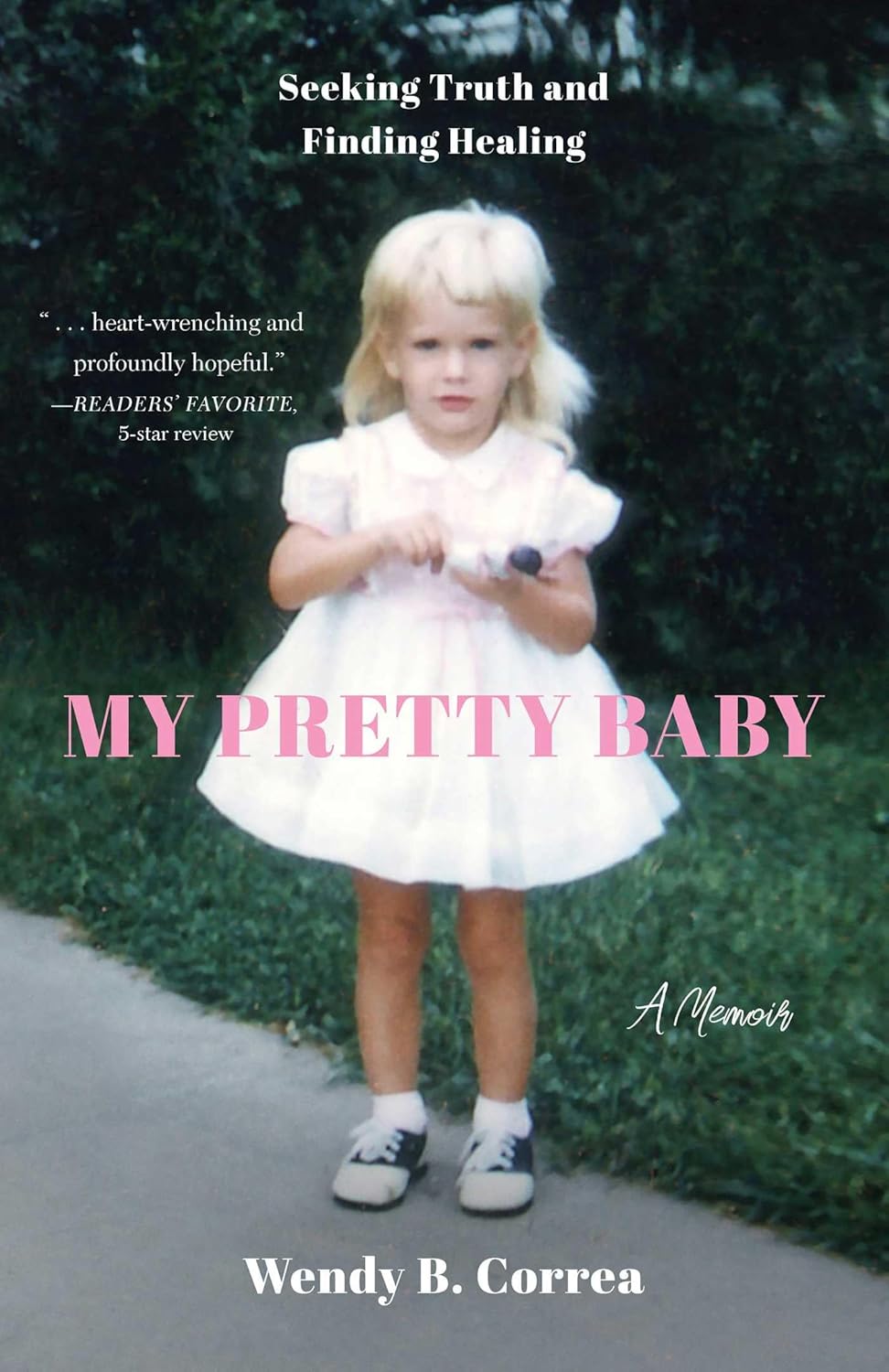

My Pretty Baby is Wendy B. Correa’s tender and searching memoir about growing up inside loss, neglect, alcoholism, and family secrecy, then spending a lifetime trying to turn that pain into understanding. The book begins with a child’s bewildered grief after her father’s death, deepens through her mother’s relationship with a volatile alcoholic stepfather, and follows Wendy into music, Buddhism, therapy, sobriety, Native American ceremony, yoga, motherhood, and marriage. Along the way, she brushes against extraordinary cultural moments, from the Beatles on Ed Sullivan to Joni Mitchell’s living room to Aspen and Hunter S. Thompson, but the real heartbeat of the book is quieter and more intimate. It’s the lifelong question beneath everything: what happened to my family, and how do I survive what I inherited?
What moved me most was how vividly Correa writes from inside the body of her younger self. She doesn’t just tell us she was afraid, she lets us feel the air leave the room. The closing of her father’s casket, the stench of carnations, the Christmas tree hurled to the floor, the child trying to protect her mother from a man who has become suddenly terrifying, these scenes have a terrible immediacy. I admired the way she keeps returning to sensory memory without making it ornamental. Smell, music, weather, smoke, lilacs, cold water, mountain air, all of it becomes part of the emotional architecture. Sometimes the book’s detail is almost overwhelming, but I think that’s also part of its honesty. Trauma doesn’t arrive in tidy summaries. It comes back as fragments, textures, songs, rooms, and smells you can’t quite wash out of your mind.
Correa is writing about healing, but she’s not selling some glossy version of transcendence. Her Buddhism, AA meetings, therapy, sweat lodges, vision quest, yoga, and eventual work with birth and body care all feel like attempts to live more fully inside a self that was once trained to disappear. I liked that the book allows love and anger to coexist, especially in her complicated feelings about Paul, who is frightening and damaging, yet also later tender with her son Mateo. That moral grayness gives the memoir real weight. The final DNA revelations could have felt melodramatic in another writer’s hands. Here, they feel like the last hidden door opening in a house she’s been wandering through all her life.
By the end, I felt that My Pretty Baby had earned its hope. It carries the sprawl of a real life, with its repetitions, ruptures, misreadings, longings, and late-arriving mercies. Correa’s writing is most powerful when she trusts the lived scene and lets the ache speak for itself, and her central idea feels hard-won: the truth may not repair the past, but it can finally let a person breathe. I’d recommend this book to readers who appreciate intimate memoirs about family trauma, recovery, spiritual seeking, complicated forgiveness, and the slow, brave work of becoming whole.
Pages: 318 | ASIN : B0DWNGSF4P
Hope and a Greater Compassion

In The Momma Puzzle. you share the childhood memories, stories from relatives, and letters that shape your experiences over decades of trying to understand your mother who died by suicide when you were a young girl. What inspired you to share your story with readers?
Ever since my mother died, I knew that I wanted to write a book about her. But I was warned as a child never to talk about her suicide. Through the weight of that secrecy and taboo and repression, I sensed there was an important story there to tell.
I wanted to tell Momma’s story in a way that would allow readers to see her as a human being, not merely as a terrible person, or a bad mother, or some kind of monster.
As a writer, and as her daughter, I was also embarking on a journey, through the process of writing the book, to discover as much as I could about who she had been and why she had to die in the way that she did.
How did your understanding of your mother change as you moved through letters, photographs, and medical records?
Since this is a memoir, the characters are, or were, real people. But for the purposes of writing the book and telling a story, these real people become created characters. I try to stay as close to the truth as possible, though, and use the process of writing to get even closer to the truth—even to create truth along with meaning, which gets at the value of art.
The character of Momma first appears as a young woman in the 1950s—the fresh, young, enthusiastic, adventurous college student who departs for a job in Saigon as a foreign service secretary. Through letters home to her best friend, and to my future father, Momma keenly observes life and politics in Vietnam; later she’s a newlywed, soon with one child, then two (the younger of whom was me); then comes her downward spiral toward suicide.
The character of the narrator (based on myself) is at first full of questions about Momma, and by the end reaches some understanding of who Momma had been, that her struggles were set in motion long before the narrator (I) was conceived.
Did writing the memoir change any of your relationships with surviving family members?
My relationships with my surviving family members have either improved or are stable/ unchanged since writing my memoir.
What is one thing you hope readers take away from your memoir?
I hope readers will take away hope and a greater compassion for people who die by suicide.
Author Links: GoodReads | Facebook | Website | Amazon
Rabbi, Your Cleavage is Showing

Rabbi, Your Cleavage Is Showing follows Mikki Mendelsohn’s life from a cold, silent childhood on the twenty-sixth floor of a Manhattan hotel, through a sudden flight to Israel during the 1967 war, where she served as a lone soldier in the paratroopers’ entertainment corps, to her groundbreaking ordination as one of the first female rabbis in America. It’s a story about the fierce, non-linear search for community by someone who was routinely made to feel like an outsider, whether by her own parents or by a male-dominated religious establishment. She simply didn’t fit the mold. Mendelsohn unspools her memories with a blunt, refreshing honesty, offering a rare glimpse into the grit required to shatter glass ceilings when the rest of the world is desperately trying to keep them intact.
What I liked most about the narrative is how beautifully the writing captures the raw friction of her early years without ever sliding into self-pity. Her recollections of a smoke-filled childhood, where love was a scarce commodity and locking herself in a bathroom to read War and Peace was a survival mechanism, carry a haunting, sensory resonance. There’s a sharp, rhythmic burstiness to her prose when she describes the shift from Manhattan’s relative luxury to the dusty realities of kibbutz life. The transition is jarring. I was particularly moved by her account of seeing a blue Auschwitz tattoo on a waitress’s arm in a Jerusalem café, a moment she writes about with a quiet, devastating reverence that completely sidesteps melodrama. Her style alternates between the brisk pace of a seasoned storyteller and the rich, reflective pauses of a poet, allowing the reader to feel the literal heat of a Sinai sandstorm or the terrifying silence of a trench during an unexpected mortar attack.
The ideas driving the latter half of the book are equally compelling, particularly her nuanced examination of faith intersecting with a deeply entrenched systemic misogyny. She doesn’t filter the indignities she faced as a female pioneer in the rabbinate, recounting everything from petty comments about her appearance to a harrowing assault by a senior colleague with a stark, unsettling clarity. It’s heavy material. Yet, what prevents the book from becoming an unremitting chronicle of trauma is her brilliant deployment of Yiddish humor and an unyielding devotion to the core text of her heritage. When she juxtaposes the absurdity of working as a go-go dancer or delivering singing telegrams with her ultimate desire to teach Torah, she reveals a remarkably resilient spirit. I appreciate that she acknowledges her own flaws and early naivete, making her critique of the religious establishment feel balanced, authentic, and profoundly human rather than merely bitter.
Rabbi, Your Cleavage Is Showing functions as an intimate and beautifully textured look at a life forged through sheer resilience and a refusal to be compartmentalized. Mendelsohn’s voice is assured and warm, carrying the wisdom of someone who has wrestled with both holy scriptures and the messy, often cruel realities of human nature. This book is a wonderful fit for anyone interested in feminist history, Jewish studies, or simply a beautifully told story of personal reinvention. It reminds us that spiritual leadership isn’t about conforming to a pre-packaged mold, but about having the courage to show up exactly as you are.
Pages: 295 | ASIN : B0GKZCKML3
Growing Up in Rural Louisiana: A Memoir
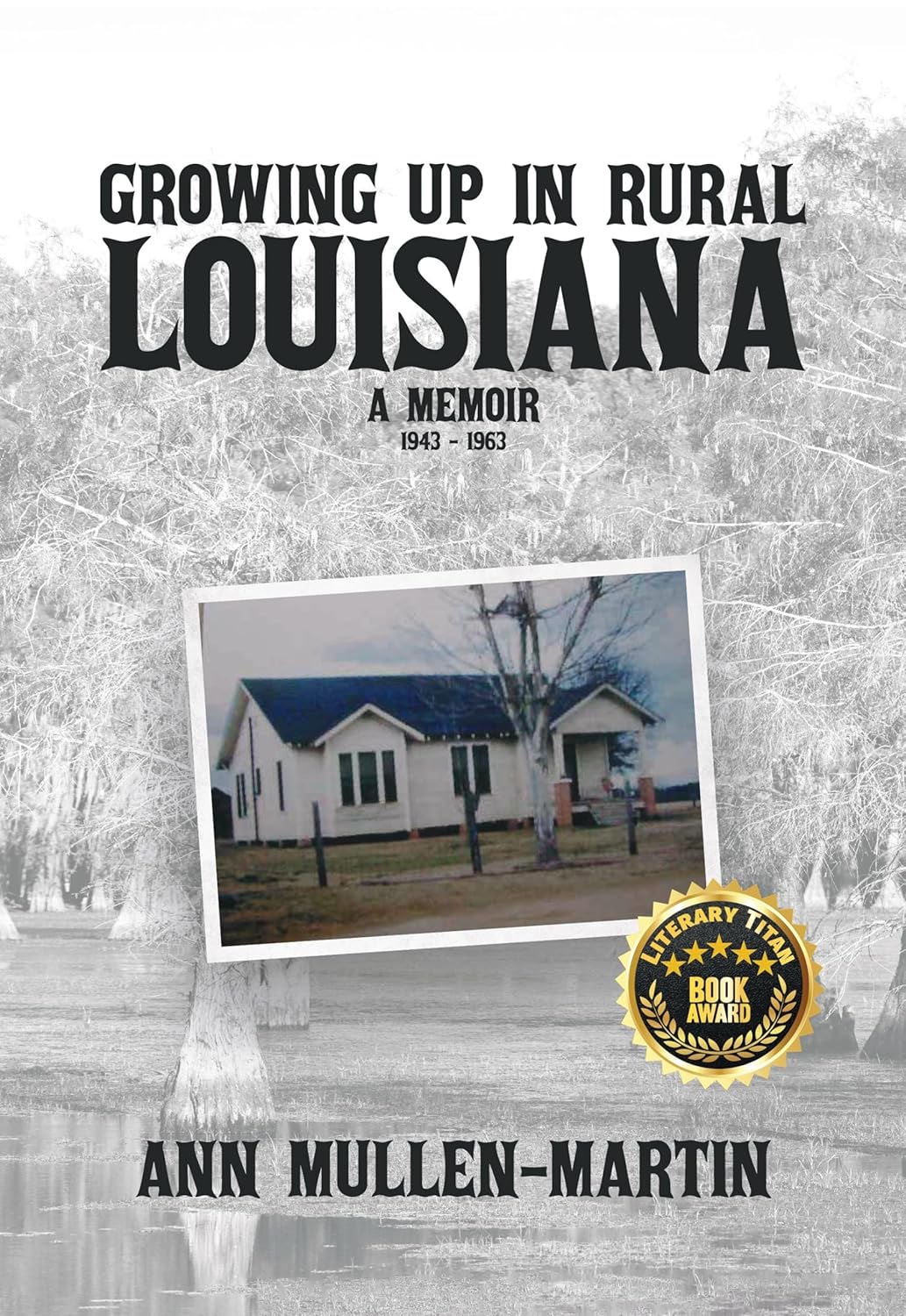
Growing Up in Rural Louisiana is Ann Mullen-Martin’s memoir of a girlhood shaped by family devotion, poverty without self-pity, religious feeling, rural custom, and the long shadow of segregation in mid-century Tioga, Louisiana. The book follows her from a childhood in a three-room shotgun house through school, grief, work, and the first stirrings of independence, until she leaves for Dallas carrying both the tenderness and the damage of what made her.
What I found most compelling is that the memoir does not merely catalogue events; it preserves a whole vanished atmosphere, creosoted walls, gravel roads, coffee at the kitchen table, railroad rhythms, and a community so small it could feel protective one minute and morally blinkered the next.
What stayed with me most was the book’s emotional grain. Mullen-Martin writes with a candor that gives the strongest scenes their force: the tornado remembered through a mother’s improvisational courage, the family’s move to the “big house on the hill,” the talismanic vase that gathers memory around it, and the raw, almost childlike terror of being sent to school and separated from her mother. None of this is dressed up into false lyricism; the feeling arrives honestly, and because of that, it lands hard. I admired the way ordinary objects and episodes accrue meaning over time. A vase is never just a vase here, and a report card is never just a report card. The book understands, in a way many memoirs do not, that childhood is not small just because it is young.
I also appreciated that the memoir is willing to look directly at the moral weather of its setting. Early on, the narrator names the racism around her with disarming clarity, including her father’s defense of segregation and her own adolescent absorption in a culture of “separate but equal.” That refusal to varnish the past gives the book more backbone than a merely nostalgic remembrance would have had. At times, the prose can be repetitive, and the book’s sheer length asks for patience, but even that excess feels connected to its deepest impulse: to save people and moments from being lost. I never had the sense that the author was performing wisdom after the fact; instead, I felt her trying to tell the truth as fully as memory permits, including where memory implicates her world and her younger self.
I’d recommend this book to readers of memoirs, family history, coming-of-age stories, autobiographical history, and inspirational life writing, especially those drawn to women’s lived history, rural life, faith, and intergenerational memory. It will likely appeal to readers who respond to Jeannette Walls, though this book is gentler in register and more regionally rooted, with less narrative flash and more porch-light intimacy. I came away feeling I had not simply read about a childhood, but briefly inhabited one. This memoir’s great gift is that it makes a modest life feel momentous without ever pretending it was anything else.
Pages: 553 | ASIN : B0DNNVFW6R
Clarity

In Writing in the Wound, you share with readers what it means to be shaped by academia, gendered power, and migration, and how your reliance on music proved to be a method of rescue. Why was this an important book for you to write?
I began writing Writing in the Wound at a moment of profound emotional and political intensity in my life. After years of navigating the Canadian immigration system, I found myself confronting not only institutional barriers but also the deeper psychological and embodied impact of living within them.
Initially, I considered writing a more overtly critical, policy-driven book—one that directly addressed the failures and frustrations of the immigration system. But I realized that such a project would take me away from my core as an artist.
What felt more urgent was to write from within my own lived experience—through sound, memory, and relationship. This book became a way of tracing how I endured, and what allowed me to stay. In that sense, it is not only a story of struggle, but of artistic becoming.
In its early drafts, the manuscript was expansive and uncontained. Over time, it found its center—particularly through my relationship with my mentor, which offered a space of care, listening, and growth. That relational grounding became essential to shaping the narrative.
Ultimately, this book created a new path for me—a path where I was no longer masking who I am or what I am enduring within this system. It allowed me to situate myself clearly as an artist, while also naming the conditions I was navigating.
I wrote this book not just to document what happened, but to understand how one continues to create, even within systems that constrain and wound.
Music appears as discipline, refuge, and language—when did it become central to your survival?
Music became central to my survival during the uncertainty of the COVID-19 period. After serving as Music Faculty for Semester at Sea, I travelled to Karachi due to the pandemic and found myself unexpectedly unable to return to Canada for nearly two years, at a time when institutions were largely closed and opportunities had disappeared.
In that period of precarity, when academic institutions had stopped hiring faculty, and it was difficult to teach remotely from where I was situated, music shifted from being a practice of expression to a practice of sustenance. Earlier compositions, like Anticipating and Living with Purpose, had received recognition on international charts and in competitions, which gave me the confidence to continue applying for opportunities. Then, Perils of Heavy Rainfall received Second Prize in Listening during COVID contest (2020).
Gradually, commissions and invitations followed, including from organizations such as New Music Edmonton and New Music Calgary, as well as from the International Women’s Day festival and the Canadian Music Week platform. What began as a fragile thread of continuity became, over time, a means of survival—both materially and emotionally.
Was there a moment when you felt your voice shifting—from survival to assertion?
Yes—there was a moment when everything I had been experiencing condensed into a single, clear sentence: that after 17 years in Canada, I still did not have permanent residency, and that this was not incidental, but tied to the structural limitations of the immigration system.
This clarity came to me in July, during a later stage of working on Writing in the Wound. By that point, the writing had begun to settle, and I was able to see my experience not only as something I had lived through but as something I could name with precision.
Being able to name that so directly marked a shift for me. Until then, much of my writing had been about processing and surviving. But that sentence became a position—it allowed me to see my experience not as an individual struggle, but as part of a broader systemic pattern.
Around that time, I also began to explore new pathways within the immigration system, including applying on humanitarian and compassionate grounds. That process required me to articulate my story not only as narrative, but as a formal claim—something that could be recognized within institutional frameworks. In that sense, my voice was no longer only expressive; it became strategic and assertive.
This shift was also reflected in how my work moved into public space. My writing on the undervaluation of artistic labour was published in Canadian Dimension, and I began sharing my story in community settings, including an event with Action Dignity. Speaking in those spaces—where these issues are often not centered—felt like an important act of bringing lived experience into public discourse.
That momentum continued with invitations to speak at larger gatherings, including a Labour Day event, where my story was witnessed by a wide network of community organizations.
In that sense, assertion was not a single moment, but a series of acts—each one moving my voice from private endurance toward public articulation and advocacy.
What is one thing you hope readers take away from Writing in the Wound?
At its heart, the book asks: what happens when our scars begin to speak?
I hope readers come away with a deeper recognition that the wound is not only personal, but structural. Experiences of migration, racialization, and institutional struggle are not simply endured—they also carry strength, insight, and endurance. They shape ways of seeing, feeling, and creating that are often overlooked or undervalued.
For those navigating migration and racialization, these experiences are frequently internalized, fragmented, or rendered invisible. This book is an attempt to give them form—to show that what is carried in the body and in memory can become voice.
If there is one thing I hope readers take away, it is that these experiences are not only sites of injury, but also sites of knowledge. When scars begin to speak, they do more than tell a story—they begin to name the structures that produced them, and in doing so, open the possibility of shifting those systems—and one’s positionality within them.
Author Links: GoodReads | X (Twitter) | Facebook | Website | Amazon
For Dr. Shumaila Hemani, music began as a calling. It unfolded into a life path through a rare human connection with eminent ethnomusicologist Professor Regula Burckhardt Qureshi, whose faith in her awakened the courage to risk everything for the artist’s path.
Spanning nearly two decades — from 2006 to the present — across the academic corridors of Harvard and the University of Alberta to the soundscapes of London, Boston, Chicago, Edmonton, Mumbai, Karachi, Calgary, Banff, and Toronto, and a world odyssey aboard a floating campus, Writing in the Wound is a story of resilience and fragile belonging, of visibility and erasure, and of the power of art — in particular Sufi music — to transmute pain into wisdom.
It is an intimate testament to truth and vulnerability in the face of institutional silencing, immigration precarity, and the long endurance toward permanent belonging.
Writing in the Wound: Acculturation, Trauma, and Music
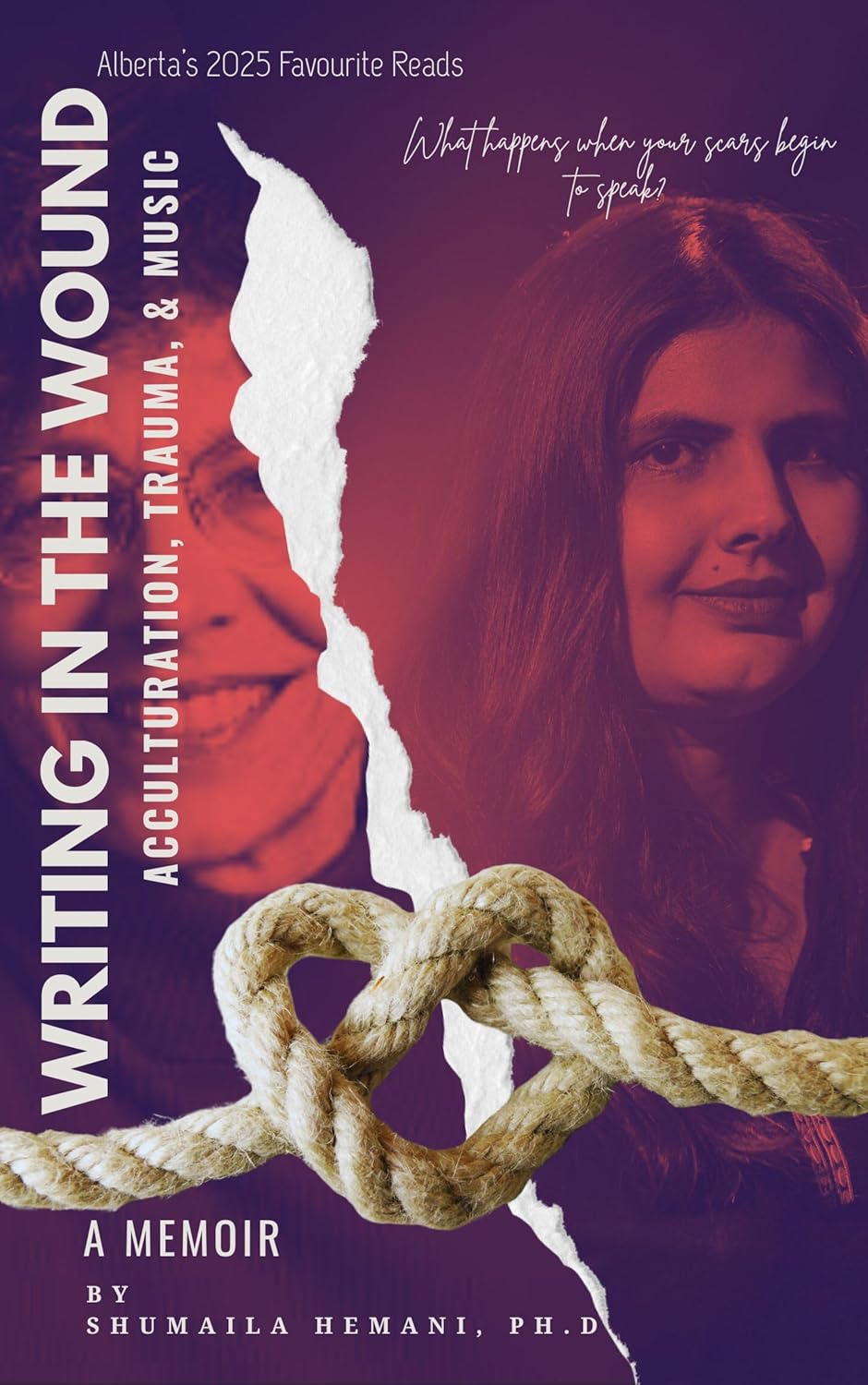
Writing in the Wound is a memoir about what it means to be shaped and repeatedly injured by migration, academia, gendered power, and the long bureaucratic violence of immigration precarity, while still refusing to let art go mute. Author Shumaila Hemani traces that struggle across Karachi, London, Edmonton, Harvard, Banff, Calgary, and beyond, returning again and again to music as both discipline and rescue. What stayed with me most was the book’s insistence that the “wound” is not just a private sorrow but a structural fact, something lived in the body and sharpened by institutions, and that song can become not a cure exactly, but a way of bearing truth without surrendering to it. Scenes like the freezing Alberta night when she seeks refuge in a restaurant lobby, her charged decision between Chicago and Harvard, and the later episodes of artistic endurance under precarity give the memoir a real narrative pulse beneath its reflective surface.
What I admired most was the book’s emotional candor and the seriousness with which it treats art. Hemani writes as if sound were breath, shelter, lineage, prayer, argument, and last defense all at once. I found that deeply moving. Some of the strongest passages are the ones where sensory memory and intellectual reflection fuse cleanly: Karachi’s street sounds and household textures, the strange thrill of hearing the theremin in London, the feeling of Cambridge as a place that “held” her differently, the sea storms aboard the World Odyssey, the pink-moon stillness that arrives after so much psychic abrasion. The prose can be overtly lyrical, but for me, that ambition is mostly earned because it rises from lived intensity rather than decorative flourish.
Its ideas are forceful and, at their best, unsettling. Hemani’s central claim that exclusion is often discussed in abstract policy language while its damage is absorbed by actual bodies felt painfully persuasive. The memoir is strongest when it shows that argument rather than merely stating it: in the humiliations of school and class performance, in the uneasy academic encounters where she feels reduced to a gap to be filled rather than a mind to be met, in the grinding absurdity of years of achievement that still do not translate into belonging. There were moments when I wanted a bit more compression, because the book sometimes circles its pain. But even that repetition began to make sense to me as part of the memoir’s design. Trauma here is not tidy, and Hemani refuses to fake tidiness for the reader’s comfort. I respected that.
I found Writing in the Wound arresting, thought-provoking, and fiercely alive. It’s a memoir that believes art can carry knowledge that institutions cannot properly hear, and that belief gives the whole book its tensile strength. It keeps faith with fracture while still making room for beauty, devotion, and survival. I’d recommend it especially to readers drawn to memoirs of migration, music, trauma, and intellectual becoming, and to anyone interested in how a life in art can be both exalted and terribly precarious.
Pages: 290 | ASIN : B0FVQB8XGV
Through Her Eyes: A Memoir of Purpose and Courage
Through Her Eyes follows Jennifer Gauthier as she grows from a noisy, painful childhood into the role of founder and CEO of a nonprofit that centers healing, youth, and community. The book moves through her early years in a home shaped by addiction, her teenage pregnancy, homelessness, and single motherhood, then into her spiritual searching, discovery of Sufism, and her work as a mentor and leader. Along the way, she keeps circling one core message. Your story is yours to claim, even if the first chapters were written by other people.
I felt her voice first, more than any single scene. The writing is direct and chatty, like a friend talking with no filter. She warns you early that she is “that person” who talks to strangers in line and laughs too loud, and the prose matches that energy. I liked that she keeps the language simple and straight. She uses a lot of short, punchy lines, and she often drops into story mode with “Throwback” sections that read like spoken-word pieces. That style pulled me in. I could almost hear her accent, see her hands moving while she talked. She jumps from memory to lesson to side story in quick turns, and sometimes I wanted a bit more shape or pause, a little more space to sit with one scene before we moved on to the next.
Emotionally, the book hit me hardest when she wrote about addiction, codependency, and the way a child tries to manage a house that feels unstable. Her honesty about wanting her father to die, then shifting into years of praying for him to live sober, landed with real weight. There is no polish on those parts, and I appreciated that. I also liked her insistence on personal responsibility without erasing systems and trauma. She talks about racism, privilege, generational patterns, and spiritual harm, and still looks straight at herself and asks, “What can I control today.” I would have liked more direct talk about structural barriers, especially given her work with underserved communities. Even so, the through-line of “I will not stay stuck” felt honest to her story and background.
I walked away feeling like I had spent time with a real person, not a polished brand. The book would be a strong fit for readers who grew up around addiction, teen parents, people who have experienced trauma and are now ready to look at it, and anyone in social work, education, or youth programs who wants a reminder of what their clients might be carrying. It will also speak to women building something from scratch in midlife, especially those who feel “too loud” or “too much.” If you want a raw, talky, spiritually curious, no-nonsense story from someone who has actually had to claw her way forward, I recommend Through Her Eyes.
Pages: 228 | ASIN : B0GCFCTHLL



