Blog Archives
What Defines Us As Human

The Dark Side of Dreams follows a woman who resurrects her grandfather’s mind to expose a corrupted digital afterlife built on power, memory, and control. What was the inspiration for the setup of your story?
The Dark Side of Dreams is the stand-alone sequel to Babylon Dreams. Corporate greed and the influence of technology on government are central themes, but the most important questions are what defines us as human and how we see ourselves. The first book was a character study of Gunter Holden, who uploaded himself to his custom digital paradise, Bali Hai, only to face corporate erasure. Unlike Gunter, his granddaughter Mira never imagines a perfect world. When she learns Gunter made a copy of his mind before his deletion, she is determined to find it. Using a device that records and replays her dreams, she finds a clue leading to this hidden copy. When she uploads him to the desolate VR landscape of Shemathra’s Realm, they both risk terrible consequences. In exchange for his help, Mira promises to tell Gunter the truth about the past he never lived.
Mira is ambitious, driven, and morally complex. How did you shape her as the emotional center of the novel?
Both Gunter and Mira grew up without mothers, but while Gunter avoided those memories, Mira secretly hopes hers is still alive. Mira was a lonely child, rejected by her adopted family and neglected by her distant father, leading her to yearn for an identity based on family. Discovering her grandfather was Gunter Holden, the pioneer of the after-death industry, she becomes determined to reclaim his stolen company, VEI, from the corporation SEINI. Her relationship with Gunter is complex; she initially bullies and threatens him to get his cooperation, appearing to him as an AI through a high-tech garment. However, her love for her partner Henry and her deep yearning for connection eventually transform her relationship with her grandfather from one of threats to genuine care.
What first inspired the idea of a corporate-controlled digital afterlife, and how did you approach building a world where death is optional but still deeply unequal?
I was originally inspired by an article on mind-uploading by futurist Ray Kurzweil, which described uploading a mind copy to a VR world. Coming from a background in film production, I was already familiar with “manufactured reality”. I became intrigued by the aftermath of such technology—what happens when life (digital) goes on after the initial choices are made? In the novel, the digital afterlife is a lucrative industry with cutting-edge “paradise” add-ons for the wealthy and “economy plans” for others. This begets new laws and complications, creating a world where even death is subject to inequality.
What is the next book that you are working on, and when can your fans expect it to be out?
As I wrote Mira’s story, I wanted to know how mind-uploading technology changed the outside world. As her story resolved, I was intrigued by characters that waited quietly in the corners—androids with human mind-uploads. Will humanity stretch to meet and accept a new version of ourselves? Prejudices, fears, and conflict are inevitable, but I’m exploring what else might happen. I won’t know for sure until I’m closer to finishing Dream Voyagers, which I expect to be out in the Spring of 2027. I like to stop and look at the world I’m imagining.
Author Links: Website | Amazon
In the high-stakes business of after-death virtual reality, who protects the vulnerable? To escape a digital hellscape of his own making, Gunter Holden—a pioneer of the industry—once chose deletion. A century later, his descendant Mira discovers a preserved copy of his mind-upload.
Mira is convinced her grandfather’s empire was stolen and is determined to reclaim it. But Shemathra is no paradise; citizens must pay tribute to a ruthless Goddess or face agonizing deletion. To expose the systemic violations of VR law, Mira re-uploads Gunter into this blighted, privatized heaven. To earn his freedom, Gunter must witness and record the unspeakable crimes occurring within the system he helped create.
As he wanders a landscape of stolen memories and digital trauma, Gunter strives for a moral awakening. In a future that feels both unsettling and deeply human, will it be enough to save them both?
The Dark Side of Dreams
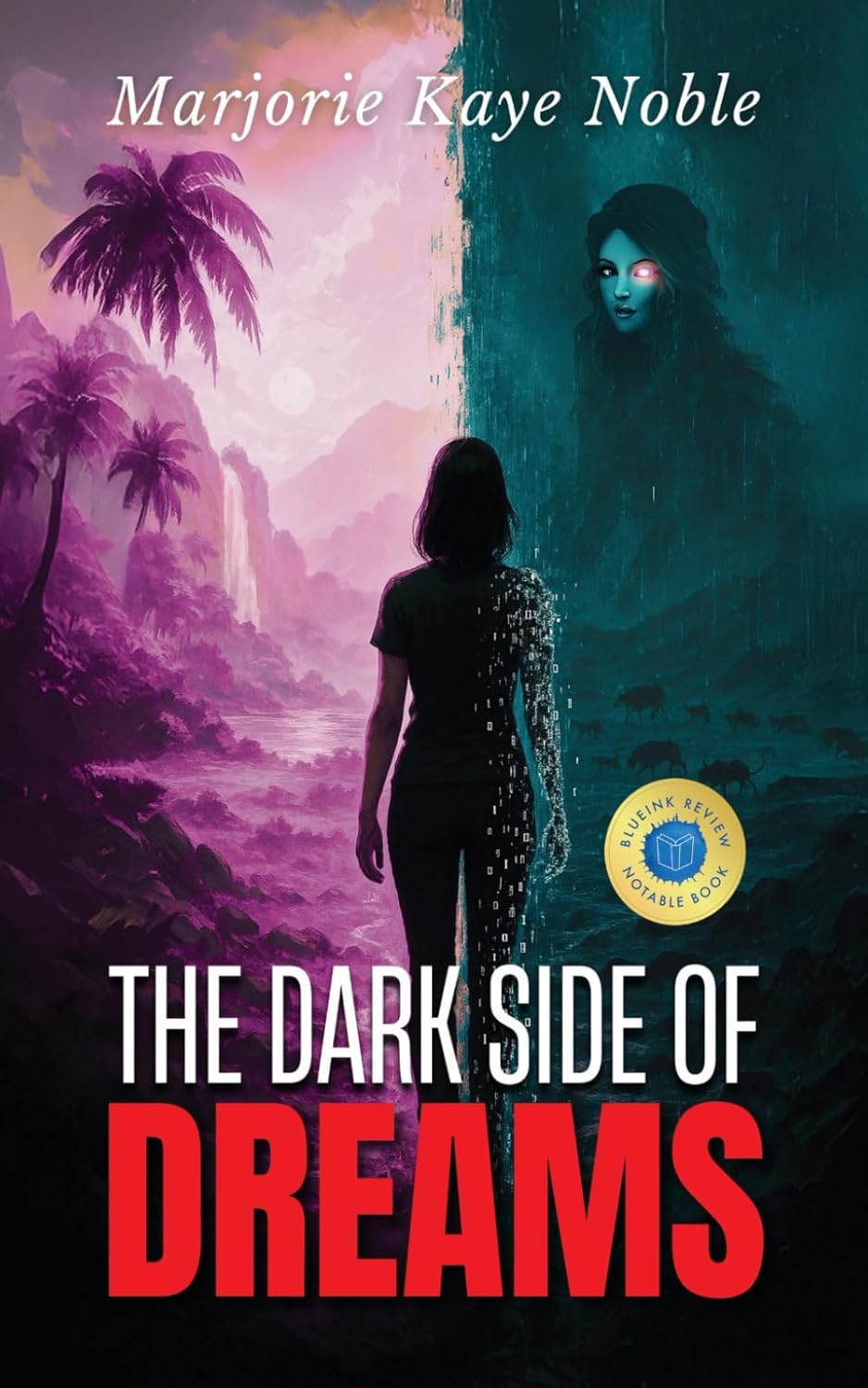

The Dark Side of Dreams is a big, idea-heavy science fiction novel that still knows how to move. It drops the reader into a future where after-death virtual reality has become its own battleground of corporate greed, surveillance, inheritance, and identity, and it does so through Mira Patel, a woman trying to outmaneuver a brutal system from the inside. What makes the book compelling is that it’s not built around a single gimmick. It’s a story about who gets to shape reality, who gets erased from it, and what happens when family legacy becomes both a weapon and a burden. The setup alone, with Mira uncovering a hidden copy of her grandfather Gunter Holden and using it to challenge the nightmare realm that grew out of his lost empire, gives the novel a strong pulse from the start.
What really gives the book its identity, though, is its world. Author Marjorie Noble doesn’t treat the future as sleek wallpaper. She fills it with clutter, relics, memory tech, corrupted paradise programs, and the unnerving logic of a digital afterlife run like bad infrastructure. That contrast is one of the book’s best qualities. A closet full of artifacts can matter as much as a virtual domain, and a line like “Not every search is an adventure. Some things want to be found.” lands because it captures the novel’s whole mood: discovery here is never clean, and the past is never truly past. The world feels layered rather than decorative, and that gives the story a lived-in strangeness that sticks.
Mira is also the right center for this book. She’s ambitious, wounded, stubborn, and often sharper than the people around her, but she’s not flattened into a stock rebel heroine. Her connection to Gunter Holden gives the novel one of its most interesting tensions. She wants justice, power, and restoration, but she’s also drawn to the same force of will that made him dangerous. That family resemblance gives the story real energy. Gunter’s presence as both ancestor and digital copy turns the novel into something more interesting than a standard fight against a villain. It becomes a conversation across generations about responsibility, ego, and reinvention.
The book’s style can be dense, but in a way that suits what it’s trying to do. Noble likes layering plot threads, histories, and invented systems, and the result is a novel that asks the reader to stay alert. Still, there’s an emotional thread running under all the tech and intrigue that keeps it human. Even in the middle of all the schemes, copies, and virtual punishments, the book keeps circling back to longing, grief, and the need to be seen clearly by someone else.
The Dark Side of Dreams is a thoughtful, dramatic, highly imaginative novel about power over memory and life after death. It’s a cybernetic family saga, a corporate dystopia, and a haunted inheritance story all at once. What I liked most is that it keeps its attention on what kind of world is being built and who gets trapped inside it. Noble clearly has a lot on her mind, but the book doesn’t feel abstract. It feels personal. That’s why the novel works. For all its virtual architecture and speculative machinery, it’s really about people trying to reclaim authorship over their lives, their dead, and their dreams.
Pages: 341 | ASIN : B0FYR41ZTM



