Blog Archives
Killing Time


Killing Time is a dark and inventive crime thriller that brings Jack the Ripper into a future where death doesn’t necessarily mean escaping justice. Thanks to a revolutionary technique called Awakening, people can recover memories of their previous lives, allowing investigators to pursue criminals whose crimes were committed generations ago. When a series of gruesome murders in London bears an unmistakable resemblance to the Ripper’s work, renowned past-life investigator Jason Ives is recruited to help Scotland Yard track down the killer. What follows is a fascinating blend of science fiction, historical mystery and psychological thriller, built around a particularly unsettling question: What happens when one of history’s most notorious murderers gets another chance at life?
Jason makes an engaging central character, combining an extraordinary talent for reading people with a decidedly ordinary struggle to understand his own relationships. His uneasy partnership with the formidable DCI Sabina Bjorkman brings plenty of friction to the investigation, while his developing romance with Samantha offers some welcome warmth and humour amid the increasingly disturbing murders. Author M W Taylor gives his supporting characters their own complicated histories, gradually revealing how their experiences connect to the investigation. The story also takes readers inside the killer’s mind, where competing personalities, religious obsessions and memories of Victorian London create a troubling portrait. These shifting perspectives give the psychological thriller elements much of their intensity, particularly as the boundaries between past and present begin to blur.
One of the book’s most interesting features is its imaginative approach to reincarnation. Awakening has transformed everything from criminal justice to historical research, creating a society in which yesterday’s victims can identify their murderers and people can find themselves accountable for crimes committed in previous lifetimes. Taylor explores the possibilities through Jason’s investigation, bringing Victorian witnesses and victims into a modern murder mystery that moves between London’s historic streets, police stations and locations farther afield. There’s a substantial amount of Ripper history woven into the story, alongside forensic detail, speculative technology and some genuinely uncomfortable moral questions. The pacing occasionally slows as characters explain the workings of Awakening or examine historical evidence, but these details help establish the rules of Taylor’s imagined world. His conversational dialogue and occasional irreverent humour provide a lively contrast to the novel’s graphic violence and darker psychological material.
As the investigation progresses, Killing Time becomes increasingly concerned with identity, guilt, obsession and the consequences of remembering lives that might have been better left buried. Taylor makes good use of the emotional complications of his premise, particularly the difficult relationship between an individual’s present-day identity and the person they once were. The plot develops through unexpected connections, personal revelations and increasingly dangerous encounters, culminating in a confrontation that brings the novel’s central questions about responsibility and redemption into focus. Even as the immediate investigation reaches its conclusion, the story leaves readers contemplating the wider implications of a world where the past can never truly be forgotten. With its combination of serial killer suspense, speculative science fiction and historical crime mystery, Killing Time is an ambitious, often disturbing thriller with an intriguing take on one of London’s most enduring mysteries.
Pages: 329 | ASIN : B06XRMGQL9

The Many Lives of Adam Capello

M. W. Taylor’s The Many Lives of Adam Capello is an ambitious work of speculative fiction that combines reincarnation, historical exploration and philosophical inquiry into a story about identity and the nature of human existence. Set in a future where a process known as Awakening allows people to recover memories and abilities from previous lives, the novel follows sixteen-year-old Adam Capello as he begins exploring his own extraordinary past. What starts as a journey of personal discovery gradually develops into an investigation of consciousness, immortality and humanity’s place in the universe. Through Adam’s first-person journal, Taylor imagines a society fundamentally transformed by the ability to retrieve the experiences of countless generations. This intriguing premise raises the question at the heart of the novel: as people accumulate the knowledge and personalities of their former selves, “do we lose ourselves?”
Much of the novel’s appeal lies in the variety and historical detail of Adam’s recovered lives. His experiences range from Victorian Britain, where he inhabits the body of pioneering photographer William Umpleby Kirk, to the brutality of plantation slavery, the philosophical debates of ancient Greece and encounters with medieval alchemists. Taylor uses these contrasting experiences to explore how historical circumstances shape individual personalities, beliefs and moral judgments. The vivid descriptions of Victorian photographic techniques are particularly engaging, while Adam’s traumatic experiences as an enslaved man demonstrate the profound psychological consequences of Awakening. The book’s journal format gives Taylor considerable freedom to move between periods, introducing historical figures and examining the social implications of rediscovering the past. Adam’s conversational voice, youthful humour and growing self-awareness provide continuity throughout these journeys, making his development as a character central to the narrative.
Beyond its historical adventures, the novel examines the ethical and emotional complications of a world in which death has acquired an entirely different meaning. Questions of criminal responsibility, romantic relationships, religious belief and personal freedom emerge naturally from the premise of reincarnation. Adam’s encounters with his former identities also expose him to grief, depression, love and violence, forcing him to confront aspects of himself that he struggles to reconcile with his present personality. His relationships with Millie, his family and his Awakening facilitator, Mike, provide an important emotional foundation as his experiences become increasingly unsettling. Taylor’s willingness to explore these ideas at length gives the book a distinctly philosophical character, with some chapters reading almost as personal essays interspersed with historical adventures. As the recurring mystery of the crystal skulls develops, the narrative shifts toward a larger science-fiction story involving ancient civilizations, advanced intelligence and the possibility of accessing both past and future lives.
The novel’s final chapters bring its historical, philosophical and speculative elements together as Adam’s unusual abilities attract the attention of Martin Kale, the scientist responsible for developing Awakening. Their investigations expand the story beyond individual reincarnation into questions about time, dimensional existence and the future of humanity, culminating in discoveries that open the way for further exploration. Yet the emotional significance of Adam’s journey remains rooted in his present life. Reflecting on the importance of his family and friends, he observes, “They are the ones who help glue my present identity, keeping me in the here and now.” This sentiment captures one of the book’s most compelling ideas: that the accumulated wisdom of many lifetimes acquires meaning through the relationships and choices of the person experiencing them. With its combination of historical detail, accessible philosophical discussion and increasingly expansive science-fiction concepts, The Many Lives of Adam Capello offers a thought-provoking exploration of what it means to be human when a single lifetime is only a small part of existence.
Pages: 300 | ASIN : B06ZZXBMHN
The Frequency

Randall D. St. Claire’s The Frequency is a science-fiction conspiracy thriller with a rugged survival story at its center. Bronx Rousselle, a former professional hockey player and Marine who now owns a pawnshop in northern Minnesota, has built his life around keeping people at a safe distance. That changes when Heather Li asks him to help her brother escape and offers him a collection of inherited Inuit artifacts, maps, and writings as payment. Those documents point toward a petrified whale, a mysterious burst of light, and a secret hidden near the Arctic Circle for decades. What begins as a shady favor quickly grows into a chase involving assassins, corporate interests, wartime research, and a discovery with enormous implications.
Bronx gives the novel most of its personality. He’s abrasive, funny, impulsive, suspicious, and surprisingly tender when his usual defenses start breaking down. His running commentary, odd expressions, and instinct for bargaining make him feel more like a difficult guy you might actually meet than a polished action hero. The book’s intimate third-person narration stays close to his fears, appetites, regrets, and survival calculations, giving the violence and Arctic danger a personal edge. His evolving relationship with Malina also gives the adventure an emotional anchor, since his larger journey is about learning that loyalty and attachment are worth their risks.
The novel shifts confidently between small-town crime, historical mystery, corporate conspiracy, and wilderness survival. Its strongest passages take place in Greenland, where cold, hunger, isolation, wildlife, and failing equipment create threats as urgent as the armed men pursuing Bronx. St. Claire has a cinematic way of staging action, but he also makes room for unusual details, dark humor, and the eerie history behind the abandoned Nazi installation. The Inuit documents connect the modern plot to an older experience of the land, while the energy technology at the heart of the mystery raises questions about greed, ownership, and what powerful people will do when a discovery threatens the world they control.
Readers of Michael Crichton will recognize the combination of speculative science, corporate ambition, historical clues, and ordinary people confronting a discovery far beyond their understanding. Like Congo or Timeline, The Frequency turns research and scientific possibility into fuel for a physical adventure, though St. Claire’s voice is earthier and more irreverent. The novel is built for readers who enjoy big ideas delivered through chases, gunfights, bitter cold, and a hero who solves problems with equal parts planning, stubbornness, and nerve. At its heart, it’s a story about a guarded man discovering that survival means more when there’s someone waiting for him to come home.
Pages: 381 | ASIN : B0H72V8NGL
A Red Age


A Red Age by Sage Osterberg and Ulysses Kittilson is a sprawling piece of military science fiction, dystopian fiction, dark fantasy, and dinosaur fiction that treats its dinosaur civilization as a fully developed political and cultural world. The foreword makes that ambition explicit, presenting the novel as an attempt to expand what dinosaur stories can do, and the book follows through with governments, religions, propaganda, ancient histories, military bureaucracies, mass media, technology, class divisions, and generations of resentment. The opening assault on Juliobriga establishes the tone immediately: this is a violent, profane, frequently funny war story in which soldiers joke their way through sewage, gunfire, terrible decisions, and gruesome deaths. From there the story expands into a much larger conflict between the Coalition and the Alliance, with political leaders, soldiers, spies, royals, civilians, and prisoners all getting caught in the same machinery of war.
One of the strongest parts of this dystopian novel is its willingness to let the world feel messy. The Coalition and Alliance each have ideologies, grievances, heroes, monsters, competent people, fools, opportunists, and characters who genuinely believe they’re protecting civilization. Cartassius, in particular, gives the political side of the story some weight. His concern that victory achieved through atrocities will simply plant the seeds of the next war gets at one of the book’s central ideas: civilizations can become trapped inside the stories they tell about their enemies. Zamma approaches the same problem from another direction, questioning the endless cycle of violence while surrounded by a royal culture that treats warfare as inheritance. Meanwhile, characters such as Kuyucak, Thalsos, Botilda, Asgremis, Zorphax, Hassa, Akragos, Izmit, and others broaden the novel into something closer to an ensemble war epic. There’s a lot happening, but that density suits a world where political intrigue, religion, espionage, family loyalty, military ambition, and personal survival are constantly colliding.
The book’s personality comes from how readily it mixes horror with absurdity. Horrific combat can sit beside bureaucratic incompetence, vulgar arguments, terrible advertising, propaganda broadcasts, religious references, and jokes that arrive at the least dignified possible moment. That combination gives this dark sci-fi novel a distinctly satirical streak. Even when the stakes reach an almost apocalyptic scale, everyday stupidity keeps intruding. The effect is especially sharp near the climax, when the Nemesis weapon transforms military victory into catastrophe. A single strike wipes out a fleet and then produces consequences far beyond the triumphant moment its users imagined, turning soldiers from both armies into equally terrified creatures running from the resulting destruction. That sequence captures the novel’s larger view of war beautifully: technology, nationalism, faith, revenge, and ambition can dress violence in grand language, but eventually the violence becomes bigger than everyone who thought they controlled it.
By the end, A Red Age feels like the opening movement of a much larger dinosaur science fiction saga, and its cliffhanger embraces that serialized quality. Kuyucak’s final blood-pit sequence folds together several of the novel’s recurring interests: spectacle, propaganda, captivity, exhaustion, violence as entertainment, and the strange possibility of finding agency inside brutality. That sequence turns the gladiatorial spectacle into something unexpectedly bleak, giving Kuyucak’s storyline a darker emotional edge before the novel closes on a chaotic final note and the promise of Part 2: A Poisoned Sky. It’s a fitting ending for a book that keeps escalating its world while maintaining a rough, conversational sense of humor. Readers drawn to military science fiction, dystopian fantasy, and dinosaur fiction will find a strange and remarkably committed world here, one where prehistoric bodies carry rifles, argue about politics, worship gods, watch trashy entertainment, make catastrophic choices, and inherit the same old problems of power and violence.
Pages: 518 | ASIN : B0FVRXDNJ8
There Is An Unseen World

Shadow Walkers follows a married couple who are pulled into a spiritual war in which gifted women and their paladin partners answer to an old sacred order. What was the inspiration for the setup of your story?
There is an unseen world, not just something whispered about in sermons, but something real, organized, and ancient. This unseen world does have rules, hierarchy, and even strategy. So, to counterbalance this I came up with the concept of gifted women and their paladins. Theirs was a blend of faith, responsibility, and partnership.
And then I asked the more personal question: what would that kind of calling do to a marriage? Because at its core, Shadow Walkers isn’t just about demons. It’s about two people who love each other deeply, trying to navigate a life that keeps asking more of them than feels fair. That tension—that “we didn’t sign up for this, but we’re here anyway”—was really the spark.
Lisa is portrayed as capable but also uncertain and burdened. What drew you to writing a leader who wrestles with doubt?
Because everyone has flaws and strengths. Lisa’s strength isn’t that she’s fearless—it’s that she feels the weight of every decision and keeps going anyway. She knows people can get hurt based on what she chooses. She knows she doesn’t have all the answers. And yet… she still steps forward. It mirrors faith in a way. You don’t always feel certain, but you move forward because you believe you’re being called to.
The story shifts between intense action and moments of humor and tenderness. How do you approach balancing those tones?
I’ve been in combat, in Vietnam. Conflicts don’t happen in one tone. Even in the middle of something terrifying, someone cracks a joke. Someone reaches for a hand. Someone says something completely ridiculous just to break the tension.
Jason, especially, became my anchor for that balance, and then the quieter moments—the tenderness, the marriage, the little bits of normal life—they’re not breaks from the story. They are the reason the story matters. If you don’t care about the relationship, the stakes don’t land.
Who do you most hope connects with this book—fans of fantasy, readers of Christian fiction, or both?
I wrote Shadow Walkers for readers who want action, mystery, supernatural tension, and a little pinch of romance. But they also want meaning underneath it. Readers who enjoy a good battle scene and a conversation about purpose. Readers who laugh at a well-timed joke and then sit quietly with something deeper a page later. And maybe, most of all, I wrote it for people who just want a story about love that holds steady, even when everything else gets a little apocalyptic.
Author Links: Website | Amazon
But the rules have changed.
When the team’s spiritual gifts refuse to go dormant after a routine mission, Lisa knows a “great evil upheaval” is coming. The summons arrives from the regal Dorinda Fletcher: the team must deploy to Haiti. A powerful bokor named Alqadim has risen, commanding an army of the possessed, ancient demons, and a relentless horde of the undead.
To fight a physical war in a spiritual realm, the Gifted are joined by their Paladins—husbands and protectors armed with high-tech, non-lethal weaponry designed to incapacitate the possessed without taking innocent lives.
The Phoenix CODEX: 138 Palindromic Mirror Edition Complete Phoenix Chronicles: Complete Phoenix Chronicles: A Trilogy of Trilogies

The Phoenix Codex: 138 Palindromic Mirror Edition is a speculative science-fiction thriller with strong elements of conspiracy fiction, metaphysical fantasy, horror, and mythic adventure. At its center is Dr. Natori Saira Evren, a synesthetic researcher drawn into a hidden pattern of Phoenix cycles, ancient Egyptian consciousness technology, alien hunters, simulation theory, and recurring resets every 138 years. The book presents itself not just as a story, but as a codex, a puzzle box, and a ritual object, with its mirrored structure, sacred numbers, and recurring symbols shaping the reading experience as much as the plot itself.
The book is committed to its own mythology. It doesn’t ease the reader in gently. It opens with pain, blood, classified files, impossible geometry, and a heroine who is already half legend before we really know her. That choice gives the novel a charged, feverish energy. Sometimes it works beautifully. The world feels huge, dangerous, and strangely magnetic, like every room has a hidden door and every number is whispering. The book wants to explain its patterns, prove them, dramatize them, and make the reader feel implicated in them all at once. That’s ambitious, but it can also be overwhelming at times.
The writing is at its best when it trusts atmosphere and image. Copper, burnt cinnamon, cold concrete, humming frequencies, jungle silence, blood on leaves: those details make the strange ideas feel physical. I could feel the book trying to turn paranoia into texture. The author’s biggest choice, though, is structural. The palindromic design, the 138-year cycle, the ascending and descending arcs, and the central mirror are not decorative. They’re the book’s engine. Even when I questioned some of the repeated exposition, I could see the purpose behind it. This is genre fiction that wants the form to become part of the spell. It’s a story about recursion.
I would recommend The Phoenix Codex most to readers who enjoy big, strange, high-concept speculative fiction, especially people drawn to ancient mysteries, secret histories, simulation ideas, cosmic horror, and books that blur the line between novel, artifact, and prophecy. Readers who like genre fiction that swings hard, builds its own symbolic language, and treats conspiracy, myth, and science fiction as parts of the same burning machine, this book has a fierce pull.
Pages: 501 | ASIN : B0GBVLRVXP

What Defines Us As Human

The Dark Side of Dreams follows a woman who resurrects her grandfather’s mind to expose a corrupted digital afterlife built on power, memory, and control. What was the inspiration for the setup of your story?
The Dark Side of Dreams is the stand-alone sequel to Babylon Dreams. Corporate greed and the influence of technology on government are central themes, but the most important questions are what defines us as human and how we see ourselves. The first book was a character study of Gunter Holden, who uploaded himself to his custom digital paradise, Bali Hai, only to face corporate erasure. Unlike Gunter, his granddaughter Mira never imagines a perfect world. When she learns Gunter made a copy of his mind before his deletion, she is determined to find it. Using a device that records and replays her dreams, she finds a clue leading to this hidden copy. When she uploads him to the desolate VR landscape of Shemathra’s Realm, they both risk terrible consequences. In exchange for his help, Mira promises to tell Gunter the truth about the past he never lived.
Mira is ambitious, driven, and morally complex. How did you shape her as the emotional center of the novel?
Both Gunter and Mira grew up without mothers, but while Gunter avoided those memories, Mira secretly hopes hers is still alive. Mira was a lonely child, rejected by her adopted family and neglected by her distant father, leading her to yearn for an identity based on family. Discovering her grandfather was Gunter Holden, the pioneer of the after-death industry, she becomes determined to reclaim his stolen company, VEI, from the corporation SEINI. Her relationship with Gunter is complex; she initially bullies and threatens him to get his cooperation, appearing to him as an AI through a high-tech garment. However, her love for her partner Henry and her deep yearning for connection eventually transform her relationship with her grandfather from one of threats to genuine care.
What first inspired the idea of a corporate-controlled digital afterlife, and how did you approach building a world where death is optional but still deeply unequal?
I was originally inspired by an article on mind-uploading by futurist Ray Kurzweil, which described uploading a mind copy to a VR world. Coming from a background in film production, I was already familiar with “manufactured reality”. I became intrigued by the aftermath of such technology—what happens when life (digital) goes on after the initial choices are made? In the novel, the digital afterlife is a lucrative industry with cutting-edge “paradise” add-ons for the wealthy and “economy plans” for others. This begets new laws and complications, creating a world where even death is subject to inequality.
What is the next book that you are working on, and when can your fans expect it to be out?
As I wrote Mira’s story, I wanted to know how mind-uploading technology changed the outside world. As her story resolved, I was intrigued by characters that waited quietly in the corners—androids with human mind-uploads. Will humanity stretch to meet and accept a new version of ourselves? Prejudices, fears, and conflict are inevitable, but I’m exploring what else might happen. I won’t know for sure until I’m closer to finishing Dream Voyagers, which I expect to be out in the Spring of 2027. I like to stop and look at the world I’m imagining.
Author Links: Website | Amazon
In the high-stakes business of after-death virtual reality, who protects the vulnerable? To escape a digital hellscape of his own making, Gunter Holden—a pioneer of the industry—once chose deletion. A century later, his descendant Mira discovers a preserved copy of his mind-upload.
Mira is convinced her grandfather’s empire was stolen and is determined to reclaim it. But Shemathra is no paradise; citizens must pay tribute to a ruthless Goddess or face agonizing deletion. To expose the systemic violations of VR law, Mira re-uploads Gunter into this blighted, privatized heaven. To earn his freedom, Gunter must witness and record the unspeakable crimes occurring within the system he helped create.
As he wanders a landscape of stolen memories and digital trauma, Gunter strives for a moral awakening. In a future that feels both unsettling and deeply human, will it be enough to save them both?
The Dark Side of Dreams
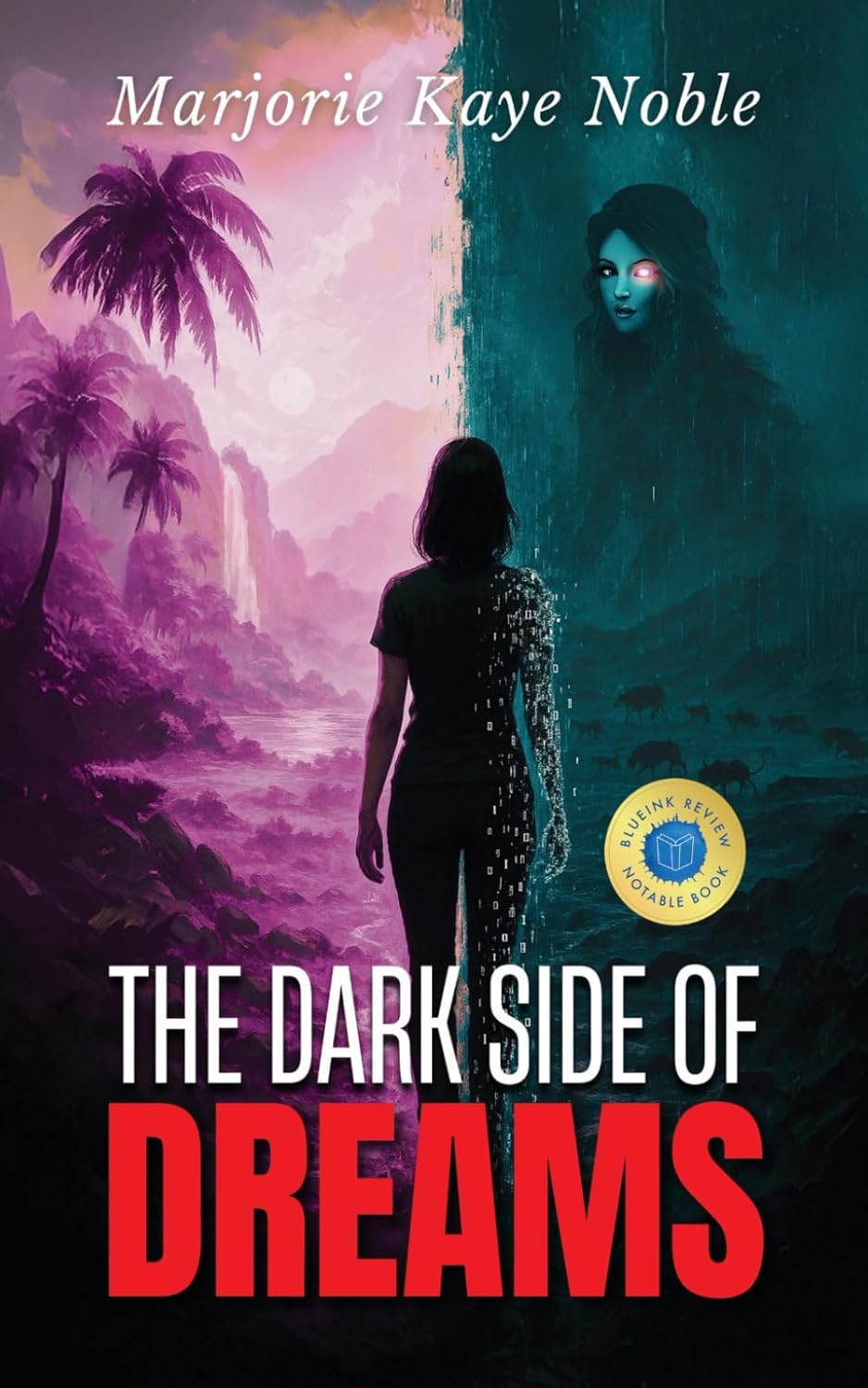
The Dark Side of Dreams is a big, idea-heavy science fiction novel that still knows how to move. It drops the reader into a future where after-death virtual reality has become its own battleground of corporate greed, surveillance, inheritance, and identity, and it does so through Mira Patel, a woman trying to outmaneuver a brutal system from the inside. What makes the book compelling is that it’s not built around a single gimmick. It’s a story about who gets to shape reality, who gets erased from it, and what happens when family legacy becomes both a weapon and a burden. The setup alone, with Mira uncovering a hidden copy of her grandfather Gunter Holden and using it to challenge the nightmare realm that grew out of his lost empire, gives the novel a strong pulse from the start.
What really gives the book its identity, though, is its world. Author Marjorie Noble doesn’t treat the future as sleek wallpaper. She fills it with clutter, relics, memory tech, corrupted paradise programs, and the unnerving logic of a digital afterlife run like bad infrastructure. That contrast is one of the book’s best qualities. A closet full of artifacts can matter as much as a virtual domain, and a line like “Not every search is an adventure. Some things want to be found.” lands because it captures the novel’s whole mood: discovery here is never clean, and the past is never truly past. The world feels layered rather than decorative, and that gives the story a lived-in strangeness that sticks.
Mira is also the right center for this book. She’s ambitious, wounded, stubborn, and often sharper than the people around her, but she’s not flattened into a stock rebel heroine. Her connection to Gunter Holden gives the novel one of its most interesting tensions. She wants justice, power, and restoration, but she’s also drawn to the same force of will that made him dangerous. That family resemblance gives the story real energy. Gunter’s presence as both ancestor and digital copy turns the novel into something more interesting than a standard fight against a villain. It becomes a conversation across generations about responsibility, ego, and reinvention.
The book’s style can be dense, but in a way that suits what it’s trying to do. Noble likes layering plot threads, histories, and invented systems, and the result is a novel that asks the reader to stay alert. Still, there’s an emotional thread running under all the tech and intrigue that keeps it human. Even in the middle of all the schemes, copies, and virtual punishments, the book keeps circling back to longing, grief, and the need to be seen clearly by someone else.
The Dark Side of Dreams is a thoughtful, dramatic, highly imaginative novel about power over memory and life after death. It’s a cybernetic family saga, a corporate dystopia, and a haunted inheritance story all at once. What I liked most is that it keeps its attention on what kind of world is being built and who gets trapped inside it. Noble clearly has a lot on her mind, but the book doesn’t feel abstract. It feels personal. That’s why the novel works. For all its virtual architecture and speculative machinery, it’s really about people trying to reclaim authorship over their lives, their dead, and their dreams.
Pages: 341 | ASIN : B0FYR41ZTM


