Blog Archives
The Perceived Nature Of Time

A Question of Time follows an insightful detective Watson as he tries to piece together what happened to his partner Holmes. Where did the idea for this novel come from, and how did it develop over time?
It evolved from a fermentation of stories. I had just read an omnibus collection of Sherlock Holmes stories by various authors. This led me to reread all Conan Doyle’s Sherlock Holmes stories along with a collection of his horror stories. In that frame of mind, I reread The Time Machine by H.G. Wells. All the stories shared the same period: the environs of late 1800s London. The ambiguity of what happened to the time traveler at the end of the Time Machine, sparked the idea of having him fall backwards through time and encounter Holmes.
My research into the period filled in the color, but the real challenge was developing the multi-layered perspective used to tell the story. It is essentially a story about a story about a story.
What was the hardest part about writing a mystery story, where you constantly have to give just enough to keep the mystery alive until the big reveal?
Keeping the pace without jumping ahead.
What were some themes that were important for you to explore in this book?
There are several themes I consider important.
The perceived nature of time.
Is there really any difference between experiencing a vivid memory where taste, smell, sound, and feeling are all here and now, or physically traveling to a different point in time?
Time travel without reference points is an unrelated set of events that could just as well be in the past as in the future.
I wanted Watson to be a man of his time and it is the strong bond of friendship between Holmes and Watson that makes Holmes confront Watson’s sense of shame over his wartime PTSD. (In the Victorian period of this story, a soldier, ex or otherwise, complaining of traumatic stress from battle was considered cowardly and deranged. Not to mention the social shame of being considered ‘not in one’s right mind’ and hence, untrustworthy. Not too different than how some are perceived today.) It is this wall that Holmes efforts at breaking down.
Will this novel be the start of a series or are you working on a different story?
I haven’t decided. There are several possibilities for a series.
But I have begun another Sherlock Holmes book. The working title is ‘The Arsenic Waltz’ and it is the backwards investigation of a possible murder due to poisoned clothing. Paris Green and Scheel’s Green dyes from that period were set with arsenic compounds that actually killed people.
Another book I am working on is ‘Medea: A Prayer for Hecate’. I hope to portray Medea as a strong, capable woman not dominated by Jason or those around her. In Greek myth any woman with those qualities was often presented as a sorceress, conniving and malicious. In the archeology and the writing from the time, I believe there is sufficient evidence to indicate she was badly maligned.
Author Links: Amazon | GoodReads
Flipping through my notes from that day leaves me perplexed. Was any of it real? That is for you, the reader, to decide.” – J. Watson
On concluding a long day of house calls, Dr. Watson receives an urgent summons to attend his friend, Sherlock Holmes. He arrives at 221B Baker Street to find Holmes in a state of deep shock and wearing scorched clothing that reeks of excrement. Fearing his friend may have been exposed to a virulent contagion, Watson must race against time to retrace Holmes’ movements and discover the source of his debility, a race that leads him to a cesspit amid the ruins of a fire-gutted warehouse, and a mysterious unburned area amid the charred timbers.
Back in his apartment, a convalescing Holmes unravels the mystery by relating his encounter in the riverside warehouse with a time traveler, who recounts his amazing exploits in the world’s far future. After promising to contact Holmes in two years, the Time Traveler attempts to return to his own time, but his time machine malfunctions, resulting in a fire that eliminates all evidence of his existence. Dazed and in deep shock, Holmes manages to escape the flames and make his way back to his lodgings.
While Holmes’ recounting of the Time Traveler’s adventures at first astonish and excite Watson, the stream of strange events―the Eloi, the Morlocks, the Palace of Green Porcelain, world-wide cataclysms, and a far-flung future devoid of human life―make him doubt the story.
With the lack of physical evidence and only Holmes’ account of what transpired, Watson―hounded by demons from his own troubled past―must determine if Holmes met an actual time traveler, or if the related events are a fabrication of Holmes’ fevered imagination.
A Question of Time pays homage to three great Victorian characters of literary fiction: Sir Arthur Conan Doyle’s Sherlock Holmes and Dr. James Watson—with a sly aside to a nefarious criminal—and the Time Traveler of H.G. Wells’ The Time Machine.
Sherlock Holmes: A Question of Time
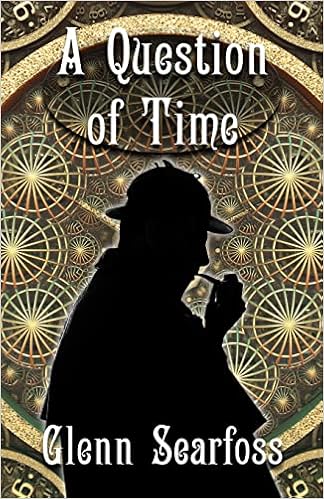

Glenn Searfoss’s novel, Sherlock Holmes: A Question of Time, presents a captivating and innovative interpretation of the renowned character of Sherlock Holmes. The plot is an enthralling mystery that commences with Dr. John Watson receiving a desperate plea for assistance from a street urchin named Bobby. Upon arriving at 221b Baker Street, Watson discovers a traumatized maid and a seemingly unresponsive Sherlock, who claims to be in a state of profound shock. In an attempt to revive his colleague, Watson retraces Sherlock’s steps, which leads to discovering a vast, unblemished circle in a burnt-down warehouse. As Sherlock awakens from his state of shock, he recounts a fantastical tale involving a time traveler who triggered the conflagration and the enigmatic circle.
The classic sleuth, Sherlock Holmes, is legendary and a favorite among mystery aficionados. Recently, there has been a trend in the literary world where authors have reimagined these timeless characters. A fresh and innovative approach to the most famous detective in history is always welcome, and Searfoss delivers precisely that with this new interpretation. I found the change in Sherlock Holmes’s character, particularly when he slips into a catatonic state for days on end, living in his filth, to be a refreshing alteration. The author’s use of old-fashioned English-style writing was a delightful surprise and felt authentic. Furthermore, the novel presents a compelling and unique storyline that cleverly merges the fantasy and science fiction elements of H.G. Wells’s works with the logical reasoning that characterizes the Sherlock Holmes franchise. Searfoss has deftly crafted an original and captivating narrative that builds upon both writers’ works, resulting in an intriguing and exceptional read.
Overall, Sherlock Holmes: A Question of Time is an exciting and refreshing take on the iconic character of Sherlock Holmes. Searfoss skillfully weaves together elements of different genres to produce a new and original story that will enthrall and captivate readers.
Pages: 216 | ISBN: 1804241857




 LITERARY TITAN