Blog Archives
Skilled At Handling Lies

Angus Sliders follows Max as he struggles to remember what versions of history are real and what is made up from Mirror’s effects, causing history to fracture further, and possibly in irreparable ways. What was the inspiration that created the journey Max goes on in this book?
Max’s journey in Angus Sliders originates from a core question. What happens to a spy when his most trusted asset, his memory, fails him? The Mirror has always posed a threat because it warps time, but the greater threat is psychological. I aimed to examine how an experienced intelligence officer, skilled at handling lies, disinformation, and shifting loyalties, would react when his internal compass fails him.
The inspiration came from three connected ideas. The first is the fallibility of memory in espionage, where spies operate within constructed realities such as covers, legends, and half-truths. The second is what could be called post-war trauma. The fear of misremembering. Lastly, there’s the ethics of changing history. If altering one moment could save lives or end them, how does someone like Max resist the temptation or cope with the guilt of decisions made in unstable times?
So, his journey ultimately revolves around identity under pressure. Max becomes a man forced to navigate through multiple versions of his own past, aware that each step could deepen the cracks. The tension in Angus Sliders comes from whether he can hold onto the truth long enough to repair the present, or if the Mirror will completely overwrite him.
I find that authors sometimes ask themselves questions and let their characters answer them. Do you think this is true for your characters?
Absolutely. For me, that’s one of the engines behind the entire Sliders universe. I often start with a question I’m unsure how to answer, for example, what would it feel like to step into a version of history that remembers you differently? How much of your identity remains when memory becomes negotiable? What does loyalty mean when time itself can be rewritten? Then I stop answering as the author and begin listening to the characters.
Max and Alicia are both shaped by the worlds they navigate. Max, for example, rarely gives the easy answer; he provides the necessary one. Alicia responds with accuracy and restraint, revealing the cost of knowing more than she can admit. So yes, my questions start the conversation, but the characters finish it. That’s the value of writing in this universe: the characters live close to points of fracture such as history, memory, and time, and their answers often reveal truths I wouldn’t have reached on my own. In that sense, I’m not just writing them. I’m discovering what they’re willing to tell me.
I felt that there were a lot of great twists and turns throughout the novel. Did you plan this before writing the novel, or did the twists develop organically while writing?
The honest answer is both. I always start with a skeleton. The main plot points, structural pivots, and key revelations that the whole story depends on. In a book like Angus Sliders, where the narrative twists around time distortion and espionage, those anchors are crucial. Certain twists must happen for the story to have the right impact. But the best twists are the ones that seem inevitable in hindsight yet are surprising in the moment. They tend to happen naturally. They appear when characters react honestly to pressure. They surface when a secondary detail suddenly becomes essential. They occur when the logic of the world requires a new fracture in the timeline.
As I write, the characters often reveal parts of the story I didn’t fully see during the outline stage. Max, for example, rarely acts like someone who wants his arc to stay linear. The Mirror’s influence almost encourages unexpected angles. Alicia makes choices that challenge the neat structural plan, deepening the stakes. So, the process becomes a balance. Plan the structure and, to some degree, let the characters decide how to move through it. That’s where the twists come from. Structure supported by surprise, and surprise supported by character truth. If I’ve done it right, the reader feels both the inevitability and the shock.
Can you tell us more about what’s in store for Max Calder and the direction of the third book?
Without revealing too much, the third book pushes Max into the most dangerous territory he’s faced yet. Not because the enemies are stronger, but because the consequences of what he’s already survived finally catch up with him. Cuban Sliders, based in the Caribbean, leaves Max standing at the edge of a world where the Mirror has been dismantled, but its influence hasn’t disappeared – it’s just increased. The third book poses a more complex question: What does a man do when the past he fought to fix begins rewriting itself around him? Max has learned to navigate fractured histories. But now he must decide which version of himself he’s willing to live with. The third book will force him to confront timelines he thought he’d closed and choices that refuse to stay buried.
Max no longer knows if he’s fighting for the right side or if the right side even exists. If the first book broke Max, and the second tested him, the third questions whether he can survive the truth he’s spent his life trying to uncover.
Author Links: Facebook | Instagram | GoodReads | Website | Amazon | Apple Books
It’s 1948. Max Calder thought he’d escaped the Mirror’s grip. But when an encrypted MI6 radio message pulls him from the shadows, he finds himself trapped in a deeper conspiracy involving Kim Philby – one that spans timelines, and versions of himself he can no longer remember… or trust.
Partnered once again with Alicia Rayes, Calder races from Lisbon to London to Edinburgh to uncover Project Oracle, a secret MI6 experiment buried at a black site called ANGUS beneath a loch at Invershiel. There, an unstable Mirror still hums. And waiting for him is Variant 6F… a doppelgänger who might be the last warning before history fractures for good. As enemies close in and memories slip through the cracks, Calder must face the truth: the timeline isn’t broken – it’s being rewritten.
Angus Sliders is a taut, cerebral spy-fi thriller steeped in Cold War tension, noir grit, and mind-bending science fiction.
Angus Sliders – A Max Calder Spy-Fi Mystery


Angus Sliders drops you straight into a foggy world of spies, memory loss, and shadowy doubles, and it wastes no time setting the stakes. Max Calder is living quietly in Lisbon when a strange broadcast pulls him back toward old secrets, and a long-buried threat named the Mirror starts to stir again. What follows is a chain of chases, coded messages, old flames returning at the wrong time, and a slow unravelling of Max’s own mind. The story moves from Lisbon’s rainy streets to steamers cutting through gray water to intelligence offices and old wartime wounds. It feels like a personal fight as much as a global one, and that tension powers the whole book.
I caught myself getting wrapped up in the atmosphere. The writing has this rich, moody quality that made me see the wet stones and dim cafes and flickering lamps. I had a real fondness for how the book blends real historical detail with fiction. It adds weight without dragging things down, and it gave the world a texture that felt lived in. I did feel a little overwhelmed during a couple of the denser spycraft moments. The pace surged forward anyway, so the confusion never lasted long. Even so, I kept reading because Max’s voice added so much color. His wit made even the bleak moments feel sharp instead of heavy.
The emotional core of the book worked for me more than I expected. Max’s slipping memory is more than a plot device. It hits like a crack that spreads through everything he touches. Every time he forgot something important, I felt a small sting as if the loss were personal. His scenes with Alicia had that same effect. Their dynamic has this messy, bittersweet edge that kept tugging at me. They know too much about each other and not enough at the same time, and their shared history hangs over every conversation. I liked that the book never tried to make their relationship tidy. It leaned into the chaos of it, and that honesty made it hit harder.
This book builds a world that kept pulling me forward, and I enjoyed being lost in it. If you like spy stories that mix real history with strange tech, or if you enjoy mysteries that twist around memory and identity, this one will be a great fit. Readers who want both grit and style in the same breath will probably have as much fun with it as I did.
Pages: 337 | ASIN : B0G26J24T2

The Dangers of Time Travel
Furniture Sliders follows a former intelligence officer who is pulled back in to discover what has happened to a classified project and the people working on it, which controls time, memory, and identity, and is now missing. What was the inspiration for the setup of your story?
I have always been a fan of both film noir and espionage novels plus I have a tech background and a fascination with quantum mechanics. I wanted to write a story that felt like a 1940s Cold War spy thriller written in noir style—then break it wide open with the addition of speculative science fiction. I had a question: what if you take the characteristics of quantum mechanics such as superposition and entanglement and instead of applying them to atomic particles, you applied them to human beings? To spies? Can you be in two places at once or two timelines at the same time? Firstly, apply the ability to manipulate space and time and then take it even further by playing in panpsychism – the concept that every inanimate object can be sentient. Of course, you would have to have some form of technology to do all of this – the Mirror is exactly that inspired by the one in my hall at home. The title literally came from a box of plastic furniture sliders that were on the table at home with the box looking like a paperback book – Furniture Sliders on the spine! Sliders was a perfect description for agents moving through space and time and their organization is called the Bureau, along with the Mirror, giving the initial tongue-in-cheek furniture connection.
I found Max Calder to be an intriguing character. What was your inspiration for this character?
Max Calder is the kind of character I love; deeply broken but still pushing forward through the fog. It isn’t about a single character or character flaw but about weaving influences together. I guess Max carries echoes of Raymond Chandler’s Philip Marlowe and Graham Greene’s morally ambiguous operatives. He isn’t polished like Bond, but weary, suspicious, and prone to moral compromise – a man affected by the machine he serves. I tried to deliberately write against cliché by grounding him in history and psychology. His gaps, duplications, and doubts reflect not only the dangers of espionage but the fragility of identity itself. Unlike many spy archetypes, Calder isn’t defined by conquest or success, but by survival, mistrust, and fear of irrelevance — hopefully making him come across as human, flawed, and complex. In many espionage novels, agents and spies are unaffected by what they do and are amazing at executing their role. In the case of Max, I wanted him to be very affected. Remorse, regret, and inner demons.
What themes were particularly important for you to explore in this book?
Primarily the consequences of messing with time and how doing so can also mess with you physically, potentially drive you insane and affect your memory while creating echoes or even doppelgangers as time threads overlap. All caused by, or underpinned by, the human-applied characteristics of quantum mechanics. It was important to explore relationships especially between protagonists and antagonists and between espionage agents and technology pitching various spy agencies against each other – even if they are supposed to have great relationships. I also wanted to introduce fictionalized real-life characters to the storyline which in this book includes Alan Turing, Hugh Sinclair and William Stephenson.
Where does the story go in the next book, and where do you see it going in the future?
There are two more books coming in the series. Angus Sliders and Cuban Sliders. Angus Sliders is planned to publish on the 15th December. One of the challenges with quantum-based technology like the Mirror is that many want to get their hands on it in many cases for various nefarious reasons. In Furniture Sliders it was the Russians and ex Nazis. In Angus Sliders, Max Calder discovers that some major occurrences in Furniture Sliders didn’t really happen and that MI6 is very involved. Even a fictionalized Kim Philby is involved as is Charles Fraser-Smith who was the inspiration for James Bond’s Q. Max Calder is more and more affected by what the Mirror can do to you. In Cuban Sliders the Russians are back in the game and so is the CIA. Through all of this the Mirror becomes even more difficult to control or destroy. The big question is – can it be destroyed at all or even stopped and who gets to control it? Are there more storylines past the initial trilogy? Yes indeed!
Author Links: Facebook | Blog | Website | Amazon | Barnes & Noble
The Bureau is chasing a secret called the Mirror—a project so classified that even its architects have vanished or been silenced. It’s said to control time, memory, even identity itself. As Calder tracks the Mirror’s echoes across empty safehouses and wartime graveyards, the lines between hunter and hunted begin to blur.
Artemis may be an ally. Or she may be a weapon. And Calder? He may not even be who he thinks he is.
As bodies pile up and truths unravel, Calder must navigate a world where nothing stays still—where every room slides just a few inches sideways when you’re not looking. In the end, he’ll face one impossible choice:
Burn the truth… or become it.
Furniture Sliders – A Max Calder Mystery
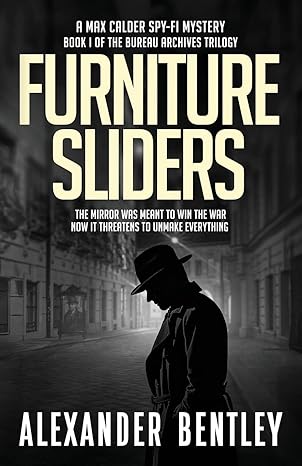

Furniture Sliders is a post-war spy-fi romp that kicks off The Bureau Archives Trilogy with a smoky, rain-slicked bang. Set in 1947, it follows Max Calder, a former intelligence officer with holes in his memory, who is pulled back into the shadows by a mysterious woman named Artemis. A cryptic file, a vanished scientist, and a strange device known only as “the Mirror” set the stage for a chase that spans seedy New York bars, crowded transatlantic ships, and the broken glamour of Vienna. The novel threads together espionage, noir atmosphere, and science-fiction intrigue, with time manipulation simmering under its cloak-and-dagger surface.
I loved how this book felt. The writing drips with mood. Fog curling down city streets, cigarette smoke blurring the edges of a room, the distant hum of jazz over clinking glasses. The pacing dances between languid observation and sudden bursts of violence. Bentley’s style pulls you into Max’s fractured mind. We’re not just following a spy, we’re feeling the tug of his half-buried memories and the unease of not knowing which shadows to trust. Sometimes the dialogue leans into pulp, almost like a wink to the genre’s roots, and it works. It kept me grinning even when the stakes turned deadly.
The ideas themselves are a bold mix. The “Mirror” concept, which is a device that remembers rather than reflects, opens the door for paranoia, philosophical tangents, and deliciously weird possibilities. Bentley resists over-explaining it, letting the mystery breathe. The interplay between Artemis and Max is sharp, edged with mutual suspicion and unspoken history. There’s a lot of world-building baked into their exchanges, which I appreciated, though now and then I wanted the plot to lunge forward faster. Still, I was hooked. Even the side characters, like the poison-bead-wielding Bishop, feel like they’ve stepped out of their own fully formed novellas.
Furniture Sliders is a strong start to what promises to be a stylish, time-twisting spy trilogy. It’s a book for readers who love their thrillers with a noir heartbeat, for fans of John le Carré who won’t mind a dash of science fiction, and for anyone who likes peeling back the layers of a protagonist who isn’t even sure of himself. It’s atmospheric, it’s clever, and it leaves you wanting the next mission right away.
Pages: 314 | ASIN : B0FF6RD921




 LITERARY TITAN