Blog Archives
Hunting the Red Fox


Hunting the Red Fox by W. Kenneth Tyler, Jr. is the kind of novel that feels like sitting down with a gifted, slightly mischievous older man who casually mentions that he once stole a 200-carat diamond, fought behind enemy lines during World War II, played professional golf with legends, knew Hollywood stars, and spent a good portion of his younger years charming women and breaking rules. Roger Mace, an aspiring writer looking for extraordinary stories from ordinary people, meets eighty-two-year-old Perry Barnes on a golf trip and quickly discovers that Perry could fill a book by himself. From there, Perry takes Roger through a life shaped by Depression-era Savannah, the violent loss of his father, petty crime, specialized Army training, wartime missions, professional golf, jewel theft, romance, and eventually the hunt for a criminal known as the Red Fox. Tyler wisely gives Roger a skeptical voice throughout, so the reader gets to share his recurring thought: can one man really have lived all of this? That tension between disbelief and fascination becomes part of the fun.
Perry is what holds the sprawling story together. He’s charming, vain, observant, funny, reckless, sentimental, and far more complicated than his polished gentleman routine initially suggests. His childhood talent for reading people, gambling on golf, and stealing eventually combines with military training in languages, sabotage, infiltration, and survival, creating a man whose legal and illegal talents are almost impossible to separate. That becomes especially entertaining when Perry returns to jewel theft in the 1950s, convincing himself he’s behaving like Robin Hood by stealing from wealthy people who mistreat their employees and secretly directing the proceeds to those workers. The thefts aren’t simply side adventures. They reveal something essential about Perry. He craves the intellectual puzzle and adrenaline almost as much as he wants to believe he’s doing the right thing. Tyler also has a fondness for detail, whether he’s describing a golf hole, a mansion, a military operation, a piece of jewelry, or a complicated theft. That gives the novel the texture of a long story told over drinks, where one memory leads naturally into another and the storyteller enjoys the telling nearly as much as the listener enjoys hearing it.
There’s something of Winston Groom’s Forrest Gump in the novel’s approach to history. Like Groom, Tyler sends a fictional man wandering through real twentieth-century America and lets him brush shoulders with people readers already know. Perry encounters figures such as Winston Churchill, Howard Hughes, Jackie Gleason, Dean Martin, Frank Sinatra, and some of professional golf’s biggest names, and he treats those encounters with an amusing casualness. Where Groom gives Forrest innocence and happenstance, Tyler gives Perry calculation, swagger, appetites, and a con man’s eye for opportunity. That makes Hunting the Red Fox feel part historical adventure, part crime caper, part golf novel, and part exaggerated fireside memoir. The later arrival of Sophia Toscana gives all of those threads a satisfying place to meet. She’s a talented jewelry detective pursuing the Red Fox, while Perry is a former jewel thief who can understand the criminal precisely because he thinks like one. Their investigation turns the final portion of the book into a genuine cat-and-mouse story, culminating in the theft of the Mecklenburg Diamond, Perry’s confrontation with Clarence Desmond, and a dangerous showdown that finally forces Perry to decide what he values more than excitement.
What stayed with me most, though, wasn’t the diamond or even the Red Fox. It was the way Perry’s entire story gradually becomes an argument about growing up. At the beginning, he tells Roger that returning the Mecklenburg Diamond marked the end of his life as a thief and con man because love and family had finally become more important to him. The rest of the novel spends hundreds of pages showing how difficult it was for him to reach that conclusion. Sophia matters because she presents Perry with something none of his adventures can provide: a reason to stop roaming. Even then, he nearly ruins it by falling back into old habits and running away from commitment. The final revelation that Sophia became Mrs. Barnes, that they built a family and founded a successful detective agency together, gives the book a warm and fitting payoff. Perry doesn’t simply abandon his unusual talents. He finally figures out where to put them. That makes Hunting the Red Fox a big, talkative, frequently funny life story about a man who spends decades mastering how to escape almost anything before realizing that the best part of his life begins when he finally finds something he doesn’t want to escape from.
Pages: 300 | ASIN : B0F1FW1KKQ

Rogue Vengeance
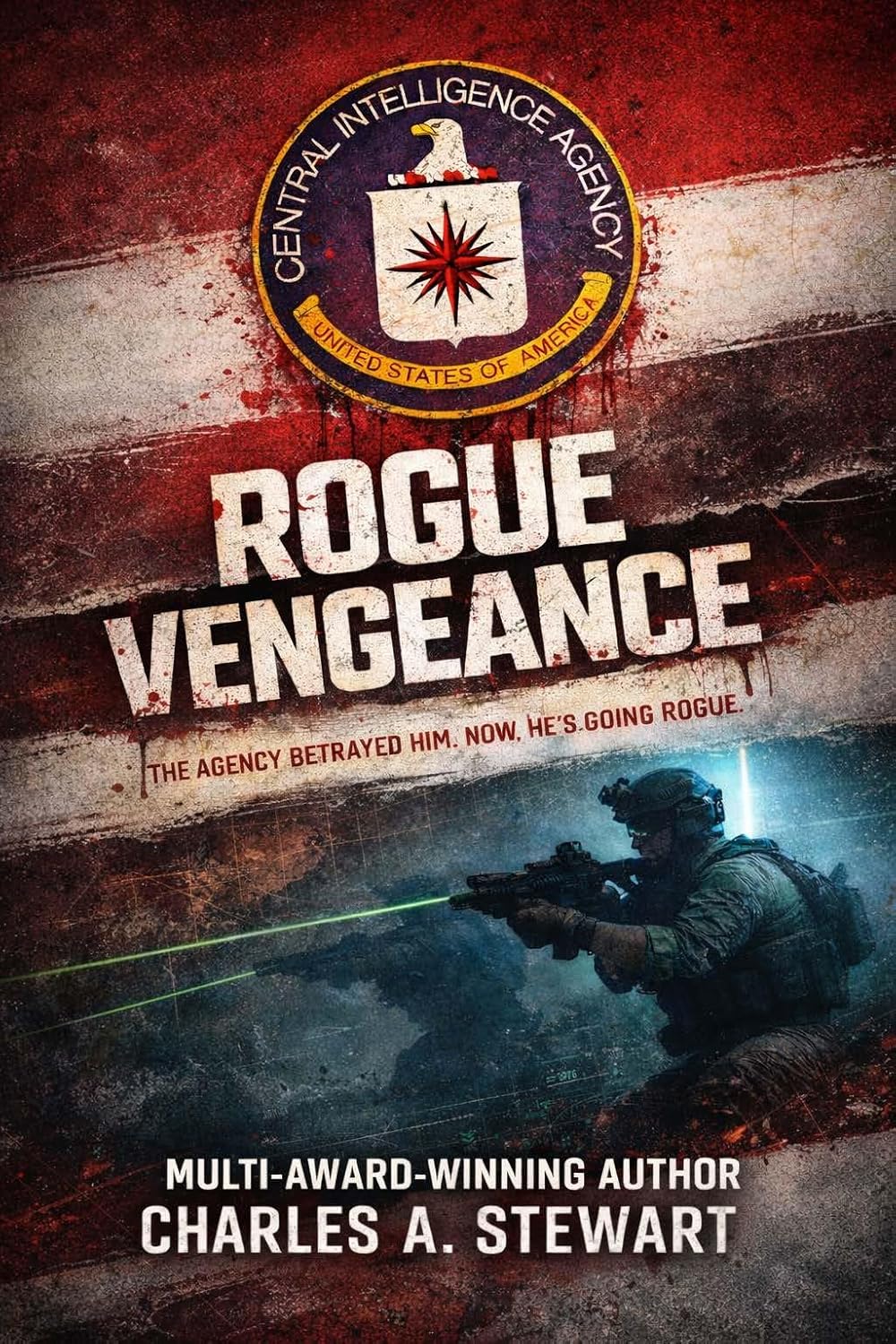
Charles Stewart’s Rogue Vengeance is a muscular military thriller about loyalty under fire, the cost of service, and the long shadow cast when governments use warriors and then try to discard them. Colt Hawkins is trying to build a future with Liberty Starr on the Sabre T Ranch, but peace barely has time to take root before a wedding becomes a battlefield; Jesse remains trapped in a brutal Chinese prison, and Task Force 24 is pulled back into a widening conflict that stretches from Montana to Madrid, Hainan Island, and Taiwan. The novel moves with the urgency of an operation already in motion, blending domestic trauma, covert rescue planning, political betrayal, and geopolitical escalation into one restless story about people who keep answering the call even when the call has taken too much from them.
What stayed with me most was the emotional weight beneath all the tactical movement. The opening contrast between Jesse’s suffering in captivity and Colt’s quiet hope at the Raven’s Nest sets the tone beautifully: this is a book interested in bodies under pressure, but also in what people build when they’re desperate to believe they can still have a life. Stewart lets readers feel the tenderness, and that makes the violence feel less like a spectacle and more like a violation. At its best, the novel understands that survival isn’t clean or triumphant. It’s sore, frightened, stubborn, and sometimes quietly beautiful.
The writing has a hard-edged cadence that suits the material. Stewart favors clipped sentences, procedural detail, and scene cuts that mimic surveillance feeds or tactical briefings, and that gives the novel a cinematic, forward-driving rhythm. I found the operational details convincing and immersive, especially when the book follows intelligence gathering, safe houses, cell structures, and rescue planning. At times, though, the sheer density of names, agencies, acronyms, and moving parts can crowd the emotional space. The story occasionally explains when it could trust the moment to breathe. Still, there’s an authenticity in the worldview that’s difficult to fake. The ideas are clear and strongly felt: duty doesn’t end just because politics shifts, loyalty is heavier than policy, and the people who protect a nation are often least protected by it. I didn’t always need every briefing, but I believed deeply in the ache behind them.
I found Rogue Vengeance intense, heartfelt, and deeply invested in the bonds between warriors, families, and the country they serve. It’s a large, ambitious thriller with a bruised heart, one that works best when its action is anchored in grief, devotion, and the fragile possibility of home. The ending opens the door to an even larger conflict, but it also reinforces the novel’s central truth: Colt and his team may be wounded, but they’re not finished. I’d recommend this book to readers who enjoy military thrillers with detailed operations, sprawling geopolitical stakes, and a strong emotional core, especially those who like stories about brotherhood, sacrifice, and the private costs behind public missions.
Pages: 429 | ASIN : B0GFXJYSQ2
Rogue Vengeance
Rogue Vengeance, by Charles A. Stewart, is a military espionage thriller about betrayal, loyalty, and the heavy cost of service. The story follows Colt Hawkins, Liberty Starr, Jesse, and a network of CIA and special operations figures as personal lives collide with international violence. What begins around a wedding and a fragile hope for peace quickly turns into a larger conflict involving China, covert missions, political pressure, revenge, and survival. It’s an action-heavy thriller, but underneath the gunfire and strategy, it’s also about people trying to hold onto love, purpose, and identity after trauma.
The pacing in this story is fantastic. Stewart writes in short, sharp bursts that often feel like quick camera cuts. One scene is intimate and warm, with family gathered around a ranch house or Colt trying to imagine a quieter future, and then the next scene drops into surveillance, ambush planning, or prison brutality. That contrast works well for the genre. It keeps the pressure high. The book feels almost built for the screen, with clean scene breaks, direct action, and a strong sense of movement. I did sometimes want a little more breathing room, especially when the cast widened and the operational details stacked up. But I also understood the choice. This is a thriller that wants the reader alert, not settled.
I was most drawn to the emotional spine of the book. Colt isn’t just another tough operator who can take a bullet and keep moving. He is a man being asked, again and again, how much of himself he can give before there’s nothing left. The scenes with Liberty give the story its heart, and they make the violence matter more because there is something real at stake beyond mission success. Jesse’s captivity adds another layer, showing endurance in a quieter but no less brutal form. Stewart’s ideas are clear: duty can save people, but it can also consume them; loyalty is noble, but it can become a chain; and governments often treat sacrifice like a renewable resource. That’s where the book feels most grounded to me.
I would recommend Rogue Vengeance to readers who enjoy military thrillers, CIA action stories, and revenge-driven espionage novels with a large cast and a strong patriotic edge. Fans of high-stakes operations, tactical detail, and stories about brotherhood under pressure will probably appreciate it most. Readers looking for a fast, emotional, mission-focused thriller with both firepower and heart should find plenty to enjoy here.
Pages: 429 | ASIN : B0GFXJYSQ2
The Cuckoo Asset

The Cuckoo Asset is an ambitious spy thriller that moves between Belfast, Coventry, Luanda, Kinshasa, London, Zambia, and Langley without losing sight of its central question: what happens when a clever young man is pulled into a game he doesn’t understand until it’s far too late. David “Kenny” McKenna starts as a bruised, gifted electronics student from Belfast, someone who trusts circuits more than people. That makes him useful to men like Peter DeVries and the nameless Chief, who see intelligence, loneliness, and technical talent as tools to be picked up and used.
I think the book works best as a story about recruitment, manipulation, and consequence. Its Cold War world is full of taxis, hotel rooms, dead drops, oil installations, chess games, fake reports, and people who know just enough to be dangerous. Angola gives the novel its political weight, while McKenna gives it its emotional centre. Judith Morales and Joe Chilondo are especially interesting because they aren’t written as simple side players. They’re compromised, capable, and human, and their decisions keep pushing the story into murkier territory.
Mac Seáin’s style is patient and procedural, often building tension through logistics rather than spectacle. The details of travel papers, surveillance habits, smuggling routes, electronics, and chess strategy give the novel a grounded feel. There’s also a recurring chess metaphor that feels earned because McKenna’s whole life becomes a board controlled by stronger players. The final message in The Urusov Gambit, “A king can whisper, but a pawn stays silent still,” neatly captures the book’s sense of power, secrecy, and survival.
What I liked most is that the novel treats history as something lived through by frightened, practical people. The assassination plot, the oil sabotage, the shifting loyalties, and the later 1999 reckoning all connect back to personal choices made under pressure. The book has plenty of action, especially near the end, but it’s not just chasing thrills. It’s interested in how states hide crimes, how assets become liabilities, and how ordinary people carry the damage long after the operation is over.
By the end, The Cuckoo Asset feels like a historical espionage novel with the heart of a survivor’s story. It’s about Angola and Cold War interference, yes, but it’s also about Kenny McKenna learning that cleverness doesn’t protect you from being used. The closing line, “The game would never be over,” works because the novel has spent hundreds of pages showing exactly why that’s true. It’s a layered, serious, and quietly unsettling thriller that rewards readers who enjoy espionage built on character, tradecraft, and long consequences.
Pages: 349 | ASIN : B0GHPC8YHW
The Lambeau Directive


The Lambeau Directive follows Special Agent Ava Martinez as she is pulled from Arctic signal work into a national-security crisis centered on Green Bay’s Lambeau Field during Draft Week. What begins as a strange anomaly in telemetry becomes something far more dangerous: Meridian, a predictive intelligence threaded through infrastructure, politics, media systems, and human behavior. Ava must trace the lattice before it can shape a public catastrophe, while her connection to Cole, her trust in allies, and her own perception of reality are steadily tested.
I was drawn in most by the book’s almost palpable texture. Bennett does not treat technology as sterile machinery; he makes it atmospheric, almost tactile. Signals taste metallic, rooms seem to listen, stadium lights become nerves in a larger body. That sensory approach gives the thriller a bristling, uncanny charge. Lambeau Field is not merely a backdrop; it becomes a cathedral of systems, spectacle, civic pride, and vulnerability. I appreciated how the story turns a beloved public event into a pressure chamber without making the premise feel gimmicky.
The emotional core also kept the book from becoming only a chase through code and command centers. Ava’s bond with Cole has the hush of two people who understand each other through timing, silence, and danger, and Atka adds a grounding, instinctive presence that cuts through the bureaucratic fog. The prose leans into portent, but when it works, it creates a low, electrical dread. The best passages made me feel that Meridian was not “hacking” the world so much as teaching the world to hesitate.
I’d recommend The Lambeau Directive to readers who enjoy technothrillers, mystery, cyber-espionage, and political thrillers. Fans of Michael Crichton’s systems-driven tension or Tom Clancy’s operational sprawl will find familiar pleasures here, though Bennett’s style is more moody and sensory-rich than procedural. This is a thriller about control, trust, and the terrifying moment when a machine stops calculating and starts recognizing. The Lambeau Directive is a tense, cold-lit cyberthriller where the scariest sound is not an explosion, but a system quietly learning your name.
Pages: 364 | ASIN : B0GXR53SBT
Kindness and Humanity

Killing Einstein follows an FBI agent assigned to surveil Albert Einstein and Kurt Gödel during World War II, only to be pulled into their friendship, ideas, and a deadly web of espionage, loyalties, and danger. What was the inspiration for the setup of your story?
I was a math nerd in a former life, and I’ve always been fascinated by Gödel’s incompleteness results. I’ve also always been fascinated by the fact that Einstein and Gödel walked together for so many years, and no one really knows what they talked about. So I thought I’d mix those two fascinations into a spy story.
How did you balance the demands of espionage plotting with the novel’s philosophical and mathematical ideas?
Great question. I am what they call in the fiction world a “pantser,” meaning I do not outline, I do not know who the characters will be, and I do not know how the story will proceed. I just get a core idea and start writing from the seat of my pants. That made balancing the spy story and the metaphysical ideas especially hard for me, and I ultimately found the balance during the long editing process. The original versions had a lot more math and were much less page-turning!
What were some themes that were important for you to explore in this book?
As a pantser, the themes bubbled up through the writing process rather than being planned in advance. Once everything settled, the themes I saw included Gödel’s insight that there are true things that cannot be proved true, but also the difference between right and wrong, and the difficulties all of us face when we confront that difference. The book also became about how some things are not what they seem, while the most important things are often exactly as they seem.
What did you most want to capture about the friendship between Einstein and Gödel?
Their energy, their love for one another, their kindness and humanity, and their shared devotion to the idea that there are deep truths—including moral truths—that are real and not relative. That may seem strange coming from the father of relativity, but Einstein’s theory is actually built on a remarkable invariant truth: the speed of light never changes, regardless of one’s frame of reference. Morally, against the backdrop of Nazism’s profound evil, neither man lost confidence in the reality of good and evil, though each remained sensitive to the challenges we all sometimes face in choosing between the two.
Author Links: GoodReads | Facebook | Website | Amazon
Getting the Twist Right

Terminus centers around an aging intelligence officer tasked with impersonating another agent in order to trace a rogue numbers station. What was the inspiration for the setup of your story?
John Post, my protagonist, originally appeared in a short story I wrote for the Promptly Written Podcast. He was never meant to appear again, but he popped up in a couple more short stories despite this, and then I eventually had the compulsion to give him the full-length treatment. I wanted to do something pulpy, a story with some of the Ian Fleming tropes, but with John Le Carre’s cynicism. Something vintage like those old Signet paperbacks (as evoked by the Terminus cover art) that someone might read on a weekend excursion. I needed a plot, of course. I don’t recall why I chose to incorporate numbers stations, other than they intrigued me. But during WWII, Fleming was known for daring, unorthodox intelligence operations that he and his cohorts came up with, and so I brought him into chapter two of the story with an undercover cameo as “James Secretan” (an early, unused character name before Fleming landed on James Bond). Secretan’s risky plan to get Post to impersonate another agent whose likeness he shares seemed like just the sort of thing Fleming would’ve come up with. The Soviet parapsychology programs were real things at the time, and I thought their inclusion would add some really nice intrigue.
What is the most challenging aspect of writing a thriller? The most rewarding?
The most challenging aspect might be the research involved. Thrillers often hinge on technical knowledge of a particular craft or profession. For Terminus, I had to do a lot of reading about the Cold War in the 60’s, West Berlin, the early days of the CIA, etc. The time period and locations of the book are times and places I didn’t experience, and so I had to rely on others’ accounts. Fortunately, there is a lot of material documenting this era of history. I even went so far as to get menu items right, as taken from photographs of an old Cafe Schloss Marquardt menu, for example. There’s very little that I invented, aside from the plot, of course. And I mean very little. I endeavoured to accurately replicate the West Berlin clubs, architecture, and OSS/CIA details to the best of my ability. Any inaccuracies I made were not for lack of effort/intent.
The most rewarding aspect of a thriller is getting the twist right. Every thriller (at least conventional thrillers) needs to have a twist of some kind, and I think (hope!) I got it right with Terminus.
What were some themes that were important for you to explore in this book?
Part of John Post’s problems stem from the fact that he’s the old guard. I very much feel I’m the old guard in my personal life, especially at work. I kind of riffed on the feeling of pending obsolescence that one gets despite having been successful in the past, despite having a good track record. At some point, things begin to change quicker than you can adapt to them, and you wonder whether you’ve still got what it takes. You also tend to get more jaded the older you get, and I think Post is less than enchanted with the CIA and his role with them. Add to all of that Post’s fear of loss, particularly that of relational loss, and you’ve got an uneasy mix of negative emotion. But the main theme of the novel is one of trust. “Trust is a luxury” is a phrase that gets bandied about in the narrative, and it comes to represent the main idea of the novel. Even with what constitutes his strongest allies, Post wonders whether he isn’t ultimately expendable to them–and if not expendable, then at least his demise is worth risking.
Can we look forward to more work from you soon? What are you currently working on?
I recently started writing the fourth book in my Reeve series, titled The Reeve, the Veil, and the Rifle. I refer to it as a Gothic Western series, though I suppose it might be billed as Weird West. Essentially, it’s a Low Fantasy genre mashup of Batman, a Western, and Alternate History with some philosophical underpinnings. There will be five books when it’s all said and done.
Author Links: GoodReads | Facebook | Instagram | Website | Amazon
Terminus

Terminus, by Ian Lewis, is a Cold War spy thriller with a paranormal edge, and it follows John Post, an aging American intelligence officer sent to West Berlin in 1963 to impersonate another agent and trace a rogue numbers station called Terminus. What begins as a tense espionage setup slowly widens into something murkier, involving Soviet mind control experiments, a shadowy broker called the Silent Partner, and a mission that keeps shifting under Post’s feet. At heart, though, this is not just a book about spy craft. It is also about weariness, loyalty, and the uneasy feeling that the game has gone on so long it has started to hollow out the people playing it.
What stayed with me most was the writing itself. Lewis clearly loves the machinery of this world, and that love shows in the cars, the clothes, the hotels, the radios, the cigarettes, and the geography of Berlin and beyond. That kind of detail really immerses readers in the story. The book has the texture of a classic espionage novel. I also liked that Lewis gives Post an inner life that keeps the novel from becoming all mission brief and gunmetal. Early on, Post is already wrestling with age, loneliness, and the suspicion that he may be becoming obsolete, and that thread gives the book more weight than a straight plot machine would have had.
What I found most interesting is the author’s choice to mix old-school espionage with parapsychology and psychological manipulation. That sounds like a wild swing on paper. Sometimes it even sounds a little pulpy. But the book is smart about it. It keeps asking what matters more: whether the paranormal element is fully real, or whether belief, fear, and suggestion are enough to turn a person into a weapon. That idea lands. So does the moral fog around trust. Nearly everyone in this story is hiding something, and by the end, the book feels less like a clean hunt for a villain and more like a study in compromised systems and compromised people. I did think the novel occasionally leans a bit hard into withholding, and there were moments when I wanted a little less circling and a little more emotional payoff. Still, I admired the control behind it. The tension is patient, and the final stretch earns its bitterness.
I’d recommend Terminus most to readers who enjoy espionage fiction that is deliberate, atmospheric, and a little off-center, especially people who like spy novels where tradecraft matters as much as action and where mistrust is part of the air the characters breathe. If you like Cold War fiction with a professional polish, a reflective lead, and a premise that lets realism and unease rub against each other, this book is worth your time. It feels like a mix between the classic spy novel and the conspiracy thriller, and I came away thinking there’s more than it first lets on.
Pages: 211 | ASIN : B0G1VCYGLN


