Blog Archives
The Runaway Girl


Andrea Barton’s The Runaway Girl, the fourth book in the Jade Riley Mysteries, takes readers into the bustling, unpredictable streets of Lagos, Nigeria, where a journalist’s determination to help three missing teenage girls draws her into a dangerous world of corruption, exploitation and organised crime. Australian expat Jade Riley is struggling to reclaim her professional identity while juggling motherhood, marriage and life in a foreign country. When she learns that two girls from a remote fishing village have disappeared after taking jobs in Lagos, she agrees to investigate. Her search leads her to a charismatic nightclub owner, a powerful criminal figure known as Gardi and a network of people whose loyalties are difficult to untangle. As the threats escalate and Jade’s own family becomes a target, her commitment to finding the girls is tested in ways she could never have anticipated.
Running alongside Jade’s investigation is the story of Yinka, a fourteen-year-old girl who leaves her impoverished village hoping to earn enough money to support her family and eventually fulfil her dream of becoming a doctor. Instead, she finds herself trapped in a succession of increasingly dangerous situations. Yinka’s chapters are among the novel’s most affecting, bringing readers close to a young woman whose resourcefulness, fierce loyalty and determination to survive are extraordinary. The alternating storylines build suspense while offering two very different perspectives on the same world. Jade has the resources and freedom to investigate injustice, while Yinka must find a way to survive it. Their eventual meeting gives the novel some of its most powerful moments, particularly as the balance between rescuer and rescued begins to shift.
Barton brings Lagos vividly to life, from its chaotic traffic, colourful markets and luxurious expatriate compounds to its lively nightclubs and remote coastal communities. The city feels wonderfully immediate, alive with music, food, humour and the daily negotiations that shape its residents’ lives. Barton’s personal experience of living in Nigeria lends authenticity to these details, while her background in dance adds an unexpected pleasure to the story. Jade’s salsa lessons become both an avenue for her investigation and a means of rediscovering a part of herself she’s neglected since becoming a mother. Her relationships with her husband, children and Nigerian friends add warmth and complexity, grounding the escalating danger in the ordinary concerns of family life. Throughout, Barton explores the circumstances that leave vulnerable young people exposed to trafficking, alongside the courage and solidarity of those determined to help them.
The Runaway Girl combines the tension of a crime thriller with the emotional depth of a story about survival, friendship and finding the courage to act. Barton handles the difficult subject of child trafficking with compassion, giving the girls individual voices, ambitions and an essential role in their own fight for freedom. Jade is an engaging protagonist whose stubbornness, compassion and occasional recklessness make her thoroughly human, while Yinka’s journey provides an emotional center that lingers beyond the final chapter. There’s plenty of danger, a satisfying mystery and some exhilarating action, but the novel’s greatest strength lies in the connections forged between women whose lives might otherwise never have crossed. Barton gives courage two unforgettable faces: a mother who refuses to look away and a girl determined to fight her way home.
Pages: 306 | ASIN : B0GTQ32H63

DEATH TAKES A KNIGHT: A Cotswold Crimes Mystery, Book 4

Death Takes a Knight by Sharon Lynn is a lively British cozy mystery that blends murder, archaeology, Arthurian legend, and a generous amount of character-driven humor. American archaeology student Maddie McGuire is visiting Glastonbury when she and her friend Lily discover a dead man dressed as an Arthurian knight, complete with a broadsword through his chest. The theatrical crime scene quickly becomes more personal when Detective Inspector Parikh, one of Maddie’s closest allies, emerges as the leading suspect. From there, this Cotswold mystery gives Maddie plenty to untangle as she tries to clear Parikh’s name while balancing coursework, her job at the Roman Baths, friendships, and her relationship with constable Edward Bailey.
One of the book’s strongest features is how naturally the mystery grows out of its setting. Glastonbury, Bath, the Roman Baths, local pubs, old buildings, blacksmithing, medieval weapons, and Arthurian history all become part of the investigation rather than simply serving as scenery. The chess motif is especially effective. Maddie begins viewing the people involved as pieces on a board, with an unseen mastermind moving pawns, knights, bishops, and rooks into place. That gives this amateur sleuth mystery a playful structure while also reinforcing the idea that the murder is part of something much larger. Lynn keeps the historical and archaeological details approachable, so the book works equally well as an archaeological mystery and a cozy mystery for readers who simply enjoy an atmospheric English setting.
Maddie herself gives the novel much of its personality. She’s curious, impulsive, funny, academically gifted, and remarkably capable of talking herself into situations that sensible people would avoid. Her first-person narration keeps the tone conversational even when the stakes rise from suspicious clues to kidnapping, violence, forgery, and organized crime. The supporting cast adds just as much energy. Simon’s restrained aristocratic manner plays beautifully against Maddie’s Arizona directness, Dolly and Lady Vivian bring their own versions of competence, James adds an unpredictable edge, and Edward’s relationship with Maddie gives the story a warm romantic thread. Even Milo the border collie becomes an important part of the action. The result is an ensemble-driven cozy crime novel where friendships and relationships matter as much as discovering who committed the crime.
What I enjoyed most about Death Takes a Knight is the way its many ingredients fit together. The Arthurian murder, Parikh’s apparent guilt, the chess imagery, forged antiquities, hidden compartments, Maddie’s architectural instincts, and the larger criminal scheme gradually converge into a satisfying solution. The later chapters increase the danger without losing the humor and warmth that define the book, and the final revelations reward details planted throughout the story. Readers looking for a British cozy mystery with an amateur sleuth, historical intrigue, archaeology, light romance, and a twisty murder investigation will find plenty to enjoy here. Death Takes a Knight is a character-rich Cotswold cozy mystery with a strong sense of place, an engaging puzzle, and a heroine whose curiosity keeps the story moving.
Pages: 320 | ASIN : B0GQDH2S31
When Shapes Take Hold


Avery Wilde’s When Shapes Take Hold: A Cascadia Mystery is a character-driven environmental mystery set along Washington’s Hood Canal. The novel follows architect Cole Walker after his dogs uncover illegal crab traps near a waterfront lodge, a discovery that leads to forged invoices, concealed shipments, a secret tunnel, and a broader scheme threatening the surrounding community and ecosystem. Wilde develops the investigation through close attention to physical evidence, local relationships, and the rhythms of the fjord. The result is a mystery grounded as firmly in its setting as it is in criminal intrigue.
Cole’s architectural perspective gives the story a distinctive way of observing the world. He reads landscapes, structures, light, and spatial inconsistencies with the same care that an investigator might study testimony. This sensitivity helps him recognize clues, but it also reveals his emotional life, particularly his need for openness, color, and belonging. His gradual movement from guarded isolation toward participation in the community provides the novel with a satisfying internal arc. By the epilogue, his thoughts about building have become a statement of personal growth: “How the shape of things might take hold if he listened.”
The supporting characters give the investigation warmth and consequence. Sam’s steady competence, Tara’s vulnerability and resolve, and the community’s investment in the water make the central crime feel personal. Murphy and Cooper contribute humor and affection while also serving meaningful roles in the plot, repeatedly using their instincts to uncover dangers the human characters overlook. Wilde balances these communal scenes with moments of tension, particularly Cole’s passage through the hidden tunnel and the operation to expose the illegal harvesting network. The novel’s deliberate pacing allows its relationships, setting, and ecological concerns to develop alongside the mystery.
When Shapes Take Hold is a story about learning to belong to a place by accepting responsibility for it. The novel connects environmental stewardship with attentiveness, courage, and public action, culminating in Cole’s defense of the fjord and the community’s recognition of his motives: “You spoke for the water. Not for yourself. People hear the difference.” Wilde presents the Hood Canal landscape as both a living system and a source of emotional meaning, giving the conclusion a sense of earned renewal. The book offers an inviting blend of regional mystery, ecological awareness, found family, and personal restoration.
Pages: 218 | ASIN : B0H66YR4MH
Enemy of the Future

Enemy of the Future by R.E. Trout is a fast-moving young adult science fiction thriller that blends time travel, biological danger, high school drama, and action-adventure mystery. The first book in the Trip Stewart Adventure series opens with Trip and his classmate Jayla trapped inside a pharmaceutical laboratory during an armed attack, then rewinds several days to reveal how an ordinary school project led them into the crisis. That opening gives the story immediate urgency, while the earlier timeline builds a web of suspicious cars, unexplained disease outbreaks, secret research, and adults who may be hiding more than they admit.
Trip makes an appealing lead for this YA sci-fi adventure because he feels like a teenager before he feels like a hero. He’s smart, observant, socially uncertain, and still grieving his grandfather, but he also has an instinct for stepping in when someone’s in danger. His developing friendship with Jayla gives the book plenty of warmth and humor between the suspenseful scenes. Their conversations, school pressures, awkward romantic moments, and shared detective work keep the speculative premise grounded in a recognizable coming-of-age story.
The time-bending element adds the book’s most intriguing layer. Trip gradually reveals that he can return to an earlier point when someone dies before their time, carrying his memories into a new version of events. That ability turns the time travel mystery thriller into more than a race to expose a conspiracy. Each choice carries emotional weight because Trip remembers outcomes that everyone else has forgotten. Trout uses that idea to explore courage, responsibility, grief, and the pressure of knowing what may happen while still having to improvise when events begin changing.
The final stretch delivers the full energy promised by the opening, with a pharmaceutical symposium, a stolen virus, armed intruders, betrayals, laboratory escapes, and Trip trying to keep Jayla and her father alive. The scientific setting gives this biotech conspiracy thriller a distinct identity, and the combination of teen relationships, speculative powers, and cinematic action makes the story easy to picture as it unfolds. Enemy of the Future works as a complete adventure while leaving Trip and Jayla with a compelling new partnership, a dangerous secret, and plenty of possibilities for the rest of the series.
Pages: 319 | ASIN : B0GZVJ5CYJ
Libraries Preserve Stories

Dead Drop in Lily Rock follows a newly unhoused hiker as a Fourth of July stopover turns into an investigation of a murder at a library where classic-book devotion and small-town secrets lead to an interesting culprit. What sparked the idea to make a library the crime scene, and to make books function as evidence?
A Little Free Library is one of the last places we’d expect violence. Quiet, ordered, built on the assumption that knowledge is shared freely and stories are preserved with care. That sense of safety is exactly what made it the right crime scene.
Mysteries disrupt what feels stable in a community. A murder in a back alley is tragic. A murder at a Little Free Library is personal. It unsettles a town’s sense of who it is. It forces people to ask not just who did this, but why would anyone violate a community service devoted to ideas?
In Dead Drop in Lily Rock, books aren’t props. They’re catalysts. They carry history, ideology, memory, and sometimes controversy. A bookmark can signal allegiance. A marginal note can reveal motive. A banned title tucked into a Little Free Library can expose fault lines in a community that otherwise prides itself on harmony.
I was also drawn to the metaphor: Libraries preserve stories. A murder investigation uncovers one.
In Lily Rock, stories matter. So when something violent interrupts that space, the truth has to be found between the lines.
Officer Janis “Jets” Jets’s sarcasm is practically a climate. How did her voice develop, and what role does she play in shaping the tone of the series?
Janis’s voice developed before Avery arrived in Lily Rock. She first appeared in the original Welcome to Lily Rock Mystery series, sent as an undercover cop during the holiday season. Once Olivia arrives, in Getaway Death, Janis becomes the counterweight to Olivia’s empathy. When Olivia leans into intuition and connection, Janis leans into process and proof.
Her sarcasm grew organically out of that tension.
Small-town policing is intimate. You’re not just enforcing laws, you’re dealing with neighbors, gossip, fragile reputations, and people you’ve known since high school. Sarcasm became Janis’s armor. It’s how she maintains authority without becoming brittle. It’s how she keeps her footing when emotion threatens to swamp the facts.
In the Avery Denning books, Janis serves as tonal ballast. Avery feels the world deeply—animals, shifts in energy, subtle emotional undercurrents. Janis cuts through that with sharp clarity. Her voice sharpens scenes, prevents sentimentality, and keeps the series from floating away into pure intuition.
If Avery listens to crows, Janis reads warrants and sometimes invents her own to make a point.
Lily Rock feels authentic down to Mayor Maguire’s bookmark celebrity. What’s your process for inventing those hyper-specific town details without overloading the story?
I treat Lily Rock like a real town with zoning restrictions and a Chamber of Commerce. Before I write, I quietly ask the following:
What would this town brag about?
What would they put on a postcard?
What would they argue about at the hardware store?
Mayor Maguire, the labradoodle with local celebrity status, began as a small detail. But once he existed, the town responded to him. Someone would absolutely put him on bookmarks. Someone else would roll their eyes about it. Others called him psychic without knowing why. That’s how details become an ecosystem rather than decoration.
The key to avoiding overload is restraint. I think of world-building like seasoning. The reader doesn’t need the entire spice rack. They need the right pinch at the right moment.
A Little Free Library doesn’t need a full architectural history. It needs one crooked hinge, a banned book tucked inside, and a note written in a hurried hand.
Specificity creates authenticity. Selectivity creates readability.
How do you design clue trails so they feel fair and still deliver a snap of surprise?
For me, fairness is sacred to a mystery.
I design clues in three layers:
- Visible clues – The reader sees exactly what the sleuth sees. No hidden evidence withheld unfairly.
- Misinterpreted clues – These are the magic ones. The clue is accurate, but its meaning is slightly bent by context emotion, or assumption.
- Quiet clues – Small, almost throwaway details that only gain weight later.
The “snap” of surprise happens when a reader realizes: Oh. That was there the whole time.
I avoid surprise for shock’s sake. Instead, I aim for inevitability disguised as misdirection. The ending should feel both startling and earned.
And perhaps most important: I design suspect motivations before I design mechanics. If the emotional truth tracks, the clue trail will feel organic.
Mystery, at its heart, isn’t about trickery.
It’s about perception.
Author Links: GoodReads | Website | Audible | Amazon
Instead, she finds a murdered woman at the foot of a Little Free Library.
Arriving in the mountain town of Lily Rock for the Fourth of July weekend, Avery plans to rent a room from Stella Rawlins—a friendly local known for her love of books and quiet acts of defiance. When Stella is killed by a sabotaged firecracker hidden inside her library, Avery becomes the discovery witness… and an immediate suspect.
With parades planned and tensions rising over which books belong on public shelves, Lily Rock’s only police officer, Janis Jets, has her hands full. Olivia Greer, a constabulary consultant with a gift for listening, offers Avery a place to stay—and a chance to explain how she ended up at the scene of the crime.
As Avery begins asking questions, she uncovers a secret network of Little Free Libraries, anonymous religious threats tucked inside children’s books, and a second shocking death that turns the case deeply personal. Along the way, she reconnects with Brad May—older, steadier, and quietly trying to make a better life—awakening feelings Avery thought she’d left behind.
Soon it’s clear this isn’t just about books.
It’s about control, belonging, and who gets to decide which stories are worth protecting.
Armed with sharp instincts, a knack for noticing what others miss, and the growing realization that her outsider status may be her greatest strength, Avery steps into a role she never expected: amateur sleuth.
But in Lily Rock, asking the wrong questions can be deadly…
and staying might mean risking her heart as well as her life.
Dead Drop in Lily Rock launches a new mystery series set in the beloved Lily Rock universe—perfect for readers who love small-town whodunits, strong women sleuths, and cozy mysteries with heart.
Murder in the Mix

Murder in the Mix blends a sharp mystery with a warm character study, and the whole thing moves with an energy that kept catching me off guard. The story follows Gina Morrison, a ghostwriter who becomes entangled in the violent death of celebrity chef Marisol St. James. Their work together opens old doors, pulls forward hidden memories, and sends Gina into a dangerous world she never planned to enter. The book mixes food, friendship, and fear in a way that made the pages feel alive.
As I read, I found myself surprised by how deeply I connected to Gina. She moves through the story with this quiet strength that sneaks up on you. Her loneliness feels so real, and I felt it hit me in the gut more than once. The scenes in Marisol’s kitchen carried this soft glow. They showed a warmth that made later events land harder. Author Carolyn Eichhorn’s writing has this habit of slipping into intimate moments so smoothly that I would forget I was reading a mystery at all, then something sharp and awful would strike and pull me right back into the danger. I loved that tension.
The mystery itself unfolds in a way that felt messy in a human sense instead of messy in a structural way, which I appreciated. Clues come in sideways. Suspicions form and fall apart. People act irrationally, just like people do when they are scared or grieving. Eichhorn’s style invites chaos without ever losing control of the story. I found myself muttering at characters more than once. Sometimes laughing. Sometimes bracing. The emotional swings felt honest, and I liked that the book never tried to make grief tidy or pleasant.
It reminded me a little of The Thursday Murder Club because both books mix a warm, character-focused story with a twisty mystery that sneaks up on you and delivers more heart than you expect. I would recommend Murder in the Mix to readers who enjoy character-driven mysteries, stories about creative people, or novels that let relationships shape the danger instead of the other way around. It is especially fitting for anyone who likes culinary settings with a bite of darkness and a lot of heart.
Pages: 201 | ASIN : B0FX6SYZN2

Out Of the Drawer

Stupid Gravity follows a sharp but disgraced software engineer who is on probation, witnesses the abduction of a girl from a homeless shelter, and has to find a way to save her without breaking her parole. What was the inspiration for the setup of your story?
I created Alex/Liliane as a secondary character in my first attempt at writing a novel. That particular Not Ready for Primetime manuscript went into a drawer and never came back out, but the rocky backstory of the strange little hacker girl with the gray-fendered Mustang stuck with me. A few years later, I brought her back in a NaNoWriMo project that morphed into a full first draft, Shadow Girl. A discussion with Hank Phillipi Ryan at a writer’s conference led me to realize that what I had really written was the second book in the series and that I needed to go back and develop the origin story. The result was Stupid Gravity.
Alex can’t seem to catch a break and just wants to get her life back on track, but the universe seems to have other plans for her. What was your inspiration for their characters’ interactions and backstories?
Back in the Nineties and Aughts, I used to hang out at a carriage house on Capitol Hill where first one and then another of my friends lived and sold weed. I’ve sometimes reflected on the irony of that little business operating comfortably and profitably for over twenty years while hundreds of more technically legitimate Denver businesses came and went. Visitors stopping in for pot or just a cup of coffee and conversation included lawyers, college professors, two dominatrixes who lived next door, one published poet, a former Penthouse pet, numerous players in the local recreational pharmaceuticals scene, a PO stopping in to buy weed from his probationer, and many more unique Capitol Hill specimens. The incidents and people from that carriage house still provide a wealth of inspiration.
Do you think there’s a single moment in everyone’s life, maybe not as traumatic, that is life-changing?
I think many people have dramatic changes in their life path due to some personal or shared tragedy. We certainly hear about individuals driven to careers in medicine, law enforcement, religion, etc., by such events. In recent years, it would be hard to calculate how many lives were drastically altered by 9/11. For most of us, though, I think life is a little more like billiard balls caroming about on a pool table. I know I’ve frequently thought back on the way seemingly innocuous decisions changed my life—a college course taken, a chance encounter in a bar, a job offer accepted or turned down, etc.
Can you tell us what the second book will be about and when it will be available for fans to purchase?
Set two years after the series opener, Shadow Girl is in the final stage of beta reads and should be released in early 2026. Still the employee-from-hell at HappyMart, still rooming with Cici, and still on probation, Alex/Liliane has developed a side gig doing what she likes to call street-level detective work. That knife-edge balance of an existence comes under threat when a stalker threatens to expose her litany of probation violations. His price for keeping quiet is a hacking job as liable to land her in prison as keep her out.
Author Links: GoodReads | Website
Disgraced software engineer Liliane Dupuis is genius-level smart, wise in the way of sarcasm, and incurably socially inept. She’s also living in her car, a forty-year-old blue Mustang fastback with one primer gray fender. She’s on probation, having allowed a manipulative ex-boyfriend to drag her into a failed ATM hacking scheme. And she’s unemployed in 2010 when finding a job is tough even for those unburdened with a felony conviction. When Liliane witnesses the abduction of a little girl from a homeless shelter, she doesn’t figure her new bottom-rung reality carries the risk tolerance for getting involved.
With funds dwindling to desperation level, she uses a fake ID to land a job at a convenience store on a seamy stretch of Denver’s Colfax Avenue. Less than a week into her new salesclerk career, Liliane watches as the shelter kidnapper walks into her store. It’s not a coincidence, she knows. Just karma continuing to mess with her. A call to the police might or might not get the abductor locked up, but the exposure of Liliane’s parole violation will absoluely land her on a Sheriff’s bus headed for the state pen. Instead, she must use her resourcefulness, hacking skills, and ruthlessly logical gray matter to track down the kidnapper and rescue the little girl.
Your Problems Solved: Cold Clues
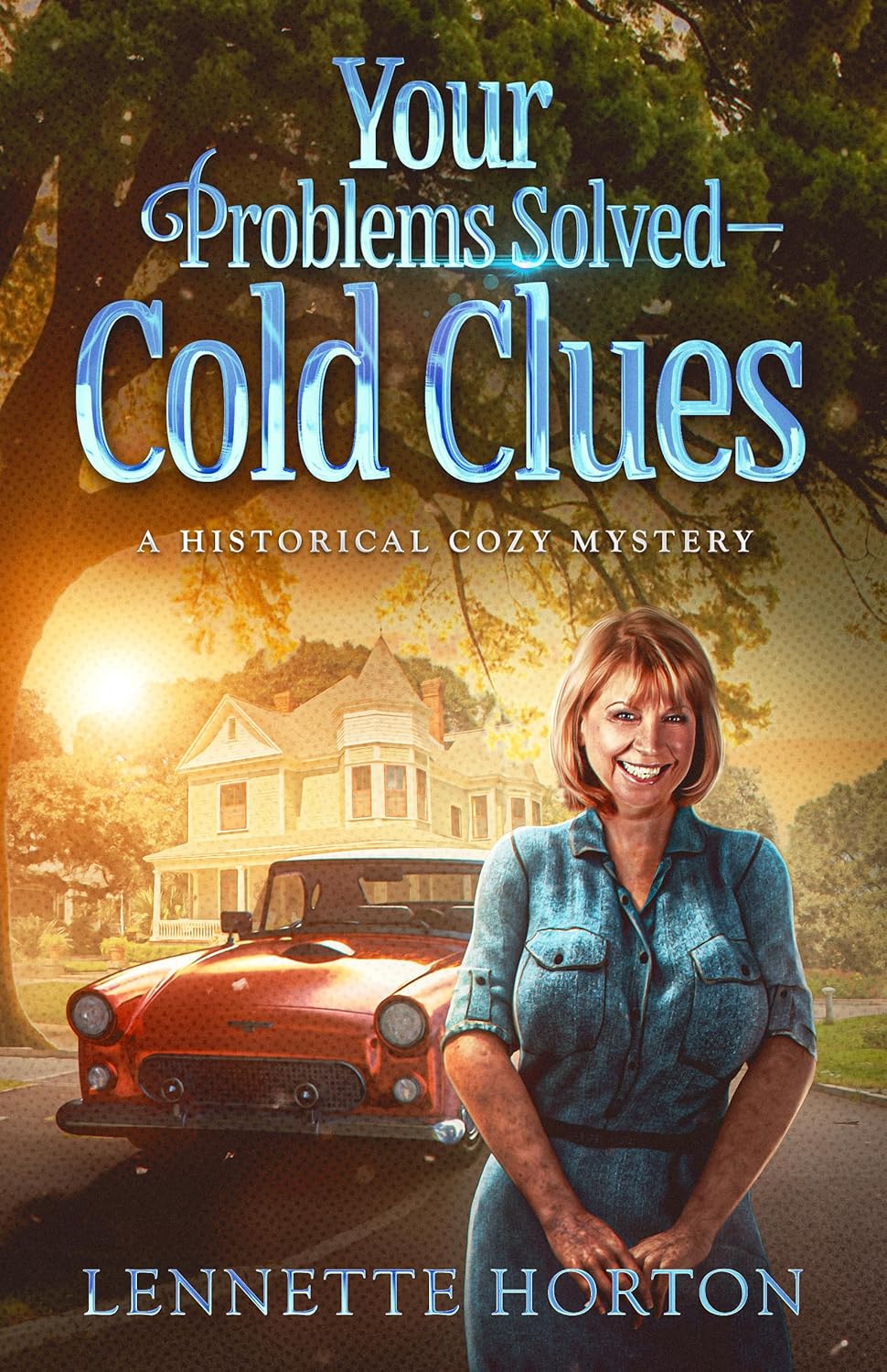
Your Problems Solved: Cold Clues hooked me right from the first scene, where retired librarian Dory Frame steps onto her porch and finds a troubled young woman asking for help. That moment kicks off a mystery rooted in a small California town in 1955, full of heat, old secrets, sharp characters, and the quiet grit of a woman who never expected to become a sleuth. The story winds through murder, corruption, community ties, and one woman’s stubborn insistence on truth. It moves with a gentle rhythm that feels like a stroll through a neighborhood, then tightens when things turn dark. I found myself caring far more than I expected to.
As I read, I kept smiling at the voice of Dory. She is steady and thoughtful, yet she surprises you with a streak of bravery that sneaks up on you. The writing made me feel like I was sitting beside her at the kitchen table, sipping iced tea while she sorted through clues and her own memories. Author Lennette Horton paints small-town life with such affection that even the gossip feels warm. There were moments that hit harder, though, like the quiet grief wrapped around Dory’s widowhood or the unease of a veteran struggling with trauma. Those scenes caught in my chest. They added weight to a book that could have stayed light but chose something richer.
I also appreciated the layers tucked inside the plot. What starts as a simple request from a desperate daughter slowly becomes a tangle of civic corruption, hidden relationships, and buried ledgers. Horton balances this with soft humor and everyday detail. One moment I was caught in the tension of a new clue, and the next I was listening to neighbors talk tomatoes and grandbabies. Oddly enough, that blend worked. It grounded the danger in something very real. I felt like I knew these people. I wanted them safe. I wanted justice to land where it should.
By the final pages, I closed the book feeling satisfied. This story would be wonderful for readers who love cozy mysteries with heart, fans of historical settings, and anyone who enjoys a heroine who solves problems with brains, kindness, and a little stubbornness. If you like mysteries that feel authentic rather than flashy, this one is a great pick. I’m looking forward to reading more of Dory’s adventures.
Pages: 342 | ASIN : B0FNTBNHY3


