Blog Archives
I Left That Possibility Open

Mystery at the Edge of the World follows a retired civil engineer in coastal California whose peaceful retirement is disrupted when he’s drawn into a murder investigation. What inspired the premise of the story?
I’ve thought about using an engineer as the protagonist in a mystery novel for a number of years. In this book, Jace is retired with a comfortable pension, so he doesn’t need to worry about making a living, which frees him to spend whatever time is needed to solve puzzles.
What made you choose a retired engineer, rather than a former police officer or detective, as your amateur sleuth?
There are many mystery stories, in fact, series of stories, where the sleuth is a doctor, a mathematician, a novelist, a lawyer, or even a clergyman. We live in a world full of infrastructure, and there are many stories that could be made from the world of construction alone, never mind all the other interactions people have with the engineered facilities around them, along with each other. But someone has to be at least a little versed in engineering in order to write about an engineer investigating a crime. There is, in fact, an entire discipline called ‘forensic engineering’ which looks at the causes of infrastructure failure, and can unearth criminal activity in the process. So, for me, this subgenre of an amateur engineer sleuth seems under-represented in literature, and looked like a field I could write in, while being entertaining and human at the same time.
Did you know who the culprit was before you started writing, or did the investigation evolve as you went?
I did not have the culprit pegged when I started writing. I left that possibility open as I wrote it, but towards the end, the red herrings swam away, and the culprit remained.
The ending leaves room for more adventures. Do you already know where Jace’s next case might take him?
Yes. I just finished the next novel, Mystery at the Hidden River, where Jace is invited to help with a case that eventually proves to be industrial espionage – and murder.
Author Links: Amazon | Website
The Ficcom Creation Link: Digital Gods


The Ficcom Creation Link: Digital Gods, by C.R. Endacott, is a science fiction thriller with a metaphysical edge, built around the idea that reality may be a constructed system and that some people are beginning to see the code beneath it. The story moves across timelines, from Sarah Yardlem in 925 AD to Sandra Melange and Jackson Blacksmith in 2025, then forward to Detective Constance Sharp in 2124 as she investigates a series of strange murders tied to aphantasia, the Tree of Life, and a hidden digital order. At its core, this is a genre-blending sci-fi mystery about truth, control, fate, and what happens when human beings get close to knowledge they were never meant to have.
Endacott doesn’t settle for a simple murder plot or a clean futuristic setting. Instead, the novel keeps widening the frame until a psychic reading, a police investigation, a cult-like movement, android government control, and questions about reincarnation all start to feel like pieces of the same machine. That could have become overwhelming, but I found myself pulled along by the sense that every strange detail mattered. Sandra’s visions, Jackson’s inability to visualize, and Constance’s sharp, frustrated detective work give the story different textures. One part feels mystical. Another feels procedural. Another feels like dystopian science fiction, looking over its shoulder at religion and asking, “What if the myth was just bad documentation?”
The writing is direct and often more interested in momentum. The dialogue explains a lot, and some scenes lean into their ideas. But there is also something compelling about that urgency. The book feels like it is chasing a revelation and wants the reader to keep up. I appreciated the author’s choice to make aphantasia more than a character trait. Here, it becomes a doorway into bigger questions about perception, free will, and who gets marked as dangerous by a system built to preserve itself. It made the science fiction genre feel personal, almost intimate, because the battle over reality begins inside the mind.
I would recommend Digital Gods to readers who enjoy science fiction with mystery, conspiracy, and philosophical tension woven through it. It will especially appeal to those who like stories about simulated realities, hidden systems, futuristic policing, psychic phenomena, and the uneasy space where technology starts to resemble theology. This is not a quiet book. It’s busy, strange, and full of big swings. For readers who enjoy sci-fi thrillers that ask uncomfortable questions and are willing to follow a story down several twisting corridors to get answers, this one offers a bold and thought-provoking ride.
Pages: 357 | ASIN : B0H1TWM6HM

Who Wants To Be A Billionaire: A Benjamin de Walters Case

Who Wants to Be a Billionaire? follows Brussels notary Benjamin de Walters as he presides over the strangest inheritance case of his career: the estate of Johan Paepe, a reclusive billionaire author whose will first leaves his family one euro, then twists into a billion-euro moral trap. Six heirs, one secret beneficiary, an AI-assisted police investigation, and a possible murder turn what should be a formal reading into a pressure cooker of grief, greed, accusation, and revelation. What begins in the controlled civility of a notary’s office keeps widening, from Johan’s decaying mansion to Usufruct, to the machinery of the Paepe empire, to an almost cosmic final passage over the Bermuda Triangle. It’s part mystery, part family reckoning, part philosophical fever dream.
I found the book most alive when it let people talk themselves into ruin. The early scenes around the table have a prickly, theatrical charge, with everyone trying to sound reasonable while their desperation leaks through the seams. Céline’s grief over Jens, Kenny’s wounded confusion about Joyabel, Pieter’s abrasive refusal to play along, and Nele’s quiet devotion to Brenda all give the inheritance plot a bruised emotional texture. The AI investigation is a smart provocation, too, because it’s not just a gadget. It becomes a mirror that flattens suffering into scores, reducing bankruptcy, illness, addiction, and bereavement into motive. I felt the book was asking a sharp question: when technology claims to see the truth, what parts of the human soul does it trample on to get there?
The writing is eccentric in a way I mostly admired. Benjamin’s voice wanders, digresses, lectures, remembers, and circles back, sometimes like a man telling a story over too much coffee, sometimes like a notary trying to notarize chaos itself. His long riffs on Hitchcock, especially Rear Window, The Birds, and Saboteur, could easily have felt ornamental, but for me they gave the book its strange weather. They echo the themes of watching, staging, suspicion, and performance. Not every detour lands with the same force. Still, I liked the unruly ambition of it. The book isn’t content to be a clean little puzzle box. It wants inheritance law, family trauma, cinema, capitalism, AI, religion, and metaphysics all seated at the same disastrous dinner table.
By the end, I was less interested in who “won” the fortune than in what the fortune had revealed about everyone who came near it. The epilogue in the purple sea of Hallerbos resonated with me because it lets the noise drain away and leaves only survival, tenderness, and the mercy of being understood. This is a strange and heartfelt novel. I’d recommend it to readers who like locked-room mysteries with philosophical tangents, family dramas with teeth, and books that aren’t afraid to veer from legal realism into something far more uncanny.
Pages: 210 | ASIN : B0GYMF6JMW
Sprinkling of the Absurd

Lonely When You’re Dead centers around a freelance writer sent to Quebec City to cover a poetry festival that quickly turns into a murder investigation, complete with riots, biker clubs, and drug debts. What was the inspiration for the setup of your story?
Good question. The obvious inspiration is simply the breaking news on any given day. It seems there is no shortage of large groups of people running seriously amok at one public or not-so- public gathering or another: rock concerts, sporting events, political rallies, children’s birthday parties. I haven’t as yet heard of an authentic poetry riot, but I’m sure it’s coming down the pike, unfortunately. But the idea of a poetry riot—rather than the actuality—is kind of intriguing, if you like your plots garnished with a sprinkling of the absurd.
Quebec City feels vivid and uneasy throughout the novel. What drew you to that setting?
My wife and I lived in Boston during the 1990’s. Quebec City was a day’s drive away, and a fine place to spend a long weekend. The city is lovely, and the old town looks like a slice of Europe set down on the St Lawrence River. Charming. The question of Quebecois sovereignty was the hot issue during the years that we visited Quebec City. There was a definite tension in the air throughout Quebec province. Sovereignty was a can of worms that hadn’t been opened yet, and no one on either side of the question was sure what might pop out. So, potent times.
The humor in the novel is very dry and sideways, even during violent scenes. How important was comedy to the book?
Quite honestly, I don’t consider myself a humorist, or even a particularly humorous writer. The humor seems to seep in, no matter what I intended originally. Lonely When You’re Dead may have a bit more humor than my other novels, because of the slightly absurd nature of the premise. Also, I think the noir/hardboiled approach to the narrative lends itself well to a bit of humor. Dashiell Hammett and Raymond Chandler are thought of as the patron saints of hardboiled mystery writing, and their work certainly displays a sense of humor mixed in with the grim mutterings and threats of bodily harm. Maybe it provides a kind of respite from the bare knuckles of the story.
What is the next book you are working on, and when will it be available?
I seem to be attracted to the mystery and thriller type of novel, and I’ve got a few ideas kicking around. I’m hoping to have a new book out by early next year. Best laid plans of mice and men…
Author Links: GoodReads | Website | Fingerprint File Books | Amazon
Sympathetic Characters

Moving Targets follows a private investigator as a stolen-artifacts case and a decades-old murder pull him into a web of corruption, grief, friendship, and the difficult work of rebuilding a life after loss. What inspired Miles Darien as a detective, especially his emotional depth and old-fashioned investigative instincts?
My love of detective stories started in the same familiar fashion as it did for so many others: Being intrigued by the exploits of Sherlock Holmes stories as a young person, I immediately began trying to figure out the cases before reading the outcome. It set me on a path of being a detective for a good detective story. As both my reading and my real experience base expanded, I became acutely aware of how the emotional elements of everyday life intersected everything we do and the people we become. The cases that a private investigator deals with come with heightened amounts of those same elements. I wanted Miles to experience those things as well, both empathetically and personally. That’s where dramas are born.
The novel balances multiple mysteries with Miles’s grief and personal healing. How did you decide how much space to give the cases versus his inner life?
I have always viewed the cases and Miles’s life to be inextricably linked. So, there was no conscious effort on my part to give a certain amount of space to one or the other. His cases were both a refuge and a challenge when mixed with what was happening in his non-work life. Whatever ended up on the page happened organically.
Miles’s circle of friends gives the book a strong sense of community. Were any of those relationships inspired by real friendships or places?
Friendships have always been extremely valuable commodities for me. The qualities I’ve admired in my friends play a big part in how I develop the sympathetic characters in my books. Conversely, negative behaviors I observe in people I encounter often develop into the less desirable characters. Taking bits and pieces of all of those people and molding them into a story appropriate character is key to creating a believable storyline. As for places, I’ve been fortunate to travel extensively in my life which gives me more diverse places and personalities to draw upon.
The ending offers hope without fully resolving Miles’s grief. Was it important to you to avoid a neat emotional conclusion?
Absolutely. I felt it was important to provide readers with some amount of a lift at the end but, at the same time, acknowledge that grief doesn’t just vanish. It finds an emotional refuge somewhere in a person’s mind, but it is always there lurking in the background. As Miles moves forward, he will deal with it less on a daily basis, but it can always be recalled, often at an inopportune time. Those times will come in handy as elements of his ongoing story.
Author Links: GoodReads | X (Twitter) | Facebook | Website | Instagram | Amazon
The investigation takes Miles and his life-partner FBI Agent Ken Caldwell, to Wisconsin’s Northwoods where the ongoing distrust between the indigenous and white populations is palpable. The case suddenly takes a deadly turn when its resolution leaves a new tragic trail of death. Miles is forced to decide whether he can continue his work while, at the same time, overcoming his guilt and paralyzing sadness. That dilemma drives him to make the biggest decision of his life.
Margaret Ann and the Reckoning

In Margaret Ann and the Reckoning, Cindy Cortez Prieto drops readers into a cemetery where death is not an ending so much as a strange continuation: Margaret Ann, a dead girl living among other spirits with her grandpa and her friends Hazel and Marco, investigates the suspicious death of wealthy Florence Mason while also facing the return of the Gazer, a malevolent force hunting her essence. The book braids a murder puzzle with a supernatural struggle, and that combination gives it an unusually lively pulse for a ghost story aimed at younger readers.
What I liked most was the book’s tonal oddity in the best sense. It can be eerie, then playful, then unexpectedly tender. Prieto has a real affection for her cemetery world, and that affection keeps the novel from turning merely grim. I liked the way the dead still squabble, joke, investigate, worry, and form makeshift family bonds. That emotional logic matters more than strict realism here, and it gives the story a homespun sincerity that I found winning. Hazel, in particular, adds warmth, and Margaret Ann’s mix of bravery, irritation, curiosity, and vulnerability keeps the novel from feeling embalmed in sweetness.
I also appreciated the novel’s willingness to be melodramatic. The wicked voices, the family greed, the spectral menace, the sense that a child detective can step straight from library research into metaphysical peril, none of it is shy. Sometimes the prose is a little blunt, and some scenes land with more earnestness than polish, but there is energy in that directness. The book doesn’t smirk at its own haunted premise. It commits. And because it commits, the spooky set pieces and emotional beats have a kind of old-fashioned crackle. And that makes the story vivid.
I would hand this to middle-grade and young YA readers who enjoy paranormal mystery, ghost adventure, supernatural suspense, cemetery fiction, and kid-detective stories with a strong streak of heart. Readers who like Neil Gaiman’s The Graveyard Book may recognize a similar fascination with childhood among the dead, though Prieto’s novel is less lyrical and more openly earnest, with a warmer, more familial glow. This is a spooky-hearted mystery that prefers soul to slickness, and that is its own kind of magic.
Pages: 143 | ASIN : B0GQ6V5D7P
Hellcat
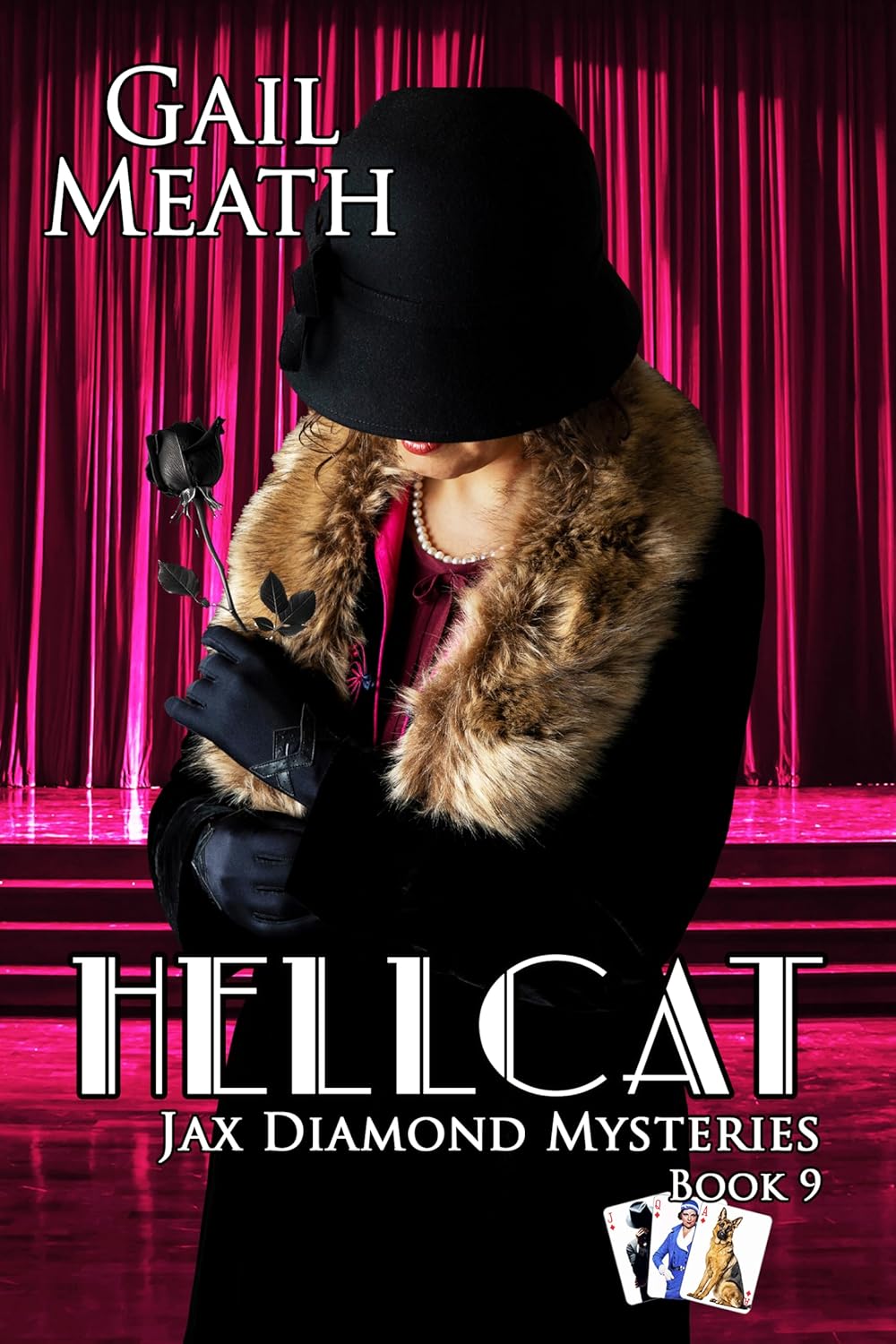

Hellcat opens like a trap snapping shut and hardly loosens its grip from there. Gail Meath drops us into 1923 Manhattan with a woman already stalking a man she believes is about to murder his wife, then braids that lethal prologue into a larger mystery involving Jax Diamond, his newlywed life with Laura, a string of gangland killings marked by lipstick and black roses, and the aching disappearance of Riley O’Shea. What I found especially satisfying is the way the book keeps shifting registers without losing its footing. It can move from an elevator-shaft death at the Plaza to a World Series sequence where Laura’s shaky rendition of “Take Me Out to the Ballgame” gives way to a genuinely stirring, stadium-silencing “Star-Spangled Banner,” and somehow both scenes belong to the same emotional weather. The result is a mystery that feels busy in the best sense, full of motion, personality, and period texture.
I enjoyed the novel’s emotional undercurrent, which is stronger and sadder than the jaunty setup first suggests. Jax’s jealousy over Vince Vitali’s flowers and his rough-edged honeymoon banter give the book a screwball warmth, but the missing-person thread lends it real ache, especially once Maureen O’Shea speaks about a marriage so steadfast that her husband would have “fought his way through hellfire” to get home. That conviction gives the whole investigation a pulse. Later, when Jax carefully coaxes the amnesiac Riley back toward himself with talk of a house, a yard, and finally Maureen’s name, the novel lands on something unexpectedly tender. Beneath the wisecracks, the book is interested in loyalty, memory, and the terrible distance between being alive and being able to return to the people who love you.
Death Row Dotty is not treated as a cheap gimmick. She becomes a way for the novel to ask what people do when institutions fail, when grief curdles into purpose, and when vengeance starts to look like justice from far enough away. There’s even a moment when public sympathy for her grows, and that complicates the moral atmosphere nicely. Meath’s writing isn’t trying to be hard-boiled in a joyless, imitative way. It’s more generous than that. The dialogue has bounce, the pacing is brisk, and the historical details, from the nightclubs to the library work to the underworld gossip, are woven in with an easy hand. The plotting can feel a little crowded, and the sheer number of moving parts asks for some patience, but I found that abundance part of the charm. The book wants romance, danger, sentiment, spectacle, family drama, and a fair bit of theatrical flair, and more often than not, it earns all of it.
Hellcat is entertaining. What I expected to be a stylish period mystery turned out to have a bruised heart, and that heart is what gave the story its staying power for me. I’d recommend it most to readers who like historical mysteries with strong relationship dynamics, a touch of melodrama, and a detective story that makes room for grief, devotion, and moral ambiguity alongside its murders and clues. It’s a lively, emotionally textured mystery, and I closed it feeling that it had more on its mind than a simple whodunit.
Pages: 218 | ASIN : B0F3JGS9KH


