Blog Archives
Rome’s Culture

In The Altar of Victory, you take readers on a journey into the days of the Western Roman Empire and the political fallout following the death of Emperor Valentinian I. Why was this an important book for you to write?
It was important to me for several reasons. My interest in this era began long ago, when I was a European History major in college and had taken a class on the period from Late Antiquity through Charlemagne (300-800 AD roughly). The period up to Constantine was well covered, as was the actual catastrophe of the sack of Rome in 410 AD and the subsequent barbarian invasion. However, the course jumped past the last half of the 4th Century, when the Roman empire was still intact and just before these catastrophes began to increase. The more I read in the intervening years, the more evident this gap appeared. Even Gibbon’s Decline and Fall of the Roman Empire tended to treat this critical period of European history in summary fashion.
I also decided that the question of how such a technologically advanced civilization like Rome, with the most organized army and engineering in the world, could fail to see the threat and fall so quickly to less organized enemies. Was there a point when the decline could have been arrested? Did it really come down in part to the deaths of perhaps three key emperors (Valentinian, Valens, and Gratian)? Was it cultural change and the loss of a Roman identity? What role did the advent of organized Christianity play? It was a host of puzzles that I wanted to understand, if not solve.
Can you share with us a little about the research that went into putting this book together?
Before I began writing, I spent several years accumulating various non-fiction sources- books by more contemporary historians like David Brown and Michael Grant; biographies of Ambrose of Milan, etc. I also went to the limited primary sources- Ammianus Marcellinus, of course, Zosimus, the letters of Symmachus, St. Jerome, Ausonius, the Notitia Dignitatum, and others; the military manual of Vegetius. Even as I began to outline the plot and write the first chapters, I continued to read and learn what I could, and still felt that so much was still missing from the historical record. Which was also good, because it enabled me to fill in with a plot of my own devising!
What were some themes that were important for you to explore in this book?
I wanted to explore what remained of Rome’s culture in the 4th Century, and how it had been eroded or replaced as the empire had grown and the city of Rome was no longer the center of the empire. I was also interested in the courts of the emperors, when the emperors no longer came from Rome or even visited very much. The idea that the key military and administrative figures had now become Gauls, Franks, and other nationalities/tribes who had only recently been enemies of Rome seemed to me to be critical in understanding how “Romanness” could have been disappearing for decades before a military transition occurred.
Another theme of importance to me was the figure of Gratian. By all accounts, he was a decent and brave military leader and tried to be a good emperor. He was also a fairly devout Christian and took an interest in the ecumenical issues of the day. And yet, he did not last, and after his reign, the Roman army did not do well in the west. I wanted to explore whether he was the last, best hope for Rome and what factors worked against his success.
Can we look forward to more work from you soon? What are you currently working on?
I am both researching and writing the sequel to The Altar of Victory, in which I intend to conclude Gratian’s story. I am also trying valiantly to finish a collection of short stories set in the 19th and early 20th centuries of Louisiana and Texas before year end.
Author Links: GoodReads | Facebook | Website | Amazon
The Altar of Victory
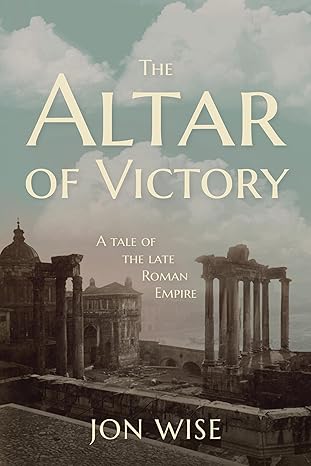

The Altar of Victory is a historical novel that plunges the reader into the waning days of the Western Roman Empire, centering around the death of Emperor Valentinian I and the political maneuvering that follows. Set in 375 A.D., it opens with Valentinian’s dealings with barbarian tribes and internal dissent, leading to his sudden death after a fit of imperial rage. The story then shifts into high-stakes political chess as the ambitious general Merobaudes races to install young Valentinian II on the throne before rivals can seize control. Along the way, the novel wrestles with themes of legacy, power, faith, loyalty, and the slow unraveling of an empire.
I found myself immediately immersed in its stark, lived-in world. The writing is richly atmospheric and historically informed, without ever feeling like a lecture. Every decision, every letter, and every small detail, like the crack in the aqueduct or the placement of a chair, feels purposeful. The prose is tight, clear, and evocative. What struck me most was how human the characters felt, especially Valentinian. He’s brutal, weary, proud, and oddly sympathetic. When he collapses mid-sentence, the emotional weight lands hard. The tension is just as strong in the quieter moments, furtive whispers in palace halls, long rides through uncertain terrain, as it is in battles and tribunals. I especially appreciated the balance between dialogue and action; the pacing kept me glued.
That said, what I really liked was the depth of the ideas. The book takes a hard look at power and how it mutates in uncertain times. The clash between the old gods and Christianity is not just window dressing; it’s a lens through which every character sees the world. Merobaudes, in particular, is a fascinating figure. He’s clever, opportunistic, not fully Roman yet entirely molded by Rome’s ideals. The women in the story, especially Justina and Mirjeta, are sharp and compelling, with agency that matters. There’s also an aching sense of decay in every corner of the empire, ruined towns, forgotten monuments, fading gods, that gives the story a haunting quality. I found myself thinking a lot about how empires die, not just politically, but spiritually.
I’d recommend The Altar of Victory to anyone who enjoys political intrigue, ancient history, or character-driven stories with bite. It’s a slow burn, but a rewarding one. If you like your historical fiction thoughtful, gritty, and emotionally textured, this one delivers. It’s not light reading, but it’s deeply satisfying, and in more than a few places, surprisingly moving.
Pages: 537 | ASIN : B0DCQ783YW

Colloquialism and Exoticism

Damnatio Memoriae is the final, emotionally raw, and beautifully written chapter of the Nero and Sporus saga. How do you feel now that you have completed Sporus’s story, and were you able to achieve everything you wanted with the characters in the novel?
This is really one long novel, but now that I’ve reached an advanced age, I always worry about being able to finish things so I decide to do it as a trilogy so that even if I were to pass away, that would still be some parts of the book out as separate books. Because of this, I’ve lived with the characters for a very long time. One thing though is that we do know how the story ends, and we’ve always known it because it’s one of the few things that the historical record actually tells us. One problem with releasing the story in smaller chunks has been people getting the last chunk and complaining bitterly about the protagonist’s fate. Unfortunately, it’s one of the few things I couldn’t change without violating the whole idea of a historical novel.
What goals did you set for yourself as a writer in this book?
My largest aim was to truly inhabit the world of the first century and completely eschew any kind of moral or philosophical biases I might have as an inhabitant of our modern era. This is very difficult because so many things that were taken for granted are now shocking, and something that taken for granted today would’ve shocked the Romans. For example, the idea of people actually being equal would have been astonishing. Sex and violence, so much a cause of societal uproar today, were not only not that profound, they were even mostly entertainment. One reader complained bitterly that I didn’t use archaic language. But the Romans didn’t know they were ancient! I had to strike a balance between colloquialism and exoticism. Everyone doing what I do has to find their own happy medium. I hope that that which is exotic or horrific about the Roman world comes across most successfully when it is treated as completely commonplace.
What experience in your life has had the most significant impact on your writing?
Bringing up a child who was completely comfortable as either gender and had no qualms about switching whenever he felt like it. This book is actually dedicated to him. I use the word him because the language I usually speak to him in is Thai, a language in which most pronouns are gender-neutral. People who grow up in this culture simply don’t suffer any agony about pronouns.
What is the next book that you are working on, and when can your fans expect it to be out?
I’m returning to science fiction and fantasy at the moment with a new post-holocaust trilogy set among wolves. I’m also doing a sixth novel in a series that I’ve been working on for over 40 years. It was very popular in the 80s and I’m reviving it. It’s one of those vast Galactic Empire kind of things.
Author Links: GoodReads | Facebook | Website | Amazon
Captured by pirates as a boy and trafficked to the slave markets of Rome, Sporus rose from a poet’s plaything to one of the most powerful figures in the Roman Empire.
The historian Suetonius tells us that the Emperor Nero emasculated and married his slave Sporus, the spitting image of murdered Empress Poppaea. But history has more tidbits about Sporus, who went from “puer delicatus” to Empress to one Emperor and concubine to another, and ended up being sentenced to play the Earth-Goddess in the arena.
The decadence of Imperial Rome comes to life in S.P. Somtow’s Literary Titan Award-winning trilogy about one of ancient history’s wildest characters.
Damnatio Memoriae

Somtow’s Damnatio Memoriae is the final, emotionally raw, and beautifully written chapter of the Nero and Sporus saga. It’s a deeply personal journey told through the voice of Sporus, a former slave and imperial concubine, who relives his (and her) rise and fall at the edges of empire, identity, and power. This isn’t your average Roman epic—it’s visceral, surreal, darkly poetic, and hauntingly queer. With Nero’s collapse and Rome’s chaos as the backdrop, Sporus reflects on life, gender, betrayal, and the myth of love, all while waiting to be executed in a packed arena. It’s intense.
What hit me first was how lyrical the writing is. It reads like a fever dream soaked in garum and incense. Somtow doesn’t hold back—there’s real pain here, but also twisted humor and staggering beauty. The opening monologue, for example, where Sporus describes the reek of sand, blood, and beast dung in the arena, while cracking dry jokes about makeup and waiting for a death scene, felt like Oscar Wilde doing Gladiator cosplay. And yet, it’s achingly tragic. And then there’s the ring scene in the marketplace, where a carved image of Persephone triggers a spiritual collapse and sparks an impromptu imperial crucifixion crisis. Absolutely brilliant and brutal.
That said, this book isn’t an easy read. It expects a lot from you—emotionally, intellectually, even morally. Nero is magnetic and monstrous, sometimes at the same time, and the dynamics between him and Sporus swing from disturbing to tender. Somtow nails this complexity. But the heartbreak really comes from how aware Sporus is of their own powerlessness, even while being dressed up as a goddess or cherished as a boy. In “Clipped Wings,” the metaphor of the clipped doves—meant to be freed in a religious ritual but secretly recaptured—just gutted me.
If you like your historical fiction brutal and beautiful, if you’re into mythology reimagined through a queer lens, if you can handle morally messy characters and poetic trauma—this is for you. Fans of Mary Renault, Madeline Miller, or even Game of Thrones at its sharpest will probably find something to love here. But it’s also for people who want to feel something deep and uncomfortable. I’m not gonna lie, it’s sometimes hard to stomach—but I didn’t want to look away.
Pages: 232 | ASIN : B0F2YZ1HRH
My Version of Vampires
To End the Night follows Julius Caesar as he battles a secret enemy, one that is dark and sinister and exists in the shadows of the Roman Empire. What was the inspiration for the setup of your story?
I really wanted to do a different take on vampires and I was watching a documentary about Julius Caesar and just thought, huh, that would be a good setting to do my version of Vampires in. I wrote the story originally in the late 90’s as a short story and then beefed it up to a novella later.
Can you share with us a little about the research that went into the historical aspects of your novel?
Loads and Loads! I have an entire bookcase dedicated to Julius Caesar and ancient Rome now. Many hours reading with highlighters and googling things for clarification. I also went on a history channel binge for JC documentaries. I listed some of the most used research items in the back of the book. I wanted the history in my historical fiction to be as accurate as possible. I am writing a book starring Genghis Khan now and already have 18 history books I’m going through.
How were you able to strike a balance between historical accuracy and supernatural events?
For me, it was a matter of motivation. Why did JC cross the Rubican? Why did he pursue power so doggedly? And then finding places to slip in the motivation. I wanted the history to be the star of the show with the supernatural as a supporting cast.
What is the next book fans can expect to see from you?
I have a book with the editor right now called The Ballad of Jayce: Not Your Mother’s LitRPG. It is my take on LitRPG. I’ve been told it is like a LitRPG meets Ready Player One. I am using an editor that is completely unfamiliar with the genre to help me make it as accessible as possible to people who do not read LitRPG. I needed a fun thing to do after all the research that went into this book. I am also 25 thousand words into my Genghis Khan historical fiction and have plans for a Terry Pratchet style book after that. I plan on bouncing between more serious historical fiction and light hearted fun things.
Author Links: GoodReads | Bluesky | Facebook | Website | Amazon
A Poet and An Artist

Moses and Akhenaten: Ancient Egypt Fiction Series Book 1 explores with great detail and some imaginative storytelling the theory that the biblical Moses and the Egyptian Pharaoh Akhenaten were the same person. Where did the idea for this novel come from and how did it develop over time?
Akhenaten amazed me as a child. He was considered the “first monotheist” and “first individual in history”.
As an adult, I wanted to write literary fiction and chose Akhenaten as a subject. This book is a response to a man who was not only a king with a unique religious vision, but also a poet and an artist.
Fiction is an art form that uses elements of the imagination as an artist uses paint. Many paintings are layered and this was my approach. It seemed appropriate because King Akhenaten was many things.
First, there is the little boy, Akhy, and his family, all of whom are based on real people instantly recognizable to those familiar with Egyptian history.
Akhenaten crossed his own time and culture to be of interest to people in many countries living in times different from his own. It is the reason he debates with modern academics in the novel and why a time machine is included.
The real King Akhenaten was an artist so far ahead that much of his work appears to be out of his time. His art, for instance, has been described as expressionistic. It is the reason this novel shows him painting both within his own time and in ours.
Likewise, his ownership of Bessie, the dinosaur is an echo of the Biblical leviathan. This creature is mentioned in Psalm 104, which is also dubbed the Song of Moses. It is this psalm that scholars have equated with Akhenaten’s own Hymn to the Aten. They both appear at the end of this novel where readers may compare the two works at their leisure.
There have been heated responses to the Moses and Akhenaten theory. Ahmed Osman had his book, which boldly stated that Akhenaten was the prophet, burned in the streets of Cairo.
My book is not an altogether serious religious discussion, which is better served in the academic realm of non-fiction. Rather, it is a celebration of the artist and the poet whose religious ideas still intrigue us.
Children appear in the novel because they, more than any of us, express the joy of life and creativity.
As for Akhenaten, Egyptologist and Director General of the Cairo Museum (2004 to 2010), Wafaa El-Saddik once said he was of huge importance, not simply as an Egyptian pharaoh but to the history of the world.
It must be remembered there is still a lot for us to discover about the Egyptian king. In the meantime, while the academics debate and archaeologists dig, this novel invites the reader to celebrate a genius who was a significant thinker and innovator in human history.
Did you find anything in your research of this story that surprised you?
My conclusion, which is that Akhenaten is not Moses.
Once heralded as a forerunner of Christ and the first monotheist, Akhenaten was later considered to be a fanatic who ruled in a manner not unlike that of the Nazis. (This is the reason there is a reference by Akhenaten in the novel to this latter-day interpretation.)
Many people, including the famous psychoanalyst Sigmund Freud, were captivated by both the prophet Moses and the pharaoh Akhenaten without making a connection that the two could be the same individual. Other writers made the connection, including the Egyptian author Ahmed Osman, who declared Akhenaten to be none other than Moses.
I visited Egypt several times, fuelled by the desire to discover more about both Moses and Akhenaten. I am also qualified in Egyptology with a postgraduate degree in the discipline.
The whole process was a massive undertaking and the novel was shelved for many years. Now, after further thought, I have concluded that Akhenaten was not the prophet Moses. Part of the reason is that there are new academic theories and archaeological evidence that support this conclusion.
However, Akhenaten’s revolution was important and still intrigues many historians. What is interesting is that the prince of Egypt, who caused issues in Egypt has no other historical parallel except with Pharaoh Akhenaten.
Both Moses and Akhenaten were raised in Egypt. Moses’ Ten Commandments are a brilliant abbreviation of the Negative Confessions within ancient Egyptian writings. It is no accident, either that there are echoes of Akhenaten in the holy books.
Even while scholars debate Psalm 104 and the Hymn to the Aten, and whether Akhenaten was a monotheist or not, his city is still out there. Badly in need of restoration, my view is that it is a city of global importance, not simply another local heritage site (as valuable as such sites are).
Despite the deep connections between Akhenaten and Moses, for me, Akhenaten stands on his own as a great Egyptian prophet who was light years ahead of his time. There is no need for him to be Moses to hold his place in history.
Egypt should be credited with his achievement as with other great works of their civilization such as the pyramids. The ancient Egyptian civilization was the most advanced of its time, and as Wafaa El-Siddik pointed out, Akhenaten is of immense importance to the world.
What were some ideas that were important for you to share in this book?
I wanted people to think about Akhenaten. We are all aware of Moses from holy texts. Three monotheistic religions recognize him as a prophet. However, archaeological evidence shows that there once lived a king who spearheaded a religious revolution and did something so extraordinary that we are still talking about it. The site of Akhenaten’s city, Tell el-Amarna, which the ancient Greeks referred to as the City of Moses, still exists in the middle of Egypt.
When will book two be available? Can you give us an idea of where that book will take readers?
Book two is available. The Tutankhamen Friendship has a British style because it is about the English discoverers of Tutankhamen’s tomb. Both English and European readers love it, perhaps due to the style and their familiarity with the story.
Book three, The Queen Who Became King is also available. It is based on the true story of an ancient Egyptian queen, and incidentally one of Akhenaten’s ancestors. Feeling that she had to protect her young nephew Tuthmosis, this extraordinary woman stepped up to rule as king. At her death, Hatshepsut left a legacy of a strong country to her nephew. Tuthmosis III, known as Tuthmosis-the-Great, inherited her throne and went on to become Egypt’s greatest conqueror. To this day, he is thought to be Egypt’s foremost military ruler.
Author Links: GoodReads | X | Facebook | Website | Book Review
He could inherit the throne of Egypt …
… and change the world forever.
But does he?
This is the first novel to set Akhenaten in his childhood.
Making use of the theories surrounding a king, who has been thought to be Moses, the book entertains with a poetic tale of children and what might have been, if only it were true!
Moses and Akhenaten: A Child’s Tale
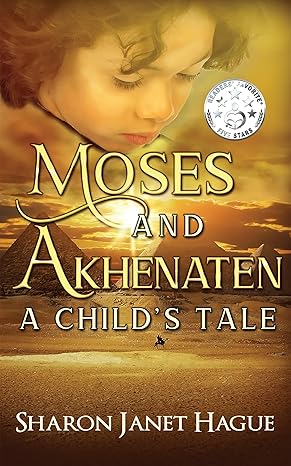

Moses and Akhenaten by Sharon Janet Hague takes on the ambitious theory that the biblical Moses and the Egyptian Pharaoh Akhenaten were the same person. The book weaves historical analysis and imaginative storytelling, proposing that the famous biblical exodus and Akhenaten’s religious revolution are intertwined stories of the same man. Through a blend of fictional dialogue, historical narrative, and philosophical musings, Hague presents a compelling story for this theory.
The book is a unique mix of informal conversation and deep historical exploration. At times, it feels like sitting in on a heated debate among scholars as characters such as Walter, Tom, and Ernest discuss the possible connections between Moses and Akhenaten. For instance, Tom’s logical statement, “If Theodore Davis’ discovery in cache number fifty-five was Akhenaten’s body, then Akhenaten cannot be Moses,” drives home the tension between hard evidence and speculative theory. This dynamic made the book engaging and made me feel like I was part of an intellectual journey, though I feel that sometimes the debates veered into detailed and repetitive territory.
One of the things I loved about the book was its willingness to tackle big ideas with an unapologetic mix of history and conjecture. The idea that Akhenaten’s monotheism predates and even influences the Jewish faith is thought-provoking, and Hague doesn’t shy away from pushing that theory. She writes, “Nobody can convince me that billions of people worshipping one god, thirty-one centuries later is anything but a success”, showcasing Akhenaten’s monumental impact, whether or not he was Moses. While the story borders on speculative fiction, Hague’s presentation of Akhenaten as a revolutionary and somewhat tragic figure is heartfelt, bringing life to what could otherwise have been a dry historical argument. At one point, Akhenaten himself complains about modern perceptions of him: “I can’t tell you how heartily sick I am of being labeled everything from a weak king to a Nazi.” Moments like this add a humorous, almost anachronistic flavor that, while entertaining, sometimes undermines the gravitas of the subject. Still, the book’s casual conversations helped break down the dense historical material, making it more digestible and approachable for readers less familiar with ancient Egypt’s intricacies.
Moses and Akhenaten is a fascinating blend of historical theory and speculative storytelling. It’s ideal for readers who enjoy mixing history with a splash of imaginative fiction. If you’re a fan of ancient history, religious studies, or philosophical debates on the origins of faith, this book will keep you thinking long after you’ve finished it.
Pages: 301 | ASIN : B0BQCT1G1Q
Matilde’s Empress: Book Three of the Visigoth Saga

Matilde’s Empress by Robert Philips delves into the turbulent aftermath of Gainas’ failed coup, leading to his death and Matilde’s desperate flight to her maternal home. There, her family embraces her, offering solace as she mourns both her husband and their unborn child. Soon after, Matilde marries her stepbrother Alaric and gives birth to their son, Theodoric. When Matilde is summoned for her connection to Gainas’ rebellion, Alaric steps in to protect her, but at a heavy cost. His intervention results in the loss of his position within the Roman Empire and his people being deprived of critical resources. Tragedy strikes again when Matilde’s tribe is attacked, and she, along with her son and servant, is taken prisoner. After enduring these hardships and eventually reuniting with her family, Matilde faces more losses, with several close family members having perished. For a brief time, she finds love and achieves high status within the Roman Empire, but it is short-lived. Though peace is eventually restored, Matilde is left with only a bittersweet resolution.
Set between 400 CE and 422 CE, Matilde’s Empress is rooted in historical fiction, drawing from real events of the Roman Empire. Some characters, like Matilde, are fictional, while others, such as Constantius, are based on historical figures. The novel explores the complexities of life in the Roman Empire, particularly highlighting how women’s femininity often overshadowed their intelligence. Matilde, a woman of sharp mind and wisdom, consistently provided sound advice, something Constantius himself acknowledged. However, her failure to bear him a child distanced him from her, favoring Placidia as empress due to her ability to give him an heir. Despite Matilde’s many contributions, she is never granted an official position, emphasizing the harsh reality that her influence depended on her attachment to powerful men. As she ages and is considered past her prime, her ability to make a significant impact fades, and she spends her later years bonding with her grandchildren. Philips excels in exploring the theme of “death by natural causes,” which adds an unexpected twist and depth to the narrative.
Matilde’s Empress is a richly layered tale of survival, loss, and resilience in a time when a woman’s worth was measured more by her ability to bear children than by her intellect. The novel succeeds in painting a vivid picture of life during the Roman Empire and offers readers a thoughtful exploration of the complexities faced by women in history.
Pages: 273 | ASIN : B0DBGQQ26F


