Blog Archives
Mask of Romulus


Mask of Romulus follows a sweeping story that stretches from Rome to India and ties together power, ambition, prophecy, and the fragile nature of empire. The book opens by painting a world connected by trade and restless ideas. It introduces Augustus at the height of his influence and an India fractured by competing kingdoms. Into this tense landscape steps Kamala, an oracle whose visions push her toward a journey that crosses four thousand miles and collides with the political storms of the Roman world. The novel layers real history with imagined personal struggles, giving the reader a sense that huge movements of empire hinge on private choices, secrets, and fate.
As I moved through the early chapters, I felt pulled in by how personal the book tries to make epic history. The scenes from Octavius’ childhood surprised me. They feel raw and grounded, almost gritty at times, and they made him more human than the distant marble figure we tend to imagine. The writing jumps between action and reflection, sometimes with sharp contrast, and that rhythm kept me alert. The prose feels almost cinematic, especially the storm at sea and the tension around Caesar’s final days. The book has a clear emotional heartbeat. It cares about loneliness, loyalty, power, and the cost of ambition. Those themes.
What really stuck with me was how confidently the author shifts between worlds. Rome feels vivid with its politics, temples, mentors, conflicts, and restless ambition. India feels just as alive in its spiritual tension and shifting kingdom lines. Even though the story reaches far beyond any one character, the author still gives each major figure enough emotion and doubt to make their choices feel real. I especially appreciated how the book doesn’t treat history like a static backdrop. It treats it as something alive and dangerous. The writing style itself is clean but emotional. Sometimes the dialogue leans formal, but I never felt pushed out of the story. Instead, it gave me the sense that these people carried the weight of their worlds in every sentence.
I feel like Mask of Romulus is a great fit for readers who love historical fiction but want more than dates and battles. It’s for people who like character-driven stories, who enjoy seeing famous figures stripped of their myth and shown as vulnerable, ambitious, or afraid. It’s also perfect for anyone who enjoys ancient-world political drama or a good cross-cultural adventure. I’d recommend it to readers who want something immersive, thoughtful, and full of heart.
Pages: 300 | ASIN : B0G26Z32D4

The Tribune


The Tribune by Paul E. Roberts is an ambitious and vividly detailed historical adventure that straddles the line between modern mystery and ancient warfare. The novel begins in the present day, following David Thompson, a struggling American PhD candidate in Roman history, who is whisked away to Romania by a mysterious phone call from an old friend. This call triggers a journey into the Carpathian wilderness in search of a long-lost Roman eagle standard—an artifact tied to one of history’s forgotten battles. The narrative then plunges into the past, weaving in the gripping tale of Septimus Flavius Patrionus, a young Roman tribune caught in the chaos of a doomed military campaign. What unfolds is a tense and haunting exploration of war, identity, ambition, and historical truth.
I admired the realism and the research, and how Roberts doesn’t pull punches when it comes to the grit and grime of soldiering, ancient or modern. The Roman scenes are brutal, rich, and immersive. I found myself far more emotionally invested than I expected, especially in Septimus’s transformation from uncertain young officer to man grappling with the brutal reality of leadership. The writing walks a fine line between clarity and rawness—straightforward and punchy one moment, introspective the next. The pacing isn’t perfect, it meanders at times, but I didn’t mind. It gave me space to breathe and soak in the mood.
Where the book really gripped me was in the blend of timelines and the emotional weight that ties the characters together across centuries. David’s desperation, his doubts, and his academic hunger mirror Septimus’s fears and hopes in a surprisingly touching way. The discovery of the eagle becomes more than just a plot device, it’s a symbol of lost causes, pride, and the weight of legacy. I love that the book isn’t afraid to be dark, mysterious, or even a little weird. The dialogue is modern and clean, and the humor feels lived-in, not forced, but rising naturally from the characters’ bond and exhaustion.
The Tribune hit me harder than I expected. It’s not just about history, it’s about how history lives in us, haunts us, and sometimes gives us purpose. This is a book for anyone who loves historical fiction with grit, academic thrillers with heart, or stories that make you question where fact ends and myth begins. If you’re drawn to the dark corners of the past or have ever stood in front of an ancient ruin and felt the weight of time press on your chest, then this one’s for you.
Pages: 233 | ASIN : B0F5GM6QQJ

My Version of Vampires

To End the Night follows Julius Caesar as he battles a secret enemy, one that is dark and sinister and exists in the shadows of the Roman Empire. What was the inspiration for the setup of your story?
I really wanted to do a different take on vampires and I was watching a documentary about Julius Caesar and just thought, huh, that would be a good setting to do my version of Vampires in. I wrote the story originally in the late 90’s as a short story and then beefed it up to a novella later.
Can you share with us a little about the research that went into the historical aspects of your novel?
Loads and Loads! I have an entire bookcase dedicated to Julius Caesar and ancient Rome now. Many hours reading with highlighters and googling things for clarification. I also went on a history channel binge for JC documentaries. I listed some of the most used research items in the back of the book. I wanted the history in my historical fiction to be as accurate as possible. I am writing a book starring Genghis Khan now and already have 18 history books I’m going through.
How were you able to strike a balance between historical accuracy and supernatural events?
For me, it was a matter of motivation. Why did JC cross the Rubican? Why did he pursue power so doggedly? And then finding places to slip in the motivation. I wanted the history to be the star of the show with the supernatural as a supporting cast.
What is the next book fans can expect to see from you?
I have a book with the editor right now called The Ballad of Jayce: Not Your Mother’s LitRPG. It is my take on LitRPG. I’ve been told it is like a LitRPG meets Ready Player One. I am using an editor that is completely unfamiliar with the genre to help me make it as accessible as possible to people who do not read LitRPG. I needed a fun thing to do after all the research that went into this book. I am also 25 thousand words into my Genghis Khan historical fiction and have plans for a Terry Pratchet style book after that. I plan on bouncing between more serious historical fiction and light hearted fun things.
Author Links: GoodReads | Bluesky | Facebook | Website | Amazon
“A Poem and a Mistake”

Poetic Justice follows a poet in Rome who is exiled by the emperor and winds up in a town plagued by a mysterious murder. What was the inspiration for the setup of your story?
It started with a question much asked by Classicists – why did the Emperor Augustus exile the poet Ovid? We still don’t really know though it hasn’t stopped people guessing. Ovid himself – the real poet Ovid, that is – hints that he offended the Emperor with “a poem and a mistake”. From there I started to wonder how Ovid would have coped living in a small Greek town on the edge of Empire. And when I discovered that, in his youth, the real Ovid possibly spent a year working in the world of law and order in Rome, that gave me the idea for him turning detective.
What kind of research did you do for this novel to ensure you captured the essence of the story’s theme?
I read Ovid’s poems – the ones he wrote in exile – and was struck by how badly he seemed to be coping. Of course, this is a portrait of himself that he wanted to convey in the poems. Interesting that he wants us to see him constantly complaining and wailing. No Roman endurance here!
I also had to research the town of Tomis, now covered by the modern Romanian city of Constanta. I was fortunate in that Constanta has a wonderful Museum of History and Archaeology, and its website freely publishes many useful documents.
I read a lot about how witchcraft is depicted in Roman writers, and I discovered that Ovid stopped at Samothrace on the way to Tomis. It is likely that he was initiated into the mysteries of the Great Gods at the huge temple complex on the island. You know the famous Winged Victory statue in the Louvre? That comes from Samothrace. These cults from the east were embraced by the Romans quite readily, which I found interesting.
What were some themes that were important for you to explore in this book?
I always like to explore the difference between what the sources tell us and what common sense tells us. If you just read Ovid, then you would wonder why anyone ever lived in Tomis, so I wanted to show life here as normal, relatable. A small town like Tomis would have a long history but there would be none of the huge buildings we see in Rome, none of what I call the Hollywood element. There would be far fewer slaves than in Rome, and the population would be mixed – Greeks, some Romans, people who had settled from around the Black Sea, lots of locals from the tribes around the Danube, and traders from around the Mediterranean. And Ovid would have been the most famous person ever to live in Tomis – just imagine if your favourite writer came to live in your ordinary, nobody’s-heard-of-it small town!
When will book 2 be available? Can you give us an idea of where that book will take readers?
Book 2 should be available by the autumn, and it takes the reader away from Tomis to an extent, giving an Empire-wide view. It’s set around the death of Augustus, and this was important because an Emperor had never died before. Everyone was waiting to see what would happen. I’m afraid our hero is still in trouble – we find out what it was that was so terrible that Augustus could never forgive Ovid…
Author Links: Goodreads | Twitter | Facebook | Website | Amazon
Rome’s celebrated love poet Ovid finds himself in exile, courtesy of an irate Emperor, in the far-flung town of Tomis.
Appalled at being banished to a barbarous region at the very edge of the Empire, Ovid soon discovers that he has a far more urgent – and potentially perilous – issue to address. A killer is at large in Tomis.
Somebody is slaughtering animals in a parody of ritual, and the Governor’s advisor Marcus Avitius is under pressure to apprehend the perpetrator.
Romans are held in low esteem by the local populace, however, and assistance is hard to come by. When the killer progresses from animal to human victims, Avitius reluctantly allies himself to the mercurial, tipsy Ovid.
It seems that Ovid has an inexplicable link to the murderer too, with his poetry providing the timetable by which the killer works.
After a secret visit from the elite Praetorian Guard, Ovid realises he is in mortal danger in Tomis. If he doesn’t follow the Emperor’s line, more than just his freedom is at risk.
With Avitius distracted by the demands of the Governor, Ovid becomes a target for dark forces at work in Tomis – and in Rome.
Recommended for fans of Steven Saylor, Lindsey Davis and Simon Scarrow.
Fiona Forsyth studied Classics at Oxford before teaching the subject for 25 years. Fiona is also the author of the Lucius Sestius Mysteries.
Poetic Justice
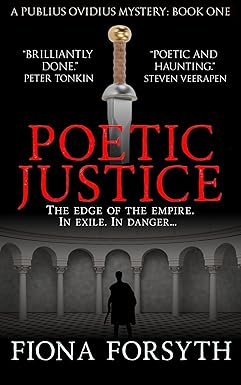
In the dwindling twilight of Roman dominion, Poetic Justice by Fiona Forsyth transports readers to Tomis, a remote outpost at the Empire’s edge, where the esteemed poet Ovid finds himself in exile. Initially dismissive of the locals as mere barbarians, Ovid’s attention swiftly shifts to a more sinister matter: a series of ritualistic murders, eerily escalating from animal to human sacrifices. As the macabre acts begin to mirror the unsettling themes of Ovid’s own verses, he forms an unlikely partnership with Marcus Avitius, the Governor’s advisor, in a bid to unravel the mystery. Together, they delve into the dark underbelly of Tomis, seeking to expose the chilling truth behind the violence.
As the inaugural installment of the Publius Ovidius Mysteries, Forsyth’s novel is an ambitious foray into historical fiction, ingeniously casting the ancient Roman poet Ovid as a central figure in a gripping murder mystery. Against the odds, the narrative captivates with its richly woven tapestry of historical intrigue and literary imagination. Forsyth demonstrates a profound command over the era, bringing Roman life’s societal and political nuances into sharp relief, thus enabling readers to immerse themselves fully in the period.
The depiction of Ovid and Avitius stands out, with both characters meticulously crafted and offering a compelling dynamic. They are supported by a cast of vividly drawn figures, each contributing to the unfolding drama and deepening our understanding of Roman society. Forsyth’s narrative prowess shines through in every element of the book, from the authentic dialogue and well-measured pacing to the underlying tension that simmers throughout, hinting at the lurking dangers in the shadows of Tomis.
Forsyth’s work is a testament to the power of historical fiction, demonstrating an ability to educate about a bygone era and entertain and engage through a story that is as thrilling as it is unlikely. Poetic Justice is a testament to the genre, proving that with enough skill and creativity, even the most obscure historical figures and moments can spring vividly to life, offering readers a window into the past that is both enlightening and profoundly entertaining.
Pages: 283 | ASIN : B0CP9HW9SJ
Empire in Apocalypse
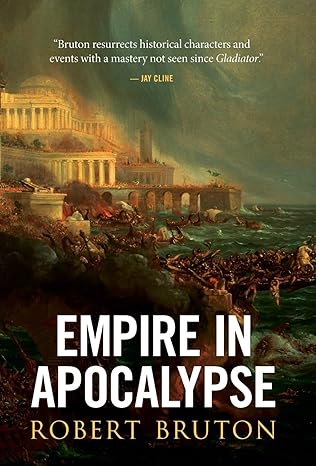
Empire in Apocalypse, by Robert Bruton, delves into a fictionalized depiction of the Eastern Roman Empire’s decline, portraying the tumultuous events that enveloped Constantinople during its final chapters. Through the life of Belisarius, a standout Roman general tasked with reclaiming Roman provinces in Italy, readers gain an intimate understanding of how warfare played a pivotal role in the Empire’s downfall.
The narrative doesn’t shy away from the other monumental challenges that besieged the empire: famine, pestilence, and widespread death. Included is the Hibernian monk, Brendan, who perceives these calamities as manifestations of the apocalyptic four horsemen, suggesting an impending end of days. One particularly gripping segment allows readers a front-row seat to the harrowing effects of the bubonic plague on the Empire.
One of the book’s strengths lies in its exploration of human responses to cataclysmic events. Characters from the commanding Emperor Justinian and the astute Theodora to the remorseful Antonina and the beleaguered Roman citizens reveal a spectrum of reactions to imminent doom. As events unfold, the narrative showcases how the pursuits, once deemed significant, lose their essence in the grand tapestry of survival and legacy.
Bruton’s meticulous research and adept writing prowess could easily make this story a standalone historical account. His deep understanding of Roman history is evident, and his talent in weaving together elements of politics, espionage, religion, romance, and military strategy makes for an engrossing tale.
While the book offers a rich tapestry of events, I feel that a more defined sense of consequence for certain characters might have made it even more immersive. Though the blending of fantasy, like Monk Brendan’s journey to the netherworld, offers a unique twist, I think the story might benefit from more integration to maintain the story’s gravitas.
While the narrative does lean heavily on religious themes, which may not resonate with every reader, those with an affinity for historical fiction or keen insights into history will find Empire in Apocalypse, by Robert Bruton, a rewarding read.
Pages: 540 | ASIN : B0CDJQ4HKV



 LITERARY TITAN