Blog Archives
Failure Was Not An Option

Beasts of War follows a young Anglo-Saxon maiden on her quest to save her village from those who have pillaged and destroyed all in their path. What was the inspiration for the setup to your story?
My novel is based on the Old English poem Judith, which can be found in the Nowell Codex and was written anonymously and undated. When setting out to write my first historical fiction novel I chose an adaptation of the Judith poem because it is the text I have spent the most time studying and the story I am most familiar with. The poem itself is only 600 lines long, each line consisting of less than 10 words. It’s a beautiful poem and a captivating story, but very few people are familiar with it. I translated the poem with my professor as an undergraduate student and wrote my master’s thesis on it in graduate school. Shortly after I graduated, I knew I wanted to take the poem and adapt it into a full-length novel that shared the Judith story and Anglo-Saxon culture in a way that was more accessible to modern readers. Because the poem was considerably shorter than a novel, I added quite a lot, including additional scenes, characters, and back stories. However, I kept everything within the world and culture of Anglo-Saxon England.
What were some driving ideals behind your character’s development?
Old English stories tend to idealize their characters. Heroes are flawless and villains are more monstrous than human. So, the challenge was to create two main characters, protagonist and antagonist, who were relatable. The situations they found themselves in are foreign to us, but the thoughts and emotions were very easy to understand. Judith found herself in a situation where failure was not an option, and I think we have all felt that way at one time or another. Holofernes was defeated because his arrogance got in his way. Again, this is something many of us can find relatable. It was important to me that my readers could feel the character’s emotions so they could better understand them as the story unfolded. I knew how my story would end even before I had an outline for it, so I used that to my advantage and really took the time to go on Judith’s journey with her, trying to understand what she would think and how she would feel in the moment as she was faced with the nearly impossible task of saving her people from a warlord. Her development was fun to watch, and since I knew she was going to be victorious, her emotions and thoughts would adjust slightly through the different scenes to help get her to the point where she was capable of rising to the challenge before her. With Holofernes, I had to take a character who seemed invincible and find where he was weak and able to be defeated. While Judith developed her strengths through the present moment, it was only through knowledge of Holofernes’s backstory and Judith’s appeal to his vices that he was able to be defeated.
What were some themes that were important for you to explore in this book?
My main reason for writing the story was to introduce readers to the Anglo-Saxon world and its stories in a way that was both entertaining and accessible. However, in writing the story the dominate theme I played with was the idea of destiny/fate and one’s own participation in it. What do you do when you know what your destiny is and at the same time nothing is handed to you… instead you must overcome your own shortcomings to succeed? This is the situation Judith found herself in, and I think too, it’s one that is relatable. So often dreams and goals can seem big and out of reach when you don’t know what steps to take to reach them. How do you wrestle with all the internal and external challenges along the way? These were the questions I used to help create Judith’s character, and I found that many other characters tended to either add to her storyline of destiny and fate or create their own.
What is the next book that you are working on and when will it be available?
My next book is about halfway through the drafting phase and is shaping up to be a bit longer than my first. This time around I am taking a paragraph from The Anglo-Saxon Chronicles and writing a novel about it. The story is based on the Viking attacks at Lindisfarne monastery in 793. There have been several novels written on the topic, but mine is told from the perspective of one of Lindisfarne’s inhabitants and follows his story from his arrival to the monastery years before the attack through the attacks and even after. The most fun part for me is that the historical text I am using, though brief, did think it was important to include that just before the attack people saw dragons in the sky. It is the only time in The Anglo-Saxon Chronicles that dragons are referenced, and so I was able to include a dragon in my story. So my next book has a much heavier emphasis on fantasy, and I’m excited to share that with readers. My goal is that it will be out by the end of 2023.
Author Links: Instagram | Website
An evil warlord is wreaking havoc across England. His trail of destruction razes the land and decimates people left and right.
He must be stopped. At all costs.
When young Judith is recruited to vanquish him, she uses her beauty and her charm to get close.
But once he’s within her reach, all is not as it seems.
His magnetism and alluring promises weaken her. And she begins to question whether she’s on the right side of this war.
If she is to escape his pull and save her people from his sinister plans, she’ll need true love and unfaltering friendship to do it.
And a little touch of fate wouldn’t hurt either. . .
Beasts of War
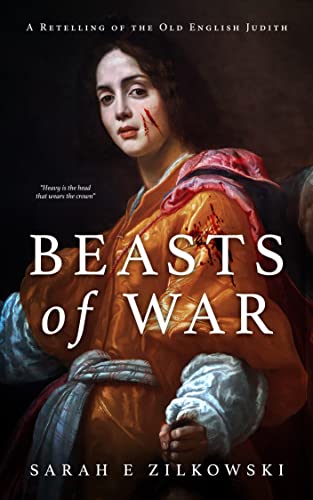

Beasts of War: A Retelling of the Old English Judith by Sarah E Zilkowski is a genuinely gripping and mesmerizing tale of heroism. This retelling of the story of Judith follows a young maiden on her quest to save her beloved village from Holofernes and his thanes, who have pillaged and destroyed so many villages leaving devastation in their path. Judith, the protagonist of the story, is tasked by her Lord to infiltrate the enemy’s camp. She is their last hope at survival.
It is refreshing to read an adaptation of a historical tale focused on the strength of women and the importance of their role within specific periods in time. This is an integral theme within many modern pieces of literature, not often seen when referring to myths and legends, especially religious texts such as the Bible.
The omniscient narrator throughout the novel allows the reader to see the overall picture of what is taking place; although primarily focused on the movements of Judith, there are moments when we move away from her and see what is going on elsewhere, this is enhanced by short bits of italicized information provided as the inner thoughts of other characters. For example, ‘Then again, he thought, I suppose mine do too,’ this is from Lord Cyneric when he recognizes the sorrow in Judith’s eyes.
Throughout this tale, the imagery used is excellently written. It varies so much, from literal graphic phrases such as ‘Slaughtering and butchering’ to contrasting elements that emphasize the gravity of the situation, like when Judith’ stood in an open space’ but ‘felt crushed by her fear.’ Although readers will enjoy metaphors throughout the novel, which refers back to tales and beliefs from the Anglo-Saxon period, when the story is set, the use of her seeing wolves and eagles, which symbolized war, helps build the tension within the overall novel.
Beasts of War: A Retelling of the Old English Judith is a riveting novel that will grip readers from the opening pages. Historical fiction and war drama lovers will find this take on the story exhilarating. Women’s fiction readers will be overjoyed at seeing Judith’s vital role as the dramatic story unfolds.
Pages: 246 | ASIN : B09ML693YF




 LITERARY TITAN