Blog Archives
Johnny’s War – Volume Two – Storm Clouds Over Africa


Johnny’s War – Volume 2 picks up where the first left off, following the ever-changing and ever-challenging journey of Johnny Pink, a young RAF officer during World War II. The book dives deep into his evolving experience, from the highs of promotion and love to the brutal lows of combat and loss. We follow Johnny as he boards a Sunderland flying boat bound for North Africa, reconnects with old friends, and gradually descends into the heart of war’s emotional chaos. It’s not just a tale of battles and bombers, though. It’s a story about growing up too fast, about finding courage in the unlikeliest places, and about the lasting scars—visible or not—that war carves into people.
Reading this was like being dropped straight into the 1940s, with all its smoke, salt, fear, and tea. The writing is unapologetically immersive. That first vivid attack on the Sunderland—my stomach actually turned. What caught me most, though, were the quiet in-between moments: Johnny’s chats with his mates, his unspoken grief, his longing for home. The author doesn’t just want us to know the facts of war. They want us to feel it. The fear, the camaraderie, the occasional absurdity of army life—it all came through loud and clear.
At times, the pacing slowed with heavy detail, especially in technical sections, but then it would slam you with a gut-punch of emotion or action that left you breathless. And I felt Johnny’s emotional shifts, while often believable, occasionally moved too quickly without enough inner reflection. But those are small things. What really stayed with me was how the war slowly changed him, not in a dramatic, movie-style way, but in that creeping, quiet erosion of innocence. It’s those little truths, told plainly, that make this book more than just historical fiction. It becomes personal.
Johnny’s War – Volume 2 is not just for military history buffs or fans of wartime dramas. It’s for anyone who wants to understand the human side of war—what it costs, how it twists people, and how, sometimes, even in the darkest places, you find light. I’d recommend this book to readers who love character-driven narratives, rich historical detail, and emotional truth. It’s not a page-turner in the thriller sense, but it sticks to your bones.
Pages: 325 | ASIN : B0F9X715VC

Hope and Faith
Precious One tells the story of two parents longing for a child, their journey through waiting, hope, and faith, and the ultimate arrival of their baby boy. What was the inspiration for your story?
My story is inspired by my own personal journey of waiting for a child. After years of anticipation and hope, I experienced a mix of emotions, including loss and joy. The story reflects the emotional ups and downs that many parents face when waiting for a child, and I hope it resonates with readers who have experienced similar challenges.
What were some ideas that were important for you to share in this book?
One of the key themes I wanted to convey is patience. The story highlights the joy and anticipation that comes with waiting for something precious, and how that waiting period can be filled with hope and faith.
What scene in the book did you have the most fun writing?
I had a lot of fun writing the scene where the parents rush to the hospital, thinking it’s time for the baby to arrive. It was a relatable moment for me, as I recalled my own experience with my son. The mix of excitement, worry, and anticipation made for a memorable scene.
What story are you currently in the middle of writing?
I’ve actually completed my second picture book, and I’m currently in the editing phase. The new book explores explaining loss to kids, drawing from my own experiences with loss. I’m excited to share this important topic with young readers in a way that’s both gentle and honest.

Finding Manhood In Scotland

In Finding Manhood in Scotland, Victor Atyas chronicles a man’s raw, restless search for masculinity and meaning through a solo road trip across the Scottish Highlands. Tired of the grind of library work and emotionally bruised by confrontations with disrespectful patrons, Mark decides to ditch comfort and routine for a rugged adventure inspired by historical ghosts, wild landscapes, and spiritual transformation. Mixing memoir, travelogue, and inner dialogue, the book follows him through ancient ruins, ghostly encounters, and soul-baring introspection.
What I liked most is how unfiltered Atyas is. The writing doesn’t try to be neat or tidy. It rambles, loops back, digresses and that’s part of its charm. In the opening chapters, we meet a man teetering on the edge of a midlife crisis, eating a stolen orange from a raven’s talons in Chaco Canyon, getting yelled at by ponytailed New Agers, and quitting his job in a rage after a library patron throws a book at his feet. The narrative is like overhearing someone muttering to themselves in a tent on a rainy night, honest, vivid, sometimes hilarious, and often surprisingly moving. His dream of being scolded by a Renaissance noble, “You are as daring as a rabbit,” perfectly captures the absurdity of self-doubt dressed up in grand metaphors.
At times, the book dives into emotionally raw territory, exploring moments of vulnerability and intense personal reaction. When Mark suspects a group of gypsies of stealing his laundry, his response is intense, shaped by years of suppressed anger and buried feelings of inadequacy. What stands out, though, is how he doesn’t shy away from examining these emotions. He confronts his own inner turmoil head-on, turning the episode into a moment of self-awareness. Rather than gloss over his flaws, Mark lays them bare, giving the story an honest, confessional quality that adds to its emotional depth.
One of the best sections is his eerie, almost mystical encounter with what he believes are Pictish ghosts at a fog-shrouded lake. He drives through mist, argues with a hallucinated version of a woman who robbed him, and is finally told by an inner voice to press forward. That moment, “Not even God Himself could have stopped me,” lands hard. He’s ridiculous, brave, and tragic all at once, and in that messy storm of feelings, something like transformation happens. I found myself rooting for him, even while shaking my head.
Finding Manhood in Scotland is for readers who appreciate messy, human stories about doubt, rage, beauty, and stumbling toward personal truth. It’s not a clean hero’s journey; it’s more like a muddy crawl across rainy pastures, fueled by oat bars, spite, and late-blooming courage. I’d recommend it to anyone who’s ever wondered if it’s too late to change, or who’s needed a personal quest just to feel alive again.
Pages: 238
A Pleasant Fiction: A Novelistic Memoir

In A Pleasant Fiction, Javier De Lucia delivers the emotionally resonant second act to his two-part coming-of-age story, continuing the story of Calvin McShane where The Wake of Expectations left off. If the first book chronicles adolescence in all its messy, comic glory—equal parts coming-of-age tale and Gen X time capsule—A Pleasant Fiction is its older, wiser, and more painful counterpart. Together, the two novels form a sweeping narrative arc that spans the giddy freedom of youth through the disillusionment and hard-earned wisdom of middle age.
De Lucia’s central theme in A Pleasant Fiction is grief, but not grief as an isolated event. This is grief as a condition of life, one that shapes identity and outlook. The book becomes a study in how people carry grief, how they adapt to it, and what they do with the space it leaves behind. But grief here is never cheapened into sentimentality. Calvin’s decisions are morally murky, especially as they pertain to his disabled brother Jared. That’s what makes De Lucia’s work so affecting: the absence of clear heroes or villains. Just people, burdened with love and trying not to collapse under it.
Jared is more than a side character; he is the axis around which the McShane family orbits. His needs shape their routines, his presence defines their household, and his vulnerability tests the limits of their resilience. De Lucia treats Jared not as a symbol, but as a person. For Calvin, Jared represents both the weight of responsibility and the purity of unconditional love. Their relationship is rendered with tenderness and brutal honesty. In one unforgettable line, Calvin reflects: “Loving him was hard. Not loving him was even harder.” That one sentence captures the emotional complexity of being a sibling to someone whose suffering is constant and visible. Jared’s life, and ultimately his death, transform Calvin’s understanding of love, sacrifice, and meaning.
A Pleasant Fiction elevates the series from charming autobiographical fiction to something far more profound. In its patient, unsparing look at illness, family, and the work of grief, the novel finds meaning not in plot twists or dramatic revelations, but in the simple, difficult act of enduring. As Calvin muses in the closing pages, maybe the idea of reunion, of eternal peace, is just “a pleasant fiction.” This is a novel about what it means to grow up and grow older. And for those who have loved and lost, it rings painfully and beautifully true.
Pages: 203 | ASIN : B0F4L1R9K5

Isolation vs. Connection
The Wake of Expectations is a raw, poetic unraveling of self in a world where dreams, disillusionment, and the pressure to perform collide. What was the inspiration for the setup of your story?
I’m totally Gen X and that rawness of self-expression—that disillusionment, too—that’s a function of my generation, a by-product of our obsession with authenticity. We were probably the first generation told we could be anything we wanted to be, but we were largely left to figure things out on our own. That contradiction creates an inevitable gap between expectation and reality.
On a more personal level, I’m a huge Kevin Smith fan. I remember him talking about not seeing his friends or his world represented on film, so he decided to make it himself. And that was mostly the impetus for writing this book: a desire to see our version of reality represented somewhere—to create something of artistic permanence to stake our claim that we were here, too. Honestly, I would rather have made a movie or a TV series, but writing a book was just more practical.
Are there any emotions or memories from your own life that you put into your character’s life?
Pretty much everything in my main character’s life is rooted in emotions or memories from my own. The story is fiction, but it’s emotionally true. Like Calvin, I wanted to be a musician. I had a girlfriend who dumped me when she went away to college. I had differences with my parents. But more than anything, I wanted to capture the longing, the frustration, the impatience—the alienation in that process of becoming. That feeling of champing at the bit, staring at a world of possibility, but being unable to get out of the starting blocks. It’s personal, but it’s also generational. Ironically, I never really felt part of my cohort, but that’s exactly what made me representative of it. I tried to capture that paradox in the book.
What were some themes that were important for you to explore in this book?
I wanted to ask questions more than present answers: What do you do when your dreams come true but don’t live up to the hype? Is it wrong to want something you can’t have? Is it sometimes better not to get what you want? And how do you become the person you’re meant to be when you don’t even know who that is yet?
A recurring theme is the desire to be fully seen—but never quite achieving it, even among people who clearly love you. That’s a major part of Calvin’s disillusionment. At his core, he’s searching for connection on his terms, not anyone else’s—and that proves elusive. He’s caught in this constant push-pull: authenticity with isolation vs. connection with compromise. And again, I think that tension is a very Gen X dilemma.
What is the next book that you are working on, and when can your fans expect it to be out?
The next book is A Pleasant Fiction: A Novelistic Memoir, and it releases on July 1—just a month after Wake (June 3). It follows the same group of characters 25 years later, and the proximity in release dates is no accident. A Pleasant Fiction is a follow-up, but not exactly a sequel. It’s a very different book—slower, more meditative—and it reframes everything in the first book. Wake is a complete work on its own, but A Pleasant Fiction is essential reading if you want to fully understand it.
I actually wrote the first draft of Wake over 20 years ago. So that book carries the reflections of a 30-year-old looking back on his twenties. The next one captures a 50-year-old grappling with the challenges of middle age. Together, they form a diptych—a two-panel meditation on the passage of time, told authentically from opposite ends of the timeline. It’s more of a dialogue than a sequence, tracing the coming-of-age through the unbecoming of middle age.
Author Links: GoodReads | X (Twitter) | Facebook | Website | Amazon
He’s just been accepted into his dream college, and his parents have won the lottery. But instead of celebrating, he finds himself drifting further from the people he loves and the future he imagined.
Set in a time before smartphones, when connection meant looking across the table instead of into a screen, The Wake of Expectations is a funny, heartfelt, and deeply human exploration of dreams deferred and dreams derailed, the courage to choose your own path, and the transformative power of love, friendship and self-discovery.
A raunchy, Gen X coming-of-age story brimming with 1990s nostalgia, The Wake of Expectations follows Calvin on an unflinching, deeply immersive journey that blends edgy humor with serious introspection, offering a biting look at the messiness of growing up. Through Calvin’s sharp, often self-deprecating lens, the novel presents a cast of richly drawn, complex characters and relationships worthy of deep literary analysis.
Mature themes and adult humor are woven throughout, so reader discretion is advised.
Johnny’s War Volume one
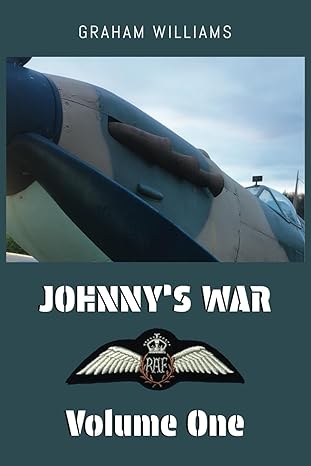
Graham Williams’ Johnny’s War: Volume One is a heartfelt and immersive account of a young man’s journey from the peaceful English countryside into the skies of World War II Britain as a trainee RAF pilot. Told through a blend of personal letters, vividly detailed scenes, and nostalgic reflection, the story follows John “Johnny” Pink from his family home to the RAF training grounds. Along the way, readers are introduced to a cast of fellow cadets, the unbreakable bond between friends, and the anxieties of wartime youth. It’s a story that doesn’t glorify war—it personalizes it, through the eyes of a son, a friend, and a hopeful pilot.
Reading this book was an emotional ride. I was struck right away by the authenticity of the writing—it didn’t feel like fiction. The dialogue between characters, especially Johnny and his friend Tommy, was real and warm, full of that particular blend of courage and awkwardness you’d expect from young men stepping into war. I appreciated how the author didn’t rush anything. Scenes breathed. Letters home from Johnny gave the book its soul. And the flying scenes were genuinely thrilling. The writing is simple and tender, almost old-fashioned in tone, which fits perfectly with the 1940s setting. The pacing is gentle, but it suits the story’s reflective nature.
What really hit me was the depth of care in the relationships. Johnny’s bond with his father had me choked up more than once. There’s such dignity in the way George keeps his hope alive, reading letters, tending the grave of his wife, and waiting. It’s a slow burn emotionally, but the ending caught me off guard. The buildup to Johnny’s solo flight was incredibly satisfying, both nerve-wracking and beautiful. And the quiet mystery of the boy with the apple added just the right amount of eerie wonder. This isn’t a flashy book—it’s thoughtful, steady, and often poignant. And that’s its strength.
If you love character-driven tales, historical settings done with care, and stories that tug at your heart more than your adrenaline, you’ll really like Johnny’s War. It’s a book for history lovers, romantics, and anyone who’s ever missed someone. I’d recommend it to readers who appreciate Band of Brothers for its humanity more than its action, or fans of heartfelt war dramas like Testament of Youth.
Pages: 364 | ASIN : B0F5Z2VXQT
The Wake of Expectations
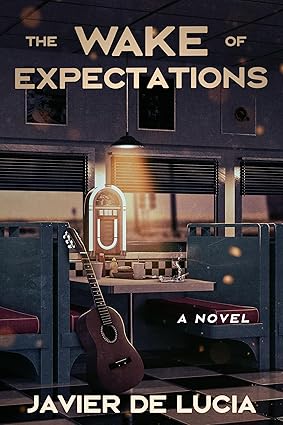
Javier De Lucia’s The Wake of Expectations is a raw, poetic unraveling of self in a world where dreams, disillusionment, and the pressure to perform collide. The book journeys through a fragmented psyche, moving between poetic introspection and philosophical musings, all while probing the cost of living under the weight of inherited ideals and cultural norms. It’s less a narrative and more a lyrical excavation—a fevered diary torn at the seams.
What struck me first was the voice. It’s angry, tender, lost, and deeply human. De Lucia doesn’t hold your hand. He throws you in. His words crackle with emotion—grief, rage, shame. The prose can be jagged, like broken glass, but that’s the point. It’s meant to cut. It’s meant to hurt. And it does, in the best way. I found myself underlining lines not because they were pretty, but because they felt true. Like he’d scooped thoughts out of the back of my mind and dared to say them out loud.
But some passages drift into abstraction. There were moments when it felt like De Lucia was writing for himself. It’s unapologetically personal, but it’s fantastic when it lands; however, I craved more shape and clarity. Still, even in its chaos, there’s something magnetic about it.
The ideas in the book were thought-provoking, and something I really enjoyed about this novel. He questions everything: ambition, masculinity, belonging, even time. And he doesn’t offer answers. Just cracks. Openings. Invitations to think, to feel. I came away shaken, but also strangely comforted. There’s something healing in the honesty, in knowing someone else is just as bewildered by the world.
The Wake of Expectations isn’t for everyone. It’s heavy. It’s weird. It doesn’t pretend to be neat or nice. But if you’ve ever felt like you’re drowning in who you’re supposed to be, this book might throw you a rope—or at least show you you’re not alone. I’d recommend it to readers who crave emotion over plot, who aren’t afraid of the dark corners. It’s poetry with teeth. And it lingers.
Pages: 551 | ASIN : B0DYBJVG9C
Hatfield 1677
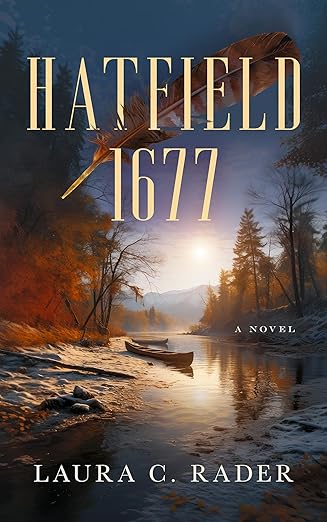
Hatfield 1677 is a vivid historical novel rooted in the real-life events of King Philip’s War. The story centers on Ben and Martha Waite, a Puritan couple whose lives are ripped apart by conflict between English settlers and Native tribes in colonial Massachusetts. When Martha and her children are captured by Native warriors, Ben sets out on a perilous mission to bring them home. Through alternating perspectives, including that of a Nipmuc sachem, the novel explores survival, love, loss, and the brutal toll of war.
From the first chapter, where Ben says goodbye to his wife and children before riding off to war, the writing has this warm, steady heartbeat. It’s historical fiction, but it never feels dry or overly formal. Rader’s prose strikes a compelling balance between lyrical and grounded. She captures intimate, sensory moments with remarkable clarity, Martha rinsing her hair in lavender water, Ben riding through the ruins of Deerfield, the tense stillness before a storm. The detail is immersive without becoming excessive. Even in the opening chapter, as Ben says a quiet, emotional goodbye to his daughters, the writing evokes a tenderness and fear that is both deeply human and hauntingly real.
What really struck me, though, was the moral weight Rader builds into the action. She doesn’t sugarcoat anything. The chapter on the Falls Fight was gutting. When Ben storms a Native camp and ends up sparing a young mother and child, it’s not some triumphant moment; it’s raw and messy. He throws up afterward. His pistol shakes in his hand. He can’t even speak about it when he gets home. It’s that emotional honesty that makes the violence and grief in this book hit so hard. And then you get Ashpelon’s chapter, a Native leader telling a parable about greedy squirrels, and suddenly, the whole war feels even more tragic. It’s layered and thoughtful without being preachy.
One thing I didn’t expect and ended up loving was Martha’s voice. She’s not just “the wife back home.” She’s smart, she’s tough, and she’s trying to survive just like everyone else. Her scene with Hannah, when they talk about love, abuse, and the impossible choices women face, felt painfully modern. There’s one line, when Martha’s holding her daughter and watching her husband ride off, where she says, “Your fair beard will need a trim when you return.” That crushed me. Because it’s not really about his beard, it’s hope, and fear, and trying not to fall apart.
Hatfield 1677 is a love story wrapped in a war story, with sharp writing and real emotional stakes. If you’re into historical fiction with heart and teeth or if you just want a book that’ll leave you thinking about it long after the last page, this one’s for you. Fans of Cold Mountain, The Last of the Mohicans, or even Outlander (minus the time travel) would feel right at home. I highly recommend this book to readers who like stories that are as much about people as they are about history.
Pages: 410 | ASIN : B0CW18FWXS



 LITERARY TITAN