Blog Archives
I Have An Enormous Curiosity

Bloom follows an international team of scientists as they investigate a mysterious and rapidly spreading harmful algal bloom. Where did the idea behind this novel come from?
Being a scientist — a Ph.D. in Molecular Biology — I have an enormous curiosity and respect for Nature. The idea for Bloom came to me when I personally noticed how warm the Mediterranean Sea was becoming, and I began to think about what consequences this could have on the delicate mechanisms that regulate the food chain and the balance of marine species
How did you balance scientific accuracy with the pacing and suspense needed for an ecological thriller?
I wanted the science in Bloom to be genuinely accurate, not decorative. The challenge was pacing it so the reader feels the mechanism of the threat — a mutated strain of Alexandrium catenella — without turning the narrative into a lecture. I also cared deeply about showing the power of Nature and its unpredictability, adding catastrophic elements that would bring a thrilling effect to the story. I tried to embed the science inside moments of discovery for the characters themselves: Marco and his team don’t explain the science to the reader, they’re racing to understand it in real time, under pressure
The novel moves across several European countries. What challenges did you face in creating a crisis that feels international rather than confined to one location?
Coordinating this crisis through a team of scientists working with the EU was a way to make the story feel real. The challenge, however, was figuring out how such issues are actually handled by the EU as an institution — I could only hypothesize how this would unfold. That’s the element that comes from my imagination and deduction, not from direct knowledge.
If readers finish Bloom with one question about the future of our oceans, what would you like that question to be?
I’d want them to ask: what other disruptions should we expect from Mother Nature in response to this sudden global warming, beyond the changes we already call “climate change”? Which animal species will rise in a specific location, and which will fall? How will these shifts affect the whole ecosystem? And most importantly — how will humans adapt to these changes?
Along the Mediterranean coast, people are dying or falling ill. Marine life is vanishing. The sea, once a source of life, is becoming a silent threat. No one knows why—or how far it will go. Called in to investigate, Dr. Marco Fassi and his team of scientists uncover unsettling patterns that point to something vast and unseen, pulsing beneath the water. As the phenomenon spreads, they’re forced to confront the terrifying possibility that nature itself is no longer under control.
For fans of Michael Crichton, Franck Schätzing, and eco thrillers grounded in real science— a slow-burn science thriller for readers who love plausible detail. BLOOM delivers a chilling, high stakes mystery where the natural world becomes the greatest threat. Propulsive and eerily plausible, this gripping novel will leave you questioning what lies beneath the surface.
Bloom: Crisis in the Mediterranean Sea
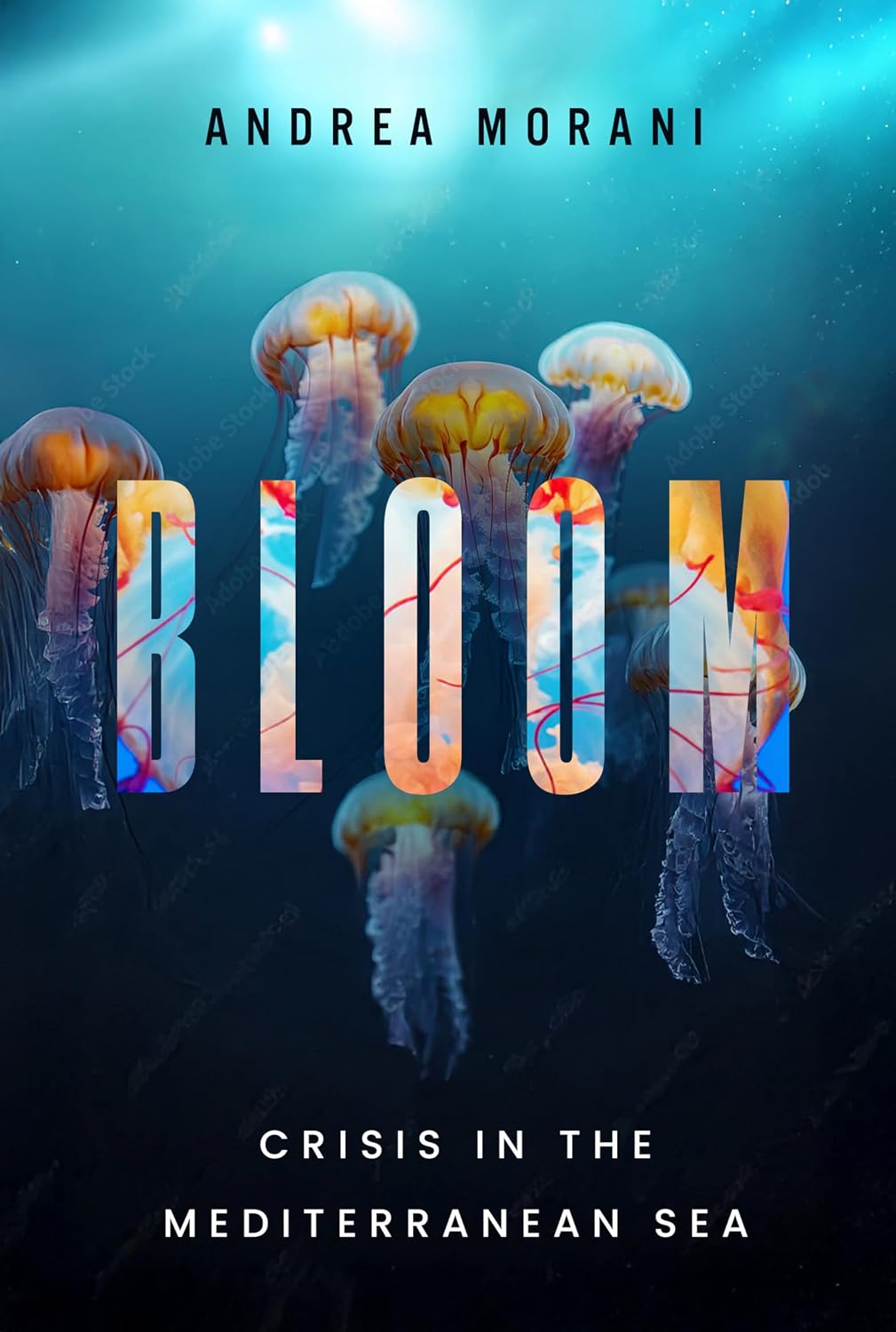

Andrea Morani’s Bloom is an ecological thriller that turns the Mediterranean Sea into both a beautiful setting and a source of growing danger. The story begins with scattered incidents that seem almost impossible to connect: swimmers suddenly can’t breathe, fishermen collapse at sea, marine animals behave strangely, and people become seriously ill after eating seafood. Those events lead scientist Marco Fassi and an international research team into an investigation of an anomalous rapidly spreading harmful algal bloom. Morani builds the novel around a frighteningly plausible idea, using rising sea temperatures, phytoplankton, toxins, genetic exchange, and synthetic biology to create a crisis that keeps expanding in scale. Because the story moves among places like Sardinia, Sicily, Naples, Italy, France, Luxembourg, Spain, Greece and the open Mediterranean, the disaster feels less like a single emergency and more like something steadily swallowing an entire region.
The science is probably the book’s most distinctive feature. Morani has a background in molecular biology, and that shows in the amount of attention he gives to subjects such as Alexandrium catenella, phytoplankton, saxitoxin, horizontal gene transfer, microorganisms, and genetic engineering. There are stretches where the novel slows down to explain how these processes work, so the reading experience sometimes feels like a thriller crossed with an accessible science lecture. Still, those details give the central threat weight. The mutated algae aren’t simply a mysterious monster in the water. The reader gradually understands how the organism behaves, why ordinary solutions fail, and why the scientists have to keep revising their assumptions. That process of observation, speculation, testing, failure, and discovery gives Bloom much of its identity and makes the eventual search for a biological solution feel earned.
Marco gives the scientific plot a more personal center. He’s accomplished and deeply curious, but his devotion to science has already complicated his marriage to Jasmine and his relationship with their daughter, Melanie. His work during the crisis forces him back into the kind of all-consuming scientific life he’d tried to balance, while his growing connection with Karen adds another layer of tension. The supporting cast also helps widen the story beyond one scientist’s perspective, particularly as the bloom begins affecting families, coastlines, economies, and political decisions across Europe. The Atlantropa storyline and Thomas’s hacking campaign push the novel even further into questions about environmental responsibility and how far people might go when they believe a larger ecological disaster is coming. By the time Marco and Karen undertake the dangerous mission near the Aeolian Islands, the novel has moved naturally from investigation into full-scale scientific adventure.
Readers who enjoy Michael Crichton will probably recognize some familiar pleasures here. Like Crichton, Morani takes real scientific concepts, extends them into a plausible speculative crisis, and lets scientists solve problems through knowledge. Bloom is especially close to Crichton’s style in the way technical explanations and thriller mechanics sit side by side, although Morani brings a distinctly Mediterranean setting and a stronger focus on marine biology and ecosystem change. What stayed with me most was the novel’s fascination with nature as a system too complicated to control completely. Even after the immediate crisis is solved, the final explanation involving warming waters and unusually frequent horizontal gene transfer keeps that idea alive. Bloom works as an environmental thriller, but it’s also a story about curiosity, unintended consequences, and the uncomfortable fact that understanding nature doesn’t always mean we can predict what it will do next.
Pages: 270 | ASIN : B0FLYPYD1B



