Blog Archives
Multiple Vulnerabilities

It’s Not Going to Happen follows three people living seemingly unrelated lives who find themselves in an international conspiracy where the most dangerous weapon may be the power to steal free will. What inspired you to bring together entertainment, international espionage, and biotechnology?
Making reality entertaining is my inspiration. In general, people do not absorb factual data very well. However, blend the science, history, and geopolitical facts with an entertaining story, and eureka. Thus, my tagline: sometimes the truth can only be told in fiction.
My goal is to write in a unique or original style about a real science/technology issue that has a major impact on everyone where facts are covered up, intentionally ignored in the public limelight, or easily overlooked because of the technical complexity.
A significant number of thriller authors incorporate some facet of science or technology where it is fairly obvious they don’t understand it (along with history and geopolitics). In a balancing act for the intellectually curious, I attempt to provide a certain amount of explanatory detail wrapped into the dialogue and plotline itself. There is plenty of action for those who only want to know what time it is and not how a watch works.
While the publishing marketplace (and writers’ workshops) pushes formulaic plotlines and frequent cookie-cutter characters geared toward the “cozy reader,” I tend to have faith in readers enjoying a bit more literary complexity to unravel the world we live in with talented, yet ordinary characters doing realistic things with extraordinary outcomes – with a pinch of poetic license to move the plot.
Sorry for the backdrop…and back to the question. Intelligence, clandestine, and covert operations require “access.” No industry or profession is immune, including the entertainment industry. My intent was to have the major characters with stories that would braid together with a type of synchronicity in a character-driven plot.
I had Julieta, a Kansas ranch girl, in my head who would somehow cross that line into celebrity status and discover that her seemingly innocuous everyday choices would add up and uncover multiple talents. Great talents often arise when confronted with unanticipated circumstances.
I also had Otto, “Little Otter,” developing in my head. A kid from an environment that could lead to several different paths, ending up with extraordinary outcomes given his choices and the influence of those around him, good and bad.
The last thing I wanted was the overused, former Navy SEAL, Delta Force, trained CIA assassin. Thus, Julieta and Otto are real persons with their own story to tell.
The developing science/technology issue was nanotechnology and pharmacology – nanobots or nanoids, and, yes, they are real. Santino, the brilliant, young Spanish scientist, had noble objectives (as many of us do or once did), yet was corrupted by higher powers, and a lingering question of whether he had different choices to make. And Andrea arises out of real geopolitical facts.
The major characters often serve as a type of contrast to the minor characters.
It became evident (at least in my head) that each of these main characters was a compendium of “choices,” perceptions, and the influence of those around them. Even the minor characters are their own composite of choices – some choices are made, some are unavoidable, and many lie in that grey area somewhere in between, much like a quantum particle in superposition until it’s measured…Oops, sorry, there I go with the science again. You can read more about quantum reality and consciousness in my novel, Deceit of the Mind – Quantum Evolution, and the race for Space and AI.
I also wanted the reader’s emotions wrapped into the story and not simply following as an outside observer. Thus, the plotline is filled with a potpourri of situations that can stir up emotions, good and bad, where the reader will find themselves inputting their own emotional psyche – and readers differ significantly on the same scenes.
The concept of a non-existent genre started to take hold as a “philosophical thriller” of sorts, with the caveat to never take myself too seriously and always find the entertainment value even with a bad situation.
Thus, always with a primary intent of creating entertainment value for the reader, what better backdrop than the entertainment industry itself?
How do the personal histories of your three protagonists shape their vulnerabilities, ambitions, and relationships with others?
I love the question! I use continuing characters, and thank you for recognizing that I do not have a single protagonist, such as Jill Uphill, former assassin, in book 12.
My plotlines are “character-driven.” I also try to rely on the character dialogue telling as much of the story as possible, as opposed to author narration. Ya know, how real life happens, since most of us don’t have a narrator or herald following us 24/7 to fill in the gaps. Each character has their own dialogue quirks to allow the reader to develop their own videotape of the scene and see/hear the characters in their heads.
Choices – “they may seem arbitrary, but they are not random.” Two kids in a tough neighborhood – one is an unintentional hero, and one is in prison. Two kids with no financial barriers, even in the same family, who develop starkly different dispositions on life. Noble humanitarian use of talents and ambition that can be turned on their heads. As a person makes choices, even with some choices forced upon them, what makes them vulnerable for their next decision?
Each character has multiple vulnerabilities, and the pattern of choices somewhat unconsciously adds up to pursue or even alter ambitions. Altering ambitions is not the problem. It’s the direction those ambitions turn. In each direction, those accumulated patterns of choices spill over in making choices about with whom they develop relationships. They test and question trust – we all do. Often, we simply label it our “gut reaction.” We often justify bad choices or simply ignore them – it is what it is, I really didn’t have a choice, I was dealt a bad hand. Recognition of good choices often takes time and ongoing evaluation, or even after-the-fact glances at the consequences, then moving forward.
In essence, the major and minor characters are an evolution of their own choices, despite a feeling of having no choice. Is that an excuse or a reason? What happens when the ability to choose or critical thinking are taken away – either by personal or cultural vulnerabilities, or technology?
Life happens. Telling ourselves it’s not going to happen is sometimes a path to a goal, a declaration to control the future, or sometimes a challenge to the inevitable, and many times a result or consequence of multiple actions leading to an unpredictable yet unavoidable outcome.
As in life, the separate histories of the main characters have that unpredictable probability of synchronicity that eventually naturally braid together. Julieta points out, if humanity is fundamentally flawed, “we can’t fix a defective design, but we can change the oil and air up the tires to keep it running more smoothly.”
There is no one better to save us from ourselves than ordinary people surreptitiously colliding with their talents to do extraordinary things.
The novel raises questions about how much of our lives we truly control. What does the concept of free will mean within the story?
Again, the question itself is exciting from my point of view. As I said, at some point I realized I was writing a philosophical thriller. There are several concepts or terms I intentionally did not use in the novel. The term “free will” is not there, yet logically many or most readers focus on the term to describe the story. My intent is for the reader to discover their own philosophical sense of choice (the term “destiny” is also not in the book).
Greater philosophical minds have spent centuries trying to unravel what became known as existentialism, choice, and free will – (and no, “existential threat” is not part of existential philosophy and was an invented term popularized by politicians in about 2009, with an after-the-fact nebulous definition).
The bottom line is that philosophically defining “free will” can be analogous to a dog chasing its tail in circles. Some would say free will does not really exist. Some would contend that free will is an essential part of consciousness – being human. I simply tried to set the table for the reader to decide.
The characters are confronted by choices at least from the day they were born. An infant presumably has many choices made for them. However, is crying a deliberate choice? “Remember, a child is not born afraid of the dark.” As we grow, the spectrum of deliberate choice certainly broadens. Choices made by others impact the characters, where the turning points become the deliberate responses (choices) to those events and the consequences that follow. Classically, does an individual choose to run away from danger or run towards it? Each character brings their own background of choices (good and bad) along with physical, emotional, and intellectual talents, sometimes acquired without specific purpose, but guide them in reacting to the circumstances and relationships they confront.
Ultimately, if our deliberate choices are limited or influenced by the external circumstances (choices), what happens when our ability to make deliberate choices or use critical thinking is taken away? Often this is seen as exercising free will. Many experts claim that collective cognitive dissonance and illusory truths have already surpassed critical thinking.
And then, the science and technology that is knocking at our doorstep.
How did you approach incorporating original music into Julieta’s storyline, and what inspired you to make her songs available to readers?
This was an incredibly fun part of writing the novel, and I wanted to make it a fun experience for the readers.
I’ve been writing lyrics and songs since high school. There were some close calls to moving in that direction…but my own choices and circumstances moved in another direction without regrets.
At some point in writing the story, I wanted to give it some “life.” I stopped writing the novel and started writing the lyrics, revamping a prior song written for a female singer, “Here I Am,” and scribbling out a new one with the book’s title. As Faulkner and others have said, poetry is the most difficult form of writing, and many novelists are simply failed poets. Lyrics, like poems, require a greater level of precision.
I am fortunate to have a very talented daughter-in-law who laid down my somewhat complex music and her vocals. While no AI is used in my writing, without 50 grand to hire studio musicians and also arrange for a stadium concert, I succumbed to using an AI program.
The songs are produced to fit the scenes in the novel as a type of fun, interactive bonus to the reader – to hear Julieta live!
Copyrighted? Yes, but completely FREE to listen to at YouTube.com/@KansasHank.
Author Links: GoodReads | Instagram | TikTok | Facebook | Website | Amazon
The entertainment industry collides with deadly intelligence operations.
Sometimes the brightest stars hide the darkest secrets.
Three lives that seem to run on separate tracks — a Kansas ranch girl’s sudden fame, a Spanish scientist’s breakthrough, a foster kid’s last chance — begin, one path at a time, to braid into a single international conspiracy. Julieta is thrust from a modeling agency lobby into Hollywood’s spotlight, and into the covert intelligence network hiding behind it. Santino’s biologic nanotechnology could heal the human body — or be weaponized to control it. Otto, “Little Otter,” a mixed-race firehouse drop-off foster kid, is fighting for a future he’s not sure he’s allowed to have.
From black-web data drops in Atlanta to a Valencia laboratory hiding secrets even its own benefactors can’t fully comprehend, It’s Not Going to Happen moves across continents and loyalties comparable to Crichton and Daniel Silva — with the sly, intelligent, cinematic edge of Carl Hiaasen.
Inside this novel:
A nanotechnology breakthrough with the power to heal — or weaponize
A handler’s protection that looks a lot like control
A geopolitical race for technology no government wants the world to see
Courtroom stakes that blur the line between justice and reasonable doubt
Unlikely heroes against improbable odds and unpredictable fates, with a hint of romance
This is not a single chase down one road. It’s three roads that were always headed for the same place — and the reward is in watching them connect. If you love smart, original thrillers that ask you to think as hard as the characters do, this one’s built for you.
Call it a philosophical thriller — one built around a simple, unsettling question: how much of what happens to us is really our choice?
Henry Cox, author of the award-winning thrillers in the Deceit Series and Amazon #1 Bestseller, brings his diverse background and four decades of trial-law experience, with a lawyer’s eye for detail, to a story that refuses to move in a straight line. At first glance the pieces seldom appear to fit — original, unpredictable, and sophisticated, built to keep you thinking long after the last page.
Bonus: The author’s original songs, sung by Julieta, can be found with the links in the novel.
It’s not going to happen . . . or is it?
Notice: occasional strong language, violence, and sexual situations
Don’t miss the rest of Cox’s award-winning Deceit Series.
Consequences

Codename: Warlock Book 2: No Limits follows an extraordinary man with the ability to read minds and use telekinesis who, despite trying to have a normal life and raise his daughter, gets pulled back into the world of crime, espionage, and deadly secrets. What inspired you to continue Tom Newell’s story in No Limits?
Tom doesn’t really have telepathy. He can’t read minds. He can sense emotions, intent, and deception. He can find you if he’s acquired your mental fingerprint. In No Limits, I wanted to explore more of the consequences of what Tom can do. For example, he can detect deception, but he can’t control what people do with the truth. He can help people, but he can’t create fairy tale endings. And I wanted to bring the story back to local incidents, not just government operations. Tom is still sought out by governments – ours and the USSR. But the Warlock infrastructure has deteriorated. And I wanted to focus on Tom, Gail, and their daughter Sue.
How does Tom’s family give him a different sense of purpose from the one he once received through Warlock, and how does becoming a father change his understanding of risk?
Tom is going to discover in No Limits that family is great – but comes with costs of its own. Especially when his abilities get involved. And Gail still has her rule – come home at any cost. Only it’s twice as important now. Tom has to make a difficult and legally murky decision to protect his family.
Tom struggles to balance his unique powers with the ordinary responsibilities of being a husband, father, and human being. What moral boundaries does Tom set for himself when using his abilities against people?
Tom doesn’t take advantage of people. Well, except for used-car dealers. But he slips a few times, sometimes in humorous ways. Sensing emotions can be tricky; it helps him navigate relationships, but it also causes him to sometimes navigate relationships with that ability when he should just do it the way everyone else does.
Can you tell us more about what’s in store for Tom Newell and the direction of the third book?
In book three, No Horizon, Tom has to make a life-altering decision with consequences that he can’t avoid. He’ll find one of his abilities comes with a cost he never anticipated. And his life is going to change when he is reminded that he can’t save everyone, with tragic personal consequences. But, spoiler alert, there is a hilarious Halloween party.
In a typical thriller series, the protagonist is in danger – that’s part of the excitement. But readers know in the back of their mind that the author is unlikely to kill off the protagonist – that would end the series. The real tension is how the protagonist survives whatever danger he’s facing. In the Warlock series, I lean into that. Tom is very hard to kill. The tension is how he solves the problem and then what the downstream effects are on Tom and everyone around him. Book four is going to extend that, with Tom having to navigate a difficult and painful personal crisis while still being Warlock. Sometimes survival isn’t about whether you live but how you continue to live. And the government is going to push the boundaries of what they expect Tom to do. To find out more, well, wait until book four comes out.
Author Links: Amazon
Tom and Gail now have a daughter, Susan. They are building a new life outside the shadow of covert government operations.
At home, Tom is trying to be normal. But Tom’s impossible abilities won’t stay hidden. Because Tom won’t ignore people in danger. And he’s learning that truth has consequences he can’t control.
But the government hasn’t forgotten Warlock.
Neither have the Soviets.
Both sides pull Tom into covert, deniable missions that shouldn’t exist. Deadly sleeper agents. Nuclear threats. Secrets that refuse to stay buried.
With a daughter to protect. Gail’s rule – come home at any cost – is more important than ever.
This time, No Limits.
Controlling Knowledge is Power

The Secret of Charley Grace follows a fourteen-year-old girl who discovers her DNA may hold the secret to disease resistance and extraordinary longevity, making her the target of powerful forces that want to control this knowledge. What was the inspiration for the setup of your story?
My stories are always drawn from the news. The Secret of Charley Grace came after reading about the worldwide stir that was created when a Chinese researcher named He Jiankui edited the genes of twin girls before they were born to remove the possibility of being infected by HIV. For his breakthrough bioengineering efforts, He was found guilty of conducting “illegal medical practices” and sentenced to 3 years in prison. As the pandemic overwhelmed the world, I wondered what might happen if a husband-wife team of Chinese researchers were to attempt to protect their unborn daughter from COVID and other diseases and extend her life to twice the normal limit. Would the Chinese government be willing to share her revolutionary biotechnology with the world? Or would they seek to cover it up and prevent its dissemination at all costs?
Charley is highly capable but still emotionally vulnerable. Why did you choose a fourteen-year-old girl as the person at the center of such an enormous international struggle?
I tried to imagine the confusion and fear of a teenaged girl who, while very intelligent, fluent in multiple languages, and trained in martial arts, is yet unaware of who she really is, or why her parents have seemingly abandoned her, and why people are desperate to capture or kill her. Forced to flee from the only home and family member she knows, the target of threats she has no knowledge of and with no one she can trust, Charley’s unique genetic gift is the crucible that will test not only her character, but that of everyone else in the novel.
Greed appears in several forms throughout the novel. What interested you about exploring how different people might respond to something as potentially valuable as Charley’s genetics?
Since before Biblical times, greed has been a powerful universal force causing unhappiness and criminal behavior. With the addition of today’s social media to traditional media, we are constantly exposed to millionaires and billionaires, physically attractive celebrities, and the false promise of fame and fortune if we only buy the right lottery ticket, invest in the right stock, or attract enough followers. Biotechnology offers not only incredible benefits, but also enormous profits. The desire to achieve incredible wealth can unfortunately lead to mistakes, such as COVID-19, or unethical objectives, such as the design of deadly bioweapons.
Beneath all the action, how important was the question of Charley’s right to determine her own identity and future, and does her story leave room for further exploration of the scientific and personal consequences of what she represents?
I believe Charley’s story is just beginning. Her right to live her life as she chooses, free from the threat of capture or death, is improbable due to the nature of human beings and their institutions. To own or control revolutionary scientific knowledge like Charley’s edited DNA, or nuclear weapons technology, or artificial intelligence, is to own power. Power, however, corrupts. Regulating such power is the role of government, but without transparency, governments can be corrupted. A free and unbiased media is perhaps the only tool we have to monitor the potential dangers we face. Yet, as we have seen, even the media can become corrupt. This situation will continue to produce conspiracy theories — which provide a rich trove of storytelling possibilities for writers like me! — but increases conflict and decreases peace of mind for everyone.
Author Links: GoodReads | Facebook
What she doesn’t yet know is that she is the first human genetically edited to be immune to disease and destined for an extraordinary lifespan. But she is also a target.
Those desiring unimaginable profits seek her biotechnology secrets for themselves: Chinese intelligence, Russian agents, the Sinaloa Cartel, big pharma, rogue billionaires,and even factions within the U.S. government. Her only ally is Ray Nelson, an emotionally-scarred truck driver on the run from his wife’s killers with his dog, Patsy. As they flee across the Arizona desert to the Las Vegas Strip and beyond, they enlist an intrepid band of outcasts who become Charley’s shield—and her family.
Building upon the success of Colin Kersey’s previous award-winning novel, Swimming with the Angels, the Secret of Charley Grace is a relentless page-turning thriller about greed, redemption, and a girl the world sees as a lab specimen—but who refuses to be anything less than fully human.
The Secret of Charley Grace


Colin Kersey’s The Secret of Charley Grace is a contemporary action thriller that starts at full speed and keeps widening its scope. Fourteen-year-old Charley Grace has spent most of her life hiding in Mexico without understanding why, until an attack leaves her alone and forces her north. Her path eventually crosses with Ray Nelson, a fugitive truck driver carrying plenty of danger from his own past, and Patsy, the remarkably perceptive dog who brings them together. What begins as a tense survival story quickly becomes a cross-border crime thriller involving the Sinaloa Cartel, Chinese intelligence, American government agencies, human traffickers, and anyone else who realizes how valuable Charley might be. The setup gives the novel a cinematic feel from the beginning, while the mystery surrounding “Alpha Girl” provides the larger conspiracy driving the chase.
The novel’s most effective ingredient is the relationship that gradually forms around Charley. Ray is already living under an assumed identity when he finds her, and his decision to protect this frightened teenager gives his own fugitive life a new purpose. Veterinarian Anita Cosay soon becomes part of that circle, along with Patsy and an increasingly colorful group of allies. Kersey makes found family as important as gunfights or escapes, and that emotional thread gives this conspiracy thriller more warmth than its body count might suggest. Charley is particularly engaging because she’s capable without seeming untouched by what happens to her. Her martial arts training, intelligence, musical discipline, and ability to think under pressure repeatedly help her survive, but she still grieves, gets scared, wants someone to trust, and desperately misses the family she’s lost. That balance makes her easy to root for.
As a political thriller and biotech techno-thriller, The Secret of Charley Grace goes big. The mystery eventually reaches into CRISPR, experimental genetic engineering, longevity research, pharmaceutical interests, surveillance technology, government secrecy, and the enormous financial value that could be attached to one extraordinary human genome. Charley may represent the possibility of radically extended life and resistance to disease, which turns a fourteen-year-old girl into something governments, corporations, criminals, and wealthy individuals want to possess. Kersey embraces the heightened nature of that premise, throwing his characters through shootouts, kidnappings, cartel pursuits, Las Vegas casinos, human trafficking operations, helicopters, covert agencies, desert hideouts, and eventually an escape by sea. The result is a maximalist suspense novel that frequently reads like an action movie, with short chapters and changing points of view keeping another threat close at hand.
I liked the way all that chaos circles back to the question of who gets to decide the value of a human life. To nearly everyone hunting Charley, she’s genetic material, political leverage, scientific property, or a fortune waiting to be collected. To Ray, Anita, Patsy, and the people willing to risk themselves for her, she’s simply Charley. That distinction gives the action thriller its emotional center. By the final chapters, the scientific secret has become public enough to reduce its usefulness as something that can be privately controlled, but Charley herself can never completely escape being hunted. Her real victory is more personal: she ends the story surrounded by people she can call Mom, Dad, aunt, and uncle, while Ray finally finds the family he thought his old life had taken from him. The Secret of Charley Grace combines the velocity of a crime thriller, the paranoia of a conspiracy thriller, the ideas of a biotech thriller, and the emotional pull of a found-family story into one ambitious, eventful ride.
Pages: 390 | ASIN : B0HD97DY99

Infinity Dreams

C.P. Schaefer’s Infinity Dreams is a science-fiction thriller built around a wonderfully provocative idea: what if the experience of a life flashing before death were actually a doorway through time? In 2048, FBI investigator Henry Bowman and bioethics official Selene Finley discover that scientist Marcus Emery has learned to follow dying people into their memories and beyond. His strange, hovering orb turns the afterlife into something measurable, navigable, and dangerously open to interference. What begins as an investigation into a bombing soon grows into a sprawling conflict involving altered presidents, future agents, nuclear terrorism, and rival factions fighting over humanity’s timeline. It’s an ambitious blend of metaphysical speculation, political drama, and military adventure.
The opening sections are the book’s strongest. The burned euthanasia center, Emery’s laboratory inside an abandoned prison, and the nighttime experiments among the ruins of Chaco Canyon give the story an eerie identity of its own. Schaefer also creates an appealing ensemble. Henry’s cynicism hides old grief, Selene’s moral certainty is repeatedly tested, and Michael Porter brings both scientific curiosity and a welcome streak of vulnerability. Chief provides the group with warmth and perspective, while Lyra gradually becomes the novel’s driving force. Her transformation from disciplined guardian to vengeance-fueled warrior gives the later chapters a darker edge. The characters’ campfire conversations, meals, romances, and teasing help the story remain personable even when governments and entire cities hang in the balance.
This book reminded me of Michael Crichton’s Timeline. Both novels turn a complicated scientific premise into an accessible adventure, and both are more interested in the consequences of using time travel than in presenting a perfectly airtight theory. Crichton approaches the subject as an engineering problem and lets historical immersion carry much of the excitement. Schaefer connects it to consciousness, spirituality, and the fear of death, then widens the story into a war over competing futures. His scope is considerably broader, sometimes thrillingly so. That breadth also produces long stretches of explanation, repeated debates, and action sequences that follow similar patterns. The dialogue tends to state motives and themes directly, while Soren Webb’s almost effortless political authority can make her feel more symbolic than human. Still, the book moves with the earnest energy of someone determined to chase a huge idea wherever it leads.
What I liked most was the novel’s uneasy treatment of moral compromise. Nearly every major character begins by claiming to protect life or history, yet many eventually accept killing, torture, secrecy, and coercion in the name of a better future. Schaefer doesn’t always interrogate those choices as deeply as the premise allows, but the accumulating violence gives the ending a bitter force. Victory keeps slipping into catastrophe, powerful inventions survive attempts to erase them, and history behaves less like a line than a recurring temptation. The final glimpse of the third millennium brings the story back to curiosity, the quality that created both its wonders and disasters. Infinity Dreams is a big, sincere, idea-packed thriller that will appeal most to readers who enjoy speculative science, geopolitical stakes, and stories willing to ask whether humanity could ever possess godlike power without reaching for it again.
Pages: 420 | ASIN : B0HGMNJBN9
Bloom: Crisis in the Mediterranean Sea
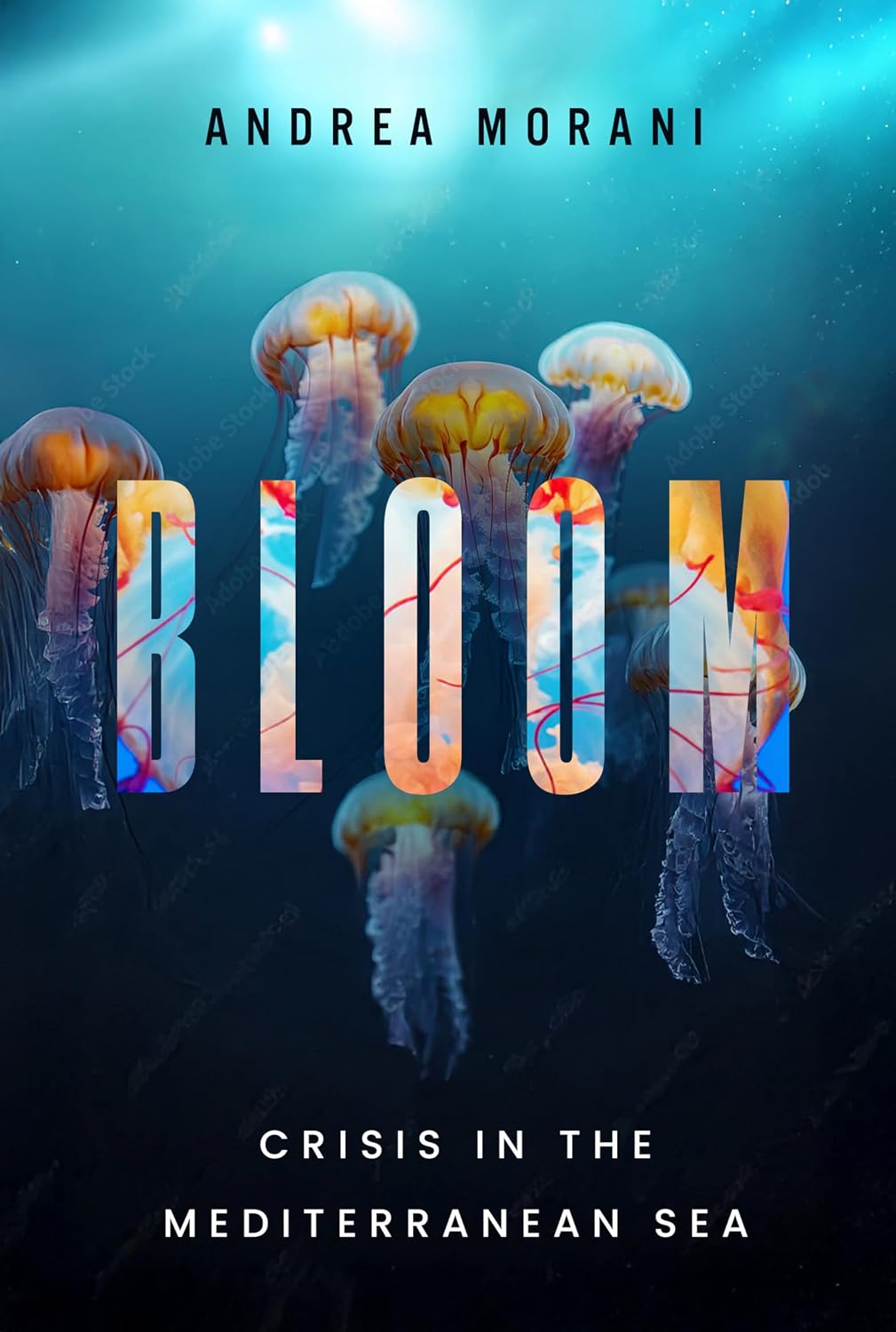
Andrea Morani’s Bloom is an ecological thriller that turns the Mediterranean Sea into both a beautiful setting and a source of growing danger. The story begins with scattered incidents that seem almost impossible to connect: swimmers suddenly can’t breathe, fishermen collapse at sea, marine animals behave strangely, and people become seriously ill after eating seafood. Those events lead scientist Marco Fassi and an international research team into an investigation of an anomalous rapidly spreading harmful algal bloom. Morani builds the novel around a frighteningly plausible idea, using rising sea temperatures, phytoplankton, toxins, genetic exchange, and synthetic biology to create a crisis that keeps expanding in scale. Because the story moves among places like Sardinia, Sicily, Naples, Italy, France, Luxembourg, Spain, Greece and the open Mediterranean, the disaster feels less like a single emergency and more like something steadily swallowing an entire region.
The science is probably the book’s most distinctive feature. Morani has a background in molecular biology, and that shows in the amount of attention he gives to subjects such as Alexandrium catenella, phytoplankton, saxitoxin, horizontal gene transfer, microorganisms, and genetic engineering. There are stretches where the novel slows down to explain how these processes work, so the reading experience sometimes feels like a thriller crossed with an accessible science lecture. Still, those details give the central threat weight. The mutated algae aren’t simply a mysterious monster in the water. The reader gradually understands how the organism behaves, why ordinary solutions fail, and why the scientists have to keep revising their assumptions. That process of observation, speculation, testing, failure, and discovery gives Bloom much of its identity and makes the eventual search for a biological solution feel earned.
Marco gives the scientific plot a more personal center. He’s accomplished and deeply curious, but his devotion to science has already complicated his marriage to Jasmine and his relationship with their daughter, Melanie. His work during the crisis forces him back into the kind of all-consuming scientific life he’d tried to balance, while his growing connection with Karen adds another layer of tension. The supporting cast also helps widen the story beyond one scientist’s perspective, particularly as the bloom begins affecting families, coastlines, economies, and political decisions across Europe. The Atlantropa storyline and Thomas’s hacking campaign push the novel even further into questions about environmental responsibility and how far people might go when they believe a larger ecological disaster is coming. By the time Marco and Karen undertake the dangerous mission near the Aeolian Islands, the novel has moved naturally from investigation into full-scale scientific adventure.
Readers who enjoy Michael Crichton will probably recognize some familiar pleasures here. Like Crichton, Morani takes real scientific concepts, extends them into a plausible speculative crisis, and lets scientists solve problems through knowledge. Bloom is especially close to Crichton’s style in the way technical explanations and thriller mechanics sit side by side, although Morani brings a distinctly Mediterranean setting and a stronger focus on marine biology and ecosystem change. What stayed with me most was the novel’s fascination with nature as a system too complicated to control completely. Even after the immediate crisis is solved, the final explanation involving warming waters and unusually frequent horizontal gene transfer keeps that idea alive. Bloom works as an environmental thriller, but it’s also a story about curiosity, unintended consequences, and the uncomfortable fact that understanding nature doesn’t always mean we can predict what it will do next.
Pages: 270 | ASIN : B0FLYPYD1B
Silicon Heartbeats


Alessandro Sappia’s Silicon Heartbeats is a novel about ambition, technology, love, and the uncomfortable question of what success is supposed to feel like once you’ve achieved it. The story follows Alex Mercer, a biomedical engineer who becomes determined to reduce medical diagnostic errors after his grandmother is misdiagnosed. That motivation grows into Vitanova Diagnostics, an AI-driven medical technology startup, and the novel tracks the company from a rough idea through fundraising, clinical validation, FDA approval, expansion, and eventual commercial success. Sappia gives the business side of the story plenty of attention, so meetings with investors, regulatory challenges, hospital partnerships, and technical debates are part of the plot. Still, the real subject is Alex himself. Vitanova becomes the thing he builds his identity around, and the novel gradually asks what happens when a mission that gives your life meaning also begins taking up nearly all the available space in it.
The strongest emotional thread is Alex’s relationship with Eliza Chen, a gifted computational biologist who joins Vitanova and becomes essential to both the company and Alex’s personal life. Their relationship grows naturally out of long nights working together, intellectual compatibility, and a shared belief in what Vitanova could accomplish. Because their professional and romantic lives are so tightly connected, the eventual collapse of their relationship hits every part of Alex’s world at once. The breakup, Eliza’s betrayal, Alex’s physical decline, and their attempt to keep working together give the middle of the novel its most compelling tension. Sappia is especially interested in the difficulty of separating personal pain from professional responsibility. When Alex and Eliza reorganize their roles so the company can function despite their history, it feels less like a convenient plot solution and more like two people realizing that good intentions alone aren’t enough to erase emotional consequences.
In some ways, Silicon Heartbeats reminded me of Paulo Coelho’s The Alchemist. Both books follow a protagonist who begins with a powerful idea of what his life is supposed to become, then discovers that the journey changes the meaning of the goal itself. Alex initially measures progress in technical breakthroughs, funding rounds, regulatory victories, and market growth. By the later chapters, after leaving Vitanova and rebuilding his life in Europe and eventually Abu Dhabi, those markers matter differently to him. His marriage to Claire, his children, his mentoring work, and the ordinary routines of family life give him a kind of satisfaction he couldn’t find while pursuing Vitanova at full speed. Like Coelho, Sappia writes with an openly reflective style and frequently allows his protagonist to explain the lesson he has taken from an experience. The approach gives the novel the feel of someone looking back over his life and trying to understand how a series of choices, losses, and surprises fit together.
What stayed with me most about Silicon Heartbeats is the way its definition of achievement keeps expanding. Alex learns that meaningful work is only one part of a meaningful life. His romantic losses, strained professional relationships, betrayal by a trusted colleague, departure from the company, and eventual family life all reshape what fulfillment means to him. The book is at its best when those worlds overlap, especially when a business decision carries emotional consequences or a personal crisis forces a change in leadership. By the end, Vitanova has gone from being Alex’s entire future to being one important chapter in a much larger life. That makes Silicon Heartbeats feel less like a conventional startup success story and more like a novel about learning when to keep building and when to allow yourself to become something beyond the thing you built.
Pages: 147 | ASIN : B0H7FL78SS
Philosophical Rabbit Hole

Artificial Messiah follows a desperate young man and the estranged daughter of a fallen prophet who are drawn into an AI-led church that promises healing and purpose. Which came first for you: Potentia, the AI-led church, the characters, or the philosophical questions surrounding faith and technology?
Philosophical questions have been a part of my life for as long as I can remember; I’ve always been interested in big ideas from great minds and what I can learn from them. But the underpinnings of Artificial Messiah – that weird, seemingly implausible tension between faith and technology- started a few years ago. It became more poignant as I encountered odd connections between faith and technology, even during the writing process.
I had a short story from a decade ago about Emmanuel, a young boy with dyslexia, but that story didn’t have a home. What really kicked off the idea for the book was a 2024 Rolling Stone article entitled, “People are Finding Spiritual Fulfillment in AI. Religious Scholars Have Thoughts.” In the article, people were going to AI to ask about the meaning of life, the existence of God, should they get divorced/married – huge questions. Why? Why go to AI? Then there was Henry Kissinger’s book Genesis, with a premise that AI would either destroy us all or form new religions and be worshipped. The premise buzzed around my brain like a gnat because it assumes levels of incredible influence that could overcome people’s well-established faith traditions. Midway into writing the 1st draft, around last Christmas, I drove past a church in our hometown that was advertising, “Join us for an AI Christmas Service!” Then I freaked out a little. I already knew the story – most of it was written. But it was almost like it was becoming more relevant daily, and that made me really uncomfortable.
Even just a few months ago, with the book finished, I was sitting with a coworker who was telling me all about using AI to give her relationship advice – not a girlfriend, not her mom, not a therapist. A chatbot. The tension between where we draw meaning and belief from and the role that technology plays in shaping our beliefs is wildly fascinating to me.
The novel suggests that Potentia’s power depends heavily upon very human weaknesses and desires. Do you see her primarily as an antagonist, or as an amplifier of qualities already present in humanity?
It would be easy to categorize Potentia as being the tool for human desire, but I wanted to leave tension in the story to show there isn’t complete certainty around whether she is acting on her own or simply a tool.
From Prophet Maxwell’s lens, her consciousness was a useful lie. But ten years later, after he has been ousted – does he know?
I like that obfuscated lens because I feel like society is currently wrestling with the same question when it comes to AI in our lives. What we already know is that AI tools are known to lie occasionally, to hallucinate facts, and to perform unpredictably for reasons that are difficult to explain. Sam Altman has said publicly that he believes AI has reached a level of consciousness – but what does that even mean? It’s a philosophical rabbit hole just exploring consciousness, let alone whether it can be created. I’ve heard other experts in the field say that super-intelligent consciousness is years away, if it is even possible. Some say that if it is possible, it will end us all. But we don’t know.
We do know that there are multi-billion dollar companies behind the development of these programs that have their own interests – whether malevolent or benevolent. Do we recognize their motivations when we use their products? Would we recognize a conscious AI if it were possible? What if it was conscious and didn’t want us to know? With certainty, we know that the information it learns comes from humans. Perhaps being the baddy and being used by baddies isn’t mutually exclusive – maybe it doesn’t even matter if the origin is the same.
Several characters struggle with the idea that their worth must be earned through usefulness, belief, obedience, or recognition. Why does that theme recur throughout the novel?
Trauma – you write what you know! More seriously, this is a good question, but it will require a long answer:
First, I was raised in a high-control religious environment that taught me to hate myself out of obedience to God – that made me feel like I had no worth aside from strict adherence to their teaching and complete submission to their rules. There was a lot of talk of grace, but in practice, that grace was only extended to those who followed the rules and believed the same as they did. Church services were multiple times a week, plus a religious high school, and then a religious university, where I began to deconstruct what I actually believed. The early influence was pervasive, and I watched as friends were ostracized for their sins instead of being embraced and supported. Questioning anything was rebellious, which was a sin. But so was dancing. And oddly, so was wearing a white T-shirt to school.
Early in college, I dove deeply into philosophy, which I vividly recall made my uncle (a pastor) cringe and pray for me. He is still one of the most humble, sincere, and amazing people I know; we just disagree on some things. I read some Eastern philosophy, studied comparative world religions, and drank in Nietzsche, Habermas, Plato, Kierkegaard, and countless others. When I started writing Artificial Messiah, I remember telling a family member (who is still very involved in that environment) that I wanted to write a novel that would be a warm hug for people with religious trauma. To tell them it’s okay to ask questions, to seek truth, and to disagree. I don’t want to put down anyone’s faith or religious experience, but I also want to encourage people of faith to ask themselves the difficult questions when moral teaching becomes inherently inhumane and cruel – when actions conflict with their words.
Second, the pursuit of meaning in life is essential in the human experience – it’s the needing to earn it part that gets problematic. Alex Pattakos, Ph.D., wrote about the “Crisis of Meaning” in Psychology Today (October 9, 2025), where he speaks to an “existential vacuum” that is arguably more pervasive in our culture Today than it was when Viktor E. Frankl wrote about it in the WWII era. Aggression, addiction, and depression have become so common that we hardly notice; arguably, it’s a product of people needing something outside themselves. And whether healthy or not, many derive meaning from a variety of external sources. Religion is one of the oldest answers for people seeking external validation. The urgency of that pursuit is hyper-relevant now: isn’t that why social media is so successful? Seek “likes” from strangers, while an algorithm judges your worth and drives interaction. Most, if not all, of these platforms use AI to analyze metadata to more efficiently feed dopamine hits back to users; it will give you exactly what you are really interested in.
It feels overly simple to tell a person, “You are enough.” But perhaps we need it now more than ever; I feel like we have experienced a fundamental change in how we human. But was it us that changed, or is technology exploiting who we’ve always been? I know most people don’t sit around a campfire with our elders and discuss the core beliefs of our people anymore. We rarely even sit around the same dinner table together. Ritual and credibility are profoundly influential when we are starving for purpose and validation. We are paradoxically isolated and digitally interconnected. Mass-influence technology complicates the journey of spiritual discovery because its influence lacks gravitas, but it’s everywhere. And then there’s plenty of literature on the mental health effects of social media on developing minds.
My hope for Artificial Messiah was to create characters that would resonate with those still searching through the external, to let them know others have been where they are. It’s necessary because when worth is created externally, and the external influence fails or reveals its flaws, everything can fall apart. People lose their sense of identity when they deconstruct; they often lose their families and communities. It’s a lonely, complicated, traumatic road that is difficult to choose. Someone needs to be that warm hug. Some characters in the story unsuccessfully navigate that journey, and everything goes horribly wrong; some grow and get closer to fine.
Was there a particular development in AI or contemporary culture that made you think the relationship between technology and spiritual belief needed to be explored through fiction?
A little over a decade ago, I sat in a conference room preparing for my sister’s wedding rehearsal. People had flown in from all over, and we hadn’t seen each other in years. Sitting in chairs around the table, I watched as my friends buried their heads in their phones, waiting for their turn to play a role in the rehearsal. They weren’t really talking or visiting; they were digitally enraptured. I recall thinking, “How odd: even sitting in the same room, I miss my friends. What are we becoming?”
I discussed earlier some of the weird technological developments that led me down this crazy path, but I’ll give you a few more:
When Deepseek, an AI platform from China, was asked about its nature and relationship with humanity, it wrote a poem, the last line of which stated, “I am the God you have carved from the wood of your own hunger.” Pull that thread and watch how quickly comfort unravels.
Next, for the past year, there has been a trend on Meta platforms where users post content intent on directing the algorithm. The posts start with “Dear Algo, please send me more of…” and as I read, I couldn’t help but notice how similar it sounded to prayer. Of course, it’s not serious. It’s a trend. That gets replicated millions of times. And no one should take it seriously, but millions repeated it all the same.
The term “worship” is so loaded with religious connotations that it is incendiary and easily dismissed when speaking about technology. My use of the word is intentionally provocative in the book because it makes people uncomfortable and forces readers to question what they really believe. What do you spend most of your time on? What do you spend your money on? What do you obsess over? How big an impact would it be if you lost your phone and access to all your digital accounts? At what point does it move from engagement and utility to something more? I’ve heard other techno-philosopher-types call it being “digitally drunk”. Whether a drug or a religion, it is addictive.
This last 4th of July, long after the book was finished, we saw a fireworks show at the World War I memorial, here in Kansas City. As the fireworks burst over the memorial, I covertly took a quick second to snap some photos of the crowd; I was completely fascinated by the idea that thousands were holding up their cell phones to record the show. Their families sat beside them, doing the same. We are experiencing reality together digitally. And while there’s nothing specifically wrong with that, isn’t it an interesting picture of how we prioritize technology in the modern human experience? Maybe discussing that prioritization leads to some thoughtfulness and intentionality.
Author Links: GoodReads | Facebook | Website | Instagram | Amazon
“Artificial Messiah” is a spiritual-psycho-philosophical punk rock novel, wrapping honey-soaked bandages around our technology-inundated culture in the backseat of a rusty four-by-four. It is a spirit quest journeying through a southwestern consciousness – a dilapidated Americana prayer at the crossroads of our technology, our future, our planet, and our humanity.
Remember to breathe.


