Blog Archives
Be Clear and Intentional
Communicate Like a Champion provides straightforward advice for enhancing professional communication, along with strategies that emphasize clarity and empathy. Why was this an important book for you to write?
This book was important for me to write because I’ve seen time and again that the success or failure of projects, teams, and even careers often comes down to communication. As a leader in telecommunications and during my doctoral studies, I recognized how often components of communications, such as clarity and empathy, were missing in professional exchanges. I wanted to create something concise, practical, and easy to use, something people could apply immediately in their workplace, whether they’re leading teams, collaborating across departments, or simply trying to be better understood.
What is one misconception you believe many people may have regarding effective communication in the workplace?
One of the biggest misconceptions is that communication means more words. People often think that long emails or detailed presentations equal effectiveness. In reality, effective communication is about being clear and intentional, saying the right thing, not everything. Another misconception is assuming silence means agreement. “No questions” doesn’t always mean understanding or alignment, and that’s where leaders need to confirm, follow up, and create space for feedback.
Did you learn anything that surprised you while you were researching and writing Communicate Like a Champion?
What surprised me most was how consistently small actions can create significant results. It wasn’t the grand speeches or high-stakes presentations that made the most significant difference; it was the everyday habits that mattered most. Things like summarizing a meeting in a single clear sentence, asking one good clarifying question, or pausing to reflect before responding. Those small, consistent habits are what transform someone into a “champion communicator.”
What is one thing you hope readers take away from this book?
If there’s one thing I want readers to take away, it’s that communication is a skill you can practice and improve. It’s not just for extroverts, executives, or “natural speakers.” With small, intentional steps clarifying intent, listening actively, and following up, you can become the kind of communicator who builds trust, fosters collaboration, and leads with confidence. That’s what “communicating like a champion” is all about.
Whether you’re a new professional, a seasoned leader, or someone navigating the complexities of hybrid teams, Communicate Like a Champion offers practical, proven strategies for improving your connection, leadership, and collaboration in the workplace.
This concise and actionable guide walks you through the core elements of strong communication—from clarifying your intentions to using empathy and follow-up effectively. With relatable examples, reflection prompts, and a 28-day challenge to build habits over time, this book helps you go beyond just “getting your point across.”
You’ll learn how to:
Communicate clearly across departments, hierarchies, and mediums
Recognize internal and external factors that influence every message
Use tone, clarity, and follow-up to earn trust and foster collaboration
Apply tools and tech that elevate your tone and clarity
Lead conversations with empathy, even when conflict is unavoidable
Whether you’re sending an email, running a meeting, or managing change, this book provides a reliable framework for ensuring your message lands and builds stronger relationships.
Communicate Like a Champion
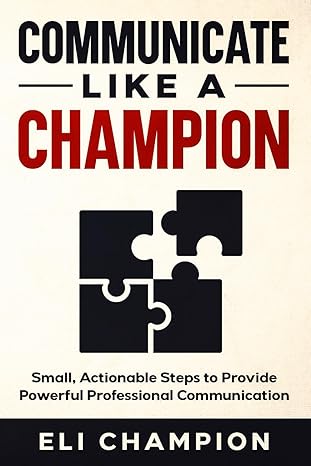

Eli Champion’s Communicate Like a Champion is a straightforward, practical guide to improving professional communication. The book breaks down why communication matters, how intentions shape interactions, what factors influence the way messages are received, and how to put strategies into practice with clarity and empathy. It’s full of simple, actionable steps, like clarifying your purpose before a meeting, checking tone in emails, and following up after conversations, that aim to make anyone a more confident and respected communicator.
What stood out to me initially was the book’s emphasis on practical application rather than abstract theory. Champion illustrates this with the example of a manager calling for “a quick meeting” without providing context. As he explains, such ambiguity often leaves employees uncertain and anxious, unsure whether they have erred or whether the meeting is merely routine. I found this example particularly resonant, having experienced the situation from both perspectives as the uneasy employee and as the manager who failed to provide sufficient clarity. The recommended adjustments, such as stating the purpose of the meeting at the outset or clarifying next steps before closing, are deceptively simple yet highly effective. I could immediately envision how these practices would have alleviated unnecessary tension and improved understanding. This emphasis on directness and transparency exemplifies the book’s core message: communicate with precision to minimize confusion and foster confidence.
I found the chapter on the “7 Components of Communication” particularly instructive. While the framework, clarity, confidence, respect, listening, tone, empathy, and follow-up may appear familiar, Champion’s illustrations prompted meaningful reflection on my own communication practices. One example contrasted the response “I don’t think that will work” with the more considerate phrasing, “I see your point, but can I offer another perspective?” The distinction is subtle yet powerful, highlighting how word choice and tone can determine whether a message is received as dismissive or constructive. Confronted with this comparison, I recognized moments when I have defaulted to the blunt response, often unintentionally undermining collaboration. The example served as a useful reminder of the value of consistently striving for a more respectful approach.
Another notable feature of the book is the 28-day communication challenge. Organized around weekly themes, such as clarity, listening, empathy, and follow-up, it provides daily prompts that encourage practical application, including exercises like restating a colleague’s point to confirm understanding or sending a follow-up email after a meeting. I appreciated that this section moves beyond theory to establish a structured practice routine. When I applied one of the suggested exercises, clarifying my intention at the beginning of a meeting, I was struck by how much more effectively the conversation unfolded. The challenge, paired with the book’s approachable tone, created the sense of being guided by a mentor offering encouragement, rather than being instructed by a prescriptive voice.
I found Communicate Like a Champion to be highly practical and accessible. Rather than relying on jargon or overly complex frameworks, it presents straightforward tools and encourages consistent application. I would recommend this book to early-career professionals seeking to develop confidence, to managers aiming to strengthen their leadership presence, and to anyone who has left a conversation feeling uncertain about its outcome. With reflection and deliberate practice, the strategies outlined here have the potential to significantly improve the way one engages in meetings, correspondence, and professional interactions more broadly.
Pages: 65 | ASIN : B0FG71T9MZ

The 20 Hour A Week CEO

The 20-Hour A Week CEO challenges the pervasive narrative that success comes from relentless hustle. Instead, Jess Cassity advocates for a mindset shift—one that prioritizes impact over hours worked. By rejecting traditional hustle culture, the book introduces a transformative model for managing online businesses with efficiency, strategic focus, and work-life balance. Cassity unpacks the key principles behind this shift, addressing topics like overcoming imposter syndrome and fostering a growth-oriented mindset. With step-by-step guides, practical exercises, and detailed checklists, readers gain actionable tools to achieve productivity without exhaustion. The strategies presented help individuals integrate personal and professional responsibilities, enabling them to thrive in both spheres.
Compact yet comprehensive, The 20-Hour A Week CEO serves as the perfect pocket guide. Its brevity ensures accessibility, while its depth covers every critical aspect of the subject. Cassity discusses everything from advanced marketing techniques to scaling strategies, providing valuable takeaways for entrepreneurs at all levels. Each chapter concludes with summary sections, reinforcing key insights and making the book easy to revisit for quick refreshers. The logical structure—beginning with mindset development and progressing to practical business strategies—ensures a clear, sequential flow. Readers can build upon foundational concepts before tackling advanced methods, creating a well-rounded understanding of the content.
Cassity’s writing style further elevates the book’s impact. Her tone is engaging, motivational, and consistently supportive. By blending personal anecdotes with clear, actionable advice, she creates an empowering reading experience. The book prompts reflection throughout, encouraging readers to adapt strategies to their unique circumstances. This balance between theory and practicality keeps readers actively engaged while fostering a sense of accountability and empowerment.
This book offers something for everyone. New entrepreneurs gain a solid foundation for building efficient work habits, while seasoned business owners discover ways to improve their existing processes. Cassity’s thoughtful approach empowers readers to reclaim their time, optimize productivity, and create a sustainable work culture. The 20-Hour A Week CEO is more than a guide; it’s a roadmap for achieving success on your own terms—an essential tool for anyone ready to work smarter, not harder.
Pages: 141 | ASIN : B0DMP9P2T9
La Hoja De Ruta Fiscal Y Financiera Para Los Españoles En EE.UU.

La Hoja De Ruta Fiscal Y Financiera Para Los Españoles En EE.UU. proporciona una exploración profunda del panorama financiero y fiscal para los españoles que viven en los Estados Unidos. Ofrece consejos prácticos sobre cómo navegar por las complejidades de las leyes fiscales y los sistemas financieros de EE.UU., comparándolos con el contexto español. El libro tiene como objetivo ayudar a los expatriados españoles a comprender y gestionar sus obligaciones financieras de manera efectiva, asegurando el cumplimiento y optimizando sus situaciones fiscales. También arroja luz sobre aspectos únicos de la fiscalidad y la planificación financiera en EE.UU. que podrían ser desconocidos para los recién llegados.
Una de las fortalezas del libro radica en su cobertura exhaustiva de los temas. Por ejemplo, profundiza en las diferencias entre los enfoques de ahorro para la jubilación en España y EE.UU., destacando la mayor variedad y los límites de contribución más altos disponibles en EE.UU. Esta comparación no solo informa, sino que también empodera a los expatriados españoles para tomar mejores decisiones financieras. La explicación detallada de herramientas como el Foreign Tax Credit y el Foreign Earned Income Exclusion es particularmente útil, ofreciendo una guía clara sobre cómo evitar la doble imposición.
El estilo de escritura es claro y atractivo, haciendo accesibles temas financieros complejos. El uso de analogías, como comparar el usufructo con disfrutar de una taza de café mientras se posee la taza, ayuda a desmitificar conceptos intrincados. Además, la inclusión de ejemplos de la vida real y consejos prácticos mejora la practicidad del libro. Un aspecto destacado es la discusión sobre las peculiaridades del sistema fiscal de EE.UU., como el Impuesto Mínimo Alternativo (AMT). El libro explica de manera efectiva cómo se calcula el AMT y sus implicaciones, proporcionando valiosos conocimientos para aquellos que no están familiarizados con este mecanismo fiscal.
La Hoja De Ruta Fiscal Y Financiera Para Los Españoles En EE.UU. es un recurso invaluable para los españoles que viven en los Estados Unidos. Ofrece conocimientos esenciales y consejos prácticos para ayudar a los expatriados a navegar por los sistemas financieros y fiscales de EE.UU., que a menudo son confusos. Este libro es particularmente adecuado para aquellos que son nuevos en EE.UU. y necesitan una guía clara y concisa para gestionar sus finanzas y obligaciones fiscales en su nuevo hogar.
Pages: 94 | ASIN : B0D51RP89G



 LITERARY TITAN