Blog Archives
Vulnerability Is Strength

The Work In Between is a memoir sharing your experiences of losing over 100 pounds, surviving cancer multiple times, and going through a period of self-reinvention. Why was this an important book for you to write?
I kept getting asked where my book was. People assumed I had written one given my experiences. After a lot of self-reflection, therapy, and conversations, I felt I was ready to tackle a book. To be honest, I wasn’t convinced I had that interesting of a story. I wasn’t sure anyone would care. However, some conversations made it clear that it might be helpful to others, if only to show you can go through some pretty tough stuff and still be a compassionate, successful, and joyful person. So, I wrote it. The response has been overwhelmingly positive.
I appreciated the candid nature with which you told your story. What was the hardest thing for you to write about?
It’s the only way I know how to be. I’m not very good at sugar coating things or only telling one side of the story (i.e., where I only look good). The hardest part was writing about when my brother Eric died. I cried when I was writing about losing all of my family, but Eric’s death was particularly difficult. Still is. I laughed a lot, too, though. I ended up remembering things I had forgotten. Good memories. Happy memories.
How has writing your memoir impacted or changed your life?
I’m happy that it’s resonated with so many people. Writing the book has made me realize I have a lot more work to do. I wrote a chapter in The Backyard Peace Project anthology and got a fantastic response to my chapter about loving ourselves harder when we stumble and fall. I think it’s a really important message to get out there, especially with all of the negativity and skewed reality from social media.
I’ve learned through my book that vulnerability is strength. Most people are tired of branded packages of unrealistic life. I think they are hungry for real, honest conversations about hard things. That’s how we grow. I was once told that I talk about things people usually keep in the shadows. That’s true. I do that because if I try to carry it all alone, it makes me sick: physically, emotionally, spiritually, and mentally unhealthy. We aren’t supposed to walk around with shame and guilt. Talking about it is healing, and it helps others process their experiences. Everyone has experienced hard things; sharing them helps us heal and grow.
What do you hope is one thing readers take away from your story?
That they are worthy just as they are and worthy of love and a good life. It doesn’t matter what the scale says, what other people tell you, or where you started in life. If you want to improve your physical, mental, emotional, or spiritual health, great. Do that. However, you are worthy of love and an amazing life no matter what.
Author Links: GoodReads | Website | Amazon
Witty, frank, and richly thoughtful, The Work In Between is peppered with wisdom from the author’s expertise in the field of Health Communication. Holmes brings an astute eye to the relationship between outward appearances and medical experiences as she draws from her doctoral education and years of service as a hospital executive. And yet, the complex web of stories that characterize The Work In Between extend far beyond Holmes’s own experiences. As this memoir makes clear, we carry family trauma in our bones. Until we do the inside work of facing our demons and declaring our worthiness, we cannot live the full, happy lives we were meant to live.
Knowing You’re Loved

Round the Twist: Facing the Abdominable shares your story about fighting for your life against Stage-4C Colon Cancer and the hurdles you faced from people in the healthcare field and your personal life. Why was this an important book for you to write?
First, it seemed as if there was a recent wave of younger cancer patients (under 50) being diagnosed, and as soon as I got my diagnosis and tried to research what was going on, I discovered that most of the information (including memoirs and biographies) mostly dealt with 50+ patients. Colon cancer historically affects older adults (in their early 70s), so much of the information didn’t apply to me. I actually didn’t set out to write a book at first, I was just blogging about my experience, but then another writer suggested I turn it into a book—I might reach a larger audience of younger cancer patients who needed to hear my story so they could have someone to relate to.
Second, my issues with the healthcare field at the beginning are not uncommon. Since publication last fall, I’ve been contacted by many younger women, so I’ve heard too many stories from these women with colon cancer that they, too, had difficulty getting a proper diagnosis. I was very lucky that my gynecologist and primary physician were on top of my symptoms and tried their best to get me into the proper hands. Unfortunately, the first oncologists I met with were not as invested in my well-being. I think this is pretty common. I wanted other patients (women in particular) to know that they don’t have to accept the word of a doctor they don’t fully trust. It’s ok to walk away and start over again with a new doctor. Your life could depend on it, but we live in a society where we often feel we need to please people, and that doctors are somehow gods among men. This isn’t true! We, the patients, need to find our voices and speak up. It’s ok. No one is going to be insulted, but you will get better care.
What were some ideas that were important for you to share in this book?
I wanted mostly for people to understand that the experience of cancer is many-layered. We’re not just sad that we have cancer, or sick because we have chemo, or happy when we get a clear scan. There are so many facets to our new reality that it can be hard for people even to talk to their spouses about it. I’m lucky in that my husband and I are so open and honest in our communication that I could tell him exactly what I was feeling and know that he would try his best to understand. Not everyone has that (that doesn’t mean they’re not in a loving relationship, it’s just that sometimes talking about hard things can be, well, hard) and I felt that if I could lay myself out there open and honest to the world, then someone might point to a chapter and say, “If you read this chapter, you’ll understand how I feel right now.”
I also wanted to point out how difficult it is to go through something as private as cancer in a world with social media. I made the conscious decision to go through my treatments in the public eye—again because I thought it would ultimately help someone else who was feeling alone. They could point to my blog or a post or a photo. I could be their voice so they didn’t have to share.
What was most important, though, was to impress upon people that no matter how scary or dark the prognosis may be, there is a beautiful world going on all around us. It is a gift to sit in the grass, to pet the dogs, to eat a good meal, to hold your children in your arms, or be held by your lover. There is always hope. If you surround yourself with people who also believe in that hope, magical things can happen. I don’t mean friendship cures cancer! But it sure helps keep your mental state positive so that you can focus on getting better knowing you’re loved.
What is a common misconception you feel people have about how to support family and friends who receive a diagnosis of cancer, and what is one thing they can do that actually helps?
The first thing some people said to me was, “Let me know what I can do to help.” Cancer is so overwhelming, we often can’t think of much more than what we’re doing right at that moment. My husband was the one who decided what I would eat for meals because trying to decide for myself was too much. There was no way I could anticipate my own needs. So although the offer sounds great, it really is overwhelming—and I never ever told people what they could do to help because I didn’t know what I needed.
What was actually helpful were those who said, “I’m coming over to do your laundry,” and “Look on your front porch, I left some food.” There were countless mornings where people left bags of food on our porch. Offering something specific, like “Can I run to the grocery store for you?” is way more helpful. People stepped up and said things like, “Don’t worry about getting to your next radiation treatment, I’ll be there at 12:30 to pick you up.” My friends who did not take “no” for an answer were the most helpful of all!
And the one thing people can always do is check in often. Simple messages to say “I’m thinking of you,” have a huge effect. Especially when I was feeling down, and someone would text, “Just wanted to let you know I love you,” I would pop out of my dark cloud. There’s never a wrong moment to check on your friend.
What do you hope is one thing readers take away from your story?
I hope that they understand that my outcome was unique, I still haven’t met the 5-year survival statistic, and that I count my lucky stars every day that I’m still here. I’ve already lost two friends to colon cancer (who were also under 50) so I know how quickly these situations go wrong. Hold on to hope, but also hold on to facts, and face reality. Life is a gift, every single day, live to the fullest and never miss an opportunity to tell someone you love them.
Author Links: GoodReads | Facebook | Website | Amazon
The long and difficult journey to diagnosis was fraught with pitfalls and wrong turns, ambivalent doctors and insensitive nurses. Through the efforts of a strong advocate, she was finally placed in the care of some of the best doctors Los Angeles has to offer, only to be devastated to learn that she had Stage-4C Colon Cancer.
Facing unspeakable odds, she dove head first into aggressive treatments that decimated her body, but never destroyed her natural optimism and positivity.
Through the lens of the natural world around her, the young cancer survivor reveals the intensely private and deeply emotional aspects of fighting for her life. Sometimes with a pinch of humor but always with raw honesty, she holds on to bright hope that warmly invites you to share in her journey.
Every Diagnosis is Different

In Welcome To The Bright, you share with readers the challenges you faced as you readjusted to life after surviving a stage 4C colon cancer diagnosis and subsequent treatments. What inspired you to share your story?
As I was recovering, I was looking for resources online on how to cope with not only the physical changes that had happened to my body and the emotional troubles I was having but also for how to reintegrate into my former life. I wasn’t finding any help, so I turned to my fellow cancer survivors for advice. It turned out we all struggled with getting back to our previous careers and lifestyles. It became clear that I was not alone in feeling adrift, and it would be important to write about this phase of the cancer journey to help other people navigate this difficult and unexpected time.
I appreciated the candid nature with which you told your story. What was the hardest thing for you to write about?
For sure the hardest was sexual dysfunction. The doctors had a hard time talking to me about it, my survivor friends weren’t talking about it, and again I just couldn’t find solid resources out there to help me. It was another thing where I thought, “I’m not alone, so if I don’t talk about it, other women will never know it happens.” It was hard to think that my family and friends would read about this very private situation, but on the other hand, there were bound to be plenty of women out there who had survived cancer to find themselves in the same position as me, and they needed to hear my story. That chapter was written for them so that they knew this wasn’t something shameful to hide and ignore, and that they absolutely are not alone.
What is one piece of advice you wish you had been given when you were diagnosed with cancer?
“Don’t compare yourself to anyone else.” Everyone’s story is different, every diagnosis is different, and even the same kinds of cancers are different. It was difficult in my support group to listen to other people’s experiences and then worry that the same thing would happen to me. I had to accept and believe that I am unique, and none of us have an exact same reaction to the drugs so we shouldn’t all expect the same outcome. Just because one person had terrible pain with a surgery didn’t mean that I would. It took me a while to understand this and just keep my eyes on my own path and not get distracted or frightened by other people’s stories.
What is a common misconception you believe most people may have about cancer survivors?
Many people just expected me to jump straight back into my previous life as if nothing had ever happened. As a musician, suddenly everyone was inviting me to rehearsals, and friends wanted to take me out to lunch. There’s a lot of PTSD involved in having cancer, how it manifests is different for everyone. I was nowhere near ready to get back on stage or sit in a restaurant. The life I lived before cancer was foreign to me, and I was on a path to discovering who I was now, post-cancer. I think people (thankfully!) don’t understand what a profound effect cancer has on us, it literally changes our lives in unimaginable ways, and I was trying to discover who I was now, in the aftermath of cancer. I know people were excited to get me back, but I was a changed person and I felt as if I needed them to acknowledge that and learn about the new person standing before them.
Author Links: GoodReads | Facebook | Website | Amazon
She never expected how difficult it would be to transition from colon cancer patient to colon cancer survivor.
Beginning a new regimen of treatments meant to prevent a recurrence, she faced the daunting task of returning to her former life. Plagued with debilitating panic attacks, she turns to nature to find the strength and inspiration she needs to navigate her rocky post-cancer recovery.
Welcome to the Bright chronicles the year after Lisa’s first clear scan and her discovery that the path through the second half of her life is going to be a long and winding road. Becoming a survivor is just the beginning.
Hope and Inspiration

Me and My Shadow – memoirs of a cancer survivor shares your story of battling cancer, your daughter’s diagnosis and treatment, and your decision to become a cancer nurse helping others. Why was this an important book for you to write?
Scarily, one in two of the population will be given a cancer diagnosis at some point in their lives and it remains the greatest fear in society. So, at the risk of sounding contrite (that is definitely not my intention) I wanted to give something back to society – to deliver a meaningful book that would help cancer patients and their loved ones.
I decided that if this piece of work was to achieve its objectives, then it had to be written from three perspectives in order that it would be different from any other survivorship chronicle. Firstly, my experience as an immature adolescent facing the turmoil of both the physical and psychological battle with cancer. This was then followed by the unimaginable trauma of having to confront and accept a cancer diagnosis of my four-year-old daughter and watch helplessly as she underwent chemotherapy, followed by the emotional journey of her terminal diagnosis. Third, I wanted this to provide an educational angle for healthcare professionals working in the challenging field of cancer services. Sadly, at the risk of sounding critical, there are nurses (and some in senior positions) who do not understand the psychological impact of a cancer diagnosis – I have witnessed this with my own eyes during my working career in cancer nursing.
I never intended to ‘just write my story;’ it had to have meaning and provide inspiration to not just the cancer patients themselves, but also their loved ones who are often left out of the cancer equation. Like me, they will need inspiration.
Moreover, I felt this would be a cathartic experience and would eliminate once and for all the demons that lurked in the canyons of my mind. Sadly, it failed to do that.
What were some ideas that were important for you to share in this book?
Everything, it had to be warts and all if it was going to have an impact. It was, however, important to include some humour along the way. Sadly, you cannot sugar-coat a cancer diagnosis, and although the treatments we deliver today are very different from the treatments I received in the seventies – today, we use less traditional chemotherapy and use more immunotherapies, immunomodulatory drugs, monoclonal antibodies, and a few vaccines, making them less aggressive by way of side effects. Nonetheless, cancer instills fear and like I did, everyone needs inspiration.
I appreciated the candid nature with which you told your story. What was the hardest thing for you
to write about?
As you would expect, recalling and writing about my daughter’s diagnosis, treatment, and then being told that she would not survive, brought about some chilling memories. I requested access to my medical records, and I was fortunate enough to be given that access. I needed that information to ensure I got the correct chronological order of the treatments, but paradoxically I wanted to confirm the actual terminal nature of my disease. So reading that, did hit me very hard, even though I clearly knew my own story – seeing it written in a legally binding document confirmed to me how fortunate I am. But, to be totally honest, even today, my cup is often half empty. I am burdened with a number of health-related issues (all as a consequence of the salubrious chemotherapy and radiotherapy I received almost fifty years ago), including another cancer battle, and I cannot help but wonder where my health will take me, luckily, my wife is constantly topping up my cup to make me realise how fortunate I am. ‘If you are fortunate enough to survive a cancer diagnosis, that legacy lives with you forever.’
What is one thing you hope readers take away from your story?
Undoubtedly inspiration – Me and My Shadow – memoirs of a cancer survivor is not a prescriptive guide in respect of how to deal with a cancer diagnosis – no such prescription exists. However, I would say to readers, take from my book whatever you can, hopefully, hope and inspiration, but feel free to criticise where you feel is appropriate because the cancer experience is an individual one and we all cope in different ways.
Finally, I would like to share a few words from the final chapter of my book. ‘Life is not a rehearsal – it is for living, a once-only opportunity to enjoy. Our future is uncertain; no one knows what lies ahead, what fate has planned. Never look back on your life unless you are prepared to smile and be reflective, never look forward unless you can dream–we all need dreams and we all need hope.’
Author Links: GoodReads | Twitter | Facebook | Website | Amazon
Award-winning author, John Walker Pattison has created an inspirational chronicle. A book that anyone touched by a cancer diagnosis should read. It has fifteen independent reviews (all five stars), plus more than thirty reviews on Amazon (all five stars) and over a dozen reviews on Goodreads (all five stars).
This is a true chronicle from three perspectives – he was diagnosed with cancer at eighteen years of age. After years of failed treatments, his parents were told that he would not survive. Yet eight years after his unexpected recovery, his four-year-old daughter is diagnosed with terminal leukaemia – he went on to become a cancer nurse specialist at the hospital that made his diagnosis decades earlier.
Today, he is one of the longest cancer survivors in the UK and recently has once again embarked upon another cancer battle of his own. A remarkable memoir that is poignant, funny and most of all, inspirational.
Today, he is once again, facing a cancer battle – but he remains philosophical and determined.
Me and My Shadow
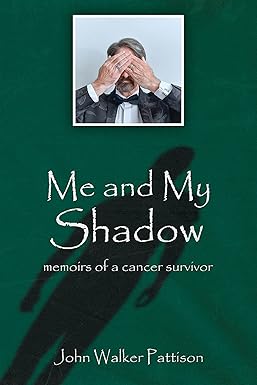

Me and My Shadow by John Walker Pattison is a deeply personal account of his lifelong journey with cancer, exploring his roles as a patient, father, and nurse. Pattison opens his story with a childhood overshadowed by a cancer diagnosis, a fact kept hidden by his parents. This narrative takes us through the complexities of his treatment, its enduring physical and psychological impacts, and the isolation from normal childhood experiences.
Pattison’s story extends beyond his own battle with the disease. As a father, he recounts the heart-wrenching experience of supporting his daughter through her own cancer treatment, a chapter that lends a poignant depth to his narrative. His dual perspective as both patient and caregiver enriches the book, culminating in his decision to become a nurse. Here, Pattison’s personal insights blend with professional care, offering a unique view into the world of healthcare.
The book does more than just shed light on the cancer experience. It delves into the broader tapestry of Pattison’s life, including his exploration of Native American cultures, a vibrant childhood, a passion for rock music, and reflections on a challenging marriage. These varied experiences contribute to the richness of the memoir, painting a fuller picture of the author beyond his identity as a cancer survivor. This book resonates with authenticity and understanding for those touched by cancer, whether personally or through a loved one. Healthcare professionals, too, may find valuable lessons in Pattison’s insights on patient care. The book weaves together heartfelt stories and reflections, revealing life’s unpredictability and the importance of resilience.
Pattison’s narrative is more than a memoir; it is a testament to the enduring human spirit in the face of adversity. His candid reflections and thoughtful observations offer a window into the complexities of living with and beyond cancer. Me and My Shadow is not just a story of survival but an invitation to embrace each moment of life with appreciation and awareness.
Pages: 233 | ASIN : B0BKYJYPY3



