Blog Archives
Young Men In Harm’s Way: A Chronicle of Service and Survival


Arnold W. Krause’s Young Men in Harm’s Way follows a young Californian from civilian life into the daily demands of infantry service in Vietnam. Drafted in 1967, Krause served with Charlie Company, 2nd Battalion, 12th Infantry Regiment, during 1968 and 1969, taking on increasing responsibility as his tour progressed. The book combines his personal story with a detailed record of his unit’s operations, drawing on military journals, letters, and fellow veterans’ recollections. That combination gives it the feel of someone talking you through his memories while spreading maps and photographs across the table.
What makes the account especially engaging is its attention to the practical business of getting through each day. Krause describes soaked fatigues, interrupted sleep, troublesome feet, meals assembled from C-rations, and the constant effort to stay alert. Radio procedures and helicopter movements become part of the rhythm of life, alongside jokes, care packages, and music drifting from a radio. His mother’s small artificial Christmas tree is a lovely detail, especially against the losses the company has just endured. These moments help you picture the young men behind the ranks and surnames, with their habits, friendships, and hopes of getting home.
The combat passages are most affecting when Krause connects an event to a person he knew. His account of David Schultz’s death during his first firefight stays with you because he returns to his own decisions and the consequences he’s spent years considering. December’s mounting casualties bring a different kind of strain, as familiar faces disappear and surviving soldiers have to keep working. His growing responsibility for other men makes each decision more consequential. You can feel how much leadership depends on experience, clear communication, and trust. His admissions about mistakes and gaps in memory make these sections especially compelling.
The book’s thoroughness also shapes its pacing. Long sequences of dates, unit movements, map coordinates, and weapons descriptions require concentration, and repeated explanations sometimes slow the narrative. Readers who enjoy following military operations closely will find plenty to work with, while others may feel most engaged when Krause returns to a conversation or a remembered scene. His strong political opinions and judgments about the war give the narration a distinctly personal stamp, although some sweeping claims would benefit from fuller support. The photographs, maps, glossary, and company roster strengthen the book’s value as a record of the people and places he wants remembered.
The closing material follows Krause’s return to civilian life, his search for old comrades, and the reunions that helped them reconnect. His later visit to Vietnam, including placing flowers for fallen friends, shows how those relationships stayed with him across decades. I’d recommend this book most strongly to Vietnam veterans, their families, and readers interested in the everyday workings of an infantry company, especially those with a connection to the 25th Infantry Division or the 12th Infantry Regiment. They’ll appreciate its patience with detail and its commitment to preserving individual names and experiences. Krause’s affection for the men he served beside is what makes the book worth spending time with.
Pages: 468 | ASIN : B0HCS4TR49

CHANCE: Beginnings

Chance. Beginnings by Roberts Essex is an expansive autobiographical narrative that traces the formative decades of Chance Brogdon, the author’s literary counterpart, from a precarious birth in rural Georgia through childhood, adulthood, public service, marriage, fatherhood, and profound personal loss. The book identifies Essex as a pseudonym for the man presented as Chance, giving the narrative the character of memoir even as it frequently adopts the distance of third-person storytelling. Its title gains significance almost immediately after the difficult circumstances surrounding Chance’s birth, when his mother resolves that her premature and injured son will survive: “And she named him Chance.” From there, chance and providence become competing explanations for nearly everything that happens to him. Family, Southern culture, work, temptation, suffering, and Christian faith form the book’s central subjects, while Savannah and southeast Georgia provide a setting that becomes nearly as important as the people themselves.
Essex is especially attentive to the physical texture of memory. Neighborhood streets, country roads, restaurants, radios, records, cars, grocery stores, storms, family meals, police uniforms, and even particular smells are preserved with remarkable specificity. That attention turns Avondale and the surrounding Savannah area into a detailed record of a particular place and generation. Chance’s mother, Anne, emerges as the emotional and spiritual center of those memories, serving as provider, confidante, teacher, and the person who first gives him the Christian faith that later becomes his primary way of interpreting suffering. His father, Bernie, is drawn more turbulently, capable of humor, ingenuity, affection, volatility, and frightening behavior. The prose itself has the rhythm of oral storytelling. Essex regularly interrupts himself, addresses the reader, digresses into local history, and returns to stories after long detours. This abundance gives the book intimacy and personality, although its preference for accumulation over compression sometimes slows the narrative. Lists, historical explanations, repeated observations, and extended anecdotes make the book feel like an archive of remembered life as much as a conventional chronological memoir.
As Chance enters adulthood, the book becomes more confessional and considerably more intense. His work in emergency medicine and law enforcement exposes him to fatal accidents, violent confrontations, drug investigations, domestic crises, practical jokes, institutional culture, and the constant possibility of sudden death. The police chapters in particular combine professional pride with stories of foolishness, danger, friendship, and grief, including the deaths of fellow officers and Chance’s own encounters with armed suspects. Essex applies similar candor to Chance’s private life, describing troubled marriages, sexual behavior, pornography, infidelity and temptation, fatherhood, and repeated efforts at repentance. These subjects are viewed consistently through Chance’s Christian convictions, so moral failure and spiritual renewal become a repeating pattern. The discussions of race, desegregation, crime, policing, and social change are also strongly filtered through Chance’s personal memories and judgments. That subjectivity is central to the book’s identity. The reader encounters twentieth-century Savannah as Chance remembers, interprets, and argues with it, with all the affection, anger, nostalgia, certainty, and contradiction contained in that perspective.
The closing chapters give the preceding hundreds of pages a sharper emotional purpose. Chance’s long desire to become a father is fulfilled with the birth of Dillon, and his devotion to his son soon becomes the most consequential relationship in the narrative. When allegations of abuse lead to Chance’s dismissal from the police department, the subsequent investigation clears those allegations, but the damage to his career and marriage has already been severe. The book then ends with Eve disappearing with three-year-old Dillon in defiance of the custody proceedings, leaving Chance searching for his son and attempting to reconstruct both his life and his faith. At that point, one of the simplest sentences in the book carries much of its central idea: “But Chance refused to give up.” Because Beginnings is presented as the first part of a larger life story, its unresolved conclusion feels deliberate. Taken as a whole, the book is a candid, highly detailed Southern life narrative shaped by family memory, first-responder experience, personal failure, resilience, and an enduring conviction that faith can give meaning to events that otherwise appear governed only by chance.
Pages: 409 | ASIN : B0F7XYQ66P
Birth, Death, and Survival

Melanie Whyte’s Birth, Death & Survival is a raw and intimate poetry collection that traces a lifetime of pain, growth, and resilience. It unfolds like a memoir in verse, starting from the innocence of childhood and winding through heartbreak, abuse, motherhood, healing, and eventual renewal. The poems feel deeply lived-in, each chapter marking a phase of her life, from the trembling echoes of a broken home to the quiet triumphs of rediscovered love and strength. There’s a narrative thread that ties every piece together: the human instinct to keep breathing, to keep going, even when the air feels too heavy to bear.
Whyte doesn’t hold back, and I admired that honesty. Her words are simple but sharp, and she lets emotion take the lead. At times, the poems read like confessions whispered in the dark. Others feel like letters written to her past self, forgiving, reflecting, reclaiming. What struck me most was the rhythm of her healing. It’s not neat or linear, and she doesn’t pretend it is. Some verses gutted me with their quiet truth, like “The Room With No Windows,” while others, like “Still I Rise From Shadows,” filled me with soft and steady hope.
As I read, I found myself pausing often, not because the writing was difficult, but because it felt too close. There’s beauty in the way Whyte turns trauma into art without glamorizing it. The collection pulses with empathy, and even in the darkest corners, there’s light breaking through. I liked how she weaves motherhood, love, and survival together; it reminded me that rebuilding isn’t just about leaving the pain behind, it’s about learning to live alongside it.
Birth, Death & Survival is for readers who crave truth, who’ve walked through something hard and come out changed. It’s a book for survivors, for mothers, for anyone who’s ever had to rebuild themselves piece by piece. I’d recommend it to anyone who wants to feel seen, or to those who want to understand what resilience looks like when it’s written in poetry and inked with life itself.
Pages: 181 | ASIN : B0FPXNQFMP
A Journey Into Manhood From the Path of an Idiot
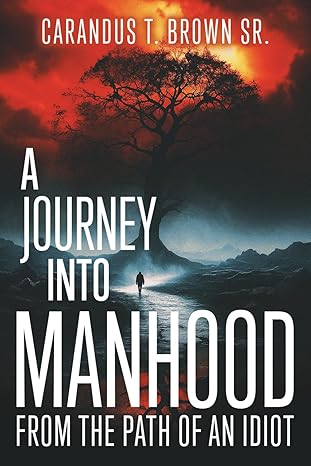

Carandus Brown’s A Journey into Manhood from the Path of an Idiot is a raw and deeply personal memoir that chronicles one man’s long, often painful climb from childhood confusion to adult accountability. With each chapter framed as a “lesson,” Brown reflects on his life from traumatic events and broken family dynamics to brushes with the law, misguided relationships, and spiritual reckonings. What starts as a candid account of pain and dysfunction slowly morphs into a powerful meditation on growth, faith, and the courage to confront your past. This is a book about how a boy with no clear path to manhood stumbles, fights, learns, and ultimately walks that road anyway.
Reading this book felt like being handed someone’s journal, written with no filter and no concern for appearances. I admired that. Brown’s writing is emotional and gritty, full of hurt and hope in equal measure. He doesn’t try to dress up his experiences. He owns his mistakes, often with heartbreaking honesty, and that kind of vulnerability resonated with me. Some parts were painful to get through, especially the loss of his nephew and the scenes with his father, but those chapters gripped me. It’s not just the storytelling, though. It’s how Brown unpacks each memory, not just to remember it, but to understand what it meant, what it cost, and how it changed him.
There were moments when the writing got a little long-winded. I sometimes wished he’d pulled back just enough to let the reader breathe. But even in those moments, I could feel the sincerity behind every word. And there’s poetry in how he writes, even when he’s angry or confused; there’s rhythm and raw beauty to the way he strings his thoughts together. His lesson on education, how he faked reading as a kid just to survive the shame, hit me in the gut. And the spiritual themes, especially his talks with God, felt real. Not polished. Not preachy. Just real.
This isn’t a polished self-help book or a clinical story of recovery. It’s a firestorm of memory and meaning, one that will resonate with anyone who’s ever felt lost, unloved, or misunderstood. I’d recommend A Journey into Manhood from the Path of an Idiot to young men navigating tough upbringings, to anyone grappling with forgiveness, and to readers who crave stories that bleed truth. Brown may have taken the long way to manhood, but this book proves he got there, and he brought a whole lot of wisdom with him.
Pages: 160 | ISBN : 978-1681116082
Dust in the Wind

Michael Triska’s Dust in the Wind is a deeply personal memoir that recounts a life lived on the edge of hardship, heartbreak, and resilience. At its core, it’s the story of Katherine, the author’s wife, a talented and vibrant woman whose life was forever altered by a diagnosis of Multiple Sclerosis at the age of eighteen. Triska doesn’t just chart her medical decline; he details their love, their marriage, and their lifelong battle against poverty, prejudice, and abandonment. What unfolds is not just a chronicle of illness, but a testament to love, loyalty, and surviving in a world that too often looks away.
I was moved by the honesty in Triska’s writing. He doesn’t pretend to be perfect. He owns his fears, failures, and frustrations. That vulnerability gave the story its power. His pain seeps through the pages, but so does his love for Katherine. The depiction of Katherine’s strength, her passion for music, and her indomitable spirit even in the face of such suffering is inspiring and heartbreaking all at once. But more than anything, what got me was the anger. The unfairness. Watching family vanish when things got hard. Seeing a woman slowly robbed of her identity while society either mocked, ignored, or pitied her. It made me furious, and it made me care.
The writing is raw, and sometimes repetitive, but it pulls no punches. There’s no sugar-coating, no elegant prose, no grand metaphors. Triska tells it like it is. Some might find the tone intense or the sadness unrelenting. But that’s also what makes the book work. It doesn’t try to romanticize suffering. It tells the truth: about chronic illness, about poverty, about caregiving, and about the thin line between holding it together and falling apart.
I’d recommend Dust in the Wind to anyone who has ever been a caregiver, battled illness, or just needed to believe that love can survive even the darkest nights. It’s not a feel-good story, but it’s a real one. And sometimes, that’s even more important. Bring tissues because this one will leave a mark.
Pages: 70 | ASI N: B0DRDM49V6
The Great Exchange

The Great Exchange is Aneasa Perez’s deeply personal and spiritual memoir that explores her journey from trauma, deception, and religious bondage toward a more authentic relationship with God. Through candid storytelling, she walks the reader through childhood neglect in Trinidad, manipulation by false prophets, abusive relationships, and ultimately, emotional and spiritual healing. Her message is clear: God is not found in ritual or human institutions but in truth, freedom, and love. This book is not just a testimony—it’s a warning, a lament, and a triumphant cry all at once.
Reading this book felt like sitting across from someone baring their soul without a filter. Aneasa’s writing is raw and emotional, sometimes scattered, but always sincere. There’s a kind of aching in her words that hit me hard, especially when she described feeling invisible as a child, or the chilling recount of abuse cloaked in religion. Her voice is tender and broken in places, yet unwavering in its hunger for God. At times, I wished for a bit more structure, but then I realized that this is about a heart cracked wide open. And that’s what makes it stick with you.
What really struck me was her critique of religious institutions. She doesn’t just point fingers, she names names, churches, and systems that exploit the vulnerable. And yet, her goal isn’t to burn it all down. It’s to call people back to Jesus, stripped of theatrics and power games. I found myself nodding, grieving, and even angry at how often good people are led astray under the guise of “serving God.” There’s something incredibly brave in how she wrestles with guilt, shame, and the idea of divine punishment, only to find mercy waiting for her every time.
The Great Exchange is a book for those who’ve been burned by the church, but still believe in God. It’s for anyone who has loved and lost, trusted and been betrayed, and still dares to hope for healing. Aneasa Perez writes not from a pedestal, but from the trenches, and that makes her story all the more powerful. I’d recommend this to spiritual seekers, survivors of religious abuse, and anyone wondering if grace still has room for them.
Pages: 98 | ASIN : B0DKQVJS49

Telling Stories That Matter

Women Making a Difference is an anthology featuring women from around the world and their stories of triumph over adversity. Why was this an important collection for you to write?
I knew that there were women making a difference in big and small ways all over the world, and yet so often these stories are not the kind that we hear about, the mainstream media always telling the sensationalist news rather than sharing positive, hopeful and uplifting news. But these stories matter and are so important to be told as they provide real-life inspiration for others to think about how they can make a difference too. You never know whose story will resonate with someone and be the catalyst for them to take action on changing the world in their own way.
Can you share with us a little about your process for selecting stories for this anthology?
Each author submitted a written application to be considered for this anthology. We received over 100 applications from women all over the world. When selecting authors for this anthology there were a number of factors we were particularly looking for – representation is important to us, so ensuring that we had a diverse collective of voices ensures that when someone reads this book they’ll find someone who’s story, experience or perspective they can relate to. We also looked for tales of courage, resilience, and overcoming significant challenges to reach success. We wanted to acknowledge that making a difference is not always an easy road, yet if you’re committed to your vision it is possible, no matter what obstacles that stand in your way.
Did you learn anything about yourself during the course of putting this book together?
During this process I learned that the work I do makes a difference too! I realised that by providing a platform for women to tell their stories I’m providing a powerful way for them to share their voices on a global stage and a powerful tool for healing through rewriting their narrative.
Can we look forward to more work from you soon? What are you currently working on?
Our next anthology is Begin It Now! This one is a call to action to women to step into their greatness, to follow their dreams and to overcome self doubt, fear and the feelings of not being enough which so often hold women back from taking the first step.
Author Links: Facebook | Website
Featuring Authors
Dr. Cara Lenore Antoine, Comfort Dondo, Ellen Hooper, Florence Kayungwa, Gaëlle Berruel, Heather McCarthy, Iris Mhlanga, Janette Salmi, Justine McLean, Kabinga Mazaba, Kate Fisher, Laura Goldberg, Leanne Butterworth, Lisa Benson, Melanie Wentzel, Nicola Baker, Patricia Gonde, Rebecca Rylands, Dr Sarifa Alonto-Younes, Zara Celik
Women Making a Difference

Women Making a Difference is a stirring anthology spotlighting the voices of women across the globe who have transformed adversity into impact. Compiled by Peace Mitchell and Katy Garner, this collection features personal stories from trailblazers in tech, social justice, education, business, and healing, each chapter a testament to resilience and purpose. Through raw honesty and bold vulnerability, these women share what it truly takes to be a change-maker—not just in theory, but in practice and not without scars.
What stood out to me most was the way the book cracked open the illusion that making a difference is about big stages or perfect plans. Dr. Cara Lenore Antoine, in her chapter “Be the First,” writes with sharp clarity and warmth about being a woman in tech, often the only one in the room. She didn’t just show up—she redesigned the room. Her story of fighting for women’s PPE in male-dominated industries struck me hard. It was funny, frustrating, and deeply human.
Comfort Dondo’s chapter, “Transformative Healing and Proactive Advocacy,” pulled me into a different kind of storm—one made of trauma, community pain, and quiet, fierce courage. Her words are heavy with truth, like when she says, “I was trying to continue to offer a lifeline for other women, while my own was still shaky.” I felt that in my bones. She makes it clear that advocacy without healing is a path to burnout. The idea of healed healers reshaping the systems that once broke them resonated deeply.
The Silent Difference by Dr. Sarifa Alonto-Younes is a quiet storm of a chapter—calm on the surface but brimming with strength underneath. She writes about the power of leading with humility, compassion, and integrity, even when no one is watching. Her story, rooted in her Muslim faith and her experiences as an educator and global advocate, reminds us that dignity, patience, and purpose can move mountains in silence.
This book isn’t about polished resumes or highlight reels. It’s about messy, brave women who said yes to something bigger than themselves. It’s about pain, yes, but also purpose. If you’ve ever doubted your ability to make a difference, this book will call you out, lift you up, and push you forward. I walked away from it feeling seen, inspired, and more determined than ever to keep showing up—not because it’s easy, but because it matters.
I would wholeheartedly recommend Women Making a Difference to women leaders, aspiring changemakers, or anyone feeling worn down by the weight of trying. This book doesn’t give you permission to give up—it gives you a hundred reasons to keep going. And it reminds you, beautifully and powerfully, that you’re not alone.
Pages: 245 | ASIN : B0DNY75MZQ


