Blog Archives
Into the Flow: A Journey to Freedom by Trying It All


Into the Flow follows Kathleen Branigan through a long, searching passage from inherited faith into lived spiritual freedom. What begins with her mother’s cancer diagnosis becomes a decades-spanning reckoning with grief, Catholic certainty, marriage, work, money, divorce, desire, embodiment, and the stubborn human wish to be saved by something outside ourselves. Branigan tries nearly everything: meditation, graduate study, coaching, therapy, dating, retreats, ayahuasca in the Amazon, and the ordinary humiliations of trying to build a life while one’s inner world is being remodeled. The book’s true subject, though, is not the catalog of experiences. It’s the gradual discovery that freedom is less an escape hatch than a way of inhabiting the life already here.
The scenes with her mother are especially affecting, from the absurd eruption of “Jimmy crack corn” during illness to the tender, almost unbearably intimate moment when her mother’s final request is simply, “Be free.” Branigan has a gift for puncturing solemnity at the exact second it threatens to become too polished. Painting her mother’s toenails candy apple red after death, fleeing corporate suffocation by way of a conga line, or wrestling with grief while trying to remain a “happy” spiritual person all feel vividly, painfully human. Her prose moves quickly, sometimes breathlessly, with a voice that is funny, self-skewering, and emotionally exposed. The comic asides crowd the quieter revelations, but the abundance is also part of the book’s charm. It feels like a mind and heart thinking aloud before they’ve had the chance to launder the mess out of the truth.
What stayed with me most was the book’s insistence that spiritual insight isn’t a bypass around suffering. Branigan is sharp about the seduction of spiritual performance, the way “trust the universe” can become another costume for control. Her ideas about grief, identity, and freedom deepen as the book moves forward, especially when she recognizes that pain isn’t evidence of failure and that emotion can become a kind of inner compass. I didn’t agree with every metaphysical leap, but I respected the sincerity of the inquiry. Branigan doesn’t present awakening as a clean arrival. She presents it as awkward, embodied, expensive, funny, lonely, and occasionally ridiculous. That honesty gives the book its weight.
Into the Flow feels less like a manual for transformation than a candid record of one woman learning to stop outsourcing her own life. I closed it with admiration for its emotional courage, its unruly humor, and its willingness to let freedom mean something more demanding than happiness. This is a good book for reflective readers, seekers in transition, people grieving an old identity, and anyone who has ever tried very hard to become whole before realizing they were never quite as broken as they feared.
Pages: 256 | ASIN : B0FWZXZ7QT

Making Global Sense: Grounded hope for democracy and the earth (inspired by Thomas Paine’s Common Sense)

Making Global Sense is Judah Freed’s ambitious and personal attempt to carry the spirit of Thomas Paine’s Common Sense into the crises of the twenty-first century. Blending memoir, political argument, spiritual reflection, and social critique, Freed calls for a “global sense” rooted in interdependence, mindful self-rule, democracy, gender equality, ecological responsibility, and resistance to authoritarianism. The book moves through antiwar protests, illness, childhood wounds, cult experience, world travel, marriage, cancer, climate anxiety, and democratic peril, using the author’s life as both evidence and vessel for a broader plea: humanity must outgrow its craving for kings and learn to govern itself with courage, conscience, and care.
Freed doesn’t write as a detached theorist arranging ideas behind glass; he writes as someone who has been bruised by the very forces he’s trying to name. His recollection of the 1971 May Day protest in Washington, DC, with its mixture of youthful idealism, state violence, and spiritual awakening in the woods afterward, gives the book its essential grammar. Again and again, public crisis folds into private reckoning. The same pattern appears in his account of surviving Stage IV cancer on Kauai, where the body becomes a map of fear, will, dependence, and grace. I found those passages the most affecting because they keep the book from floating away into abstraction. Freed’s ideas are large, sometimes almost planetary in scale, but his best writing happens when he lets a single scene carry the weight: a medic armband, a hospital bed, a crushed car under a snow-laden limb, the strange quiet at the Chalice Well, a driver in Mumbai trying to understand an American who wants Gandhi rather than shopping.
I admired the book’s moral urgency. Freed’s central concepts, especially “alpha male rule” and “authority addiction,” are forceful and memorable, and at their best they illuminate the hidden emotional bargains people make with power. His argument that democracy is not only a political structure but an inner discipline feels genuinely valuable. Climate change, patriarchy, authoritarian politics, consumer culture, trauma, spiritual awakening, economics, and global governance all gather under one immense canopy. Freed is not interested in tidy compartmentalization. His style has the breathless drive of a lifelong journalist who has also become a survivor, seeker, and elder. It can be aphoristic, impassioned, blunt, tender, and occasionally overfull, but it rarely feels indifferent.
The ideas that stayed with me most were the ones linking personal growth to democratic responsibility. Freed’s insistence that inner work and outer work belong together feels less like a slogan than a hard-won conclusion. His proposal of “personal democracy” asks for something more demanding than voting or agreeing with virtuous principles; it asks for a kind of daily moral adulthood. I was especially moved by the way he returns to Thomas Paine not as a museum figure but as a living provocation. Paine’s challenge to monarchy becomes, in Freed’s hands, a challenge to every place we still secretly want someone else to think, choose, rescue, punish, or rule for us. Making Global Sense is a brave, searching, and unusually intimate book, written with the conviction that hope must be grounded or it becomes fantasy. I’d recommend it to readers drawn to political spirituality, democracy movements, climate ethics, memoir-driven social criticism, and big, earnest books that ask not only what the world needs, but what kind of person we’re willing to become.
Pages: 357 | ASIN: B0DLHMMS72
The Resilience Mindset: How Adversity Can Strengthen Individuals, Teams, and Leaders

The Resilience Mindset is Terry Healey’s part memoir, part practical guide to living through adversity without letting it harden or diminish you. Healey begins with the devastating cancer diagnosis he received as a young UC Berkeley student, then follows the long aftermath of surgery, facial difference, recovery, faith, work, support, and self-rebuilding. From there, he shapes those hard-won lessons into his ReBAR framework: Reflect, Build, Act, and Renew. The book widens near the end through stories of people such as Robert Paylor, Shawn Harper, Jamie MoCrazy, and Jason Schechterle, each of whom has faced profound hardship and found a way to keep moving toward purpose.
Healey doesn’t write about resilience as if it’s a glossy slogan on a conference wall. He writes from the raw place where fear has a pulse. The scene after the Tumor Board, when he runs to the restroom after hearing he might lose part of his face and possibly his eye, is painful in a way that feels completely human. So is the moment on the Bay Bridge when Corey Hart’s “Never Surrender” comes on the radio and suddenly, almost mysteriously, the world lets in a little light. I found that tenderness persuasive. The “take it away” guy could have felt too neat in another book, but here the encounter lands because Healey is so alive to the small mercies that arrive when a person is nearly out of strength.
I also appreciated the book’s central idea that confidence can be rebuilt through repeated, deliberate acts. That feels compassionate and useful. The ReBAR framework has a sturdy, workable quality, especially when Healey connects reflection to gratitude, action to risk, and renewal to the daily work of becoming less afraid of change. The book leans into encouragement and statistics. I appreciated how the book leans into encouragement and supporting research, giving its message both warmth and structure. Even when the prose moves quickly from pain toward purpose, that momentum feels true to Healey’s larger vision: resilience as an active, daily practice rather than a place where we stay still for too long. The writing has a warm directness that suits the material. Healey’s voice is earnest, and even when the book becomes more workbook-like, it never loses the sense that someone real is sitting across from you, offering what helped him survive.
The Resilience Mindset understands that adversity is not a single dramatic event, but a long-term internal weather system that changes how a person sees everything. Its best passages are the ones where Healey lets vulnerability and resolve stand side by side. This is a good book for readers facing illness, grief, career disruption, insecurity, or any season that has shaken their sense of self, and it will especially resonate with people who like personal stories braided with practical reflection. I’d recommend it to anyone who needs a steady, humane reminder that rebuilding is rarely glamorous, but it can be deeply beautiful.
Pages: 208 | ISBN : 978-1770418561
Where Fear Meets Faith: Heartfelt Stories of Connection, Surviving Cancer and Living Life
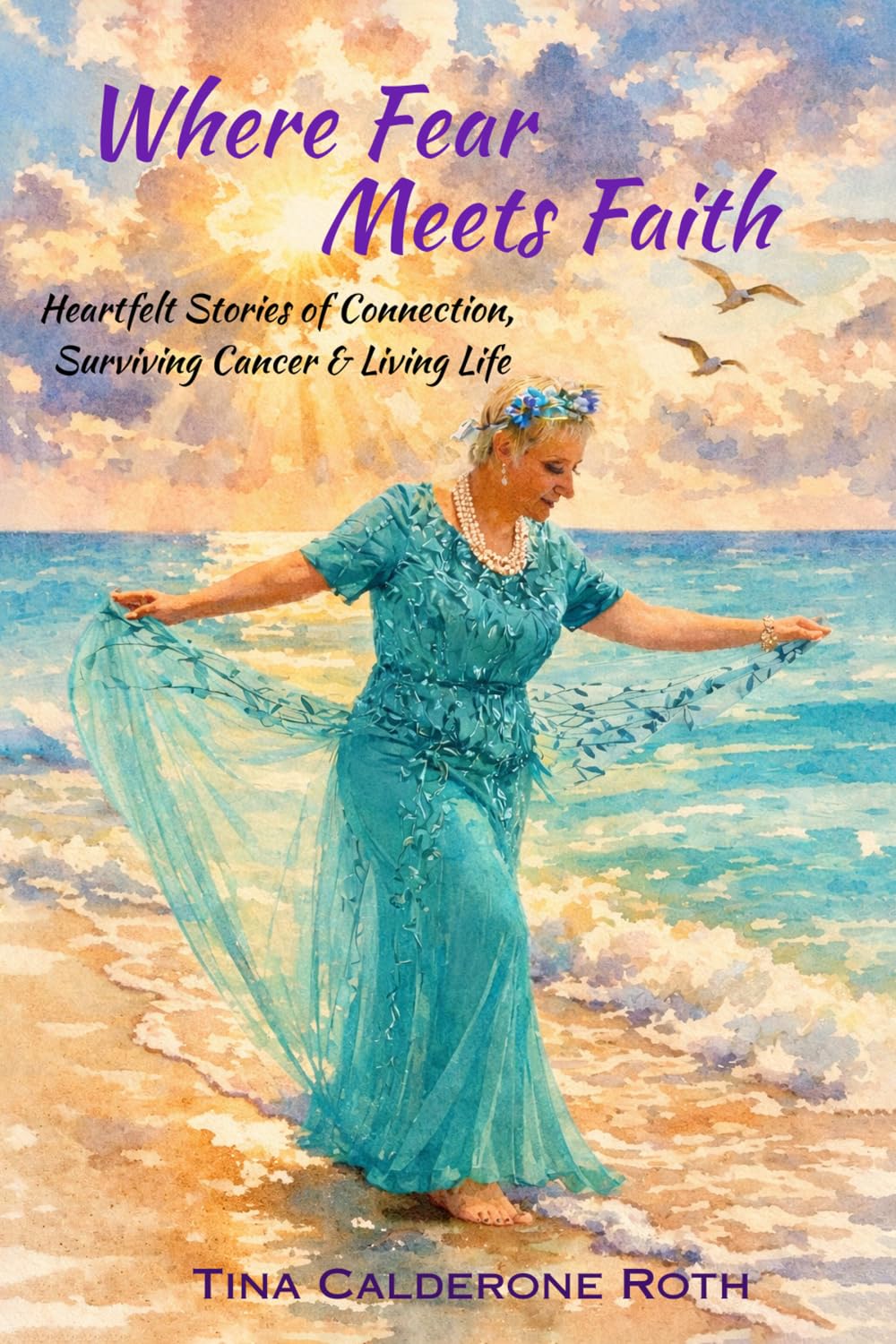
Where Fear Meets Faith, by Tina Calderone-Roth, is an inspirational memoir built from short personal essays about cancer, family, faith, gratitude, healing, and legacy. Calderone-Roth writes about her 2022 cancer diagnosis, her daughter Sarah’s medical challenges, the steady love of her husband Gary, the friends and caregivers who carried her through, and the small acts of kindness that became lifelines. The book is organized around Family, Gratitude, Healing, and Legacy, and each story ends with reflection questions meant to help readers think about connection in their own lives.
I liked how personal the book feels. It doesn’t try to turn cancer into a neat lesson. Calderone-Roth lets fear sit in the room. She talks about crying in cars, shaving her head, needing food trains, leaning on prayer, and trying to be both a patient and a mother at the same time. The writing is direct and heartfelt, sometimes almost like a journal shared across a kitchen table. That closeness gives the memoir its warmth. The prose circles back to gratitude, strength, and connection, and that choice gives the book a steady emotional rhythm. Those themes become anchors throughout the memoir, reminding the reader that healing isn’t one single moment but a return, again and again, to the people, beliefs, and small acts of care that help us keep going.
I was especially drawn to the author’s choice to focus less on medical detail and more on human presence. A nurse praying in a parking lot. A friend placing a prayer in the Western Wall. A teacher making lentils. A dog resting beside her after chemotherapy. These moments could have been sentimental, but they land because they are specific. You can feel the texture of ordinary care. I also liked that the book’s faith is sincere without feeling cold or preachy. It is faith as lived support, not just belief stated on the page. The reflection questions at the end of each piece make the book feel part memoir, part devotional, and part guided journal, which fits the genre well.
I recommend Where Fear Meets Faith to readers who appreciate inspirational memoirs, cancer-survivor narratives, faith-based reflections, and short essays about resilience. It will likely speak most strongly to people who have faced illness, caregiving, grief, or a season when they had to accept help even when it felt hard. This isn’t a detached literary memoir. It’s tender, open-hearted, and deeply grateful.
Pages: 111 | ASIN : B0GZD3PC27
Labor of Love

Surviving Cancer: Poetry and Prose is a blend of poems, short reflections, and spiritual notes that trace your journey through cancer, aging, gratitude, and faith. Your poetry shares a deeply personal experience and changes in your worldview. How hard was it to put this collection out in the world for people to read?
It was NOT difficult at all to write this book because it came from my heart, my experiences, and my mission or purpose to help others. Practically most or all of my writings are to create for good cause. Writing Surviving Cancer was really a “labor of love.” Upon publishing the book, many people were interested in reading it because they survived cancer, knew someone dear to them who had been diagnosed with cancer and either survived or died.
Do you have a favorite poem in the book, and if so, why does it hold special meaning for you?
The following poem from my book is my favorite and is meaningful for me because it explains my sweet-and-sour experience of cancer treatment in order that readers may understand and appreciate the cancer experience:
CANCER: A SWEET-AND-SOUR EXPERIENCE
In July 2020, I was diagnosed with cancer as a doctor said;
Without my earthly and heavenly guardian angels and good healthcare,
I certainly could be dead;
I suspected such diagnosis and thus had no fear;
Neither did I breathe deeply or shed a tear;
I told a few among family and friends soon after one day,
Because cancer is not something that I’m ashamed to say;
Yes, through the pain from surgery and chemo, I never lost sight—
Of the joy and appreciation of my kind and competent healthcare
workers both day and night;
Loving family and friends were there by my side,
While impostors found a way to dodge and hide;
And, of course, I prayed for God to allow me to live to do His will—
And not let microscopic cancer cells find a way to kill;
And now I’m cured and cancer-free;
I’m ready to continue God’s work as usual and as you can now see.
Note. This poem was written during December, 2020 soon after my chemo treatment and cancer-free diagnosis.
How has this poetry book changed you as a writer, or what did you learn about yourself through writing it?
I never thought that I would die from cancer; however, I learned to be even more appreciative of my life and purpose after surviving and still remaining here among the living on Earth. Even more, I learned who among my friends and family, whom I told, were supportive and there for me during my treatment. My diagnosis and successful treatment of cancer convinced me more than ever that my life has been guided and protected by God and my ancestors. The writing of this book changed me by enhancing my humility and increasing my mission of helping others.
What do you hope is one thing readers take away from Surviving Cancer: Poetry and Prose?
I contracted cancer of the colon because I refused to submit to a colonoscopy until symptoms suggested that I needed to see a gastroenterologist—symptoms that included significant loss of weight, loss of appetite, and iron-deficient anemia. I was blessed to survive cancer; therefore, I urge readers of my book to get a colonoscopy or screening for other types of cancers before it is possibly too late. Many cancers are preventable if diagnosed and treated in their early stages.
Author Website
Surviving Cancer: Poetry and Prose


Surviving Cancer is a blend of poems, short reflections, and spiritual notes that trace Frederick Douglas Harper’s journey through cancer, aging, gratitude, and faith. It moves from personal stories about illness and recovery to broader meditations on history, injustice, friendship, love, and the fragile beauty of life. Many pieces are short and direct. Others feel like private conversations caught on the page. Across the book, Harper circles back to survival, divine protection, and a deep belief that life still has purpose for him after cancer, a theme he states openly in his introduction and early poems such as “Cancer: A Sweet-and-Sour Experience” and “God Had My Back.”
Reading this book felt a little like sitting with someone who has lived many lives and refuses to hide what any of them meant. I found myself pulled in by the plainness of the writing. It surprised me how steady and open his voice stayed, even when he talked about pain or fear. I felt that steadiness most in the pieces about his surgery and chemo, where he shares his relief, his gratitude, and even his frustration in simple, almost conversational lines. There was something honest in how he chose clarity over polish. It made me slow down and listen.
What moved me most was how wide he cast his net of concern. On one page, he reflects on his own scars. Next, he is calling America to stand up to injustice, to mourn the Trail of Tears, or to speak softly to someone who feels broken. I felt warmth rising off these pages. I also felt a kind of stubborn hope. There were moments when I wanted the book to push deeper into the contradictions of survival, but even when it didn’t, I could feel Harper’s heart working hard to stay open. That sincerity hit me harder than I expected. It reminded me that writing can be a kind of prayer or maybe a hand held out to strangers.
I would recommend this book to readers who enjoy reflective writing, people who are healing from illness, anyone who leans toward spiritual or faith-colored poetry, and anyone who wants a book that speaks plainly about gratitude and survival without pretending life is perfect. It drifts and circles back, yet that wandering shape fits a man who has lived through fear and come out wanting to share whatever wisdom he has gathered. I felt comforted, and I felt nudged to think more tenderly about my own life.
Pages: 175 | ASIN : B09RSVZ32H

The Destiny of Our Stars

Greta McNeill-Moretti’s The Destiny of Our Stars is a heartfelt memoir about love, loss, and renewal. At its core, it’s the story of a woman navigating widowhood after losing her soulmate, Lawrence, to brain cancer. The book moves from raw grief to spiritual awakening, with reflections on fate, synchronicity, and the mysterious ways the universe brings meaning to suffering. It’s not just a chronicle of mourning; it’s a roadmap through the darkest corners of heartbreak toward the quiet light of acceptance and hope.
The author writes with such sincerity that I often felt like I was sitting across from her, listening to her unpack her life. Her words are simple, but they cut deep. I admired how she didn’t shy away from the messy parts, depression, guilt, the confusion of still wanting to live when your reason for living is gone. She uses humor in surprising places, and it works. It keeps the story grounded and human. Sometimes her honesty stings, but that’s what makes it beautiful. It’s a book that feels lived, not written from a distance.
What really stayed with me was her belief in synchronicity and destiny. I was moved by her conviction. It’s impossible not to root for her as she rebuilds her world, piece by piece. Her reflections on love extend beyond romance. She writes about compassion, family, and friendship in ways that make you think about your own life. At times, the detail is overwhelming. But I think that’s part of the magic. She doesn’t let you skim through her pain. She makes you sit with it, the way grief makes you sit still until you learn to move again.
I’d recommend The Destiny of Our Stars to anyone who has lost someone they love or who simply wants to understand what real resilience looks like. It’s for people who appreciate writing that’s emotional but never self-pitying, and who don’t mind tears mixed with laughter. This book is raw, deeply personal, and surprisingly comforting. It reminds you that even when life shatters, the pieces can still reflect light.
Pages: 298 | ASIN: B0GC7RFP5S
The Hope of Heaven

Singing Through Fire shares with readers how your life took an unexpected turn when you developed a chronic illness, leading you to cross paths with a youth pastor facing terminal cancer, and falling in love even though you knew your time together was limited. Why was this an important book for you to write?
Singing Through Fire was important for me to write because I knew God was calling me to share my story to encourage other sufferers. Walking through illness and loss was never the path I would have chosen, but it became a place where God’s presence and grace shone most clearly. Writing the book was an act of obedience, a way to testify to His goodness even in seasons of deep suffering. My hope was simply to be faithful with the story He entrusted me with.
What is one piece of advice someone gave you that changed your perspective on God and faith?
One of the most life-changing truths someone shared with me was that our present suffering, as heavy as it feels, is not the end of the story. Scripture reminds us that the eternal glory awaiting us far outweighs the pain we endure now. That perspective shifted my focus from asking “why me?” to lifting my eyes toward the hope of Heaven. It doesn’t erase the grief, but it gives it meaning and frames it in light of eternity.
What was the most challenging part of writing your memoir, and what was the most rewarding?
The hardest part was returning to memories that were still raw with grief and pain. Writing about them meant reliving them, and at times I wondered if my heart could handle it. But the most rewarding part was seeing how God had been present through it all, and how He wove beauty and love even into suffering. Putting it on paper gave me perspective, gratitude, and a way to honor the people and moments that shaped my story.
What do you hope is one thing readers take away from your story?
I hope readers come away with the assurance that even in the darkest seasons, God has not abandoned them. Life may not unfold as we expect, and suffering may come in ways that feel unbearable, but God is still faithful. If my story encourages someone to hold on to hope and to trust His heart, even when His plan feels hidden, then the book will have done its work.
Author Links: GoodReads | X (Twitter) | Facebook | Website | YouTube | Instagram | Amazon
Enter Matthew Silverman: a witty, wise, and impossibly joyful youth pastor and professor facing terminal cancer. What begins with a few random encounters soon ignites an extraordinary, God-written love story that neither of them saw coming.
As their unlikely romance unfolds between medical crises, late-night laughter, and unexpected musical performances, Matthew’s unshakable faith challenges everything Lara thinks she knows about God’s goodness—and what it means to walk with Christlike faith, resilience, and joy in the face of overwhelming grief and suffering.
But with time against them, one question looms louder than the rest: What if this gift is only for a moment?
Surprisingly funny and spiritually rich, Singing Through Fire is a modern-day “Job meets Lucille Ball.” It explores what it means to suffer, love, and even laugh and make music while your life is burning down around you. It eloquently gives voice to the aching questions many sufferers quietly carry—then takes readers inside the breathtaking story of two people who found miraculous love and defiant joy amid heartbreaking loss.
It reveals how God can use even our deepest pain to write the most beautiful love stories—even on the cusp of eternity.


