Blog Archives
Character Growth

Madison’s Mission follows a devoted lady’s maid caring for her mistress and hiding her past, whose life takes an unexpected turn when she meets the distinguished foreman overseeing the castle’s extravagant construction. What was the inspiration for the setup of your story?
Boldt Castle is the most famous tourist attraction in the Thousand Islands Region. Every year, nearly a quarter of a million visitors enjoy its beauty, including me. I’ve always wanted to write a story about it and Heart Island. But it wasn’t until recently that I finally developed a compelling storyline.
Ever since I was a child, Boldt Castle’s story has fascinated me. It’s a story of love and loss and begins with the talented businessman, George C. Boldt, a German immigrant who became proprietor of the Waldorf-Astoria Hotel in New York City and the Bellevue-Stratford Hotel in Philadelphia. In 1900, Boldt embarked on an ambitious project to construct a six-story, 120-room castle inspired by the grand architecture of European châteaux. He meticulously planned every detail as an expression of his love and devotion, with hearts everywhere. You’ll experience its construction throughout my story and wonder at those who put so much of their hearts into it. When you visit there, your perspective will never be the same.
There was a lot of time spent crafting the character traits in this novel. What was the most important factor for you to get right in your characters?
Technically, the sub-genre I write in is called “faction”—factual fiction. The setting and owners of that castle and mansion are all real characters and stories, and then I overlay fictional servants who tell the story. It’s rather complicated, but it’s oh so much fun. This gives me so much “scope for the imagination,” as Anne Shirley would say. I focus on character growth. But I’m a sucker for romance and happy endings, so if a relationship is part of my main character’s storyline, all the better!
What were some themes that were important for you to explore in this book?
I hope readers are reminded that no matter the hardships we face, God is always at work behind the scenes—restoring, healing, and guiding us toward His best. Madison’s Mission is ultimately a story of hope, reminding us that love rooted in faith can overcome even the deepest sorrow and that purpose often rises out of pain. Madison is terrified of opening herself up again because of all the pain she’s endured. But God gently leads her to realize that love and community are part of the healing process. Through Emmett, and through unexpected circumstances, she learns that God is not finished with her story. That’s something I think many readers will relate to.
Will there be a follow-up novel to this story? If so, what aspects of the story will the next book cover?
I have a new series coming out in early 2027 based in the Thousand Islands, so I’ll continue to feature the beautiful landscape, history, and drama set around Boldt Castle and in the St. Lawrence River during the Gilded Age.
Author Links: GoodReads | X (Twitter) | Facebook | Website | Amazon
A Boldt Castle story
By Susan G Mathis
Step into the captivating world of Boldt Castle in 1903, where dreams are forged in the fires of adversity and love.
Madison Murray, the devoted maid to the legendary Louise Boldt, harbors a singular mission—to care for her ailing mistress while hiding her own painful past. Her life takes an unexpected turn when she meets Emmett O’Connor, the distinguished foreman overseeing Boldt Castle’s extravagant construction. Their connection sparks with promise, yet the chasm of class difference and hidden secrets loom large.
Just as their budding romance begins to flourish, tragedy strikes, shattering their world. A deadly accident leaves Emmett wrestling with guilt and at the center of an investigation that could unravel everything he holds dear. Then Madison finds herself ensnared in a dangerous coverup that threatens her very life.
When Mrs. Boldt passes away, Madison is left reeling—jobless and burdened by the weight of her perceived failures. In a world filled with uncertainty, can she summon the strength to move forward and confront her past? Will Emmett rise above his challenges to forge a future alongside the woman who has captured his heart?
Redemption Over Shame

A Certain Man is a searing, lyrical reimagining of the woman at the well, following a fierce Samaritan woman’s battle for freedom, faith, and healing in a world that seeks to break her. What was the inspiration for the setup of your story?
Actually, the inspiration came from the phrase that Jesus used to start several parables. “There was a certain man…” There are Bible scholars who teach that this was a sign to those listening that He was about to speak a true story of real people. I began to contemplate who these people would have been and what their back story would be. So the kernel of the story actually began with Samuel. Then my imaginings expanded to who he would have loved.
How did you balance historical authenticity with creative liberty, especially in reimagining familiar Gospel moments?
I never want to sacrifice Scripture for story. So when Jesus is “onstage” in the Bible, I do not add to His words. But, for instance, the Bible says that Jesus stayed in Samaria for two days after He met the woman at the well. So then this period is open for fiction. Even so, I am careful that He does not teach something that is not found elsewhere in scripture. Sometimes, like the encounter with the woman at the well, the narrative is very sparse and seems to jump from topic to topic. So here I used Mara’s thoughts to try to “fill out” the story. Jesus of course knows her thoughts and answers her. The challenge is to stay authentic to the intent and meaning of scripture without making Jesus a two-dimensional character. He was fully human and fully divine… and that is compelling.
What were some themes that were important for you to explore in this book?
The book explores themes of faithfulness, loyalty, and freedom particularly for women in a culture that often considered them chattel. Further, the hero and heroine must learn to forgive others and each other, choose good over evil, and redemption over shame.
Mara’s journey is steeped in trauma and spiritual transformation. How did you approach writing those darker, more intimate scenes?
The times of the Bible were scandalous and treacherous. While I did not want to include any gratuitous violence or sexuality, I did want the story to ring true in a tasteful way that dealt with very real issues. While there are humorous and lighter moments I wanted the reader to be brought into the times as they were. I believe “there is nothing new under the sun” and that the struggles of my characters to speak to hearts today.
The woman at the well has often been considered to be a loose woman, a harlot. But Jesus says she had five husbands. It is only the sixth man who is not her husband. What would make her give up on marriage, give up the security of a husband supporting and protecting her? I tried to read between the lines of scripture and use research of the time period to flesh out a plausible back story for each of my characters.
Author Links: GoodReads | X (Twitter) | Facebook | Website | Amazon
An Unsung Neighborhood

The Mystery from Way Back When follows a man returning to his childhood church where he meets a young woman who is the baby he rescued years ago. She now needs his help to find her birth mother. What was the inspiration for the setup of your story?
My father grew up a member of a close family that were proud members of Sacred Heart Church in the Keighry Head neighborhood of Elizabeth, New Jersey. He attended Sacred Heart School and was even an altar boy. Sacred Heart Church later became Our Lady of Fatima Church. I wanted to set a mystery there, in Keighry Head. It’s an unsung neighborhood and, from my late dad’s stories, the way it once was when he was a boy during the Depression and World War II has pretty much disappeared.
What were the morals you were trying to capture while creating your characters?
Above all, strength of character and decency! The main character, Benny, doesn’t hesitate for a second when he sees a young girl at a distance abandoning a baby on the steps of his church. He takes the baby right home to his mother, knowing she can help the little one, and then tries to identify who abandoned her. It’s World War II. The people are patriotic. The kids have their eye on a suspected spy. Maybe a lot of people these days don’t realize this, but Catholics have always taken a lot of flak in this country, even yet, and especially since the whole situation came to light about the pedophile priests. In this story, the priest doesn’t belong in jail. He’s a really good guy.
What was your favorite scene in this story?
Oh, that’s an easy question! When Benny brings the abandoned newborn baby home and his mother tends to her, she starts to sing to the baby, and naturally, the song is “Baby Face.” Benny, his brothers, and even the old grandfather who lives with them chimes in. It’s joyous! It turns the baby’s sad start into something of a celebration of her arrival.
What is the next book that you are working on, and when will it be available?
There were two books that I had started working on and then put temporarily aside. I picked them up again and I’m continuing with both. They’re mysteries. One is set on a cruise ship and the other in a non-profit organization where someone is corrupt to the core and stealing the funds. I also have another one in mind, and it’s a mystery that unfolds during a wedding, where the parents of the bride are divorced and it’s always a battleground when they’re required to get together. So I’ve got three books in the works, and they should be available later in the year. Somehow, for me, it works out beautifully to work on more than one book at a time. I’m loving the whole process of creating all of these stories!
Author Links: GoodReads | X (Twitter) | Facebook | Website | Amazon
The only clue to the child’s origins is a note found in the basket requesting that she be raised Catholic. The police arrive to get the baby to the hospital while the parish priest arranges for her adoption. Meanwhile, the boys try to play detective and figure out who gave the baby up. Benny even has a likely suspect, Nancy Kilkenny, but she hotly denies it.
Years later, the baby, all grown up, has an urgent reason to connect with Benny and Timmy to try and find out what really happened way back when. Who was the mother who gave her away? What happened on that memorable day in 1944? And can she ever manage to find out the truth?
Love, Forgiveness, and Salvation

St. Paul Goes to Spain follows three men bound by their shared faith and curiosity about the apostle Paul, who, after discovering a letter, they go on a journey to the places they think Paul could have visited in Spain. What inspired the setup of your story?
Well, I wrote it as an historian and a Christian, but I was long interested if Paul actually made a missionary trip to Spain which he mentioned in some other published Scripture, such as the Book of Romans. Plus, I have loved fiction ever since early-life discoveries of Steinbeck, Hemingway, etc. It is a way of reaching people and drawing upon your imagination to tell great stories that, in fact, usually reach a lot more people than histories! I did an earlier novel on early Christianity in the Americas (Columbian discoveries, conquests, and settlements) and how Jesus, or, more exactly, some of his followers and prophets may have reached the New World hundreds of years before 1492, and they left evidence (artifacts in the forms of the Cross), and I was off into the past again, this time inventing and tracing a story which I think could have actually happened. Ok, I’ll stop here. I’ve had a couple cups of coffee and it is Saturday morning and football games don’t begin until this afternoon!
What were some themes that were important for you to explore in this book?
I’ve always enjoyed the trajectory and messages of the Apostle Paul in the New Testament, especially since he produced more than half of the Books of the New Testament. He was, in fact, the writer who did more to write down the teachings of Jesus, or to create the theology of Christianity. So I suppose my principal interest was in exploring, one, the central themes of Christianity that Paul taught (love, forgiveness, salvation, etc.) and, two, how he probably took them to Spain, a country I have long loved and admired given my background and experiences, first visiting as a young Naval officer in the Sixth Fleet in the Mediterranean in the mid-1960s, and then over the years as a historian, where I especially learned about the land and its people while researching for my dissertation in the Archive of the Indies, Seville, 1970-71,.
What experience in your life has had the biggest impact on your writing?
Without a doubt, it has been the growth of my Christian faith, influenced especially by my marriage to my wife Louise more than thirty years ago. Without going into detail, she showed me that true worship in understanding did not come necessarily with reading and doing good works, but through the faith that comes when God in his infinite Grace accepts you into his world. You have but to accept. Secondarily, but no less important (although not as transcending as making the same discovery that Martin Luther made in the early sixteenth century when he discovered for himself, while teaching at Wittenberg on the Book of Galatians, the true power of the grace of God) was my teaching the history of Christianity over the last almost five decades to various forums, from my students at the University of Alabama, to mission trips into places like Honduras and the Dominican Republic, and my all-time favorite students, the prisoners of the Tuscaloosa County Jail where I’ve been ministering on a weekly basis for twenty-five years.
What is one thing that you hope readers take away from St. Paul Goes to Spain?
That the Christian message given to Paul by Jesus (beginning with his Road to Damascus conversion) was indeed aimed to the entire world, albeit a world circumscribed by the knowledge of geography of the world 2000 years ago. Taking it to Spain was just reaching the far Western end of the Mediterranean and I even hint that Paul may have voyaged into the Atlantic with some of the intrepid Phoenician mariners of the times and zipped across the Atlantic, about fifteen hundred years before Columbus!
What if the Apostle Paul, after his release from imprisonment in Rome, embarked on a daring journey to the far reaches of the Roman Empire? “St. Paul Goes to Spain” by Lawrence Clayton is a riveting historical fiction novel that imagines this very scenario, blending meticulous research with engaging storytelling.
Join Matthew Western, an intrepid archaeologist, as he uncovers ancient artifacts in the Sinai desert, sparking a quest to prove that Paul indeed traveled to Spain. His journey intertwines with the lives of several compelling characters:John Baldus, a former Army soldier and current Divinity student, who grapples with faith and doubt while investigating Paul’s journeys.
Domingo, a Dominican priest in modern Spain, facing spiritual challenges and historical mysteries.
Slate Watson, a daring crop-duster pilot with a rich military past, whose adventurous spirit leads him into the heart of biblical archaeology.
Sarah Maxwell, an Englishwoman tracing her ancestors’ historic discoveries, contributing her own expertise to the mission.
Together, they delve into historical sites, uncover ancient manuscripts, and piece together the lost chapters of early Christian history. From the dusty libraries of St. Catherine’s Monastery to the vibrant landscapes of modern Spain, their quest reveals profound insights and unexpected connections.
“St. Paul Goes to Spain” explores the intersection of faith, history, and archaeology, offering readers a captivating journey through time and belief. It’s a story of discovery, adventure, and the enduring impact of one man’s mission to spread the Christian faith.
LAWRENCE A. CLAYTON was born in October 1942, in Summit, New Jersey. He lived in Peru for seven years. He attended Duke University (B.A., 1964), and earned his M.A. (1969) and Ph.D. (1972) at Tulane University in Latin American History. From 1964-1966 he served as an officer in the U.S. Navy on the USS Donner (LSD-20), cruising both in the Caribbean and the Mediterranean with the 6th Fleet. He was on the faculty of the University of Alabama from 1972-2013. He directed the Latin American Studies Program from 1980 to 1992. He was Chair of Department of History 2000-2007 and was Interim Chair, 2009-2010. His specialties focused on Latin American history and the history of the Christian church. He is now Professor Emeritus of History. He retired in 2013. He held two Senior Fulbright Lecturing Awards, one in 1983 to Costa Rica and one in 1988 to Peru. In 1983 he served as President of the South Eastern Council on Latin American Studies. In 1999 he held a year-long Pew Evangelical Scholars Fellowship.
St. Paul Goes to Spain: A Novel


St. Paul Goes to Spain by Lawrence A. Clayton is a captivating work of religious fiction that brings together history, faith, and intrigue. The story introduces us to three main characters—Matthew, John, and Domingo—whose lives, while seemingly different, are bound by their shared faith and curiosity about the apostle Paul. This shared religious fascination drives the plot, with much of the narrative centered on the discovery of a letter believed to be written by Paul to a church in Spain.
The novel’s premise revolves around the authenticity and location of this letter, sparking a journey of discovery for the characters and their companions. This quest takes them to places Paul could have visited if his journey to Spain, hinted at in the New Testament, had indeed taken place. This historical mystery gives the book its compelling edge, encouraging readers to reflect on Christianity’s roots while expanding their understanding of faith. One of the most fascinating aspects of St. Paul Goes to Spain is its grounding in real-world history. Clayton weaves in significant historical events, such as the fall of the Berlin Wall, and touches on modern political issues, including the ongoing turmoil in the Middle East. These references not only add depth to the narrative but also prompt readers to think critically about war, politics, and their impact on religion, both past and present. The question of whether Paul ever reached Spain is a topic of theological debate, and Clayton skillfully uses this ambiguity to drive the story. The characters explore regions Paul might have visited, offering readers a fresh lens through which to consider early Christianity and its spread. By blending history, religion, and politics, the author successfully creates a rich, thought-provoking narrative.
Clayton’s ability to merge these elements makes the book worthwhile for those interested in world events or religious fiction. St. Paul Goes to Spain offers a unique perspective, encouraging readers to contemplate both the historical and spiritual aspects of faith while providing an engaging exploration of Paul’s possible travels. I highly recommend it to anyone drawn to stories that intertwine history, belief, and current affairs.
Pages: 237 | ASIN : B0DC6PPXF8

The Royal Order of the Last Coin
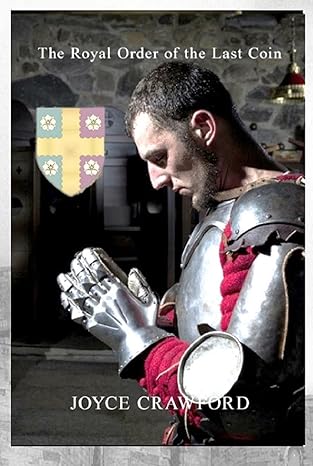
In Royal Order of the Last Coin, Joyce Burton Crawford embarks on a captivating journey through her family’s past, unearthing a hidden chapter that reaches back to the 13th century. This compelling narrative blends themes of service, courage, faith, romance, and moral conviction, all centered around the birth of the De Burton legacy. Crawford masterfully intertwines history and storytelling, crafting a narrative that feels alive with emotion and depth.
Rather than a straightforward recounting of historical facts, Crawford reimagines events through a unique blend of fact and fiction. Her writing defies the conventions of traditional historical works, transforming what could have been a dry retelling into an engaging and emotionally resonant story. She doesn’t simply list events; instead, she adds touches of humor and moments of romance that draw readers in, making history feel fresh and relatable. Narrated from the perspective of her ancestors, the book unfolds in third person, giving each character their own voice and allowing their stories to develop with nuance. This narrative choice brings the past to life, giving readers an intimate view of the lives, struggles, and convictions of those who shaped the De Burton legacy. Despite the centuries between them, these ancestors feel vivid and immediate, their experiences unfolding naturally through Crawford’s careful and concise prose. Joyce’s writing is clear and accessible, ensuring readers can easily follow along as she guides them through her family’s rich history. She sets the stage from the outset, explaining her purpose and providing context for what is to come. Every scene and event is described in meticulous detail, making the story not only easy to follow but deeply immersive. The reader is transported into the world of her ancestors, experiencing the weight of their decisions and the significance of their faith. While the pace occasionally slows during more detailed sections, these moments offer readers time to reflect on the deeper themes at play—faith, legacy, and personal duty. Crawford isn’t merely recounting her ancestry; she’s capturing the essence of the values that shaped her family, particularly their unwavering devotion to God.
Royal Order of the Last Coin is more than a historical account. It is a deeply personal exploration of legacy and faith, a heartfelt story that will resonate with readers interested in family history or tales of moral conviction and strength. Crawford’s work is a testament to the power of storytelling to bring the past to life, making it an enriching and memorable read.
Pages: 214 | ASIN : B0B3JW932M
Galatians 6:9

In Due Season follows a fourteen-year-old boy who escapes a life of abuse by stowing away on a ship bound for the colonies, where he grows deeper in his Christian faith. What was the inspiration for the setup of your story?
I like to “hook” my readers from page one of my stories, and an escape scene does just that. I’ve always been a fan of Charles Dickens, so I wanted to start with an “Oliver” twist by setting the story in a London workhouse. Five chapters later, he ends up in Williamsburg, Virginia, which is my favorite place to visit! I love the colonial era of American history, and with the Revolution taking place during the time of my story, there was a lot of action from which to draw. I also decided on the five major characters, all living in one household: James, the father, a loyalist with a debilitating disease; Bradley, his arrogant patriot son; Rebekah, James’ daughter embittered by her blindness and recent jilting by her fiance; Elizabeth, the newly orphaned housekeeper who is also tasked with the impossible job of helping Rebekah out of her self-pity, and John, the mistreated indentured servant. I had a general plot in mind, but with the characters’ differences and unique situations causing internal and external conflicts, they practically wrote the story themselves!
John endures many hardships and setbacks, but these only strengthen his faith as he moves forward. What were some driving ideals behind your character’s development and the development of his faith?
I love the character of John. He has suffered much, but because of a man who cares about his dire situation, he realizes God’s love for him and gives his heart to Christ. That decision, although he’s not perfect and struggles with anger, hurt, and bitterness, allows him to have the inner strength to face more difficulties. He grows in patience, love, and most importantly, the ability and desire to forgive.
What were some themes that were important for you to explore in this book?
Forgiveness is a major theme, not just in this book but in most of my stories. The title, In Due Season, is taken from the Scripture verse, Galatians 6:9 – “Be not weary in well doing, for in due season ye shall reap if ye faint not.” This is the promise Elizabeth clings to when the progress in helping Rebekah seems slow.
Is this the first book in the series? If so, when is the next book coming out, and what can your fans expect in the next story?
I never intended for this to be more than a standalone book. However, it is now Book 1 in a trilogy. Book 2, Season of Uncertainty, is scheduled to be released on October 1st! It covers 1778-1781. I was amazed when researching for the book how many things relating to the American Revolution happened in and around Williamsburg. It’s made for a very exciting story! The beloved characters from Book 1 are back, and some new characters are introduced. (There’s some sweet romance, too, as in all my books, but, as usual, it takes a back seat to the main plot.)
Author Links: GoodReads | X | Website
In Due Season: A Story of Colonial Williamsburg
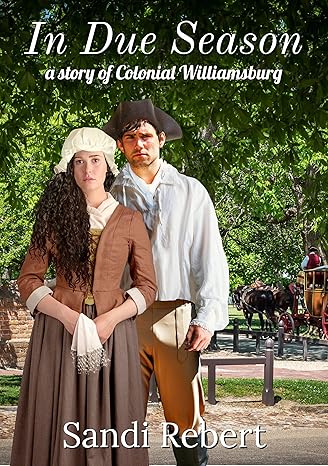
Set against the backdrop of colonial Williamsburg in the 1770s, In Due Season, by Sandi Rebert is an essential read for fans of Christian and historical romance. The narrative centers on John, who, after escaping a workhouse at the tender age of 14, discovers the love of Christ through a stranger’s life-saving act while stowed away on a ship. This profound encounter draws John closer to the Christian faith, but his newfound freedom is short-lived as he is sold as an indentured servant. Years later, his life takes a transformative turn when he meets Elizabeth, and together they grow in their Christian faith.
In Due Season is a beautifully crafted tale of salvation and finding solace in Christ. For John, who has endured a harsh life, God’s love initially seems an unreachable concept. Despite their vastly different upbringings, John and Elizabeth are united by tragic circumstances, and their shared faith becomes a strong bond. The book emphasizes key Christian values: kindness, courage, forgiveness, perseverance, and long suffering. I appreciated how it distinguished between mere church-going and living a true Christian lifestyle, illustrating how faith can be a profound source of comfort and strength during hardships. John’s struggles serve as a poignant reminder to Christians that in times of adversity, they can find solace in turning to God. It was heartwarming to witness each character’s journey to faith, their spiritual growth, and the realization that true freedom is found in God.
In Due Season, by Sandi Rebert, is a moving and inspiring novel that masterfully weaves together themes of faith, love, and perseverance. Through the trials and tribulations faced by John and Elizabeth, Rebert illustrates the transformative power of God’s love and the enduring strength found in faith. The rich historical setting, combined with the heartfelt narrative, makes this book a standout in the genre of Christian historical romance. Its simple yet compelling writing style ensures that readers are not only entertained but also deeply moved. This book is a testament to the enduring power of faith and love, making it a must-read for anyone seeking both inspiration and a captivating story.
Pages: 273 | ASIN : B08M127B83



 LITERARY TITAN