Blog Archives
SEAL of Honor


Jessica Ashley’s SEAL of Honor is a Christian romantic suspense novel built around danger, second chances, and the kind of love that refuses to fade with time. Zane “Cap” Knox is a former Navy SEAL living under the weight of secret missions and past failures, while Tessa Lane is the woman who vanished from his life eighteen years earlier. When she returns injured, hunted, and unsure who to trust, the story brings them back together in a way that feels emotional, urgent, and deeply tied to their shared history.
At its center, this is Zane and Tessa’s story. Their connection has the ache of unfinished love, but it’s also shaped by trauma, guilt, faith, and survival. Zane’s protectiveness comes from a place of devotion, not control, and Tessa’s fear feels rooted in everything she’s endured. One of the most telling lines comes when Tessa thinks, “My life is expendable; his isn’t.” That moment captures how little she values herself early on, and it makes her later growth feel meaningful.
The suspense side of the book keeps the pace moving. There are attacks, kidnappings, secrets, corrupt operators, and a larger conspiracy tied to the missions Zane and his team have been forced to carry out. The action scenes are tense, but the book doesn’t lose sight of the emotional stakes. Zane’s team adds a strong brotherhood element, giving the story a found-family feel that supports the romance.
Faith is woven through the story in a direct and heartfelt way. Tessa’s journey back toward God is one of the book’s strongest threads, especially because it’s tied to her sense of worth and her ability to believe she’s not alone. Her realization that “God may not deliver us from our pain, but He will always bring us through it” reflects the heart of the novel. The faith elements aren’t just background details; they shape the characters’ choices, their healing, and the way they face danger.
SEAL of Honor is a fast-moving blend of romance, faith, and suspense, with a couple at its center who have to fight for both survival and trust. It’s emotional, action-heavy, and hopeful in a way that fits the characters’ wounds. Readers who enjoy protective heroes, second-chance romance, military brotherhood, and Christian themes will find plenty to connect with in Zane and Tessa’s story.
Pages: 386 | ASIN : B0FSLYQYJM

There Is Always More

Into the Arms follows a woman from her early days at a Catholic boarding school through a series of life-shattering experiences into womanhood, leaving her questioning everything she was taught and seeking a life filled with truth and joy. What was the inspiration for the setup of your story?
I think as young children we see the world through a different lens than the adults around us. We have an innocence and grand awareness of what is happening, a wisdom and a sensitivity that actually allows us to see through things without the burdens, expectations, ideals and conditions on life that we seemingly pick up through our developing years. Yet this is crushed so very quickly and we are asked to jump aboard the treadmill of life with little to no concern of what may be true for us.
The staggering numbers of young suicides, teenage self-harming, drug and alcohol abuse is only but rising. I don’t know a single person who hasn’t questioned why we are here or what life is about in some shape of form throughout their years. With no answers, often a distinct lack of purpose, and only a show of hands pointing us in a direction other than what we are sensing from within, it seems we stop trusting ourselves and what we feel, usually at a huge cost.
I wanted to offer something more than the usual depiction of life, that may allow space for others to ponder on something grander than what is usually served up; to return to the innocence, wonder and sensitivity we all had as children; to not brush over all the daily irks but to acknowledge them for what they are, and to live untainted by their brutality, in the glory of who we truly are.
All of these factors and more were the inspiration.
I found Rei to be a very well-written and in-depth character. What was your inspiration for her and her emotional turmoil throughout the story?
Rei is a character that many, if not all, of us can relate to. A young being inquisitive, playful and eager to see the world and explore its people; a being craving to be seen and loved for who they truly are. It’s what permeates our skin and is often the basis for all that we do, whether consciously or not. We see each other as such vastly different characters on the world stage and in its playground, when in truth there is so much we have in common with one another. Despite this commonality we are taught to covet our insecurities which often creates further separation and emotional turmoil.
Our pathways through to, and including, adulthood are paved on our experiences at birth and as youngsters; these are often turbulent, rocky or laden with nuances that distort our behaviours moving forward. We are taught that there is something wrong with us and we react accordingly, when actually perhaps it is more than the individual stories and structures we have grown up with.
Bringing light to emotional turmoil such as this is important to help us all understand that intrinsically there is nothing wrong with any of us, we have just been encrusted with layer upon layer of brutality from everything around us. Unpacking this is wise, it’s no-one’s fault per se, yet the burdens we carry are often grossly unnecessary and harmful for all.
I feel we have a responsibility in life to live and share what is true. Unpacking and unpicking situations and experiences can be hugely healing and empowering and it gives us an awareness from which we can grow. Using Rei’s character, I felt able to give voice to occurrences that are often left unspoken about, and that felt great.
What were some themes that were important for you to explore in this book?
Abuse is such a huge word with many connotations and examples attached to it. Just as everything in life there are 50 shades (and more) of it. The novel touches upon this but I’m not sure in life we stop and give it much air time. Whilst it happens to ‘someone, way over there’ we are quite happy to go about our every day regardless. To add insult to injury, because we have these 50 shades of abuse, we often accept the so called lesser-scale abusive behaviours because there are far-worse versions out there, telling ourselves it’s not so bad, it could be worse. And so the behaviours go on, not being called out, not being stopped. For this reason we can see how we are all complicit enablers in the play out. This is an extremely relevant and important theme that runs through our daily lives that I felt was necessary to explore.
Love too was, and is, a biggie and is believe it or not linked to the abusive theme above. Without fully loving ourselves it is easy, if not second nature, to accept abuse, regardless of where it falls on the so-called sliding scale. Anything that is not loving is abusive. Simple. Why would, and do, we settle for anything in-between and call it something different? Why have we given up on ourselves and the love we truly deserve? We can’t expect the quality of anything to raise if we except lower standards ourselves; supply meets demand. I wanted to explore this too, because too often we bitch and moan about everything, without actually making the small, simple steps within ourselves that we are capable of making that could and would bring about huge and eternal change globally.
Were you able to achieve everything you wanted with Rei in the novel?
I think a character as universally relatable as Rei could continue on as a never ending story. There are so many experiences in every day life, minute-to-minute, moment-to-moment that highlight things that go on around, or to, us. Perhaps we have given voice to them, perhaps not, but they are all possible learnings for us. How can one possibly cover them all?
Rei’s journey had to have an end date (2025 in this story), but perhaps there could be more as the years unfold and she connects back to what came before and all that is left there to deepen into. Within the pages it felt complete, but as the story so beautifully depicts There is always more.
Author Website

Rei grows up on the fringes, taught by society from young to stay quiet and look pretty, not questioning life until it is too late. Escaping the clutches of family and relationships she builds a life free from everything she’d known, but at a cost.
Could losing everything be the richest lesson of all or was it merely a delay tactic from living all that was there to begin with?
A magnificent story, with lightness and dumbfounding truth all over it.
Blue Jeans and Lavender Gowns


A. W. Anthony’s Blue Jeans and Lavender Gowns follows Terry Deitz as he grows up in small–town Illinois during the 70s and 80s. The story tracks his friendships, his awkward steps toward romance, and his slow discovery of who he wants to be. The heart of the book sits in his connection with Debbie Douglas, a quiet farm girl who surprises him again and again. Much of the book lives inside everyday moments. School hallways. Study hall banter. Football games. Long drives on dark country roads. It all builds a picture of simple places where small choices shape a whole life.
I felt myself leaning in as I read because the writing has this easy, steady flow that feels honest. Sometimes it rambles the way teenagers talk, and sometimes it snaps into sharp little moments that hit harder than expected. The author keeps the language simple, but the emotions run deep. I appreciated how Anthony lets Terry speak for himself without polishing his thoughts. He admits fear. He overthinks things. He wants to do the right thing, then stumbles. That made him feel real to me. Debbie felt real, too. She works hard. She hides her nerves. She wants kindness more than anything. Watching them circle closer together gave me a warm, hopeful feeling.
The book looks at family pressure, faith, and the everyday pain that people try to hide. Some of the scenes surprised me with how tense or tender they got. I liked how the author handles faith with a light touch. The characters lean on God without turning the story into a sermon. It shows how young people try to make sense of love, fear, failure, and forgiveness. The dialogue sometimes made me laugh, and the charm of the book carried me through.
By the time I finished, I felt like I had spent time with people I might actually know. That is what made the story work for me. I would recommend Blue Jeans and Lavender Gowns to readers who enjoy wholesome romance, small–town nostalgia, and stories that unfold gently. Teens and adults who like clean Christian fiction would enjoy it most. If you want a book that feels warm and sincere, with characters that you’ll keep thinking about, this one is worth reading.
Pages: 271 | ASIN : B0FZ2V62J7
Searching For Meaning

White Jasmines follows a woman facing a profound personal crisis who engages in direct conversations with God, sending her on a deeply introspective journey confronting love, faith, and identity. What was the inspiration for your story?
The inspiration for White Jasmines came from a period in my life when the inner world felt louder than the outer one. I was watching how people, including myself, search for meaning when they feel lost—how we try to speak to something larger than ourselves when the usual language of life stops making sense.
I became fascinated with that private space where doubt, faith, love, and identity collide. The idea of a woman in crisis having a direct conversation with God allowed me to explore those questions with honesty and vulnerability. It wasn’t sparked by a single event, but by a long stretch of introspection, memories that resurfaced unexpectedly, and the desire to understand how we rebuild ourselves after being broken open.
The story grew from that silence, that questioning, and the need to give shape to emotions that often go unnamed. It became a novel before I realized it—almost like the dialogue had been waiting for someone to write it down.
Are there any emotions or memories from your own life that you put into your character’s life?
Yes, there are emotions and memories from my own life woven into the character’s journey, though never in a literal or autobiographical way. I drew from moments when I felt untethered, when life asked questions I wasn’t ready to answer. Those private experiences—grief, uncertainty, the search for meaning, the ache of longing—helped me understand her inner landscape more honestly.
Some memories, even small ones, left echoes that shaped how she thinks and feels. The way she notices silence, the way she questions love, the way she rebuilds her faith—those elements grew from my own reflections during challenging periods.
While the character is not me, the emotional truth behind her struggles and transformations is deeply personal. I used those memories as a compass, guiding me toward a story that felt authentic rather than imagined from a distance.
What were some themes that were important for you to explore in this book?
Several themes guided the heart of White Jasmines. I was drawn to the tension between faith and doubt—how both can coexist inside one person, and how questioning can sometimes be its own form of belief. The book also explores the fragility of identity, especially when life forces us to confront the parts of ourselves we try to avoid.
Love, in all its complicated forms, was another essential theme. Not just romantic love, but the quieter forms: self-love, forgiveness, and love that persists even after disappointment.
And finally, I wanted to explore transformation—the slow, often painful process of breaking and rebuilding. The 40-day dialogue with God became a way to examine how someone can return to themselves with new clarity after facing the hardest truths.
Those themes together naturally, creating a story that sits at the intersection of introspection, spirituality, and emotional honesty.
What is one thing you hope readers take away from White Jasmines?
If readers take one thing from White Jasmines, I hope it’s the understanding that their inner struggles are not a sign of failure but a passageway to gaining deeper self-awareness. The book invites readers to sit with their doubts, heartbreaks, and questions without rushing to hide or fix them.
I want readers to feel that even in moments of loneliness or confusion, there is meaning to be found—sometimes quietly, sometimes unexpectedly. If the story gives someone a little more compassion for their own journey or reminds them that transformation often starts in the most uncertain places, then it has achieved what I hoped for.
As her days become part of a greater spiritual plan, her ordinary experiences take on new meaning and significance. She reflects deeply on her daily life, imagining God present in her moments and narrating her philosophical perspectives on life, death, and love. Through her narratives, she intertwines philosophy and poetry, questioning love and creation in search of understanding, even regarding the Lord of the Universe. She engages in deep, intimate dialogues with God, inviting Him into a profound challenge while liberating herself from her pain and sorrow. In turn, God grants her life new meaning by revealing His presence in the beauty of nature. By recounting her memories, she frees herself from her previous world and enters a new realm within herself, which she expresses poetically. The book consists of an introduction followed by forty days of narration, telling the story of a Sufi in love who liberates herself from her past and enters a world of light and inner peace, envisioned for the reader in a dream-like manner.
Into The Arms
From the very first page, Into the Arms throws you straight into the storm. This isn’t a story told, it’s lived. We follow Rei, a girl clawing through her youth with an aching heart and sharp eyes, struggling to understand love, shame, and survival in a world that often turns its back on innocence. Author Angelica Lamb’s novel is part memoir, part emotional reckoning, a raw and lyrical unraveling of trauma, told through flashbacks, poetic fragments, and brutal honesty. We’re led from Rei’s early days at a cold Catholic boarding school through a series of shattering, formative experiences into womanhood. What holds it all together is a quiet inner light, dimmed but never out. The writing itself is jagged, unfiltered, emotionally dense, and it works.
Angelica Lamb doesn’t give you time to warm up or settle in. You’re tossed into Rei’s mind. Her pain, her longing, her awkward, tender, and often horrifying moments, every one of them slices through you. Some scenes, especially with Rei’s father or the grotesque acts at boarding school, made me physically squirm. And yet I couldn’t stop. The writing is wild. Sentences swerve, thoughts bleed into each other, and punctuation comes second to rhythm. It reads more like memory than fiction, fragmented, dreamlike, vivid. Lamb’s greatest gift might be how she makes trauma feel both intensely personal and alarmingly universal. I saw my younger self in Rei more times than I care to admit.
There’s barely a plot in the traditional sense, but the emotional thread? Oh, it’s there. It pulls you under and doesn’t let go. I loved the way Lamb lets Rei be a contradiction. Sweet and angry. Lost and wise. Scarred and still somehow soft. Her journey is filled with abuse, abandonment, awakening, and through it all, this persistent, haunting whisper: “You are love.”
If you’ve ever felt silenced, if you’ve questioned your worth, or carried shame that didn’t belong to you, then Into the Arms might just feel like someone seeing you. I’d recommend it to women healing from emotional or sexual trauma, to lovers of poetic memoir, and to those who find power in pain. It’s a hard read. A beautiful one. And one I won’t forget.
Pages: 416 | ISBN : 1036966186
White Jasmines

White Jasmines is a poetic, spiritual, and deeply introspective journey through the soul of a woman confronting love, faith, and identity. The book unfolds like a diary of divine conversation, tracing forty days of communion between a narrator and a presence she perceives as God. It drifts between prose and poetry, dream and revelation, exploring themes of solitude, womanhood, and transcendence. The story begins with heartbreak and the collapse of faith, then moves through cycles of pain and renewal. What begins as an inward cry slowly transforms into a meditation on existence itself.
Hasti Saadi’s writing doesn’t just describe emotions; it breathes them. Her words rise and fall with the rhythm of confession. The imagery of seas, skies, the Virgin Mary, rain, and jasmine feels alive, wrapping each page in tenderness and melancholy. The tone wavers between gentle surrender and fierce rebellion, as though the narrator keeps arguing with God but never stops loving Him. The sincerity behind each line hit me.
There were moments when the prose turned heavy, circling the same questions of pain and faith. Still, it’s part of what makes the book powerful. It mirrors the way grief and longing echo in real life. I admired how Saadi wove philosophy and personal reflection without sounding like she was teaching. Her honesty about doubt and divine loneliness was what struck me most. She doesn’t try to explain life; she feels it raw and lets it spill. The tenderness in her language reminded me that even despair can be beautiful if faced with courage.
I’d recommend White Jasmines to readers who crave depth and aren’t afraid of introspection. It’s for those who’ve loved fiercely, questioned their faith, or felt unseen. It’s not a book you read quickly; it’s one you sit with, letting its quiet questions linger. It’s a spiritual mirror for anyone ready to look closely at the mess and mystery of being human.
Pages: 220 | ASIN : B0FRJDTTTC

Land Without Shame

Land Without Shame is a fast-paced Christian action thriller set in a gritty future where Cody Musket Jr. carries the legacy of a heroic family name. Twenty years from now, the world is plagued by political chaos, human trafficking, and high-tech warfare. When Cody finds himself in Caracas, rescuing a baby from a dumpster, he’s thrown into a whirlwind of danger involving plane crashes, guerrilla warlords, underground resistance groups, and a starlet who discovers her strength in the middle of tragedy. The story follows Cody’s mission to rescue victims of trafficking while wrestling with his own call to bravery, sacrifice, and faith.
Let me say this right off the bat, I was hooked from the very first chapter. The writing is raw and cinematic. It doesn’t waste time with fluff. It hits you with emotion, action, and conviction. I appreciated the way Miller balances suspense with moments of heart. The book feels personal, like the author poured his soul into these characters. There’s grit in Cody’s journey, but also tenderness. I felt the danger in the jungle, the pressure inside the crashing plane, the lump in my throat when Cody rescues a newborn from the garbage. Miller knows how to build tension, and he does it with simple words that hit hard. The inclusion of grounded Christian values didn’t feel preachy, it felt like backbone.
What surprised me the most was how much the characters grew on me, especially Diamond Casper. At first, she seemed like just another spoiled celebrity, but watching her come apart and rebuild herself through pain and survival, that hit differently. It’s not just a rescue story. It’s about redemption. About choosing courage even when your knees are shaking. The villains are ugly in all the right ways, but the heroes? They’re messy, complicated, sometimes broken, but they rise. And I admire that. Even the sci-fi tech isn’t overdone. It just feels like part of the world without stealing the spotlight from what matters.
Land Without Shame is a bold, unapologetic adventure. It’s thrilling, emotional, and deeply rooted in themes of family, sacrifice, and faith. I’d recommend this book to readers who enjoy clean but intense stories with spiritual weight, especially fans of action thrillers, survival tales, or stories with strong moral centers. If you like your heroes bruised but brave, and your endings hard-earned, this book delivers.
Pages: 247 | ASIN : B0F4MDDH9C
Love’s Lifeline
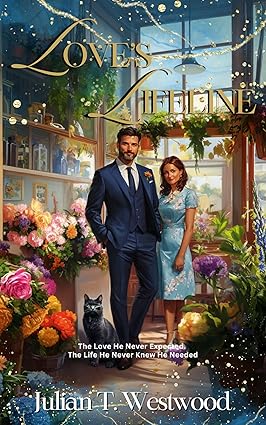
Julian T. Westwood’s Love’s Lifeline tells the story of Dr. Reginald “Reggie” Fitzwilliam, a polished and buttoned-up couples therapist whose life is meticulously ordered, until it’s not. Set largely in his office and personal sanctuary, the book unfolds through therapy sessions with clients, private reflections, professional pressure, and the unexpected companionship of a perceptive British Shorthair cat named Freud. What begins as a chronicle of others’ love lives slowly peels back Reggie’s own carefully constructed walls, revealing his struggles with vulnerability, approval, and connection. The story builds through subtle moments and personal revelations, ultimately landing on a touching and honest reckoning with his past and the possibility of new beginnings.
As the story progresses, layer after layer of Reggie’s composed exterior came off, and I found myself rooting for him more with every page. Westwood’s writing is clever and filled with understated emotion and wry humor. The dynamic between Reggie and Freud is one of the book’s most endearing elements; it gives the narrative a cozy heartbeat amid the psychological introspection. The therapy scenes themselves are handled with grace and humanity. They’re believable and gentle, and they sneak up on you emotionally. There’s a patience in the pacing that lets the weight of small moments linger, which I appreciated. But what got me most was Reggie’s slow unraveling, the way his struggle to admit his own need for love mirrors the very people he helps every day. It’s painfully real, and it hit home.
There were stretches where I wanted the tension to snap a bit louder or for a character to say something messy. The conflicts, especially with Cassandra, his sharply drawn colleague, felt a bit too restrained, and I craved more sparks. Also, the prose, while elegant, occasionally felt a little too polished, like Reggie himself. Still, even with that, Westwood’s command of character and emotional insight is clear and compassionate. This is a book written by someone who understands the ache of longing and the awkward dance of self-discovery.
Love’s Lifeline is a warm, reflective, and gently transformative story. I’d recommend it to anyone who enjoys character-driven fiction, especially readers who are drawn to stories about personal growth, emotional complexity, and the quieter forms of bravery. Therapists, perfectionists, and anyone who’s felt boxed in by expectations will likely see themselves in Reggie. It’s not flashy or fast-paced, but it lingers in your mind and in your chest.
Pages: 278 | ASIN : B0DG5TR66Q


