Blog Archives
The Paths We Take

Thin Places is a reflective collection of personal essays that finds moments of connection, grace, and the sacred in the ordinary encounters and places of everyday life. Why was this an important book for you to write?
So much of this book is about journeys, the paths we take, and the unforeseen changes in direction along the way; this idea, too, that all roads lead to where we are going. Similarly, writing this book was very much a journey for me. While I tried to keep to a minimum the number of essays directly about me and my journey, I became a part of every essay, or every essay became a part of me—meaning, in crossing paths, everyone’s journey became my journey and my journey, in turn, connected with theirs. It was incredibly healing, also humbling, empowering, enlightening, inspiring, you name it! Writing it also solidified in my mind the ideas about which I write, especially this overarching idea that there are a lot of people and just as many paths and it doesn’t really matter the path or the series of paths we are on compared to someone else’s as long as we learn to love. I really do believe that it is in love that we find our way. In a world where there can be a lot of conflict, especially now, I needed that reminder.
How did you decide which family experiences belonged in the collection?
I didn’t set out to retell certain experiences. I simply set out to be more aware and try to capture what I felt or what came to mind in the moments when I first felt or thought them. But I did feel drawn to find thin places as well as extraordinary stories with staying power in unlikely or ordinary places. No sooner did I settle on that theme of journeys and thin places than I began to see them everywhere, in places, people, and things. More than that, I came to realize that everyone has a story, everyone is a story, and we all have deep desire to share our story and what we learned or who we became along the way. So, it wasn’t so much deciding what essays to include as it was getting out of the way so that I could see stories and thinness where I might not normally look. The more I listened and observed and altogether stepped into people’s stories, the more powerful they became and the deeper my connection to them grew. Meaningful stories and personal connections really are everywhere, if we look for them. Because of that, many of the stories I tell, though not mine, were observed by me. So I am a part of each story, each essay, but they are not about me.
How did personal failure become part of the spiritual questions in the book?
First, that question makes me think of Krista Tippet, the host of OnBeing, who talks a lot about “living the questions,” which is to say there is value in learning to sit and be okay sitting with uncertainty. My life has definitely given me a lot of opportunities to sit with questions, many of them coming in the midst of deep pain and the settling dust of despair. Second, any time there is struggle, no matter who is struggling or what that struggle looks like, I think “spiritual” questions are not far behind (whether we or not we recognize or utter them). Not religious questions, mind you, but spiritual questions, which I see as being more universal, those questions that lead us to consider how it is we are all connected together, and what it truly means to love and be our brother’s or sister’s keeper. But we can’t get to that level of understanding and love without vulnerability and being open, to some degree, about our weaknesses, mistakes, struggles, wounds, etc. This book does not shy away from highlighting those things. To that end, some of the thinnest places seem to be born in or because of hardships. While this book is not about my divorce, nor is it about my kids’ mental health struggles in the wake of that divorce, that moment, or failure as you might call it—in looking back—proved to be a catalyst for greater degrees of growth, love, and understanding. So, for me, without that moment, I don’t think I would’ve been ready to ask the questions I needed to ask in order to understand what I needed to understand.
What was the greatest gift this collection gave you as a writer and as a person?
My writing journey and my life journey, they are pretty much one and the same. I love that Leonard Cohen quote that says, “If your life is burning well, poetry is just the ash.” In that sense, life gave me the gift to experience what I did, and in writing about it, I found the gift expanded, a gift that keeps on giving, if you will. More specifically, it connected me to so many people. And it continues to connect me to many more. It also helped me see people as they really are, which is not unlike you or me. That takes effort, and it is a work in progress, but I don’t know if there is a greater gift after which to seek. The more we can understand or seek to understand, the less of judgment, hate, hurt, war, etc. there will be.
Author Links: GoodReads | Instagram | Website
Thin Places: Portraits, Prayers, & Liminal Grace


Arthur Thomas Lee’s Thin Places is a collection of personal essays built around a deceptively simple idea: ordinary life is full of moments when the distance between the everyday and the sacred seems to narrow. Lee borrows the Celtic idea of “thin places,” moments or locations in which heaven feels close, then expands it well beyond traditionally religious settings. A grocery-store parking lot, a Walmart aisle, a customer-service call, a hospital room, a desert labyrinth, an old photograph, a freeway, a family dinner, and an encounter with a stranger can all become such places. What gives the collection coherence is Lee’s insistence on attention. Again and again, he looks closely at people who might otherwise remain part of the scenery and finds in their gestures, histories, wounds, humor, and kindness a reason to linger.
The essays are deeply autobiographical, with Lee’s four sons, divorce, remarriage, blended family, parents, siblings, grandparents, and friends forming the book’s emotional center. Yet the memoir material continually opens outward. A scar becomes a meditation on healing, an old basketball becomes a lesson in parental love, footprints become records of belonging, and the inscriptions in used books become evidence that lives remain present long after their owners are gone. Lee states the principle plainly near the beginning: “What is true for books is true for people: The deeper you go, the better you will understand them.” That sentence functions almost as the collection’s method. Lee reads people the way he reads books, attentive to marginalia, damaged pages, unfinished chapters, and the significance of what appears between the lines. His recurring fascination with language, etymology, punctuation, literary quotations, signs, slogans, and overheard phrases gives the book an unusually verbal texture without separating those word games from its larger concern with human lives.
Formally, Thin Places sits comfortably between literary essay, memoir, nature writing, and devotional meditation. Most pieces begin with a concrete scene, often humorous or unassuming, before gradually widening into questions of grief, mortality, faith, compassion, forgiveness, or connection. Short poems between the essays act as small clearings, giving the reader a moment to observe a bird, tree, river, snowfall, or patch of sage before moving forward. The repeated “Amen” at the end of the essays creates a liturgical rhythm, while Lee’s spiritual imagination remains expansive, drawing connections among Christian belief, other religious traditions, literature, art, nature, and the moral lives of strangers. In later pieces, the book gathers many of its recurring images into a common vocabulary of roads, scars, hearts, light, stories, rebuilding, and return. By “Afterwards,” words themselves have become the subject again, bringing the collection back to the place where it began and giving the whole book a circular, carefully considered shape.
What distinguishes Thin Places is the seriousness with which it regards small encounters. Lee writes about profound grief, suicide, addiction, family rupture, illness, aging, and death, but he places those experiences alongside jokes, roadside signs, birdsong, basketball, bad puns, shared meals, unexpected phone calls, and acts of kindness. The effect is cumulative: the sacred in this book isn’t confined to extraordinary revelation but emerges through sustained attention to ordinary people and ordinary days. The final essays make that ethic especially clear, returning to the reasons people remain connected to life, to one another, and to the unfinished stories still ahead. Thin Places is therefore both a record of one man’s family and losses and a broader invitation to read the lives around us more closely. Its governing conviction is that attention can become a form of love, and Lee gives that conviction substance through a collection that is tender, observant, playful, and earnestly hopeful.
Pages: 318 | ASIN : B0H5T7C6MK

One Day at a Time-A Daily Journey with Jesus
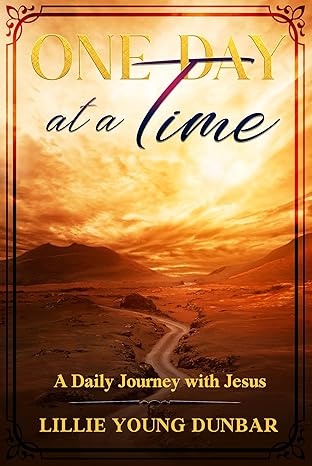
Jesus remains one of the most polarizing and influential figures in history, revered by billions and central to countless historical and religious texts. To practicing Christians, he is the ultimate source of light, mystery, and blessing, a guiding presence whose teachings shape their daily lives. Yet, in the chaos of modern life, it’s all too easy to lose sight of his teachings. One Day at a Time: A Daily Journey with Jesus by Lillie Dunbar offers a thoughtful and practical reminder of what it means to live intentionally with Christ at the center of one’s heart and mind.
Dunbar’s book is designed for practicing Christians who seek to deepen their faith and live out the core principles of their belief. For believers, this book serves as both a guide and a call to action, urging them to align their daily lives with the values and teachings of Jesus.
The structure of the book is simple yet profound. Dunbar encourages readers to embark on a 31-day journey of reflection, devotion, and mindful living. Each day serves as an opportunity to examine Jesus’ teachings and consider how to apply them practically. The goal is not just personal growth but a ripple effect of positivity, where living according to Christ’s example influences and uplifts others as well.
This is no small task. In an age where many profess Christianity while neglecting its foundational principles, Dunbar’s invitation is both timely and ambitious. The writing itself is clean, introspective, and meditative qualities that lend the book a tone reminiscent of devotional literature or even a modern spiritual guide.
Dunbar’s clarity of thought and depth of conviction shine through on every page. She writes with sincerity and purpose, offering readers a glimpse into her own connection with Jesus and inviting them to foster a similar relationship. For those seeking to grow closer to Christ and to live with intention and faith, this book is an excellent companion.
One Day at a Time is more than a guidebook; it’s a gentle yet firm nudge toward living a life of purpose rooted in the teachings of Jesus and infused with grace. Dunbar’s work is a heartfelt offering to those willing to listen and act.
Pages: 105 | ASIN : B0DPL3MP2P


