Blog Archives
The Paths We Take

Thin Places is a reflective collection of personal essays that finds moments of connection, grace, and the sacred in the ordinary encounters and places of everyday life. Why was this an important book for you to write?
So much of this book is about journeys, the paths we take, and the unforeseen changes in direction along the way; this idea, too, that all roads lead to where we are going. Similarly, writing this book was very much a journey for me. While I tried to keep to a minimum the number of essays directly about me and my journey, I became a part of every essay, or every essay became a part of me—meaning, in crossing paths, everyone’s journey became my journey and my journey, in turn, connected with theirs. It was incredibly healing, also humbling, empowering, enlightening, inspiring, you name it! Writing it also solidified in my mind the ideas about which I write, especially this overarching idea that there are a lot of people and just as many paths and it doesn’t really matter the path or the series of paths we are on compared to someone else’s as long as we learn to love. I really do believe that it is in love that we find our way. In a world where there can be a lot of conflict, especially now, I needed that reminder.
How did you decide which family experiences belonged in the collection?
I didn’t set out to retell certain experiences. I simply set out to be more aware and try to capture what I felt or what came to mind in the moments when I first felt or thought them. But I did feel drawn to find thin places as well as extraordinary stories with staying power in unlikely or ordinary places. No sooner did I settle on that theme of journeys and thin places than I began to see them everywhere, in places, people, and things. More than that, I came to realize that everyone has a story, everyone is a story, and we all have deep desire to share our story and what we learned or who we became along the way. So, it wasn’t so much deciding what essays to include as it was getting out of the way so that I could see stories and thinness where I might not normally look. The more I listened and observed and altogether stepped into people’s stories, the more powerful they became and the deeper my connection to them grew. Meaningful stories and personal connections really are everywhere, if we look for them. Because of that, many of the stories I tell, though not mine, were observed by me. So I am a part of each story, each essay, but they are not about me.
How did personal failure become part of the spiritual questions in the book?
First, that question makes me think of Krista Tippet, the host of OnBeing, who talks a lot about “living the questions,” which is to say there is value in learning to sit and be okay sitting with uncertainty. My life has definitely given me a lot of opportunities to sit with questions, many of them coming in the midst of deep pain and the settling dust of despair. Second, any time there is struggle, no matter who is struggling or what that struggle looks like, I think “spiritual” questions are not far behind (whether we or not we recognize or utter them). Not religious questions, mind you, but spiritual questions, which I see as being more universal, those questions that lead us to consider how it is we are all connected together, and what it truly means to love and be our brother’s or sister’s keeper. But we can’t get to that level of understanding and love without vulnerability and being open, to some degree, about our weaknesses, mistakes, struggles, wounds, etc. This book does not shy away from highlighting those things. To that end, some of the thinnest places seem to be born in or because of hardships. While this book is not about my divorce, nor is it about my kids’ mental health struggles in the wake of that divorce, that moment, or failure as you might call it—in looking back—proved to be a catalyst for greater degrees of growth, love, and understanding. So, for me, without that moment, I don’t think I would’ve been ready to ask the questions I needed to ask in order to understand what I needed to understand.
What was the greatest gift this collection gave you as a writer and as a person?
My writing journey and my life journey, they are pretty much one and the same. I love that Leonard Cohen quote that says, “If your life is burning well, poetry is just the ash.” In that sense, life gave me the gift to experience what I did, and in writing about it, I found the gift expanded, a gift that keeps on giving, if you will. More specifically, it connected me to so many people. And it continues to connect me to many more. It also helped me see people as they really are, which is not unlike you or me. That takes effort, and it is a work in progress, but I don’t know if there is a greater gift after which to seek. The more we can understand or seek to understand, the less of judgment, hate, hurt, war, etc. there will be.
Author Links: GoodReads | Instagram | Website
Thin Places: Portraits, Prayers, & Liminal Grace


Arthur Thomas Lee’s Thin Places is a collection of personal essays built around a deceptively simple idea: ordinary life is full of moments when the distance between the everyday and the sacred seems to narrow. Lee borrows the Celtic idea of “thin places,” moments or locations in which heaven feels close, then expands it well beyond traditionally religious settings. A grocery-store parking lot, a Walmart aisle, a customer-service call, a hospital room, a desert labyrinth, an old photograph, a freeway, a family dinner, and an encounter with a stranger can all become such places. What gives the collection coherence is Lee’s insistence on attention. Again and again, he looks closely at people who might otherwise remain part of the scenery and finds in their gestures, histories, wounds, humor, and kindness a reason to linger.
The essays are deeply autobiographical, with Lee’s four sons, divorce, remarriage, blended family, parents, siblings, grandparents, and friends forming the book’s emotional center. Yet the memoir material continually opens outward. A scar becomes a meditation on healing, an old basketball becomes a lesson in parental love, footprints become records of belonging, and the inscriptions in used books become evidence that lives remain present long after their owners are gone. Lee states the principle plainly near the beginning: “What is true for books is true for people: The deeper you go, the better you will understand them.” That sentence functions almost as the collection’s method. Lee reads people the way he reads books, attentive to marginalia, damaged pages, unfinished chapters, and the significance of what appears between the lines. His recurring fascination with language, etymology, punctuation, literary quotations, signs, slogans, and overheard phrases gives the book an unusually verbal texture without separating those word games from its larger concern with human lives.
Formally, Thin Places sits comfortably between literary essay, memoir, nature writing, and devotional meditation. Most pieces begin with a concrete scene, often humorous or unassuming, before gradually widening into questions of grief, mortality, faith, compassion, forgiveness, or connection. Short poems between the essays act as small clearings, giving the reader a moment to observe a bird, tree, river, snowfall, or patch of sage before moving forward. The repeated “Amen” at the end of the essays creates a liturgical rhythm, while Lee’s spiritual imagination remains expansive, drawing connections among Christian belief, other religious traditions, literature, art, nature, and the moral lives of strangers. In later pieces, the book gathers many of its recurring images into a common vocabulary of roads, scars, hearts, light, stories, rebuilding, and return. By “Afterwards,” words themselves have become the subject again, bringing the collection back to the place where it began and giving the whole book a circular, carefully considered shape.
What distinguishes Thin Places is the seriousness with which it regards small encounters. Lee writes about profound grief, suicide, addiction, family rupture, illness, aging, and death, but he places those experiences alongside jokes, roadside signs, birdsong, basketball, bad puns, shared meals, unexpected phone calls, and acts of kindness. The effect is cumulative: the sacred in this book isn’t confined to extraordinary revelation but emerges through sustained attention to ordinary people and ordinary days. The final essays make that ethic especially clear, returning to the reasons people remain connected to life, to one another, and to the unfinished stories still ahead. Thin Places is therefore both a record of one man’s family and losses and a broader invitation to read the lives around us more closely. Its governing conviction is that attention can become a form of love, and Lee gives that conviction substance through a collection that is tender, observant, playful, and earnestly hopeful.
Pages: 318 | ASIN : B0H5T7C6MK

Emotional & Intuitive

Sacred Geometry for Healing presents a collection of mandalas devoted to the deeply renewing experience of meditation. Why was this an important book for you to write?
The intention of Sacred Geometry for Healing began as the expression of myself as an artist. My goal as an artist was to find my essence, my true nature, and I began to discover myself as a mandala artist. My spirit would move me, and I would create mandalas with the synchronicity of numbers, 4 – 6 – 8 – 12 – 24 (sacred geometry), and so on. As my artwork manifested, I began to hand tool the mandalas in copper. A process known as copper repoussé. Copper is a healer and spiritual conductor. I presented my work in galleries and art shows and co-founded an art gallery collective.
Many, many beautiful mandalas were too intricate to tool in copper as 18 or 24 intricacies in the circle. And that emotionally pained me that they were being left behind. In 2019, when the gallery I was managing was closed temporarily due to the pandemic, the mandalas left behind began to call to me! I realized they were destined to be compiled into a book & Sacred Geometry for Healing: Art on a Mission was born and published!
My mission was to help healing through the observation of art. To create my book to facilitate the practice of deeply viewing and concentrating (meditating) on each of my artworks and their deep collective subconscious and consciously titled meaning. And thus instigating a way for the viewer to receive healing. This was a concept I evolved in sympathy with the tradition that relates mandalas with meditation in different aspects. From 2019 to 2025, a little knock in my solar plexus would keep telling me my book was unfinished. In 2025, after expanding the narrative and republishing my memoir, I had a revelation. Mantras! Mantras were speaking inside me to be written as corresponding healers in synchronicity with the visual and title meanings of each mandala in the original edition. 51 mantras flowed from me next to each mandala, and I knew the entire truth of my artist’s healing mission had come to fruition – Sacred Geometry for Healing: MANTRAS AND MANDALAS FOR MEDITATION.
How do you hope readers engage with the imagery—analytically, emotionally, or intuitively?
My approach to the creation of sacred geometry mandalas was natural, emotional & intuitive. The artworks manifested from me and spoke to me. After I created them, I felt their meaning as if they were communicating to me, and titled each work as I discovered its embodied meaning. They came from a deep connection with nature and creation. I feel the natural connection for the viewer is personal, and I hope each mandala conveys a universally accessible experience, whether by emotion, intuition, or analysis.
Do you see sacred geometry as something rooted in belief, or as something that can be experienced regardless of belief?
I see sacred geometry as something we experience every day naturally in nature, as a seashell or a snowflake. My mandalas, I hope, feel natural and accessible to everyone as nature is to all humanity, regardless of our individuality, beliefs, etcetera.
If a reader takes just one thing from this book, what do you hope it is?
I hope each reader receives something personal, as an artist feels when their art is viewed at an exhibit. I hope they are moved and receive from experiencing my artworks, deep meanings, and personal mantra expressions. And can relate them for themselves in any way they choose.
Author Links: GoodReads | Website | Amazon
Mantras and Mandalas Guide for Meditations – Each mandala in this book has a universal and personal meaning. Each title and aura blue print image embodies the spirit of what has been experienced in the collective consciousness of human experience, connecting to the divine. As god experiences, we experience.
Choose your mandala for the moment by either concentrating and opening the book and finding your spirit guided selection or browse the titles and choose what resonates with your heart at the moment. Remember you are not alone, what you are facing and experiencing from joy to despair has been faced by those who came before you and by those that are here with you now. Focus your meditation on your selected mandala and read the corresponding mantra. You can repeat it out loud during you meditation or remain silent.
“The artworks are resonating as a blueprint of human – god emotions and you
can feel the unseen universal – the sacred geometry blueprint of life experience.”
Bio- Originally upon graduation with a BFA in dance and choreography—I was a member of two contemporary dance companies and a producer for a cable tv station, before I was isolated from the world. Upon my return a decade ago, I am now an accomplished artist in galleries and shows. I am a member of an artists association and am the co-founder of an art gallery collective.
Adria: The Artist.
Sacred Geometry for Healing: MANTRAS AND MANDALAS FOR MEDITATION

The concept of the mandala has appeared across cultures for centuries, carrying with it a long tradition of symbolism, reflection, and spiritual focus. Mandalas are intricate works of art, rich in detail and visual harmony. More than decorative images, they are designed to evoke expansive, universal ideas and invite contemplation. To study a mandala is to enter a quieter mental space, one where negative thoughts recede and more restorative, life-affirming ones can take root.
When meditation joins with sustained focus on a mandala, the effect can feel deeply renewing. Add the repetition of a simple mantra, and the practice becomes even more centering. Together, these elements create room for reflection, sharpen concentration, and help restore a sense of inner balance. They encourage the mind to return to what matters most.
In Sacred Geometry for Healing: Mantras and Mandalas for Meditation, Adria Chalfin presents a nonfiction collection devoted to that very experience. The book features a series of mandalas, each paired with an explanation of its intended purpose and a short mantra for meditation. The format is accessible. The effect is immersive.
The appeal of the mandala lies in its elegant simplicity, even as the artwork itself remains highly intricate. Each design reflects the idea of sacred or universal geometry, the belief that certain shapes carry a transcendent quality. These forms are not merely beautiful. They are meant to focus attention, deepen awareness, and awaken a sense of connection that feels larger than the self.
Chalfin’s collection draws on this tradition with care and intention. Her mandalas represent themes such as aura, nature, holy light, and more. Some carry clear Christian associations. Others feel open-ended and nondenominational, making the book accessible to readers from a range of spiritual backgrounds.
Skeptics may not accept the healing power often attributed to mandalas or mantras, yet that does not diminish the book’s value. Belief is not the only point. The real benefit may lie in the practice itself: choosing an image that resonates, sitting with it, breathing deeply, and allowing the mind to settle. In that stillness, readers may find clarity, calm, and a renewed sense of energy.
That may be this book’s greatest strength. In a culture dominated by technology, immediacy, and material distraction, the act of stepping away becomes more than refreshing; it becomes necessary. Sacred Geometry for Healing offers a simple means of doing exactly that. It provides a space for pause, for inward listening, and for temporary escape from the noise. For readers seeking a meditative aid or a gentle spiritual reset, Chalfin’s book offers both beauty and purpose.
Pages: 114 | ASIN : B086Q7T2PB
Nature Mandalas for Busy Minds
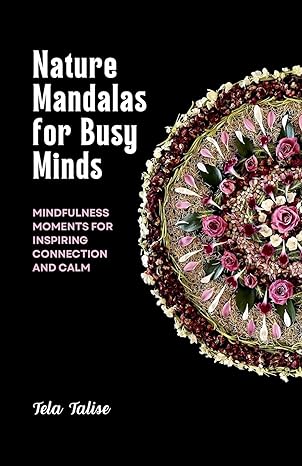
Life is noisy, fast, and often overwhelming. Nature Mandalas for Busy Minds is like a deep breath of fresh air on a chaotic day. Tela Talise offers a beautifully crafted guide to mindfulness through nature-inspired mandalas, weaving together reflections, affirmations, and journaling prompts that encourage stillness and self-awareness. The book is about admiring mandalas and using them as tools for introspection, healing, and finding peace in a world that never slows down.
One of the things I absolutely loved about this book is its approach to mindfulness. It doesn’t preach or overcomplicate things. Instead, it gently invites you into a space of self-reflection. Talise starts by explaining her own journey—how art, nature, and mindfulness helped her through personal struggles, including postpartum depression. Her vulnerability in sharing this made the book feel deeply personal. The section “My Mandala Story” struck a chord deep in me, especially when she described realizing she had abandoned her creative passions for the sake of life’s obligations. How often do we forget to nurture the things that bring us joy?
Beyond personal storytelling, the book is structured in a way that encourages ongoing practice. Each mandala is paired with an intention—concepts like “Acceptance,” “Healing,” and “Patience”—alongside affirmations and journal prompts that make you pause and reflect. I found the “Lost Connections” section particularly powerful, where Talise discusses how we deal with relationships that fade or change over time. The affirmation, “I release the void created by farewells, welcoming the potential for new connections and growth,” felt like a necessary reminder that endings can be beginnings, too. The way she ties each theme to natural elements—like using dried roses and rosemary to symbolize memory—makes the experience feel so tangible, like you’re truly connecting with something beyond just words on a page.
What makes Nature Mandalas for Busy Minds so special is its accessibility. You don’t have to be an artist, a meditation expert, or someone with hours to dedicate to mindfulness. Talise makes it clear that even a few minutes of reflection—staring at a mandala, answering a question, repeating an affirmation—can be transformative. I tried her suggestion of flipping to a random page when seeking guidance, and it was almost eerie how spot-on it was. One night, overwhelmed with overthinking, I landed on the “Overthinking” mandala, which compared negative thoughts to weeds in a garden. The reminder to focus on “flowers” instead of “weeds” helped reframe my spiraling thoughts in a way I desperately needed.
I recommend this book to anyone looking for a simple yet meaningful way to incorporate mindfulness into their daily life. If you find yourself constantly stressed, always in your head, or struggling to slow down, this book is for you. It’s also a perfect gift for someone going through a tough time—a gentle, nonjudgmental companion that reminds you to breathe, reflect, and reconnect with yourself.
Pages: 167 | ASIN : B0DSC9GRKD


