Blog Archives
Finding Self-Worth
Janice Everet is a Southern gothic historical romance that retells Jane Eyre through the perspective of a blind heroine growing up in the 1930s American South. What was the inspiration for this creative and intriguing retelling of the classic story?
Janice Everet was my first attempt at a historical fiction novel, and it was a true joy to write. I chose to retell this story because, as much as I love Charlotte Brontë’s book, I found the idea of blindness being used as a sort of test or punishment to be both frustrating and sad. I am blind myself and wanted to depict a more affirming exploration. Also, my editor and friend, Stephanie Ricker, gave me the idea to explore Jane Eyre from my own perspective. Like Janice, I find solace in stories, and I love walks in nature. I am also a person who had to learn assertiveness, as I was very passive growing up. Janice Everet is a story of finding self-worth and discovering a worldview that others might not share, but it is a story of finding your voice and discovering that you truly matter. Janice’s character began to assert herself quite forcefully, and all the other characters did as well. Writing this book was both cathartic and surreal, a joyful experience I will never forget, and the characters will always haunt me. They’re some of the “truest” fiction characters I have ever had the honor of creating. They truly do not feel like something created, but something that has always existed. This is not by my doing, I can assure you. They just needed to be brought to life. This fact is hard to explain, but the characters are truly special.
Janice is based on the character of Jane Eyre, but you have added your own unique twist to this classic character. Are there any emotions or memories from your own life that you put into your character’s life?
Yes, this novel does explore some difficult topics, but Bronte’s original work explores abuse as well. What I love about the original Jane Eyre is that it is a story about a woman who defies her society’s expectations, but she does so in a humble way. So many books portray “strong” women as girl bosses or Mary Sues (people who don’t struggle or who are insufferable to be around). I wanted to portray a strong woman who is also quiet and humble, but who does not allow others or her disability to define her.
Over 83% of disabled individuals will experience assault of some kind in their lives. This shocking percentage is one I understand through personal experience. I wanted to portray the very real ways that disabled people are often treated by those who perceive them as weak or worthy of nothing but disparagement. I wanted to depict resilience and provide hope despite the horror often encountered in the world. This world is a cruel place, but it is also a place of resilient hope. How often do we encounter horrifying things on the news? Yet in the midst of the horror, hope can always be found if we seek it. Fiction enables us to explore difficult things, but true storytelling involves providing a leavening agent of hope and courage to balance out the horrific.
In your book, you explore the struggles of living with a disability, trauma survival, and the complex social dynamics of living through the Great Depression, WWII, and the 1950’s. What interests you in these subjects?
I am interested in the Depression, World War II, and the 1950’s, both because my grandfathers served in World War II and because my grandparents grew up in those eras. That generation truly learned the meaning of the word sacrifice and endured so many hardships. It was so interesting to research the time periods more extensively. I find the generation in which my grandparents grew up to be a remarkable one (as well as a generation marked by trauma that we might never fully grasp). To tell a story from that time period was truly fun and cathartic.
What is the next book that you are working on, and when can your fans expect it to be out?
I am working on a book called Earth Charmer (a sequel to my book entitled Wind Charmer). The story contains Native American lore and fantastical elements. Fans should probably expect its release in early 2027. I am also considering another historical fiction story in which one of the characters from Janice Everet makes an appearance, a story about polio and a mysterious entity in a music school. This idea is still germinating.
Author Links: GoodReads | Amazon
Growing up in the oppressive home of her Aunt Richards, Janice is stifled by condescending attitudes and flagrant disregard. She finds solace helping the household servants as they, too, are belittled. Janice especially enjoys the company of Gustav, her aunt’s servant, who is often mistreated because of the color of his skin.
When a harrowing event forces Janice to take an unexpected journey, doors are opened and opportunities are revealed. As Janice navigates school years of both triumphant and tragic times, helps with the war effort and makes both friends and enemies, her dark past lurks in the shadows.
When Janice accepts a position to teach a precocious and rambunctious little girl who is also blind, the malevolent events of her past prove to have shocking connections with her brusque and mysterious employer. Hidden passions, danger and self-discovery await in this account of a strong woman who will stop at nothing to protect the ones she has grown to love. Yet true love often means letting go. A story of confronting adversity, hidden secrets and forbidden love, Janice Everet will make you see Charlotte Bronte’s classic with new eyes.
This book is the adult debut of the author. The story contains mature sexual content as well as some mild profanity.
Janice Everet: A Southern Gothic Jane Eyre Retelling
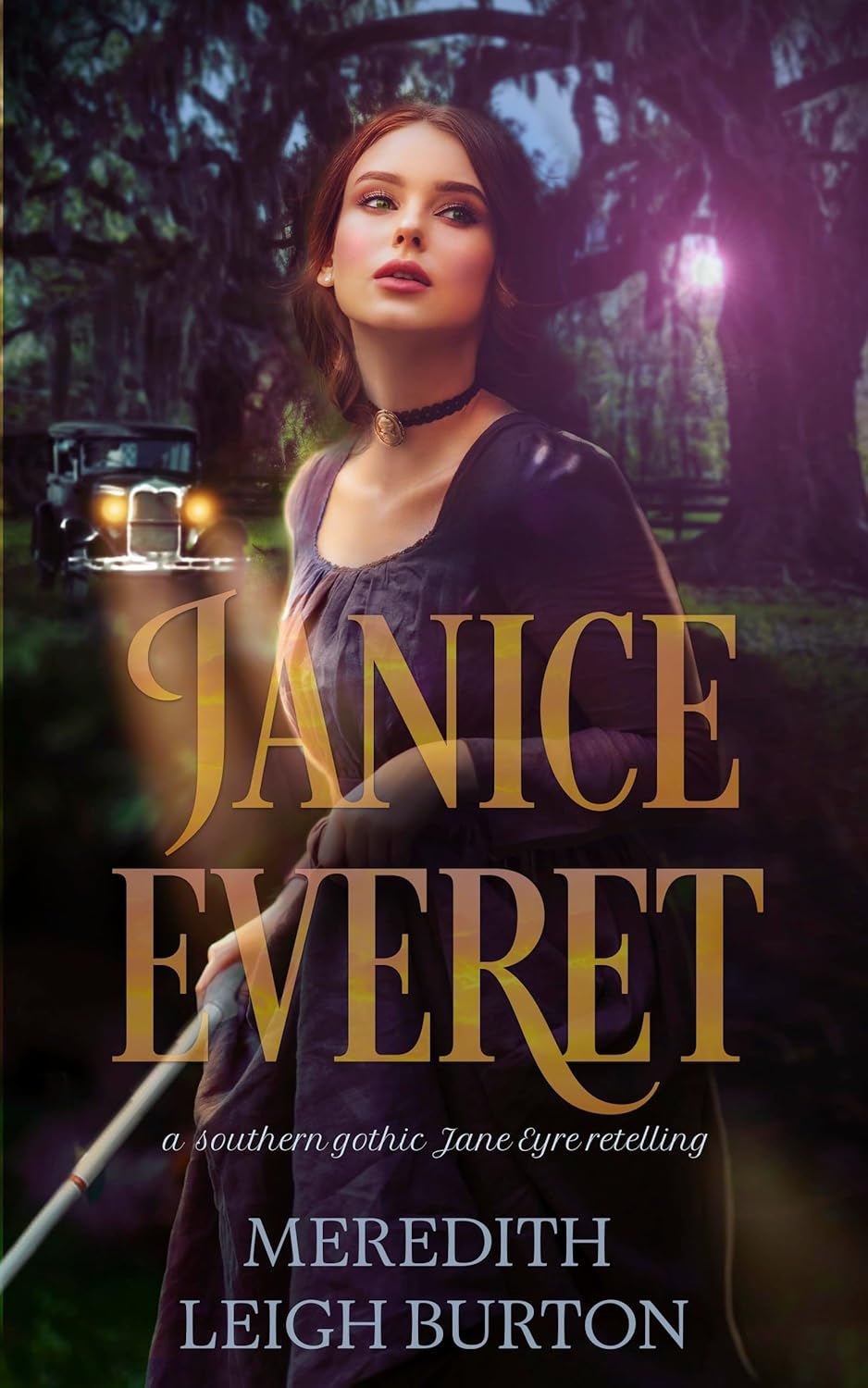

Janice Everet is a Southern gothic historical romance that retells Jane Eyre through the perspective of a blind heroine growing up in the 1930s American South. We follow Janice from a childhood shaped by cruelty and neglect, through her years at a school for the blind, and into adulthood as she becomes a teacher and finds both purpose and love. The book mirrors the familiar arc of Jane Eyre but transforms it, rooting the story in disability representation, trauma survival, and the complicated social dynamics of its time.
As I read, I kept returning to how intimate Janice’s voice feels. Burton writes her with a sensitivity that made me slow down, especially during the painful early chapters. The scenes with Arnold, in particular, are hard to take. They’re written with an unflinching honesty that makes Janice’s fear almost tactile, and moments like the doctor noticing the bruising around her eyes and gently explaining her retinal damage hit me right in the chest. The book doesn’t sensationalize the abuse; instead, it sits with the emotional fallout and lets Janice carry both her pain and her stubborn resilience. I liked that the writing never turns her blindness into a metaphor or punishment. Burton even says in her author’s note that she wanted to challenge that trope directly, presenting blindness not as a tragedy but simply as part of Janice’s life and identity. That intention really comes through.
What surprised me most was how naturally the story shifts from gothic tension to warm, character-driven romance. The scenes with Edwin feel like stepping into sunlight after a long walk in the dark. Their relationship grows slowly, with a gentleness that contrasts with everything Janice has survived. I found myself appreciating the quieter moments: shared meals, woodworking, guiding each other through unfamiliar emotional terrain. Even the small exchanges with side characters, like Janice reading a story to a child on the bus or meeting friends at Pembrook, widen the world and keep the novel from sinking into despair. Burton’s choices here make the story less about escaping the past and more about claiming a future. And because the book is a romance, the emotional payoff lands in a satisfying, comforting way.
By the time I reached the end, I felt like I’d traveled with Janice rather than just observed her. The blend of Southern gothic atmosphere, historical detail, and classic romance gives the book a distinct flavor. It’s not a light read; some chapters sit heavily, especially for readers sensitive to themes of assault, trauma, and systemic prejudice. But the heart of the story is hopeful. It’s a journey toward dignity, connection, and the quiet courage of choosing joy after years of being told you don’t deserve it.
If you enjoy character-centered stories, historical romance with emotional depth, or retellings that genuinely reimagine their source material, this book will speak to you. Fans of Jane Eyre who have wondered what that story might look like with a heroine whose challenges aren’t tied to beauty or sight but to agency and survival might find this version even more resonant. I’d recommend Janice Everet to readers who appreciate Southern gothic atmosphere, nuanced disability representation, and a romance that feels earned and tender.
Pages: 238 | ASIN : B0FYK3JCKG

Redemption of Even the Most Evil

In Firefax, a family of highly-trained assassins is left to contend with their eldest sibling’s maniacal behavior and two rival spy agencies following the death of their patriarch. Where did the idea for this novel come from?
I originally wrote this when I was 17 or 18, and I think a great many things inspired it, especially books that I enjoyed as a teen, like Treasure Island, the works of Patrick O’Brian, and Fyodor Dostoevsky. The biggest inspiration for me when I first came up with the idea and wrote it, was probably the book Demons by Fyodor Dostoevsky. I’d highly recommend it, especially if you want a much deeper exploration than I’m capable of writing of the darkness and absurdity contained within the human soul.
The Firefax family is absolutely fascinating. What character did you enjoy writing for? Was there one that was more challenging to write for?
I enjoyed all these characters! The most fun to write was probably Murdoch. His interactions with all his siblings and with Esperanza were very amusing to describe. I also had a lot of fun writing Istäni’s character. Cara was the hardest to write because she is such a deeply repressed individual, and what boils beneath the surface isn’t always clear.
What were some themes that were important for you to explore in this book?
I wrote this book first as a teenager, and part of what I was exploring at that time was my own teenage angst after I was diagnosed with type 1 diabetes. Louis’ suffering is honestly part of that exploration and hasn’t changed much at all since I originally wrote the work (though, just to be clear, the character Louis himself is in no way based on me). Then, it sat in a drawer for many years. I continued writing in the interim, including some other currently unpublished fantasy works, learning and growing as a writer. I finally took Firefax out of the drawer in 2021, during the delta wave of COVID.
At the time of the rewrite, I was working in the hospital, taking care of a lot of COVID patients, and it was honestly hell on earth. People died every shift. It was very hard. I talk a bit more about this on my substack here. Rewriting Firefax was an escape for me, and a means of survival during a very dark time, more than anything. That said, I find it interesting what themes others take away from it. I think a lot of what people find in the work they bring in themselves, and interpret through their own lens, as with any piece of art.
For me, the biggest theme I see when I look back at the novel is the idea of isolation, and how inhuman it can make people to be cut off from community and love and connection. But there is also exploration of how to overcome that, and the hope, perhaps, of redemption of even the most evil people through love.
Can fans of the Firefax clan expect to see a second installment? What are you currently working on?
I am actually working on a sequel to Firefax, and probably a third book with these characters as well. I wanted Firefax itself to stand alone; people can read it and be satisfied with that one book and its ending. But there’s definitely more to come for those readers who want more of these characters.
My next work to be published will be a historical fiction set during the war between the British and French and their Native allies over the Great Lakes Region in the year 1759. It’s called La Belle Famille, and the ebook can be preordered here: La Belle Famille, or you can wait for the official release on the 265th anniversary of the battle, July 24th, 2024. It’s a high-stakes adventure tale leading up to perhaps the most pivotal battle of that entire war. There are no assassins in it, but plenty more dysfunctional family dynamics and excitement.
Author Links: GoodReads | Website | Amazon
Legend tells of a city of gold on a phantom island. The wealth of that city could end the American Revolution. But the only person who knows the island’s location is the world’s deadliest assassin. And he’s not giving up that secret without a fight . . .
The world’s oldest family of high-profile assassins, the Firefaxes, have been killing off dignitaries—and being well-compensated to do so—for centuries. The family is thrown into turmoil by their patriarch’s death and the return of their cunning, cruel prodigal, Murdoch. With their father dead, Murdoch is the only one who knows where the Firefax wealth is, kept on a secret island. But two competing intelligence networks in the American Revolution are bent on tracking down the legendary treasure to end the war, whatever the cost. However, these spy networks may have met their match in this wily, dysfunctional family of killers.
Firefax


In Firefax, by Amelia M. Vergara, the American War for Independence serves as a vivid backdrop to a tale of familial ties, espionage, and moral ambiguity. The narrative centers around the Firefax siblings, who have been nurtured on their family’s Maralah farm with a unique skill set tailored for assassination. Following the demise of their patriarch, the siblings are compelled to navigate their complex relationships anew, while simultaneously contending with their entanglement in a dangerous game orchestrated by Murdoch, the eldest, between two rival spy agencies, Argonaut and Myrmidon, in their quest for the elusive island of Lubrerum.
Vergara skillfully merges elements of mystery, action, and high-seas adventure in Firefax, creating a multifaceted and engaging story. Despite a large cast of characters within the Firefax family, Vergara introduces them methodically, allowing readers to become acquainted with each one. The narrative occasionally leans on the suspension of disbelief, yet I feel it remains within the bounds of plausibility.
Character development is a strong suit in this novel. Murdoch Firefax emerges as a complex antihero—his enigmatic and ruthless nature not only propels the storyline but also creates friction among the characters. In contrast, Cara Firefax serves as an emotional counterbalance to Murdoch, adding depth to their interactions and the overall plot. The storyline is well-crafted and paced, with the War for Independence casting a significant yet subtle influence over the events. The mystery woven through the narrative challenges the characters and keeps readers engaged, balancing predictability with emotional investment. The book concludes with an unforeseen twist, prompting speculation about the future of these intriguing characters.
Firefax is an absorbing read, deftly blending historical context with a family saga of secrecy and survival. Vergara’s narrative is both a cerebral journey and a heart-pounding escapade, making it a compelling read for those who appreciate historical fiction with a twist of intrigue.
Pages: 496 | ASIN : B0CFKHBYBV
Always Stay True to the Characters

My Dearest Miss Fairfax follows a young woman who is forced to hide her engagement to the man she loves as she navigates the lies the two have created. What was the idea, or spark, that first set off the need to write this story?
MDMF is my third Jane Austen-inspired book. Jane Austen Lied to Me is a modern romantic comedy, and A Woman’s Persuasion is a modern LGBTQ translation (I went through Persuasion chapter by chapter and rewrote it to prove that Persuasion is ABSOLUTELY relevant to modern audiences… when you have the stakes right!). In order to work on marketing my other novels, I was learning about how to join groups – including Reddit. I found subreddits for historical fiction for other books I’ve written, and historical costuming subreddits – and the Jane Austen subreddit. You don’t just jump on there and sell your book – you go take part in conversations. It’s so much fun!
So I got into this involved conversation, that somehow or other turned to Emma. The girl everyone loves to hate. I must be a very cantankerous person, I have a fondness for the characters that everyone loves to hate. Mrs. Bennet. Emma. (And after writing this book, Frank Churchill.) The thread that ended up in me writing this novel started with me writing a defense of Emma. We need to look at her without the modern lens. Women at this time have only ONE opportunity in her life to improve her situation – by marrying well. Is it terrible that Emma is focusing on helping Harriet marry well? Or is it selfless?
It was a very long and interesting conversation! And like a good conversation, it wandered over many interesting points and topics. Somehow, it came to the point that there isn’t much written in Jane Austen Fan Fiction on Jane Fairfax. Someone said there is a book out there, but it’s actually really bad. So now, I’m intrigued. I re-read Emma, watching for the bits of Jane and Frank’s story. I went and bought a used copy of Emma, and took a pink highlighter to it while I re-read it again.
The hints to Frank and Jane’s story are all over Emma!
Now I needed to write this story.
What were some of the emotional and moral guidelines you followed when developing your characters?
The biggest guideline that I follow for all my stories is to always stay true to the character. In this particular case, my characters are not mine – they are Jane Austen’s. I cannot violate that guideline! I have to, have to, have to stay true to Austen’s characters. The first thing I did was to take all the hints in Emma that we have about Jane’s romance with Frank, and put them in chronological order. And then start asking questions, and look for the most logical answers whenever there is a gap in the information.
What was your favorite scene in this story?
Probably the proposal. The scariest thing to write.
Scenes that aren’t part of Emma are the most terrifying part – when there is NO information to go on, and I have to rely on the Weymouth Historical Society, and Jane Austen reddit fans and JASNA members. To me, it’s absolutely imperative that the story rings true. It needs to feel like the truth. It needs to be what Jane Austen would have written had she chosen to tell us that part.
What Mrs. Dixon’s first name is, that was concerning. Sophia Dixon nee Campbell gets her first name from one of King George and Queen Charlotte’s children. Why are there so many Janes and Elizabeths in England? Names of queens. How did Frank and Jane meet? That was the second most frightening thing to write. So, “write what you know;” it’s based on a visit to a restaurant in Madison when I’d gone back for a visit. When it came time to write the proposal, I was terrified. It needed to be romantic. It needed to be unique. It needed to ring true with Janeites (even though JA never gives details on proposals in her books). And it needed to be memorable.
To this day, I can’t tell you where it came from. The muses paid me a visit one day, I started writing, and suddenly the scene was done, and I sighed with satisfaction. It felt right.
What is the next book you are working on, and when will it be available?
Sadly, right now my personal life is going through some chaos, so it is going to be a little while until I get back to the research and writing. But for those who expand beyond reading regency era books, I am working on a third book to finish out the Scions of Pittsburgh books. Wealth and Privilege and Brains and Beauty are set in Pittsburgh between 1875 and 1889. I get to write about bustle dresses instead of bonnets and spencers. The third book will be called Deceptions and Desires.
As for Jane Austen inspired books? I’ve had a few ideas, but nothing that has driven me yet to go buy a used copy of the book and get out my pink highlighter. Historical fiction is my first love, and after My Dearest Miss Fairfax, I don’t think I want to go back to modern interpretations.
I’m working on making Audiobooks of all my novels. But that’s EXPENSIVE. But for a reason. Talented people have to put in a lot of hours recording and editing an audiobook. The only way to avoid that expense is AI – which I can’t condone using instead of an actual talented person… so I have a GoFundMe to raise the money to pay for a narrator! Please check out my GoFundMe HERE.
Author Links: GoodReads | Twitter | Facebook | Website | Instagram | YouTube
Miss Jane Fairfax has spent her life—though poor and expecting the eventuality of a governess position—by the side of a Colonel’s daughter, living beyond the means she was born into. When she meets the enigmatic and handsome Frank Churchill in Weymouth, she can’t help but fall for him. It’s love at first sight.
Mr Frank Churchill, the heir to his aunt’s fortune and dependent on her goodwill, knows that he cannot marry without Mrs Churchill’s permission. Desperate to marry Jane, he proposes not only marriage but a plan to hide their engagement until his aunt approves of the match. The couple travel separately to their same small hometown of Highbury, where Jane’s ridiculous aunt and the notorious Emma Woodhouse threaten the understanding between them, and as the months pass by, Jane worries that they will be secretly engaged forever, with no happy ending in sight.
As their lies and deceits pile up, can their love survive the social pressures that threaten to tear them apart?
My Dearest Miss Fairfax
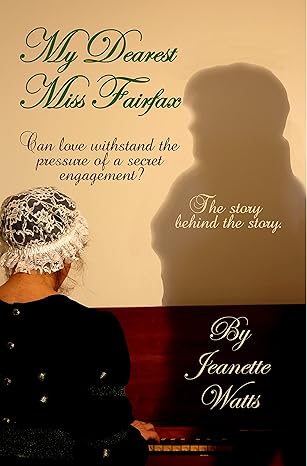
Immerse yourself in the captivating world of My Dearest Miss Fairfax, a novel that breathes new life into Jane Fairfax, a memorable character from Jane Austen’s Emma. In this inspired retelling, Jeanette Watts masterfully unfolds the hidden layers of Jane’s life, exploring her secret engagement with Mr. Frank Churchill. As Jane navigates the aftermath of her parents’ demise, she bravely faces a future as a governess, despite her refined upbringing. Her journey takes her from Weymouth alongside the newlywed Sophie Campbell to the quaint town of Highbury, the residence of her grandmother and Aunt Bates.
This novel is not just a story; it’s a vibrant tapestry woven with the intricate threads of character-driven narrative and eloquent dialogue. Readers are invited to delve deep into Jane’s inner world, experiencing her struggles and resilience amid a society obsessed with the lives of others. The blossoming, yet covert, romance between Jane and Frank is both touching and fraught with challenges, making their journey a heart-rending experience. While the climactic resolution of their love story and Jane’s final reckoning with the meddlesome townsfolk may leave one yearning for a more gratifying closure, the overall experience is a delightful foray into Austen’s world.
Watts’ narrative prowess shines through every page, seamlessly introducing a rich array of characters and their motivations. The story’s brisk pace and engaging dialogue bring each character to life, offering a fresh perspective on both beloved and lesser-known individuals from Emma. Whether you’re a devout Jane Austen fan or a newcomer to her works, My Dearest Miss Fairfax promises a journey filled with intrigue, romance, and a nuanced exploration of societal norms. Step into Jane’s shoes and embark on a journey that will leave you contemplating the intricate dynamics of love, society, and personal fortitude.
Pages: 322 | ASIN : B09TG5XMWX
I’ve Always Been Interested in Ancient History

Delicatus follows a young boy from ancient Rome who is enslaved by pirates and becomes a key player in Poppeae’s plot to become the Divine Empress. Where did the idea for this novel come from?
I first encountered Sporus at Eton, studying Alexander Pope with the remarkable teacher Michael Meredith, a guru to generations of literary and stage personalities. Pope’s satire on an 18th century local aristocrat notorious for sexual ambiguity led me to be fascinated by this figure, who was well known enough in 18th century England for a poet to allude to him in a satire, yet mostly just a footnote in history books about ancient Rome today if he appears at all. I would encounter this character from time to time (there’s an illusion, for instance, in the TV series “Succession”) but there are only scraps in the historical record. But what scraps they were! Not just the relatively well-known bit about Sporus getting castrated by the emperor Nero and made his wife … but what happened to Sporus in the year 69 AD when four different emperors held the throne and all had a different relationship with Sporus … from a second wedding to an order to execute him in the arena … and all before Sporus turned twenty. But it took me another fifty years before thinking of it as a novel.
What kind of research did you do for this novel to ensure you captured the essence of the story’s theme?
I’ve always been interested in ancient history and I’ve written both serious and satirical novels in that setting, so I have been doing research for decades. It’s a way of taking revenge on my bullying Latin teacher, as well. I’ve read most of the primary sources (some in the original) but more important, I spent a lot of time daydreaming about what that world, with its radically alien attitudes, was really like … because, despite its weirdness, it is a world populated by real people who speak to us today. One of the things that is hardest to wrap one’s mind around is that absolutely no one that there was anything wrong with slavery, and that because slaves could not be distinguished by race, there was a kind of continuum where you rise to a position of great power and still technically be a slave. Big things like that influence the world-view, but also little things, like human urine being collected to use in laundries. This is a very well studied period so there is a lot of consensus about what this world was like. But there are still gaps in the consensus and this is where imagination comes in.
What is one pivotal moment in the story that you think best defines Sporus?
When Sporus receives his freedom from Petronius, and realizes that in many ways nothing has changed. In a sense this is a central theme of the story. Even the Emperor, we’ll see in the second book, suffers from a kind of enslavement.
To be honest, I didn’t originally conceive of this as a trilogy but as a big fat book. But I’m getting on in years and I want to make sure the whole story comes out. In terms of the trilogy, the real pivotal moment probably happens in the middle of Book Two … I am writing that moment even as we speak.
Can you tell us what the second book will be about and when it will be available for fans to purchase?
The second book will be on sale Dec 1 and is already available for pre-order. The second book deals with Sporus actually becoming Empress and takes us to the humiliating end of his reign … and the third book deals with Sporus’s life in the Year of Four Emperors … perhaps the most eventful time of all.
If readers can’t wait, and have a U.S. Amazon account, they can find the Delicatus series posted in installments on the amazon vella platform, where we are almost half-way through the second book.
Author Links: GoodReads | Twitter | Facbook | Website
World Fantasy Award winner S.P. Somtow weaves a vivid adventure about one of the most colorful personalities in ancient Rome. Delicatus, the first volume in a trilogy, speaks of Sporus, from his enslavement by pirates in a remote corner of the Empire to his meeting with the great satirist Petronius and the woman to whom he bears a striking resemblance, the beautiful Poppaea with her manipulative plans to seduce the Emperor Nero and become Divine Empress.
Delicatus: From Slave to Empress in Imperial Rome
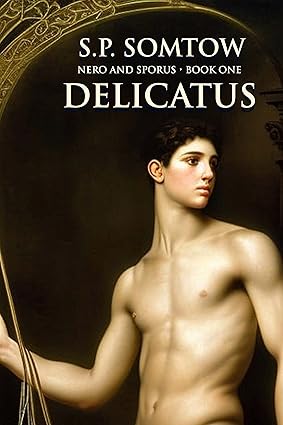
The Roman Empire stands as a repository of numerous invaluable treasures, ranging from priceless works of art to awe-inspiring feats of engineering and architecture. Rome, over the course of millennia, has indelibly carved its legacy. However, greatness is not achieved without a steep cost, and in the case of Rome, that cost was borne by the countless lives of enslaved individuals. Sporus, among the millions who enabled the grandeur of Rome, emerges as a protagonist whose narrative traces the trajectory of a young boy ensnared by slavery, transformed into a plaything for the affluent and influential. His tale epitomizes internal fortitude, adaptability, and an unwavering yearning for freedom in the face of seemingly insurmountable odds.
Within the pages of Delicatus by S.P. Somtow, readers are invited to embark on a deeply personal journey, experiencing the world through the eyes of a young child ensnared and subjugated by Romans. The narrative casts a revealing light upon the lives of the opulent and influential of Nero’s era, all observed from the unique vantage point of an enslaved child who was procured and conditioned to satiate the carnal desires of his masters. This unfiltered portrayal immerses us in the complexities arising from personal and cultural disparities, as sex, politics, and personal safety intertwine, weaving a tapestry that resounds with authenticity and relevance.
Delicatus is an exceptionally well-crafted work of fiction that seamlessly transports its readers into the unrefined facets of Roman life. The author deftly incorporates nuanced themes of gender identity and human sexuality, skillfully avoiding the imposition of modern values upon the subject matter. The prose emulates the style and language of contemporary writers of that era, effectively channeling the spirit of the time. While the narrative delves into graphic and mature content, the author’s discerning approach ensures that it is rendered with consummate taste. This book comes highly recommended for discerning and mature readers who seek to truly immerse themselves in the sights, sounds, and smells of authentic life within Nero’s Rome, all from the perspective of an unlikely protagonist.
Pages: 246 | ASIN : B0BR88V6VZ



 LITERARY TITAN