Blog Archives
My Personal Exploration of Meaning

Dominique’s Journey follows a man whose journey across Europe, the Ottoman world, Persia, and India becomes a transformative search for identity, faith, love, and the enduring connections between people. What was the inspiration for the setup of your story?
What inspired me? This trilogy is probably my personal exploration of meaning. As a recently retired person with a limited runway left, I’m exploring many of these questions myself.
This is one book in a trilogy. In it, I’m trying to examine some pretty existential questions about continuity, connection, love, spirituality, growth and sacrifice. I wanted to explore those things in the same universe, but seen from multiple perspectives, where each person perceives reality through their own lens.
Dominique’s Journey grows out of a plot line that was introduced in the first book, Prima Nocta, which is itself an exploration of personal growth. My own experiences with yoga (the spiritual practice, not the athletic practice) turned out to be great scaffolding on which to build Dominique’s story… taking him to an ashram in India might just be my dream.
I also love the historical perspective: trying to understand what it would really have been like for a person to do something as monumental as Dominique does in this book. It’s easy for us to say that someone traveled from France to India. It’s another thing to ask what a gritty experience that would be in 1533.
Dominique travels through the Holy Roman Empire, the Ottoman world, Persia, and India. How did you research these different cultures and historical periods?
That’s a phenomenal question, and one of the reasons it took so long to bring this novel to publication.
I hated history in school: “memorize these dates and the order in which these events occurred.” But as an adult I’ve come to love the stories and imagining what it was really like to be there? So, I brought a lot of reading to this writing already. But taking that to the level of detail I needed for this novel required a great deal of additional research — especially getting the spiritual practices and philosophies right. I wanted to treat them respectfully, honor the beauty of their insights, and understand how they could actually contribute to Dominique’s growth rather than just using them as exotic scenery.
So, a lot of reading, personal practice, and learning from practitioners.
But we’re also living in the modern age, and AI is a great research assistant. I don’t think AI should do the art, the communication or the content of human experience. But it is useful for finding the questions you need to ask and the facts you need to verify. And you definitely need to verify them! I learned pretty quickly to ask the same question five different ways, double-check with primary or reliable sources, and challenge answers that seemed too convenient. Some of the ‘hallucinations’ AI gave me during this research were either terrifying or hysterical. So I treated it as my research assistant… with a substance abuse problem.
One other thing struck me while I was researching all of these spiritual practices and paths. Fantasy readers routinely learn an entire pantheon for a book — its practices, rituals, gods, beliefs and rules. Then the book or series ends and, in a sense, all of that learning is wasted.
If a reader is willing to put that much effort into understanding an invented spiritual world, why not introduce them to traditions that actual people have spent centuries thinking about and are still practicing? Isn’t that more useful?
How did you balance the mystical elements of the story with its historical setting?
Honestly? I don’t think that was the challenge. Readers can make those differentiations pretty easily.
The events Dominique walks through are actual events of his time, and the places are real — with the exception, perhaps, of the ashram. Shambhala is an actual legend, but not one that’s ever been geographically confirmed.
The real balancing act was with the spiritual practices. There, I had to balance a character’s interpretation of his own or somebody else’s beliefs with what those traditions actually taught historically. Where there was a potentially misleading interpretation, I felt some responsibility to point it out. For example, Dominique parrots the common belief about the Catholic Church’s practice of indulgences, and there’s a footnote pointing out that he doesn’t have it exactly right. Dominique is allowed to be wrong. I just don’t want the reader to accept his interpretation at face value.
The same thing happens with the metaphysics. I’m writing fiction, so I’m perfectly willing to invent. But I tried not to make a real spiritual tradition claim something that I invented. The fictional metaphysics can extend beyond a teaching without contradicting the teaching itself.
And, for readers who really want to dig into this stuff, there’s an appendix that explicitly identifies which paths and practices are represented, including places where the legendary ashram’s teachings cherry-pick practices or use more-modern conventions ahead of its time.
The story’s epilogue changes the way readers understand earlier events. When did you decide to use that circular structure?
Personally? I love stories that do that — especially ones that reward the reader on a second read because events mean something different once you know the ending. Prima Nocta did that in a different way. It told the stories of six relationships from one perspective, then showed how those same relationships were perceived from the other side.
With Dominique’s Journey, the ending explains the beginning. But the architecture does something else too. Dominique spends the first half of the book learning experientially — he goes out into the world, encounters people, ideas, religions, love, loss and things he doesn’t understand. Then, in the second half, he essentially has to learn it all again, by integrating what he learned. The experiences haven’t changed. He has.
That’s one of the reasons I like endings that make you reconsider the beginning. That’s the way life works, right? Reality looks different depending on who’s looking at it — and sometimes depending on when they’re looking at it. T.S.Elliott wrote:
We shall not cease from exploration
And the end of all our exploring
Will be to arrive where we started
And know the place for the first time.
I think Dominique’s journey works something like that.
Author Links: GoodReads | Facebook | Website
In 1523, French scholar Dominique Guillaume is stripped of his life’s work and future for asking questions The Church considers blasphemous. Then Léonide, the mysterious woman who awakened his heart, dies while leaving him an impossible quest:
Go east. Go south. Learn the secret of the sutra.
For eleven years, Dominique crosses Europe, the Ottoman Empire, Persia and India. Love, loss, unfamiliar faiths and extraordinary women and men begin rebuilding the man who left France.
He thought knowledge created experience.
He learns that experience creates knowledge.
For another decade, the enigmatic mystic Yogini Trikala prepares him for a hidden ashram where knowledge must be lived.
There, Dominique is entrusted to Leela Devi, a blind Tantric priestess who cannot see light, yet sees the colors of human auras. Playful yet wise, she guides him through the Seven Veils: an initiation through meditation, ritual, desire, embodied experience and altered states of consciousness.
Through Tantric Yoga and the Divine Feminine, the physical journey turns inward. Dominique confronts love, attachment, identity and ultimately the boundaries of self.
He thought he needed to become somebody to find his purpose.
He learns he must become nobody to fulfill it.
Dominique’s Journey is a sensual, spiritually daring story of love, loss and becoming, blending sweeping historical adventure with a metaphysical exploration of consciousness, connection and what it means to become fully human.
For readers drawn to the spiritual self-discovery of Eat, Pray, Love, the transformative quest of Paulo Coelho’s The Alchemist, and the sensual, sacred history ofThe Red Tent.
Dominique’s Journey stands alone. No knowledge of Prima Nocta is required.
Mature content advisory: Contains adult themes and some on-page intimacy, sometimes personal, sometimes spiritual.
Dominique’s Journey / A Mystical Quest Through Love, Loss and Becoming / Per Asperum in Lucem


Dominique’s Journey, by D. J. Pratt, is an ambitious historical and spiritual adventure built around one man’s search for meaning, love, and a truth he can sense long before he can fully understand it. Beginning in 16th-century Europe, Dominique Guillaume follows a path set in motion by Léonide, the mysterious woman whose brief presence changes the direction of his entire life. His travels carry him through the Holy Roman Empire, the Ottoman world, Persia, and eventually India, and Pratt gives each stage a purpose beyond changing the scenery. Dominique is constantly being reshaped by the people he meets, including lovers, friends, teachers, soldiers, mystics, and family. What starts as a physical journey gradually becomes an examination of identity, faith, connection, and the possibility that some relationships reach farther than a single lifetime.
One of the book’s most interesting choices is the amount of time it gives Dominique to change. His transformation doesn’t happen through one revelation. He learns through friendship, desire, danger, grief, religion, language, discipline, and years of occasionally frustrating spiritual practice. That gives the novel an unusually patient rhythm. The later sections at Shambhala become especially immersive as Dominique works through the Purple Lotus and its chakra-based veils under the guidance of Leela Devi. There’s a lot of Hindu, yogic, Buddhist, Sufi, and mystical terminology here, but those ideas are woven directly into Dominique’s experiences. Leela’s journal entries are also a smart addition because they let us watch Dominique’s transformation from outside his own head. More importantly, they turn what could have been a solitary enlightenment story into something more emotionally complicated as teacher and student become increasingly bound to each other.
Readers of Paulo Coelho’s The Alchemist will recognize some familiar territory. Both novels follow a traveler who leaves the life he knows because something deeper seems to be calling him, and both treat chance meetings, intuition, love, and apparent coincidence as parts of a larger spiritual pattern. Dominique’s Journey, though, takes that basic idea into a much larger and denser world. Pratt spends considerable time on history, competing religious traditions, sexuality, philosophy, reincarnation, and the mechanics of spiritual awakening. Dominique’s repeated idea that he’s becoming an event within the universe captures the book particularly well. The journey isn’t simply about arriving at Shambhala. It’s about watching an identity slowly become porous enough to connect with other people, other traditions, and ultimately the larger fabric of existence.
I liked the way the novel links love to transformation. Léonide motivates Dominique’s journey, Avice and others teach him different forms of intimacy and connection, and Leela eventually becomes inseparable from the spiritual culmination of his quest. By the time Dominique reaches the final veil, the book has spent decades of his life preparing for a choice between release and return, so his decision carries real thematic weight. The epilogue then reaches backward and forward through time to reshape what we thought we understood about Léonide, Dominique, and the mysterious bond connecting them. It gives the story a circular quality that suits its recurring images of threads, waterwheels, rebirth, and lives crossing across time. Dominique’s Journey is the kind of historical fantasy that wants adventure, romance, philosophy, and mysticism occupying the same space, and its strongest moments come when all four finally converge. For readers who enjoy philosophical historical fiction, the novel’s depth and layered exploration of spirituality, history, and identity will be part of its appeal.
Pages: 456 | ASIN : B0HFM6ZMT7

Recipient of the Literary Titan Book Award

Prima Nocta: A Mystical Quest for Love
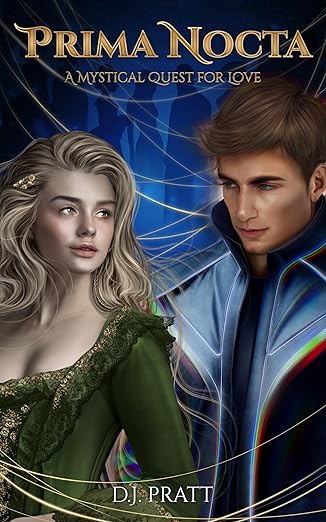
Prima Nocta is a sprawling, intimate, and deeply passionate novel that moves through time and culture to explore the idea of soul connections, those rare and fated relationships that transcend logic, distance, and even death. Through a series of interconnected vignettes told from different perspectives and historical settings, the book traces recurring meetings between soulmates over centuries. It begins with a hunted philosopher in 16th-century France and moves to a grieving daimyō in Edo-period Japan, a nobleman in Renaissance England, and onward into modern and future lives. Each tale crescendos in a moment of intense emotional and erotic connection, all part of a larger narrative arc about love, memory, and the spiritual bonds that tether us across time.
From the very first page, I was struck by the raw emotion Pratt brings to the prose. It doesn’t hide behind elaborate metaphors or highbrow literary tricks. Instead, it opens its heart right to you. The writing is so personal. There’s a genuine ache that lives in every chapter. I felt it most in the quiet moments, those simple exchanges of glances, the gentle touches, the characters’ longing to be seen and understood. The dialogue doesn’t try to be clever. It tries to be true. And it is. That’s what makes it hit so hard. It’s not clean or tidy. It’s messy and complicated and bursting with yearning. The characters aren’t perfect, and neither are their lives, but the connections they form are electric. You believe in them. You want them to win. Even when they can’t.
There’s something haunting about the way Pratt weaves the spiritual and the physical. These aren’t just love stories. They’re meditations on fate, identity, time, and what it means to truly know someone. The way the book blends sensuality with existential questions is bold and surprisingly tender. It’s not erotica for the sake of titillation. It’s about finding divinity in the act of connection. The erotic scenes feel earned, not gratuitous. They’re emotional revelations just as much as physical ones. And that’s where the book shines most. It dares to suggest that sex, love, and meaning are all wrapped up in the same tangle, and I completely bought into that.
The pace is slow in places. It lingers, it wanders, it reflects. But if you’re someone who likes your stories soaked in feeling and not afraid to be a little weird or mystical, you’ll find something special here. I’d recommend Prima Nocta to readers who crave emotional intensity, who love deeply romantic fiction with spiritual undertones, and who are open to a narrative that feels more like a journey than a destination. This book isn’t afraid to look you in the eye and ask big questions.
Pages: 333 | ASIN : B0F1YTBGR1


