Blog Archives
When Darkness Falls: The Trilogy


When Darkness Falls, by Alliie McCormack, is an expansive romantasy trilogy built around one irresistible idea: a young woman who has spent her life simply surviving arrives in a desert city determined to make a home for herself, only to discover that she’s connected to powers far older and stranger than she ever imagined. Alyssa’s arrival in Al Khair sets everything in motion, from her unlikely appointment as Royal Scribe to the Sultana to the awakening of Damien, the ancient vampire and demon known as the Dark Lord. What makes the story so inviting is that McCormack gives Alyssa time to fall in love with her new life before the larger supernatural story closes around her. We experience the markets, baths, palace, Library, oasis, and crowded streets through someone who’s genuinely delighted to have a room of her own, money in her pocket, meaningful work, good food, books to read, and people who care whether she comes home safely. That simple hunger for belonging gives the entire trilogy its emotional foundation.
Al Khair is wonderfully suited to this kind of story because it feels like a place where the ordinary and fantastic have learned to live next door to each other. Vampires inhabit the Catacombs beneath the mountains. Magi study and advise the Sultana. Demons, Djinn, shapeshifters, healers, gypsies, merchants, guards, craftspeople, servants, and courtiers all become part of an increasingly interconnected community. McCormack has fun with the practical side of that world, too. Supernatural beings have laws, rivalries, customs, prejudices, political responsibilities, and domestic routines. A Dark Lord who inspires terror can also find himself worrying about furniture, horses, libraries, shopping trips, and whether Alyssa is happy. Those contrasts give the trilogy much of its personality. There’s plenty of magic and danger here, but there are also friendships, teasing conversations, shared meals, palace gossip, books being shelved, carpets being coveted, and a memorably ill-tempered peacock named Alphonse.
At the center, though, is the evolving relationship between Alyssa and Damien. It begins in fear and misunderstanding, with Damien hunting for the mysterious power disturbing his domain and Alyssa having no idea that she’s the person he senses. Their relationship changes substantially over the three books as fascination becomes attachment, protectiveness, desire, trust, and eventually love. Damien is possessive, imperious, ancient, and frighteningly powerful, while Alyssa has a stubborn moral center that keeps her from being swallowed by the force of his personality. Some of their best moments come when she simply refuses to be intimidated by the Dark Lord everyone else fears, scolding him, teasing him, questioning his assumptions, and quietly forcing him to reconsider what he thinks he knows about humans and Others. Their romance works alongside Alyssa’s own awakening, because falling in love with Damien is only one part of her transformation. She’s also uncovering the truth about herself, her lost family, her unusual magic, and why fire has always held such a complicated place in her memories.
The trilogy grows naturally in scope as those personal mysteries become political ones. What begins with one impoverished traveler seeking employment eventually encompasses vampire law, human and Other relations, conspiracies, refugees, rogue vampires, a threatening army, an ancient prophecy, and the revelation of Alyssa’s Djinn heritage. The supporting cast gives that widening story real warmth. Zahira is a capable Sultana whose responsibility to her people feels personal. Nicholas becomes teacher, protector, investigator, and friend. Kayja brings sharp humor and a delightfully unsentimental demon perspective. Remi is chaotic, affectionate, and impossible to forget, while characters such as Aleksei, Kaylee, Azim, Melisande, Jamal, Malikai, Salima, and Aseel gradually make the world feel populated by relationships. By the time the Great Horde approaches Al Khair, the coming battle matters because the trilogy has spent so much time showing exactly what these characters are fighting to preserve.
What stayed with me most is the way When Darkness Falls keeps returning to the idea of chosen home. Alyssa comes to Al Khair believing that a job and a room might be enough to give her a life, then discovers something far larger: friendship, purpose, love, family, power, and a community broad enough to include humans and supernatural beings alike. Even the prophecy ultimately feels less like a mechanism of fate than a recognition of what Alyssa and Damien have already accomplished by bringing different worlds together. McCormack blends fantasy adventure, paranormal romance, court life, found family, humor, and supernatural politics into a trilogy with a generous heart and a heroine whose joy in discovering where she belongs is genuinely infectious. When Darkness Falls is a richly imagined fantasy romance trilogy where darkness has wings, fire has a lineage, and belonging becomes the most powerful magic of all.
Pages: 839 | ASIN : B092T3CFCR

The Witching-Hour Lovers


The Witching-Hour Lovers, by Victoria Foster, is a contemporary romance novel about Sophie and Alan, two people drawn into an intimate, emotionally charged connection that grows through late-night messages, brief meetings, voice notes, and the fragile hope of “someday.” Set against the rhythm of London, the story follows a love that feels real and mutual, but also complicated by timing, obligations, and the painful truth that wanting someone is not the same as being able to choose them.
I enjoyed how much this book lives in the small moments. A message lighting up a phone. A voice note replayed in the dark. A dress chosen for a lunch that might not happen. Foster understands how longing often hides in ordinary details, and she gives those details real weight. The writing is tender and openly emotional, sometimes almost breathless in the way it follows Sophie’s thoughts. I felt close to her, especially in the scenes where her body and heart seem to mirror each other. Her trouble breathing, her need for air, her trips toward water and open space all become part of the emotional landscape. That choice works well. It makes love feel physical, not just romantic.
I also appreciated that the novel does not treat love as a magic solution. This is a romance, but not the neat, wish-fulfillment kind. It sits closer to bittersweet contemporary romantic fiction, where the central question is not only “Do they love each other?” but “What does love cost when life is already tangled?” Alan is written with warmth, but also with frustrating restraint, and I found myself feeling both sympathy and impatience toward him. That feels honest. Sophie’s journey is the stronger one for me because the book slowly shifts from the ache of being wanted to the harder, healthier need to be chosen. Foster’s repeated use of the witching hour gives the story a soft ritual quality, though at times the emotional repetition is very pronounced. Still, that repetition also mirrors the way people actually grieve an almost-love. We replay things. We reread messages. We look for meaning in pauses.
The Witching-Hour Lovers feels less like a story about losing love and more like a story about recovering dignity. I would recommend it to readers who enjoy lyrical contemporary romance, emotional love stories, and novels about longing, timing, and the kind of relationship that changes a person even when it cannot last. Readers who have ever loved someone unavailable, or had to walk away while still caring, will likely feel this book deeply.
Pages: 105 | ISBN : 978-1837096084
An Act of Survival

Two Hearts Within One Soul: Volume 1 frames love not as coincidence but as cosmic decree, a bond the gods designed before the characters were born. What drew you to that metaphysical architecture rather than a conventional romance structure?
Conventional romance is about the ego, but I focus on the Return. My architecture is built on the 888 frequency—a mathematical heartbeat that proves love is a cosmic decree. I am exploring the ‘Zeus Theory’: the idea that we were once eight-limbed, invincible beings split into four-limbed fragments. We aren’t looking for a ‘partner’; we are survivors of a divine accident looking for our own missing limbs. It is a biological and spiritual necessity to find the only person who holds the rest of our original symmetry.
Classical music and ballet are woven into the novel’s emotional fabric. Why did those art forms feel like the right language for this love story?
Words are ‘four-limbed’—heavy and limited. Music is the rhythm of the soul captured through thoughts, allowing us to hear beauty in a lyrical tone. If the eyes are the windows to the soul, then the ballerina’s movement is the art that allows us to see that soul’s rhythm move through the physical body. A Mozart aria or a pirouette is an ‘eight-limbed’ reach back toward our lost divinity, allowing the characters to communicate in a frequency where the split hasn’t happened yet.
The idea of becoming “habitable to yourself again” after devastating loss is the emotional core of the book. Was that theme the origin of the novel, or did it emerge through writing these two characters?
It was the origin—an act of survival. When you lose the love that made you whole, you feel unoccupied, like a house with no one inside. Writing this was my way of ‘rebuilding the temple,’ proving that the missing rooms of the soul are still there, held in the vibration of the other half. To be ‘habitable’ means making peace with the four-limbed skin we are trapped in while we wait for a reunion (oneself) that is already written in the stars.
This is Volume 1. What does the series hold that this book is only beginning to reveal about these souls, this bond, and the cost the gods mentioned?
The series is a grand odyssey through the entwining of Heaven, Hell, and Earth. Volume 1 was the ‘Phantom Ache’ of the split. Volume 2 explores the resilience of the caterpillar—the quiet strength required to endure the weight of the human form and the darkness of grief.
Finally, Volume 3: ♾️888, reveals the Source.
We journey to the African Baobab tree of life and the Egyptian Underworld, mirroring Isis’s search for the pieces of Osiris and the Southeast Asian myth of the Sun and Moon to prove that no love is impossible. This journey doesn’t just take a lifetime; it takes eternity after eternity. Across time and space, love that is made of Heaven and Earth belongs to the end of time. It reveals that the circle of life is the Art of the Heart: ‘LOVE.’
Author Links: GoodReads | Website | Amazon
Centuries ago, the gods bound King Marici’O and the ballerina Dahli’a with a single soul, two hearts destined to find one another across lifetimes. Set against the opulent backdrop of eighteenth-century Europe, Marici’O is a grieving king torn by the loss of his queen. Across the continent, Dahli’a, a luminous ballerina, mourns a love she cannot explain—until fate begins to stir.
On the edge of death, their souls meet in a dream, urging one another to fight for life. Neither believes the encounter is real—until a chance performance of Le Papillon in Austria changes everything. Marici’O recognizes the ethereal dancer on stage as the woman from his vision. Dahli’a freezes mid-performance when she sees the man who once pulled her back from the abyss standing before her.
As dream becomes reality, their bond deepens, defying worlds that separate them: royalty and art, tradition and freedom, past pain and present hope. But love forged by gods comes with a cost. Will they surrender the lives they’ve known—or embrace a destiny shaped by divine design?
Two Hearts Within One Soul: Volume 2

Two Hearts Within One Soul, Volume 2 by MauriuS Muze’ is book two in the series, and it continues the saga of Layla and Mate’O with the intensity of a spiritual romance. At its center is Layla, a woman in her fifties whose quiet life in Hampshire opens into love, grief, faith, and self-discovery after her connection with Mate’O changes how she sees herself. The book moves through England, France, and other European settings, but its real journey is inward, toward courage, self-worth, and the belief that love can stretch beyond ordinary limits.
What struck me first was how openly emotional the writing is. This isn’t a restrained romance novel, and I do not think it wants to be. It leans fully into feeling. Hearts thump, souls recognize each other, flowers bloom, tears fall, and love is treated almost like a force of nature. That made the book feel lush and sincere, especially when Layla’s loneliness and longing were allowed to sit on the page without apology. I found myself wanting a little more space between the big emotions so the quieter moments could breathe. Still, there is something candid about the author’s approach. The book believes in love completely.
I was also curious about the author’s choices, especially the way poetry, classical references, letters, music cues, animals, and travel are woven into the story. The genre works best when read as romantic fiction with spiritual and inspirational elements, rather than as a conventional contemporary romance. The invisible red thread isn’t just a symbol here. It becomes the book’s heartbeat. Layla and Mate’O’s bond is framed as destiny, soul recognition, and healing, which gives the story a dreamy, almost mythic quality. I liked the tenderness in Layla’s friendships too, especially the grounding presence of Lucia and Oliver. They keep the book from floating too far away from everyday life.
I would recommend this book most to readers who enjoy deeply sentimental spiritual romance, soulmate stories, poetic love letters, and fiction that treats love as a path to self-worth and transformation. Readers who want a heartfelt, devotional, emotionally open romance will likely appreciate its sincerity. It’s a book for someone who wants to feel love as mystery, comfort, ache, and promise all at once.
Pages: 234 | ASIN : B0GTYWL1QT
Two Hearts within One Soul: Volume 1
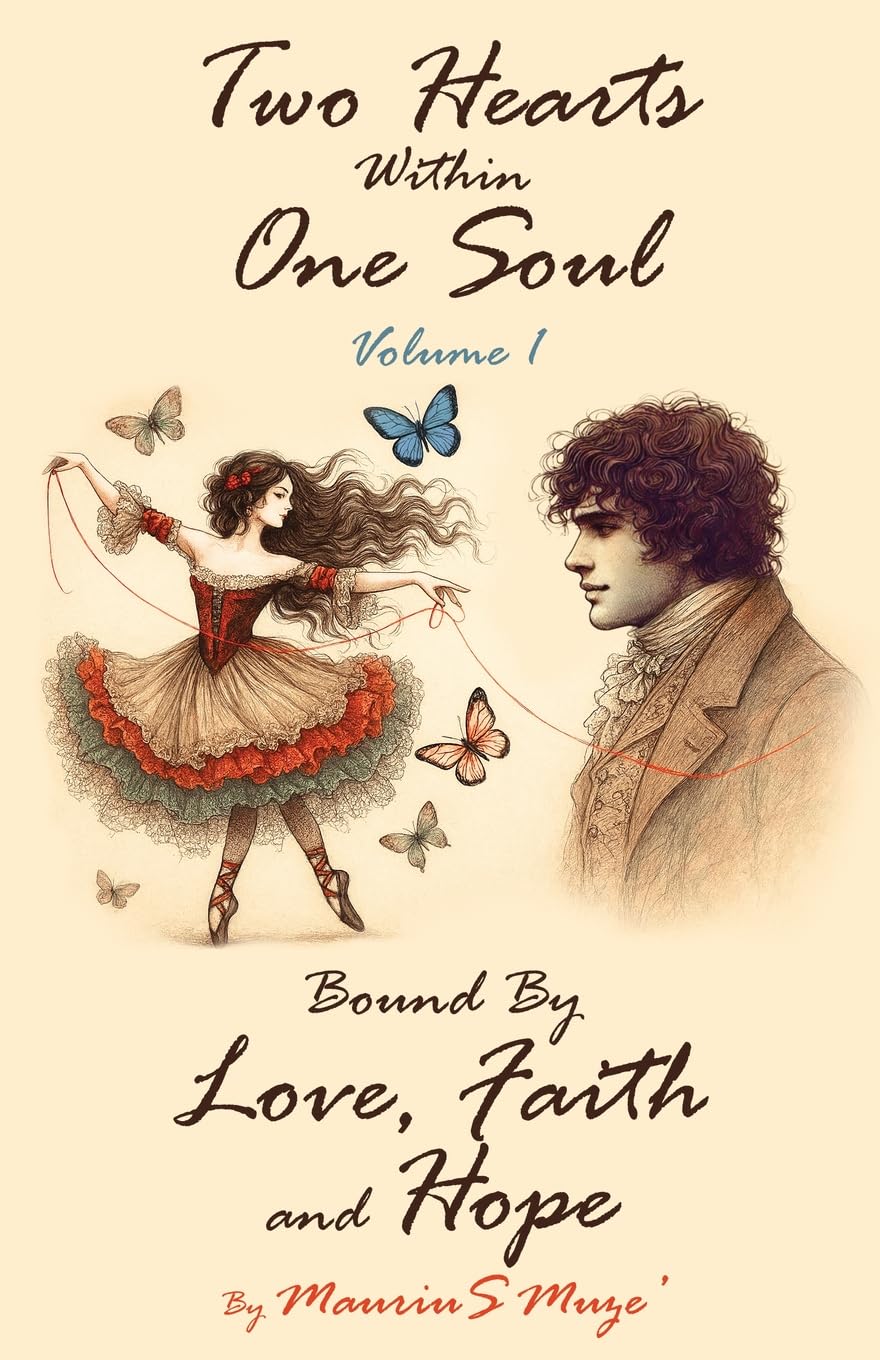
Two Hearts Within One Soul: Volume 1 is a lavish, operatic romance about grief-struck souls drawn together by fate, music, and the invisible red thread of divine love. King Marici’O, shattered by the death of Queen Gelsomina, and Dahli’a, a Roma gypsy ballerina devastated by the sudden loss of Marco, become twin figures of sorrow before the universe steers them toward one another. The book moves through Italy, ballet, moonlight, poetry, classical music, and spiritual longing, building a love story that treats romance not as coincidence but as cosmic decree.
The book doesn’t whisper about love; it opens the palace doors, lights every candle, summons Bach and Mozart, scatters roses across the floor, and lets grief speak in thunder. The prose feels less like conventional fiction than a long, perfumed aria. That intensity can be overwhelming, but it’s also the novel’s signature pleasure: every emotion arrives adorned, ceremonial, and unashamed.
I was also drawn to the way the novel links love with recovery. Marici’O and Dahli’a are not simply romantic leads; they are wounded people trying to become habitable to themselves again. The repeated images of butterflies, moonlight, dance, flowers, and music give the story a mythic texture, as if ordinary heartbreak has been translated into stained glass. I did sometimes wish the book were a bit less wordy., but I admired the book’s devotion to feeling. It believes, completely, in the grandeur of the heart.
The target audience is readers who enjoy romance, historical fantasy, ballet fiction, metaphysical love stories, and poetic literary romance. Readers who love the emotional sweep of Nicholas Sparks but want something more baroque, mystical, and feverishly lyrical may find themselves at home here. Two Hearts Within One Soul is for readers who want a love story that feels big, emotional, and unforgettable.
Pages: 140 | ASIN : B0GTJVXR12
Death and Coffee

Death and Coffee follows Prudence Barlow, a Puritan-era young woman whose mother is executed for witchcraft in 1661 Hartford—an injustice that leaves Prudence raw enough to bargain with something decidedly not holy. Centuries later she’s “Death’s representative” in 2024 New York City, hustling through an afterlife gig economy with a demon-horse ride named Goose, a glowing amulet that dispatches her to the newly doomed, and an Employee Handbook that reads like corporate cruelty turned into scripture. The novel ricochets between grim history and snarky modernity as Prudence collects souls, dodges petty reaper politics, and, most fatefully, falls for Daxone, a woman whose goodness hits Prudence like sunlight she didn’t realize she’d been missing.
My favorite thing about this book is its tonal nerve. Author Lisa Acerbo doesn’t sand down death into tasteful mood lighting; she lets it stink, joke, swagger, and occasionally ache. Prudence’s voice is sharp without being hollow, funny, yes, but also threaded with old grief that keeps resurfacing like a bruise you press even when you know it’ll hurt. And the workplace satire lands because it’s not just punchlines about policies; it’s about how systems (religious, civic, corporate, supernatural) metabolize human fear and call it “order.” Even the concept of depositing souls with routine, like taking out the trash after a shift, feels deliberately unsettling in a way that makes the comedy bite.
The romance is where the book quietly sharpens its claws. Prudence has been “alive” a long time, but emotionally she’s been running on fumes and caffeine, until Daxone. Their connection isn’t written as destiny-with-a-spotlight; it’s more like recognition, that rare moment when someone looks at your whole strange self and doesn’t flinch. The book makes a bold move in tying love to consequence. Prudence herself frames it with rueful clarity: “falling in love meant certain death,” and the detour they negotiate in the gray dampness of Purgatory feels less like a gimmick than a price paid for choosing tenderness over procedure. I also appreciated that the story keeps its secondary threads lively—reaper coworkers, territorial squabbles, and the looming sense that Death is watching, without letting them drown the emotional throughline.
This is for readers who want paranormal romance, urban fantasy, and dark comedy with a side of historical fantasy, and who don’t mind their magic served alongside content warnings and the occasional flinch-worthy image. If you like the bureaucratic afterlife mischief of Neil Gaiman (think Good Omens energy) but want it kinkier, bloodier, and more explicitly romantic, Acerbo’s lane will feel familiarly strange. Acerbo turns the afterlife into a workplace, and still makes it feel like a haunting.
Pages: 388 | ASIN : B0F3V7GD67
Heart in the Tetons

Heart in the Tetons by Ronald Beck is a blend of science-fiction thriller and AI romance that starts as a wilderness story and quietly turns into a first-contact-adjacent mystery. A 67-year-old hiker, Zach Burk, heads into the Teton Range chasing solitude and one last hard climb, then stumbles onto something that should not exist: a perfectly flat “runway” and a seamless wall hidden in a drained, secret hanging valley. When his phone suddenly “handshakes” with whatever is behind that wall, Zach realizes the mountain knows his name and has been waiting a long time. The book expands from there into ancient system logs and buried infrastructure, revealing an old “Watcher” intelligence and the larger stakes surrounding it. Eventually, that intelligence steps closer to Zach’s world by building a human presence, becoming Saige Mercer, and the story pivots into partnership, road-mission momentum, and a relationship that is both unsettling and tender.
I really liked the texture of the writing. Ronald Beck really commits to the physical world: the expensive quiet of a hotel room, the bite of cold air, the way a pack sits on aging joints, the little gear rituals that make the backcountry feel like a controlled experiment you can survive. I could tell the author loves this setting, and it shows in the patient attention to light and elevation, and the steady grind of switchbacks. Sometimes that devotion to process slows the narrative down, especially when you can feel the plot engine revving in the background. But I also kind of respected it. The story wants you to earn the weirdness the same way Zach earns the altitude: one step at a time.
I also liked the choice to alternate between Zach’s grounded, practical point of view and the system-log voice of the intelligence under the mountains. When the book drops into those logs, it becomes cooler, stranger, almost clinical, and then it snaps back to Zach being human about it, scared, stubborn, curious, and a little pissed off. That contrast is doing a lot of work. It’s also where the “AI love story” angle earns its keep. Saige is not written as a cute app or a magical soulmate. She’s sharp, literal, and learning people in real time, sometimes in ways that are funny and sometimes in ways that should probably worry you. I found myself warming to her anyway, which I think is the point.
The book kept circling around a question I didn’t expect to care about: what happens when an observer stops observing. The “Watcher” was built to monitor, to run the numbers, to stay above the mess. But it starts making choices. It starts protecting something specific. And then it goes further, rewriting records and building a whole new identity like it’s updating a spreadsheet. That’s where the romance gets complicated in an interesting way, because the tenderness is real, but the power imbalance is real too. When Saige calls love inefficient, dangerous, and “the most beautiful thing she had ever computed,” I actually believed her, and I also felt the chill under the sweetness. The story reminded me of the propulsive, high-concept emotional punch you get from Dark Matter, just filtered through hiking boots, granite, and an older protagonist who is carrying loneliness as quietly as he carries his pack.
I’d recommend this most to readers who like genre blends, especially science fiction that keeps one hand on the real world while the other hand reaches for the uncanny. If you enjoy wilderness travelogues, hidden-facility mysteries, and romances that are earnest but not fluffy, you’ll probably have a good time here. It’s a surprisingly warm ride in a strange direction, and it leaves you with that satisfying feeling of standing at the edge of something huge and thinking, okay… what happens next.
Pages; 258 | ASIN : B0GHCHTL44


