Blog Archives
Blending Adventure With Science

Galileo’s Points of Light in the Night Sky follows a pair of curious siblings and Dr. K and her magical time portal, who travel back to Renaissance Italy to meet Galileo and experience firsthand the wonder of his telescope and discoveries. What was the inspiration for the setup of your story?
The inspiration came from my desire to make science and history feel alive for children. Galileo’s discoveries changed how we understand the universe, yet for many young readers, history can feel distant or abstract. By introducing a magical time portal and pairing the story with two inquisitive siblings, I wanted to create a bridge between today’s readers and the past. The setup allows children to see history not as dusty facts in a textbook but as living experiences full of curiosity, wonder, and adventure.
I enjoyed your characters, especially Dr. K. What was your favorite character to write for and why?
Dr. K was certainly the most rewarding character to write. She is both a guide and a fellow traveler, modeling how to ask questions, nurture curiosity, and balance seriousness with a sense of wonder.
Through her, I was able to weave together elements of science, history, and imagination.
She is not only a mentor to the children in the story but also a representation of my own lifelong passion for encouraging young minds to explore the world around them.
What were some educational aspects that were important for you to include in this children’s book?
I wanted to emphasize both Galileo’s scientific process and the cultural context of his discoveries.
Children learn not only that Galileo built a telescope and observed the moons of Jupiter, but also that these observations challenged established beliefs of the time.
The book highlights critical thinking, perseverance, and the courage to question accepted truths.
I also included a “Science Primer” at the back of the book to give readers and educators additional resources, ensuring that the story supports learning in both classrooms and homes.
Can you tell us more about what’s in store for Dr. K and the direction of the second book?
The second book, Marie Curie’s Radiant Quest, transports readers to Paris at the turn of the 20th century.
In this story, Dr. K and the siblings meet Marie Curie and learn about her groundbreaking work with radioactivity.
The narrative continues to blend adventure with science, showing not only Curie’s discoveries but also her perseverance in the face of challenges as a woman in science.
The series as a whole will continue to introduce children to great scientists across time, always with an emphasis on curiosity, resilience, and the wonder of discovery.
Author Links: GoodReads | X | Facebook | Website Books | Website Authors
In the awarding-winning Galileo’s Points of Light in the Night Sky, the first book of the captivating Dr. K’s Portal Through Time series, Jennifer, a vivacious 10-year-old, and her intellectually curious 8-year-old brother, Daniel, embark on an exceptional voyage through the annals of time. Guided by the enigmatic and brilliant scientist, Dr. K, they are transported to the heyday of Renaissance Italy, straight into the workshop of the iconic astronomer, Galileo Galilei.
As they traverse the time portal, Jennifer and Daniel experience firsthand Galileo’s groundbreaking observations of the celestial expanse through his innovative telescope. They are enlightened about the significance of questioning established norms and the audacity needed to defy the status quo. The siblings witness Galileo’s unveiling of the cosmos’s wonders and his revolutionary proposition that our Earth is not the center of the universe.
Throughout their journey, Jennifer and Daniel support Galileo in chronicling his pioneering discoveries. They confront challenges that enhance their problem-solving abilities and deepen their grasp of the scientific method. Their adventure cultivates an appreciation for the quest for knowledge and the potency of curiosity.
This enthralling tale seamlessly blends history, science, and adventure. It offers young readers a captivating, educational narrative, introducing them to the mesmerizing world of astronomy and the enduring contributions of one of history’s most illustrious scientists. The story of Jennifer and Daniel will inspire the readers to question, explore, and cherish the pursuit of knowledge, just like Galileo did. The book, while being a thrilling read, also helps foster a love for STEM disciplines in young, inquisitive minds, making it a perfect addition to any child’s reading list.
At the end of Book 1 is a QR code for the Science Primer, a comprehensive, free downloadable guide over 100 pages long, written specifically for parents and teachers. It also includes a complete Teacher’s Guide with detailed lesson plans, a glossary of terms, and an extensive list of resources such as books, videos, websites, and other online Resources for teaching about Galileo and his discoveries. The primer is designed to make science education engaging and accessible. Each of the books written for the series will feature its own tailored Science Primer. Book 1 itself also includes a glossary of terms and resources designed specifically for children ages 8-12, complementing the exciting adventures of Jennifer and Daniel.
Book 1 – Galileo’s Points of Light in the Night Sky (Dr. K’s Portal Through Time)


Galileo’s Points of Light in the Night Sky tells the story of two siblings, Jennifer and Daniel, who, with the help of the mysterious Dr. K, travel back in time to meet Galileo Galilei. Through their journey, they witness Galileo’s discoveries firsthand, from the moons of Jupiter to the phases of Venus. They even help him build a telescope. Along the way, the children learn not just about the science of the universe but also about curiosity, resilience, and the courage it takes to question the world around you. It is part history, part science, and part adventure, written with young readers in mind, and it manages to make centuries-old discoveries feel fresh and exciting.
I found myself charmed by the storytelling in this children’s book. The voice is warm and approachable, and the author makes sure the science never feels heavy. Instead, it comes alive through dialogue and adventure. The way the kids interact with Galileo is delightful, and their wonder mirrors what I imagine any curious child would feel meeting a great mind of the past. I also liked how the book wove in real facts without turning it into a dry lesson.
There were moments where the writing leaned into explanation, and I felt the momentum slow. Still, those small bumps didn’t take away from the bigger experience. The heart of the book is curiosity, and that comes through loud and clear. I also appreciated how the narrative balanced Jennifer’s voice with Daniel’s. It gave the story a sense of shared discovery, which felt true to childhood adventures.
I’d recommend this chapter book to kids who are fascinated by space, science, or history, and also to parents or teachers looking for an engaging way to spark that interest. It’s perfect for middle-grade readers who enjoy a mix of imagination and learning. The story encourages children to ask questions and to see science as an adventure. For me, that’s its greatest success.
Pages: 104 | ASIN : B0F4NQTCNP

Book 1 – Galileo’s Points of Light in the Night Sky (Dr. K’s Portal Through Time)
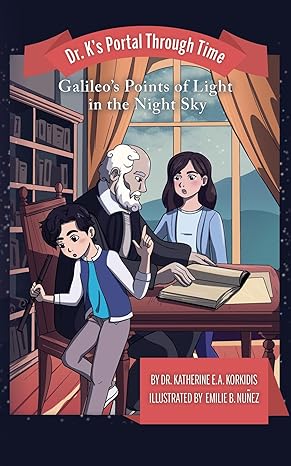
Dr. Katherine E.A. Korkidis’s Galileo’s Points of Light in the Night Sky is the first book in her Dr. K’s Portal Through Time series, and it’s part history lesson, part science primer, and part adventure story. It follows Jennifer and Daniel, a pair of curious siblings, who stumble upon Dr. K and her magical time portal. Together, they travel back to Renaissance Italy, step into Galileo Galilei’s workshop, and experience firsthand the wonder of his telescope and the audacity of his discoveries. Along the way, the kids not only learn about Jupiter’s moons, the phases of Venus, and the birth of modern astronomy, but they also discover the importance of curiosity, observation, and persistence.
The first thing that caught my attention about this book was how effortlessly it weaves fact with fiction. For instance, the scene where Jennifer helps Galileo build his telescope is not just a charming piece of dialogue; it’s a clever way to introduce kids to optics and focal lengths without feeling like a lecture. I found myself smiling at Jennifer’s excitement when the blurry image sharpened into Jupiter and its moons. That moment carried the same sense of awe I remember from my own first look through a telescope. The science was accurate but approachable, and that balance is hard to pull off in a children’s story.
I also appreciated how personal the narrative felt at times. Jennifer’s relationship with her grandfather in the opening chapter set the tone beautifully. Their bond over stargazing gave the adventure real heart. Later, when Jennifer and Daniel stood side by side at the end, promising to always explore the stars together, it felt earned. The book wasn’t just about Galileo’s discoveries; it was about how science can be shared, passed down, and made meaningful within families. That emotional thread made the whole story more engaging.
Another highlight was the way Dr. Korkidis portrayed Galileo himself. She didn’t make him an intimidating genius, but rather a patient teacher who invited the kids into his world. His explanation of the moons of Jupiter and how he realized they orbited the planet was fascinating, and his gentle encouragement to keep asking questions stuck with me. The inclusion of real historical details, like the Medicean stars and Galileo’s struggles with skepticism, grounded the story while still keeping it light enough for younger readers.
This book left me feeling inspired and a little nostalgic. It reminded me of the first time I realized science could be an adventure. I’d recommend Galileo’s Points of Light in the Night Sky to curious kids around 7–12, but also to parents, grandparents, and teachers who want to spark a love of STEM in children. It’s not just a story about Galileo, it’s a story about why wonder matters, why questions matter, and why we should never stop looking up.
Pages: 104 | ASIN : B0F4NQTCNP

Marie Curie’s Radiant Quest: Dr. K’s Portal Through Time

Marie Curie’s Radiant Quest is a creative blend of historical biography, time-travel adventure, and science primer for curious young readers. Through the eyes of siblings Jennifer and Daniel, who travel with Dr. K through her magical portal, we get to witness the life, struggles, and triumphs of Marie Curie. From her early days in Paris to the discovery of radium and polonium, her groundbreaking Nobel Prizes, and her wartime work with mobile X-ray units, the book manages to cover both the sweep of her achievements and the personal grit behind them.
What I enjoyed most was how the story balanced real history with an almost playful sense of wonder. Curie describes the grueling, years-long process of isolating radium from pitchblende. The children’s questions bring an immediacy to the narrative, transforming what might otherwise seem like abstract science into a vivid account of perseverance and conviction. When Curie explains that discovery is rarely linear but instead filled with challenges and unexpected turns, the insight resonates deeply. It is a lesson that holds equal weight for adults as it does for younger readers.
I also liked how the book made science approachable without dumbing it down. In Chapter One, when Dr. K explains radioactivity, she compares unstable atoms to restless kids who can’t sit still and then to bubbles that “pop” to release energy. I was struck by the moment when Daniel exclaimed, “Pop? Like popcorn?” The lighthearted exchange underscores how effectively the book employs humor to make complex scientific concepts more accessible. It’s clever, and it makes concepts that would usually be intimidating feel relatable. The writing is clear, warm, and often funny; it kept me turning the pages even in parts I already knew from history.
Another standout for me was the way the book handled Marie Curie’s resilience as a woman in science. The narrative doesn’t shy away from the difficulties she faced, whether it’s being shut out of higher education in Poland or the immense skepticism she encountered in France. The moment when she becomes the first female professor at the Sorbonne felt huge, and it was powerful to see Jennifer draw strength from that as a young girl dreaming of her own future in science.
Marie Curie’s Radiant Quest left me with a real sense of admiration, not just for Curie, but for how stories like this can inspire curiosity in kids. The mix of adventure, history, and hands-on science makes it a great pick for classrooms, families, or anyone who wants to introduce children to one of the most remarkable figures in science. If you’ve got a young reader who asks “why?” a lot or if you’re an adult who still remembers the magic of discovery, this book is for you.
Pages: 116 | ASIN : B0F6M4MVX4


