Blog Archives
A Simple Idea

Deadworld follows an ordinary boy whose life takes a turn when a mysterious globe and mirror connect him to a dying realm. Where did the idea behind this series come from?
My ideas for all my books and writing come from various places. Sometimes dreams, watching television, or a simple idea where I start to write, and the characters I create take me on their journey. Deadworld started with a ‘What if’ idea. What if a boy believes he belongs on Earth but truly belongs elsewhere? I also wanted strange things to happen to him early in the story. Events he wasn’t sure were only happening to him, but because three or four happenings occurred then, it was something he couldn’t ignore.
Did you always imagine this as a portal fantasy, or did the “other world” element develop later as the story grew?
I never used the word portal for this story, even though that’s what it is. I tend to use the word journey and a journey of discovery. The other world element was always there from the beginning. It was just a question of how many other worlds there would be. I originally thought of five worlds, but then reduced it to three. I’m not sure I could maintain the excitement and originality for writing five books.
The Deadworld has a haunting, decaying atmosphere. What inspired its visual and emotional design?
I wanted to convey a world that was dying, and has been for over a century, though, because of the slow decaying process, the people of that world never realised it until forty years into its demise. The world had to be beautiful once and needs to be restored to its original state, but by someone special who has exceptional powers. The Deadworld needs to be saved because it is the lifeblood of the other worlds, too (explained in the book). If Deadworld dies, then all other worlds will, eventually, die too.
Can you give us a glimpse inside the next installment in The Child Guardian Series? Where will it take readers?
The second book is about the Oceanworld and the enemy, Zander, from the first book has resurfaced to threaten that world. Again, George and Arianwen play big parts in helping to save that world. I’m now 75% through the first draft of my second book and will be undertaking a big self-edit before it’s finished.
Author Links: GoodReads | X (Twitter) | Website | Amazon
George Shilling longs to have a normal life. Struggling to adjust to his father’s new marriage, the clever middle schooler tries to focus on keeping his grades up and forget his strange dreams that feel like a warning. But when he passes the Old Curiosity Shop, he discovers an oddly familiar globe and mirror that suddenly transport him to another world.
Shocked to learn he has special powers George must now control them if he is to succeed in saving his home world from dying. But first the brave eleven-year-old must defeat a tyrant ruler determined to end the world for his own gains.
With new found abilities, can George survive a final confrontation and restore peace?
Deadworld is the gripping first book in The Child Guardian middle-grade fantasy series. If you like unassuming heroes who never give up, detailed world-building, and good vs evil, then you’ll love Jerzy Jones’ action-packed children’s novel.
Buy Deadworld to defeat evil today!
Deadworld


The Child Guardian: Deadworld follows George, an ordinary boy whose life tilts into the impossible when a mysterious globe and mirror connect him to a dying realm called the Deadworld. With his brave best friend Arianwen beside him, George discovers hidden family ties, strange powers, and a conflict much larger than himself, all while trying to hold on to the simple comforts of home, school, cricket, and his father.
I really liked how the book lets George be frightened, uncertain, and still courageous. As a parent, that mattered to me. He isn’t some glossy chosen-one hero who instantly knows what to do. He worries. He hesitates. He wants to be normal. That made his bravery feel more tender and believable. I also found Arianwen a wonderful counterbalance: sharp, loyal, stubborn in the best way, and never treated as just the sidekick. Their friendship has a lived-in warmth to it, the kind of bond children recognize because it’s built on teasing, trust, and showing up when things get scary.
The writing has an old-fashioned adventure feel, with lots of sensory detail: smells, cold air, glowing objects, strange creatures, and those eerie shifts between the familiar world and the Deadworld. The pace is quick, and there are moments where the mythology is thick, but I appreciated the ambition behind it. The ideas are heartfelt: courage isn’t the absence of fear, power needs kindness behind it, and children often understand loyalty more purely than adults do. I was especially moved by the family thread running underneath the fantasy. George’s longing for connection gives the story its emotional weight.
Deadworld is a rich and imaginative fantasy with a good heart and a darker edge than I expected from the opening chapters. It has danger, loss, wonder, humor, and a sincere belief in friendship as a saving force. I’d recommend it for confident middle-grade readers who enjoy portal fantasies, mysterious objects, hidden worlds, and stories where a sensitive child has to grow into courage without losing his softness.
Pages: 209 | ASIN : B0GGYR97RX

On Emerald Wings


On Emerald Wings opens like a fireside tale and then keeps widening until it feels like a full sky. It begins with the Green Wizard Verridon carrying a hidden infant to the hermit Althea, who becomes Godmother to Andreana, or Andi, and raises her deep in the Emerald Forest with the horse Zalaryn as her other guardian. Years later, Andi is a practical, tree-climbing forest girl whose life is split between herbcraft, Green magic, and her wonderfully unruly friendship with Rowan, a pooka with mismatched eyes and a talent for turning any quiet moment into chaos. When Andi’s attempt to save the Emerald Stag leaves the forest wounded, the story shifts into a larger quest involving a fallen kingdom, the rise of the Raven Queen, and the mystery of Andi’s true identity, all building toward battles in Oakfield that are both personal and political.
The book has that rare middle-grade or young YA fantasy quality where the world is enchanted, but the feelings inside it are recognizably human and sometimes sharply painful. The scene with Andi and Rowan facing the hexenwolves is thrilling on its own, but what lingers is the cost of it, the terrible moment when Andi realizes that saving the stag has stripped the trees bare and placed her out of balance with the forest she loves. That choice gives the book moral weight. I also found the found-family thread genuinely affecting. Godmother and Zalaryn feel authentic, bruised by history, loving in slightly guarded ways, and the mystery around their past gives the early chapters a quiet ache. Rowan, meanwhile, is the spark in the tinder. The prankster energy, the blunt loyalty, the sheer comic force of that personality kept the book from ever becoming solemn for too long. I was especially taken with the Starlight Vow because it turns friendship into something ceremonial and binding without draining it of warmth.
As for the writing itself, I found it earnest, vivid, and often charming. Author Jesse Whipple has a strong instinct for comic voice. The owl in the prologue, Rowan’s dead-serious nonsense, and even Andi’s dry reactions to pompous figures like the absurdly titled Corvinous give the book a buoyant rhythm that kept me smiling. I also think the author is at their best when writing movement and transformation. Andi crashing through branches, discovering the physical fact of her dragonwing body, or hurling herself into danger on the steps of the library all have an immediacy that makes the action easy to picture. This is not fantasy trying to reinvent the genre from the ground up. I felt it was more interested in restoring old pleasures with sincerity: balance versus corruption, magic as stewardship rather than domination, courage as something tied to loyalty and grief rather than swagger. That old-fashionedness mostly worked on me.
I admired the way the book lets wonder coexist with responsibility, and the way Andi’s growth never feels abstract but bodily, costly, and intimate. The final stretch, with its exhaustion, aftermath, and hard-won survival, left me satisfied while still making room for more story. My overall feeling is that this is a deeply likable fantasy, generous in spirit and grounded in affection for its characters. I’d recommend it especially to readers who want classic quest fantasy with warmth, younger heroes who feel emotionally real, animal and forest magic, and a strong found-family core.
Pages: 243 | ASIN : B0CW1J2QQH
The Faded Wonders
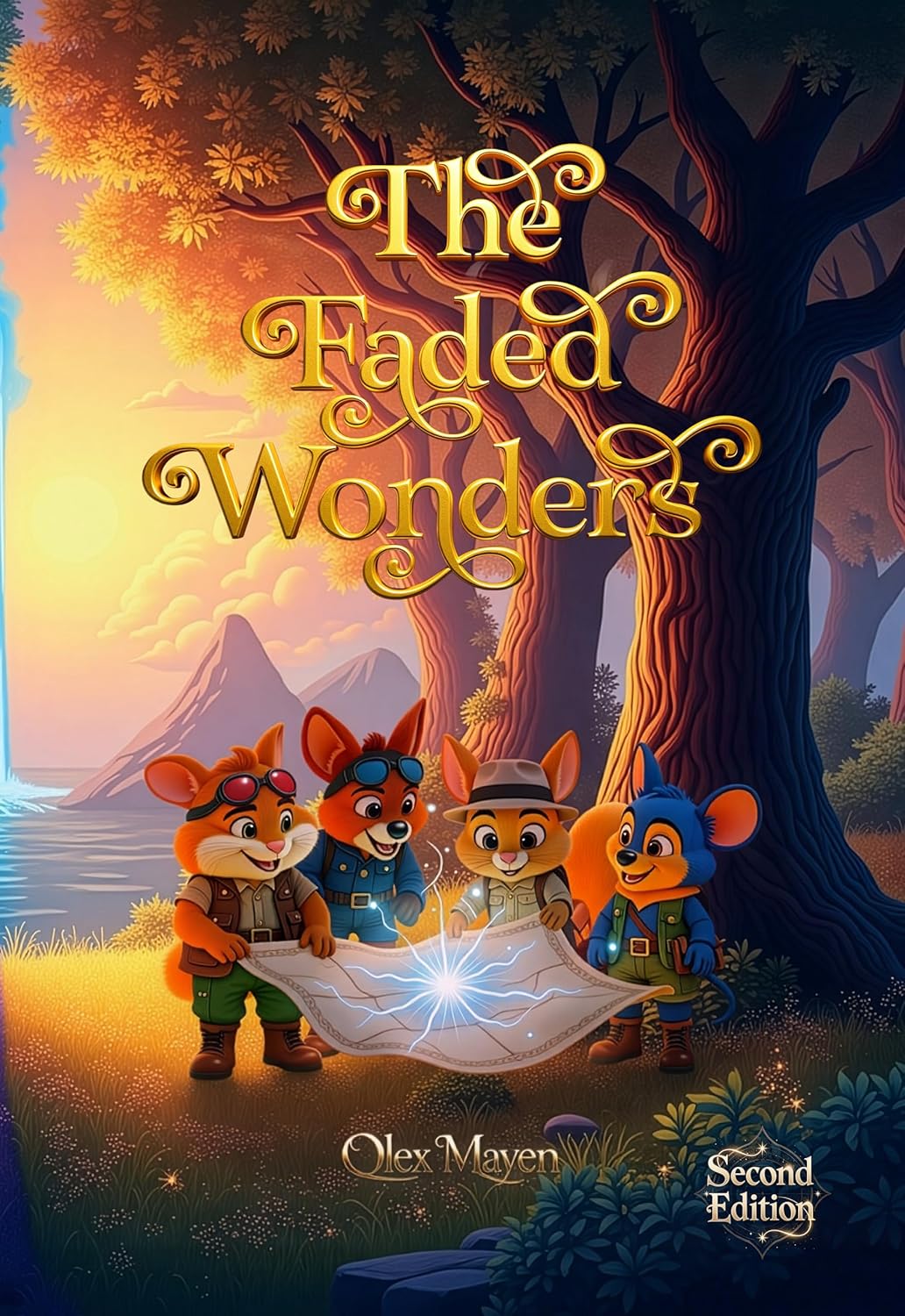
The Faded Wonders, by Olex Mayen, follows four little adventurers who crash into each other’s lives and end up following a strange glowing map that hints at forgotten “wonders” hidden all over their world. They hike through wild places, solve odd little mysteries, and meet some pretty weird, magical stuff, all while trying to figure out what these wonders actually are. It feels like being dropped into a cozy fantasy game where every new area has its own mood, its own challenge, and a tiny hint that something bigger is waiting just out of sight.
Reading it, I felt wrapped up in a really cozy yet big adventure. Like a video game level select, married to a bedtime story. The writing is rich and cinematic, with waterfalls that hiss like silver curtains and caves that hum with trapped songs and strange guardians. I liked how each character brings a different flavor to the journey. Blukky is pure wonder, Scouty is the careful map nerd, Vroomy is all speed and swagger, and Chippy keeps cracking grumpy jokes and practical comments, so the story never gets too serious. The structure is very questy. Forest puzzle, ice puzzle, ocean puzzle, sky puzzle, fire puzzle, space puzzle. That rhythm feels satisfying, especially for kids who enjoy “what’s the next level” stories.
The book keeps nudging at softer ideas, and that hit me in the feels more than the big magic. The Starforge scene, where they are told that power fades but wisdom sticks, lands gently but is impactful, and I really appreciated that choice. The theme of “wonder that never disappears, it just waits” runs all the way from the opening note to the final key that is meant for future dreamers, and that gave the whole thing a warm echo in my head after I finished. I also loved that the friends are allowed to be scared, or annoyed, or tired. Vroomy is not just a show off; he learns patience. Chippy complains, then steps up anyway. Blukky worries and still moves forward. Those little emotional beats make the big cosmic stuff feel more grounded.
The pictures in this book pop right off the page, all bright colors and soft glowing details that feel kind of like a Pixar movie in book form. The characters are super cute with big, expressive faces that make them feel alive. Every scene has a strong mood, from cozy and warm to cool and mysterious, and the art makes the world feel magical.
I would recommend The Faded Wonders to kids who are ready for a longer, chaptered adventure and for children who enjoy reading something lush and imaginative out loud. It feels like the start of a series that readers can grow with, and I can see this working great as a shared nighttime read for ages roughly seven to eleven, depending on reading level. If a child loves fantasy worlds with talking animal heroes, glowing artifacts, and a gentle lesson about curiosity and courage, this book fits nicely on their shelf. It suits readers who like maps, quests, puzzles, and that feeling of “one more chapter, then bed, promise.”
Pages: 198 | ASIN : B0G9M82SV3
Big Feelings and Big Ideas

The Elf Who Didn’t Believe in Children centers around an elf who is sent into a spiral of doubt when she discovers a letter from a child who insists elves do not exist. Where did the idea for this story come from?
This title actually came from my family. In the 1980s, my grandmother went back to school alongside one of my aunts. In a writing class together, my aunt wrote a short story called The Elf Who Didn’t Believe in Children. The plot was completely different from mine, but the title stayed in my grandmother’s files for years. In the 1990s, while my grandmother was cleaning things out, she handed it to me because she knew I loved writing for kids. She basically said, “Maybe you’ll do something with this.” And I did. I ran with the title and built an entirely new story around it. The book is dedicated to my Aunt Virginia because without her, Flossy wouldn’t exist. As a parent, I was also inspired by the many philosophical debates my own children loved to have. We talked about belief constantly – belief in holidays, in magis, in the tooth fairy, in things we can’t see, and in larger spiritual questions. Kids are natural skeptics and profound thinkers at the same time. They want proof, but they also want to wonder. Flossy was born right at the intersection.
Flossy is a firecracker of a character. Are her traits and dialogue modeled after anyone in your own life?
Flossy is a delightful mash-up of so many people I love: strong-willed kids, big thinkers, skeptics, artists, and a little bit of me, too. I’ve always admired children who ask why and refuse easy answers. Flossy has that rebellious streak, but she also has a huge heart waiting to open. Her humor, her dramatic flair, her “I’ll believe it when I see it” attitude – that all comes from real conversations I’ve had with my kids when they were younger, when they were trying to make sense of a complicated world.
What authors have most influenced your love for children’s literature?
I’m deeply inspired by writers who trust children with big feelings and big ideas. Roald Dahl showed me that stories can be mischievous, tender, and slightly subversive all at once. Madeleine L’Engle taught me that faith, doubt, and love can sit in the same room together. And Kate DiCamillo writes with such enormous compassion for lonely hearts. They never talk down to children. They invite them upward. That’s always my goal.
Can we look forward to seeing more work from you soon?
What are you currently working on? Absolutely! I always seem to have a few stories going at once. The next picture book I am currently working on is titled Hoggy, Foggy, and Their Terrifying Life with a Spider. At first glance, it’s funny and fast – a ghost afraid of a spider, a spider afraid of a ninja, and a ninja afraid of a ghost. Everyone is running from everyone else. Doors slam, feet pound, chaos erupts. But when they finally stop running, they talk. And that’s where the real story begins. The book gently explores loneliness, friendship, moving away, grief, and what it means to remember someone after they’re gone. It doesn’t try to explain death to children; it tries to reassure them that love stays, memories stay, and we can be brave in very quiet ways. I wrote it with my granddaughter, Moon, during a time when our family was navigating loss. There is laughter in the book, silliness, knitting jokes, and sliding down banisters – but underneath it is a promise to children and the grown-ups who read with them: even small things can carry big love a long, long way. So yes – more stories are coming, and they will continue to hold humor in one hand and heart in the other. (Flossy would probably approve of that.)
Author Links: GoodReads | Instagram | Chasing Sara | Banned Books | Website | Amazon
The Elf Who Didn’t Believe in Children

The Elf Who Didn’t Believe in Children follows Flossy, an elf who lives at the North Pole. She carries a sharper edge than the cheerful, happy-go-lucky elves around her. They wear festive greens and reds. Flossy goes darker. She works just as hard as anyone in the workshop, yet she can’t shake one unsettling belief. The toys aren’t going to children. In fact, Flossy doesn’t believe children exist at all. Then she finds a letter, supposedly written by a child, claiming the opposite. The child insists it’s the elves who aren’t real. That single message knocks the foundation out from under Flossy and sends her into a spiral of doubt. Everything she “knew” starts to look flimsy.
The Elf Who Didn’t Believe in Children, by Sara Madden, is a children’s book that feels best suited to slightly older kids, readers who have outgrown the simplest storylines, and can handle themes with a little bite and complexity. Some children’s books rely on art to carry the experience. Not here. The prose and illustrations work in tandem, each strengthening the other. The story stays close to Flossy’s perspective, which makes her voice stand out. She reads like a riot girl elf. Suspicious. Self-possessed. Unmoved by tradition. Sara Madden leans into that contrast and makes it sing, shaping Flossy into a confident girl-boss figure who trusts only what she can observe for herself.
As Flossy starts to entertain the idea that children might be real, the plot opens into something deeper. Her doubt spreads. One question becomes many. If she’s wrong about this, what else has she accepted without thinking? That shift turns the story into an invitation to stay flexible and curious. To revise beliefs when facts change. To loosen the grip of a rigid worldview. That lesson doesn’t show up often in children’s books, and it lands with real force here.
The Elf Who Didn’t Believe in Children is a picture book that nudges kids to reconsider what they’ve been told, especially when new evidence appears, and deserves attention. In this case, I think the theme elevates the entire book. The result is a children’s story that succeeds on every level and has the makings of a fresh, new holiday favorite.
Pages: 55 | ASIN : B0BMM8YLLY
Respecting Water
The Tralls of Mundi follows a group of tralls headed to the Coming Together celebration who, along the way, discover a dark and dangerous adventure that threatens the tralls’ future. What was the inspiration for the setup of your story?
Illegal damming of water sources is becoming an issue in Australia, especially in areas that have a lot of agriculture and limited water resources.
There are many reasons for this, some quite understandable, and in a vast country like Australia the situation is hard to monitor.
Unfortunately, however, Illegal dams can have a negatively impact on the environment and ecosystems.
They can lead to habitat destruction, degrade water quality, negatively impact aquatic life and cause health risks for humans through contaminated water.
I wanted to make my young readers aware of these issues and hopefully encourage them to be respectful water users in the future.
Were there any characters that you especially enjoyed writing for?
Each book in The Tall Series is dedicated to two of my grandchildren. The two represented in “The Tralls of Mundi” are often complimented on their leadership, persistence, courage and resourcefulness so I was keen to highlight these traits in the main characters, Jete and Jak.
What was the inspiration for the culture of your characters? Is it modeled after any particular society?
There are two memories that are very special to me. The first was when I lived with my grandparents in Tasmania. We spent a lot of time traipsing through the bush and marvelling at the beautiful flora and fauna during the daytime and then at night, we’d read and re-enact the classics. Those memories are very dear to me and I tried to share them with my family and my readers through this series.
The second very precious memory is of the time we spent living on Badu Island in the Torres Strait.
The laid-back, happy, communal life-style of the islanders and the friendly way they included us in their lives had a strong impact on us and Badu and the friends we made there still mean the world to us.
My hope is that by threading that happy, peaceful ambience through my stories , I could impart the same feeling to others.
What is one thing that you hope readers take away from The Tralls of Mundi?
I hope “The Tralls of Mundi” engenders a deep respect in my readers for the environment and a desire to protect it. I also hope they learn the importance of all water resources and treat them with consideration and care.
Author Links: Facebook | Website
When the terrified tralls discover that the village of Mundi and all its inhabitants have disappeared they are convinced the Chameleons have returned, and when they find that the mighty River Maire is now only a dried-up mudflat, those fears are strengthened.
Jete and Jak are determined to save their friends but what they find when they enter the Sacred Caves of Mundi leaves them so confused and horrified, they are no longer sure they can save the tralls of Mundi or even their own kinships.
The Tralls of Mundi is the second book in The Trall Series; a collection of environmentally based portal fantasies set in the Australian bush. It is recommended for readers 9 years to 13 years.
Many Types of Families
Pesky Penguins follows two adopted sisters who get whisked away by a magical beam of light to all sorts of places after they wish for different things. What was the inspiration for the setup of your story?
Becky and Sonya’s adventures were originally written as short-story drafts with the intention of making a picture book series about the girls. I decided against that model after publishing The Dee Lanson Series, which is for middle-grade readers. I love writing chapter books! So, I tossed around the idea of combining the adventures into the fantasy novel now known as Pesky Penguins and went with it!
What was your inspiration for their characters’ interactions and backstories?
At first, I imagined Becky and Sonya as friends and neighbors, but I felt the story would have greater depth if they were sisters. Being one of three sisters, I know how important and strong the bonds can be. Also, there are many types of families, so I wanted to show that adopted siblings can have a strong connection even if they come from different backgrounds.
Family, responsibility, and helping others are virtues that are highlighted throughout the story. Why are these important to telling the story?
Becky and Sonya are presented with a challenge when the baby penguin follows them home. They feel sad for Petey because he is separated from his family. The strong bonds within their own family fuel their desire to return Petey to his, even though they would love to have him for a pet. They assume the role of caregiver while they figure out what to do. It is a great learning experience for them and for the reader also.
Will this novel be the start of a series, or are you working on a different story?
I would love for The Adventures of Becky and Sonya to become a series, but at the moment it is a stand-alone book. The future of The Adventures of Becky and Sonya is yet to be decided!
Author Links: GoodReads | Website | Amazon
Two adopted sisters, Becky and Sonya, get a big surprise when a beam of light transports them to Antarctica! They are surrounded by penguins as their adventure begins! When a baby penguin follows them home, they see just how fun and wacky life can be. Their attempts to get him back to his penguin family don’t go as expected; they never know where the light beam will take them next. Join Becky and Sonya on their exciting, magical journey!
Pesky Penguins is a heartwarming story of the importance of family, developing responsibility, and helping others.
Janice Laakko is the award-winning author of “Gloppy”, the first book in “The Dee Lanson Series”


