Blog Archives
The Progression of Women’s Rights

The Crones’ Tales gathers five women from different eras of the feminist movement in a cottage to drink wine, trade stories, debate ideas, and retell a classic fairy tale through the lens of their own generation. What inspired the idea of gathering women from different feminist eras into one story?
The short answer is that it evolved. A few years ago, I had an idea for an anthology of fairy tales written by different female authors. I talked to the women in my local writer’s centre. There was a lot of interest but no action so I decided to move on to other things. Still, the idea of fairy tales told by different voices stayed with me and then last year I set myself a challenge – I would publish a short story every two weeks on my website. During this challenge, I wrote the story What’s In A Name and realised that that story had a distinctive voice. That made me wonder if I could return to my original idea but instead of different writer’s voices, I would write with different story teller’s voices. That meant that I needed to figure out what these women had in common and what would bring them together. I considered story telling frameworks like the travellers (Canterbury Tales), the strandees (The Decameron), the desperate (The Thousand Nights and One) and then I remembered a movie called My Dinner With Andre. The plot sounds terribly dull – two men eat dinner and talking – and yet it’s one of my favourite movies. With this idea of a dinner conversation in mind, I remembered reading about Mary Wollstonecraft attending dinners thrown by her publisher, Joseph Johnson at 72 St Paul’s Churchyard Lane in London. It was the Age of Enlightenment, an age when men were focused on their rights and freedoms. Johnson invited these radical thinkers to sit around his dining table, eating, drinking, talking. Mary wasn’t the only woman to attend these dinners, but it was her Vindication of the Rights of Women that made her stand out. She didn’t want to only be a woman who wrote, she wanted to be a woman who could support herself with her writing. While she never achieved her goal, her voice came to represent that of the movement that would much later, become known as feminism. It was this slow progression in the fight for women’s rights, the progress and the regression, that led me to ask the question – how have women’s ideas of ‘their rights’ changed over time.
How did you approach representing different waves of feminism through the five women, and what tensions between generations were most interesting to explore?
That’s a great question. Beatrice is modelled on Mary W — only mellowed a bit with age — because she pre-dated any formal movement. Women before and during the Enlightenment, were like lone voices struggling to create their own lives. She witnessed the women of the French Revolution being murdered for demanding the same rights as men. She never achieved the financial independence she longed for and she died, like so many women of her age, in childbirth. While her daughter, Mary went on to become famous as a writer, Mary W and her treatise and her life were debased by her husband William Godwin. Her treatise lay dormant for years until it was revived by the Seneca Falls Convention which produced the Declaration of Rights and Sentiment written by Elizabeth Cady Stanton. Magret is not based on Stanton alone – but perhaps her prickliness is — because she was part of a movement. That movement for women’s rights was an off shoot of the abolitionist movement which not only pushed to free the slaves but also pushed for black men to receive the right to vote. In 1870, black men won that right, but women wouldn’t get the same right in America until 1901. That’s a 30-year gap. In those 30 years, WW1 wiped out so many young men that women had to fill the gap. Then WW2 again asked women to take the place of men. Each time they stepped up, they gained confidence in their ability to keep the home fires burning. So why did they abdicate their newfound freedom in the post-war years? The simple answer seemed to be that women were told they were no longer needed and that coincided with the media building an image of a fairy tale life in the suburbs. Initially I planned a Rosie the Riveter character, but I didn’t think that adequately portrayed why so many women retreated to home and hearth. Women, especially those who knew what men endured during the war, were much more complex than that. So what, I wondered would convince that woman to take up the role of the traditional housewife? The solution was to choose a woman who knew exactly what she was giving up. Someone who understood that it was an act of sacrifice. For younger women today, I think the 50s of America looked like a peaceful, domestic age when women vacuumed their immaculate houses in heels and pearls while their husbands went to work in the cities. Ginger isn’t that woman. If anything, she and her husband strive jointly to create their own safe haven. I think, that’s why she has a vested interest in upholding that image. As for Verna, the 70s feminist, she is the one who’s internally most conflicted. Her generation demanded the same sexual freedom as men while also railing against being treated as sex objects. They entered the work force demanding the same jobs as men but settled for less pay, thus reducing worker’s wages. They changed divorce laws and found themselves raising children on their own. They toppled the male dominated house of cards but failed to provide a firm foundation for the next generation of men and women. That internal conflict, that desire to have it all, Verna pushes onto her millennial daughter. It’s Chloe who is told she needs a career to feel fulfilled but also feels the need to be the wife and mother that the boomers traded for success in the boardroom. Verna’s fairy tale speaks for both her and Chloe. And finally, there is Florence, the Gen Z woman. While the storm rages outside and she sits in her cosy cottage, she wants a world without conflict – one that gives everyone an equal chance. The question is, will she hide in her cosy cottage or will she step outside and face the storm?
What do you hope readers take away from the conversations between these women?
The current backlash against women’s rights, places the rights of all people in jeopardy. And that is frightening and demoralising. What I want readers to take away is that we have weathered such storms before and in the process become stronger. We’ve encountered schisms in our movement and learned from them. And finally, in terms of my writing, I want readers to take away that the current night may have come to an end but there are more evenings to come.
Author Links: GoodReads | Facebook | Website | Substack
The Crones’ Tales


The Crones’ Tales gathers five women from different eras of the feminist movement in a single stormy evening, as they converge on Florence’s cottage to drink mulled wine, argue, and trade re-imagined fairy tales. Beatrice, a Mary Wollstonecraft stand-in from the Enlightenment, sits beside suffragist Margret, suburban housewife Ginger, second-wave firebrand Verna and their younger host Flo, whose politics stretch toward intersectional, eco-minded justice. Between courses of food and history, each woman tells a tale, Rumpelstiltskin from the miller’s daughter’s point of view, a reworked royal romance, a twist on the maiden-in-the-tower myth, and more, each story refracting the struggles and contradictions of her own generation, until their shared night edges toward both reckoning and renewal.
Reading it, I felt as if I’d been invited into a book-club in a liminal cottage at the edge of a wood: cosy, candlelit, but with the wind of social change rattling the windows. The frame narrative is warm and talky, yet undercut by real unease, about backlash, about violence, about Chloe, Verna’s absent daughter. I especially loved “What’s In A Name?”, the miller’s daughter’s first-person retelling of Rumpelstiltskin, where questions of naming, contracts, and ownership of labour get teased apart with sly humour and mounting rage. The way the narrator realises she’s been letting everyone else do the thinking for her, and then literally walks herself out of the castle to reclaim her life, landed for me as both a fairytale catharsis and a contemporary wake-up call.
I also enjoyed how unabashedly the book nerds out about language and history: the etymology of “spinster”, the politics baked into fashion, the colour codes of suffragist sashes, the quiet sabotage of knitting. Those passages risk feeling like mini-lectures, but the characters’ squabbling keeps them alive, Verna’s sharp, sometimes defensive quips bouncing against Margret’s earnestness and Beatrice’s reflective gravitas. Every so often, I felt that the moral is stated a touch too plainly, and I wished for a bit more narrative subtlety or ambiguity. Still, the overall effect is a kind of polyphonic tapestry: stories within stories, threaded with grief, missteps, and stubborn hope that the sisterhood, however frayed, can re-stitch itself.
I’d hand The Crones’ Tales to readers who love feminist fairytales, mythic retellings, historical fantasy, and speculative fiction that talks back to tradition. If Angela Carter’s The Bloody Chamber had a gentler but no less incisive cousin who wanted to sit you down and argue through several waves of feminism, it might look a lot like this book. For anyone who has ever felt both indebted to earlier feminists and exasperated with them, these crones offer a generous, sometimes prickly, but always human conversation. I think, in the end, The Crones’ Tales reminds us that the stories we inherit are only the beginning of the stories we’re allowed to tell.
Pages: 132 | ASIN : B0GH57ZXM2

Little Creatures: Rise of the Thrangrim
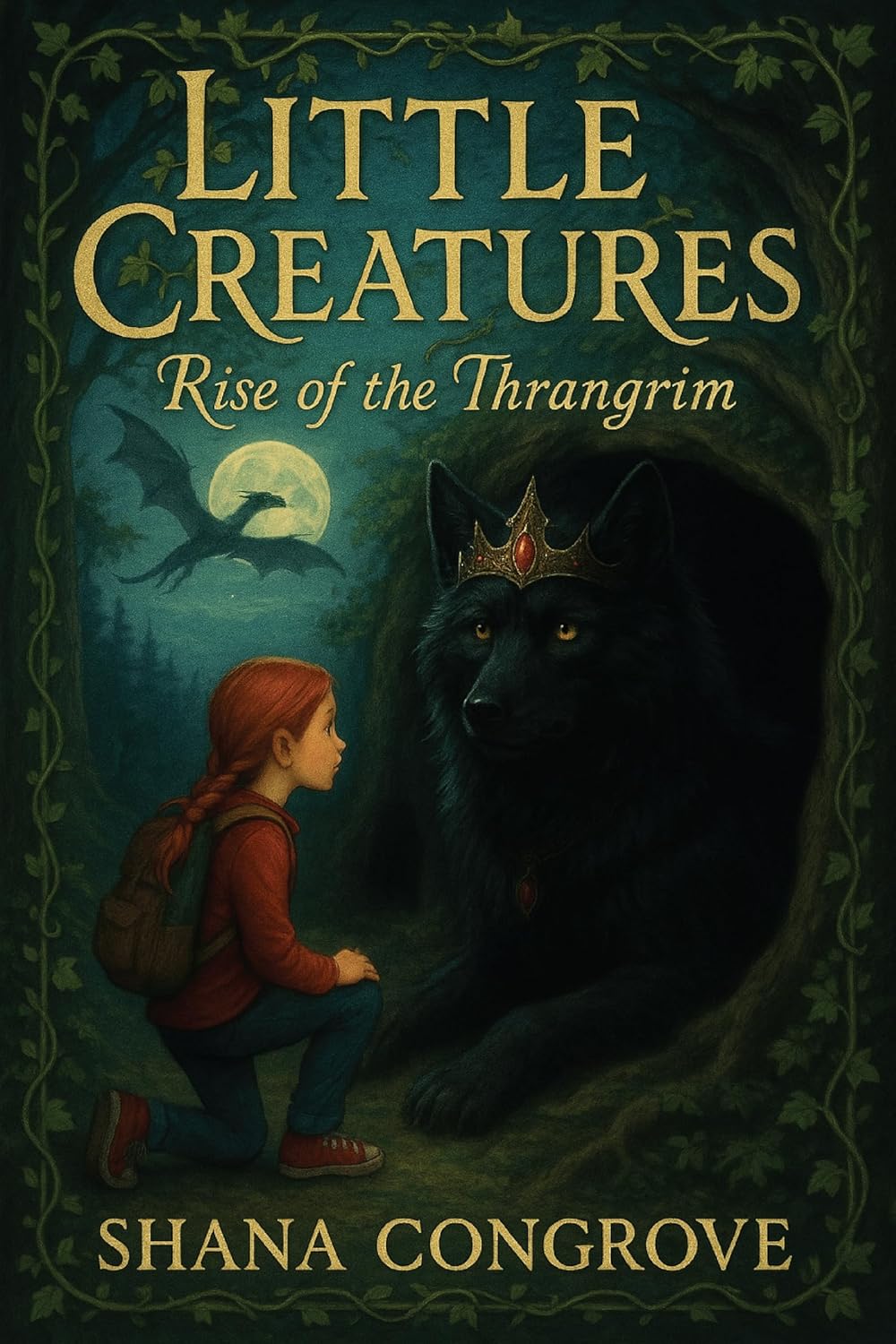

In Little Creatures: Book Two — Rise of the Thrangrim, Zowie’s “normal life” barely gets a foothold before two Little Forest Elves show up at her window with bad news: the Sky Fairies have been captured by the Thrangrim—stone-and-shadow brutes led by Grallok, who broke an ancient dream-binding spell by poisoning the fairies’ dreams with nightmares. Zowie and her dad, Daniel, slip into the supernatural realm through a tree-portal, meet the last free Sky Fairy (Aurora), and follow a living map across strange territories to gather allies and, ultimately, awaken Vortharion the Flamebound—an old, sleeping dragon whose return might be the only real answer to a threat this big.
My favorite emotional connection in this book is the father-daughter pairing. Daniel isn’t window dressing; he’s a presence, protective, a little sarcastic, and deeply tender in that “I’ll be brave because you’re watching me” way. When the quest yanks them apart (and it does, sharply), the story suddenly feels riskier, like the training wheels came off and Zowie has to discover what courage feels like in her own body, not just in her intentions. I also appreciated the book’s straightforward and earnest spirituality. Zowie begins in prayer, and the story keeps that sense of reverence without turning every page into a sermon; it’s more like a soft lantern the characters carry.
Stylistically, this reads like an episodic fantasy road trip: meet a new species, learn their rules, earn their help, move on. That structure is comforting, almost bedtime-story adjacent, even when the stakes are “everyone gets conquered by nightmare trolls.” The tradeoff is that the book sometimes pauses to explain lore in big, neat blocks (Grallok’s dream-corruption backstory, the rules of realms, the prophecy weight of the Golden Oraya). Still, the creature design has a gleeful weirdness, Glowtails, Scuttle Bugs, dire wolves with royal gravitas, and the wonderful illustrations reinforce that tactile, penciled-in fairytale mood. And when the finale hits, it delivers a clean, kid-thrilling payoff.
Kids who like middle-grade fantasy, portal fantasy, quest adventure, mythic creatures, and clean, faith-leaning fairytales will really enjoy this story, as well as parents who enjoy reading aloud without bracing for cynicism. If your shelf has The Chronicles of Narnia (or you grew up on C. S. Lewis’s blend of wonder and moral clarity), this will feel like a gentler, more creature-catalog-forward cousin. It’s a story that believes that bravery can be small and still be seismic.
Pages: 112 | ASIN : B0GGJCZPQR
Blurred Lines Between Reality & Nightmare

The Dreaming at the Drowned Town follows a haunted Filipino translator whose nightmare-plagued diary unravels a deadly expedition to a newly risen island where history, paranoia, and ancient horrors collide. What was the inspiration for the setup of your story?
We’ve always been drawn to overlooked corners of Philippine history, especially the transitional period of the 1920s, when cities like Cebu were rapidly modernizing under American rule while remaining at the cultural crossroads that decided the modern Filipino identity–between the legacy of three centuries of Spanish-style hacienda communalism and the enduring influence of the Church, the new American nation envisioned by the suit-wearing, English-nicknamed Sajonistas, and the vision of a country free from both that endured in places like Eastern Visayas. We’ve wanted to write a story in that setting for the longest time, portraying the interaction between people trapped between any of or perhaps none of the paths the Philippines was on the verge of walking, and the conflict that would arise from the clash between their different values and cultural contexts.
The core of the novel, however, came from two major sparks. The first was a love for early 20th-century cosmic horror, particularly the works of H.P. Lovecraft. Kyle has been a devoted fan for years before we ever started writing professionally, and he always wanted to craft a proper homage grounded in our own cultural landscape. The second—and more unexpected—inspiration came from real life. Around the time of the 2024 Manila International Book Fair (MIBF), when we launched our debut novel, Answering the Human Question, Kyle had come up with the concept of a protagonist troubled by vivid and terrible dreams, inspired partly by his own string of nightmares that he had been dealing with at the time through journaling. This entered the story as the main character and narrator of Enrique, who would write about his dreams as Kyle did. It also shaped in some aspects the book’s dream logic–its many false awakenings and the often blurred lines between reality and nightmare.
We also pulled from real historical curiosities like the desolate, sunken town of Pantabangan, the very real Drowned Town that exists here in the Philippines. It’s located in Luzon and in the province of Nueva Ecija, and it resurfaced during the El Niño droughts of both 2020 and 2024. We also combined the aesthetic of that place with Dawahon Islet, which, like the titular Drowned Town, is found near Leyte. Dawahon is a tiny yet densely packed community built on a reef that Kevin often flew over during pilot training. The distant glances and later images of empty, almost liminal spaces in both locations created an uncanny timelessness. It immediately planted in our minds the place where the book’s central mystery would unfold: a drowned town rising again after centuries beneath the sea.
The atmosphere is incredibly vivid. What research or techniques did you use to capture the sensory overload of the island and Enrique’s nightmares?
Much came from layering real-world observation with psychological insight. Research and a little bit of Kevin’s background in biology gave us a foundation for sensory detail—how bodies react to exhaustion, how coastal environments smell, sound, and move. Our travels to parts of the Visayas gave us firsthand experience of environments that feel both crowded and isolated, which helped shape the island’s suffocating atmosphere.
On Kyle’s end, his study of psychology—as well as a few readings of old court decisions for Philippine Law—taught him how perception breaks down under stress. Around the time of MIBF 2024, he was having recurring nightmares, and journaling them became the seed for Enrique’s dream sequences. Those dreams were chaotic, absurd yet vivid, and he translated that rawness into the book’s “dream logic.”
In addition to being partly inspired by Kyle’s own journaling, we employed Enrique’s diary as a framing device. In doing so, we hoped to keep the nightmares disorienting but maintain that they were narratively coherent. The diary form lets us narrow the focus to Enrique’s senses: the heat sticking to his skin, the sulfur that burns the throat, the texture of the drowned town rising from the sea. When those sensory details begin to distort or repeat, the reader feels Enrique’s unraveling in real time.
How did you approach blending real historical tensions of the American-occupied Philippines with cosmic or supernatural horror elements?
We began by grounding the story firmly in Philippine history. The 1920s was a pivotal transitional period in our hometown and province—Cebu was rapidly modernizing under American rule, yet memories of the Philippine-American War and the Revolution before it still lingered. A younger generation of Sajonistas emerged, eager to embrace American culture and modernity, and they often clashed with their elders, who had been shaped by centuries of Spanish influences and even hateful opposition to the betraying, conquering Americans themselves. Naturally, we wanted readers to feel that political and cultural tension in every scene, long before the supernatural appeared.
From there, the horror grew from two sources: Lovecraftian atmosphere and Filipino folklore. Lovecraft shaped the tone and structure—the slow unraveling of sanity, the tension between logic and the unknowable. But we never wanted to imitate Western cosmic horror wholesale. Filipino folklore, possessing tales of otherworldly spirit realms and the phantasms of the restless dead in spades, also played an important role in shaping the story’s identity. In our culture across its history, dreams have often held great power and importance, heralding either auspices of fortune or warnings of a coming malevolence. The sea has long been the place of both the dead as well as the living, and so it seemed natural as well as Filipino for us to portray the water with that same mystic aura.
When these folkloric themes collide with the real political tensions of the American occupation, they amplify each other. The characters themselves reflect this clash–to name a few, the American who believes he brings enlightenment and progress, the Western-educated Filipino guide plagued both by nightmares and generational trauma brought on by war, the old revolutionary who compromises his morals by relying on the wealth of his oppressors, and a corrupt constable armed by the law of a distant empire to fulfill his personal depravities. All of them come together in a chaotic misalliance of pathologies and dysfunctions beneath the cross of a condemned Spanish village, in the caves where the ancestors before told their stories, and above the depths of what came before them all.
Lita’s character goes through some of the most surprising twists. What was your process for constructing her arc?
When we were constructing the original skeleton of the story for Drowned Town, we wanted to explore imperialism—not just as the domination of one country over another, but on a smaller, interpersonal scale through the abuse and conflict that occurs between people. Every character written in this story speaks to or personifies that concept in some way, and Lita began as no different. The age gap between wife and husband, the bursts of passion punctuated by periods of ignorance from one side and betrayal from the other—she represents the country in her own way, a young and beautiful person being taken advantage of by a much older figure. We wanted another victim of imperialism, and in her case, we told the story of a kind of sex tourism and all the sordid perceptions that come with being someone in that world. However, we also wanted her to be aware of that dynamic, so she could play that game and defeat those who would take advantage of her or hold her in low regard. She needed to bear an innate refusal to be victimized, so that by the end she could be the true writer of the story—the architect of her own fate—rather than simply a supporting role in someone else’s narrative. That’s where her most surprising twists come from: the realization that she was never the object of the story, but its author all along.
Author Links: GoodReads | Facebook | Website
When an ancient town mysteriously emerges off the coast of Leyte, Enrique has no choice but to follow his employer to investigate. But as the expedition unravels, so too does the boundary between dreams and reality. With the island’s dark secrets coming to light, Enrique must face the horrors of its past before he too is claimed by the Drowned Town.
Bringing Magical Worlds to Life

Little Creatures follows a science-loving twelve-year-old girl who recently moved from the city to a quiet town and discovers that her backyard and bedroom wall are hiding a magical mystery. What was the inspiration for the setup of your story?
“From an early age, I was captivated by tales of fairies and elves—”Peter Pan” was my favorite. Alongside my love for stories, I had a deep passion for art, often spending hours sketching in my room. Around the age of twelve, I dreamed of writing a story about tiny elves hidden within the walls of a house. Life moved on, and that idea remained just a dream.
Today, as an author of adult fantasy, I decided to challenge myself by creating a children’s book. Instantly, my imagination returned to that twelve-year-old version of me—the one who longed to bring magical worlds to life. Now, I’ve finally fulfilled that dream and proudly checked it off my bucket list.”
In fantasy novels, it’s easy to get carried away with the magical powers characters have. How did you balance the use of supernatural powers?
“Because “Little Creatures” is a children’s story, I aimed to keep the supernatural powers simple and the narrative easy to follow—engaging young readers without overwhelming them with excessive detail.”
What were some themes that were important for you to explore in this book?
“The central theme of “Little Creatures” is that good always triumphs over evil. In a world often filled with chaos and destruction, I believe it’s important for children to experience stories with hopeful, fairytale endings—nurturing their imagination and reinforcing the power of positivity.”
Will this novel be the start of a series or are you working on a different story?
“Absolutely! I’ve already completed the sequel, “Rise of the Thramgrim,” and I’m excited to share that a third installment, “Curse of the Sandman,” is also in the works. This series is just beginning to unfold, and I can’t wait for readers to experience the journey ahead.”
Author Links: GoodReads | X | Facebook | Instagram | Website
Can a science-loving girl save a place where magic rules?
When twelve-year-old Zowie Lillian Saintclair moves from bustling Houston, Texas, to the quiet town of Greenwood, Arkansas, with her family, everything seems normal until she begins to spot little creatures that only she can see hiding in the shadows of her backyard.
And just as she thought things couldn’t get any more bizarre, she discovers something otherworldly living within her bedroom walls. That’s when she realizes her life is about to change in ways she never imagined.
Perfect for readers of all ages who love fantasy, adventure, and a smart heroine who isn’t afraid to explore the unknown.
Little Creatures

Twelve-year-old Zowie Saintclair arrives in Greenwood, Arkansas with deep uncertainty. Houston had shaped her world, and this quiet town shares almost nothing with the life she left behind. Her doubts fade quickly, though, when an unexpected mystery draws her in. Strange, miniature beings begin appearing in her backyard. The sightings unsettle her, and she questions her own reason. The oddities escalate when she realizes her bedroom walls may shelter hidden life, creatures that seem impossibly magical. A science-loving girl suddenly stands before a truth she never imagined: not everything fits inside the boundaries of logic.
Little Creatures, written by Shana Congrove, speaks directly to young adult readers. The story carries more depth and length than very young children might prefer, yet older elementary and middle-grade audiences will likely find themselves engrossed. Its spirit recalls Lynne Reid Banks’s beloved classic The Indian in the Cupboard, with a similar sense of wonder and discovery.
The delicate, fairy-like beings Zowie encounters begin as timid observers. Over time, they recognize something familiar in her and gradually step into the light. Their world comes with a mythology of its own, layered, imaginative, and fully realized, yet never so dense that it burdens younger readers. The history behind these creatures gives them warmth and dimension, making them surprisingly relatable despite their magical nature.
From the opening chapters, fantasy and practicality collide. Zowie’s devotion to science shapes her thinking, yet her youth allows her an openness that adults often lose. Congrove suggests that maturity can narrow the imagination, leaving grown-ups tethered to a rigid sense of reality. Zowie lives outside that constraint, and it’s precisely this flexibility that invites the creatures closer.
Her willingness to accept what she sees makes her an appealing guide through the story. Curious, intelligent, and deeply empathetic, she anchors the novel with a strong emotional center. The magical company she keeps adds charm and excitement, but Zowie herself remains the heart of the narrative. Following her journey turns Little Creatures into a rewarding and memorable read.
Pages: 144 | ASIN : B0FTZ9HLNL
The Boy Who Cried Wolf! And Other Great Stories With Lessons

The Boy Who Cried Wolf!, by Dr. Uzma Farooq, Samir Ahmad, and Amani Ahmad, is a charming collection of thirteen timeless fables originally told by Aesop, retold here with fresh language and vibrant illustrations. Each story comes with a clear moral, from “The Tortoise and the Hare” to “The Wolf in Sheep’s Clothing.” The retellings stay true to the heart of the originals while making them more engaging for a modern audience. The lessons are simple and bold, making this book a go-to resource for both children and adults looking to reflect on honesty, patience, effort, and the consequences of one’s actions.
I found myself smiling often while reading. The writing is clean and energetic. It doesn’t try to be clever for the sake of it, and that’s what makes it feel real. There’s no fluff here, no over-explaining. Each fable gets right to the point, but it’s done with flair and warmth. I especially appreciated the playful rhythm and the subtle humor. The story of “The Fox and the Crow” made me laugh, while “The Ants and the Grasshopper” hit with a little sting of truth.
The heart behind the work is a standout feature of this collection. This wasn’t just a lazy rehash of old stories. You can feel that Dr. Farooq and her sons cared deeply about the messages in each tale. The dedication and acknowledgments give a window into that love for family, for storytelling, for teaching life’s harder truths without being preachy. And Kam Wing Lo and Lai Sun Ip’s illustrations are a delight. They give the book an extra layer of warmth and make it easy to imagine a parent and child reading together before bed.
I heartily enjoyed The Boy Who Cried Wolf! It’s funny, sharp, and full of heart. I’d recommend it to parents, teachers, or anyone who wants a sweet dose of old-school wisdom with a fresh coat of paint. Perfect for reading aloud, discussing over dinner, or just flipping through when you need a reminder of what really matters.
Pages: 38 | ASIN : B0F7S5YK3X
Take It All In

A Fairy on My Sleeve follows a woman who encounters a fairy while reading under a tree and causes her to contemplate the belief and magic of the ordinary. What was the inspiration for your story?
Many years ago on a glorious summer afternoon, I was digging in my flower garden, watching the bees, dragonflies, and butterflies, which were all flitting about me.
Without warning, a little one landed on the sleeve of my shirt.
It sat there for a short time, slowly opening and closing its wings.
As I gazed at it, I swear it looked back at me, just for an instant before it flew off.
It was a rather idyllic moment on its own, but in my mind, I changed it from an insect to a fairy.
With that simple revision, it had suddenly become a wondrous, magical event.
What were some ideas that were important for you to share in this book?
I think that the most important message in this story is to just slow down, smell the flowers, and pay attention to the little things that are all around.
Turn off your phone, go outside, and have a look around – and a listen. It’s amazing what you can discover when you start to pay attention.
What is one thing that you hope readers take away from A Fairy on My Sleeve?
One thing I hope that readers take away is to put down the devices, go outside, and take it all in. Just by looking into a simple flower pot you can see an extraordinary hidden world, full of life.
Insects and other organisms that live in the dirt and hide amongst the leaves all have their own story. If you look at them long enough, they will tell you that story.
What is the next book that you are working on, and when will it be available?
I have a new book called Where Do All The Fairies Live? along with two others that are currently ready for illustration.
I also have my first children’s song recorded which is in the process of being mixed.
The song is called “Full Moon Friend,” a happy little bedtime song, which will hopefully be ready for release next month.
Author Links: GoodReads | Amazon
Join author, poet, and actress Mari Sherkin as she glimpses a magical world where things are as real as they seem.


