Blog Archives
The Crash of Worlds


The Crash of Worlds by Alisse Lee Goldenberg is a fantasy adventure about what happens when disaster, grief, politics, magic, and family loyalty all collide. The story opens with the destruction of Coralnoss after Marcus’s warnings are ignored, then follows Zayna as she tries to save what is left of her people, Lucas as he searches for a way to reach her, and Audrina as she faces hard questions about love, duty, and whether she truly wants the throne. It’s a deep fantasy novel, with kingdoms, spells, royal conflict, sea voyages, and magical communication, but its real weight comes from human problems: fear, prejudice, pride, loss, and the need to ask for help.
I like how grounded the book feels, even when the world is full of magic. Goldenberg does not treat the disaster as a quick plot device. Zayna’s chapters linger in the mud, hunger, ruined homes, and the awful silence after a community has been broken. It gives the fantasy stakes a physical heaviness. At the same time, the writing is direct and accessible, which makes the emotional turns easy to follow. Some moments are blunt, but that plainness also works in the book’s favor. Grief is not always elegant. Sometimes it’s just one foot in front of the other, carrying supplies, calming a baby, and trying not to fall apart.
I also found myself thinking a lot about the author’s choices around leadership. Audrina’s storyline is not just about being a princess in love with Gertrude. It’s about the cost of being visible in a world that may not accept you. Her conversations with Navor are some of the warmest parts of the book, and they give the story a tender center. Then there’s the contrast with Parven, whose cruelty shows how family and power can become dangerous when pride is mistaken for principle. The book is curious about what makes a ruler good, but it’s also candid about how institutions fail people. The council ignores Marcus. Coralnoss pays for it. Later, survivors still hesitate to accept help because old fears are hard to shake. That felt painfully believable.
I would recommend The Crash of Worlds most to readers who enjoy character-driven fantasy with royal drama, found family, queer representation, and emotional stakes that matter as much as the magical ones. Readers who like sincere storytelling, big feelings, and a fantasy world built around loyalty and survival will likely appreciate it. It’s best for fans of accessible YA-style fantasy who want adventure, heart, and a reminder that rebuilding after loss is rarely clean, but it’s still possible.
Pages: 282 | ASIN : B0GY65N8BK

The Progression of Women’s Rights

The Crones’ Tales gathers five women from different eras of the feminist movement in a cottage to drink wine, trade stories, debate ideas, and retell a classic fairy tale through the lens of their own generation. What inspired the idea of gathering women from different feminist eras into one story?
The short answer is that it evolved. A few years ago, I had an idea for an anthology of fairy tales written by different female authors. I talked to the women in my local writer’s centre. There was a lot of interest but no action so I decided to move on to other things. Still, the idea of fairy tales told by different voices stayed with me and then last year I set myself a challenge – I would publish a short story every two weeks on my website. During this challenge, I wrote the story What’s In A Name and realised that that story had a distinctive voice. That made me wonder if I could return to my original idea but instead of different writer’s voices, I would write with different story teller’s voices. That meant that I needed to figure out what these women had in common and what would bring them together. I considered story telling frameworks like the travellers (Canterbury Tales), the strandees (The Decameron), the desperate (The Thousand Nights and One) and then I remembered a movie called My Dinner With Andre. The plot sounds terribly dull – two men eat dinner and talking – and yet it’s one of my favourite movies. With this idea of a dinner conversation in mind, I remembered reading about Mary Wollstonecraft attending dinners thrown by her publisher, Joseph Johnson at 72 St Paul’s Churchyard Lane in London. It was the Age of Enlightenment, an age when men were focused on their rights and freedoms. Johnson invited these radical thinkers to sit around his dining table, eating, drinking, talking. Mary wasn’t the only woman to attend these dinners, but it was her Vindication of the Rights of Women that made her stand out. She didn’t want to only be a woman who wrote, she wanted to be a woman who could support herself with her writing. While she never achieved her goal, her voice came to represent that of the movement that would much later, become known as feminism. It was this slow progression in the fight for women’s rights, the progress and the regression, that led me to ask the question – how have women’s ideas of ‘their rights’ changed over time.
How did you approach representing different waves of feminism through the five women, and what tensions between generations were most interesting to explore?
That’s a great question. Beatrice is modelled on Mary W — only mellowed a bit with age — because she pre-dated any formal movement. Women before and during the Enlightenment, were like lone voices struggling to create their own lives. She witnessed the women of the French Revolution being murdered for demanding the same rights as men. She never achieved the financial independence she longed for and she died, like so many women of her age, in childbirth. While her daughter, Mary went on to become famous as a writer, Mary W and her treatise and her life were debased by her husband William Godwin. Her treatise lay dormant for years until it was revived by the Seneca Falls Convention which produced the Declaration of Rights and Sentiment written by Elizabeth Cady Stanton. Magret is not based on Stanton alone – but perhaps her prickliness is — because she was part of a movement. That movement for women’s rights was an off shoot of the abolitionist movement which not only pushed to free the slaves but also pushed for black men to receive the right to vote. In 1870, black men won that right, but women wouldn’t get the same right in America until 1901. That’s a 30-year gap. In those 30 years, WW1 wiped out so many young men that women had to fill the gap. Then WW2 again asked women to take the place of men. Each time they stepped up, they gained confidence in their ability to keep the home fires burning. So why did they abdicate their newfound freedom in the post-war years? The simple answer seemed to be that women were told they were no longer needed and that coincided with the media building an image of a fairy tale life in the suburbs. Initially I planned a Rosie the Riveter character, but I didn’t think that adequately portrayed why so many women retreated to home and hearth. Women, especially those who knew what men endured during the war, were much more complex than that. So what, I wondered would convince that woman to take up the role of the traditional housewife? The solution was to choose a woman who knew exactly what she was giving up. Someone who understood that it was an act of sacrifice. For younger women today, I think the 50s of America looked like a peaceful, domestic age when women vacuumed their immaculate houses in heels and pearls while their husbands went to work in the cities. Ginger isn’t that woman. If anything, she and her husband strive jointly to create their own safe haven. I think, that’s why she has a vested interest in upholding that image. As for Verna, the 70s feminist, she is the one who’s internally most conflicted. Her generation demanded the same sexual freedom as men while also railing against being treated as sex objects. They entered the work force demanding the same jobs as men but settled for less pay, thus reducing worker’s wages. They changed divorce laws and found themselves raising children on their own. They toppled the male dominated house of cards but failed to provide a firm foundation for the next generation of men and women. That internal conflict, that desire to have it all, Verna pushes onto her millennial daughter. It’s Chloe who is told she needs a career to feel fulfilled but also feels the need to be the wife and mother that the boomers traded for success in the boardroom. Verna’s fairy tale speaks for both her and Chloe. And finally, there is Florence, the Gen Z woman. While the storm rages outside and she sits in her cosy cottage, she wants a world without conflict – one that gives everyone an equal chance. The question is, will she hide in her cosy cottage or will she step outside and face the storm?
What do you hope readers take away from the conversations between these women?
The current backlash against women’s rights, places the rights of all people in jeopardy. And that is frightening and demoralising. What I want readers to take away is that we have weathered such storms before and in the process become stronger. We’ve encountered schisms in our movement and learned from them. And finally, in terms of my writing, I want readers to take away that the current night may have come to an end but there are more evenings to come.
Author Links: GoodReads | Facebook | Website | Substack
The Crones’ Tales


The Crones’ Tales gathers five women from different eras of the feminist movement in a single stormy evening, as they converge on Florence’s cottage to drink mulled wine, argue, and trade re-imagined fairy tales. Beatrice, a Mary Wollstonecraft stand-in from the Enlightenment, sits beside suffragist Margret, suburban housewife Ginger, second-wave firebrand Verna and their younger host Flo, whose politics stretch toward intersectional, eco-minded justice. Between courses of food and history, each woman tells a tale, Rumpelstiltskin from the miller’s daughter’s point of view, a reworked royal romance, a twist on the maiden-in-the-tower myth, and more, each story refracting the struggles and contradictions of her own generation, until their shared night edges toward both reckoning and renewal.
Reading it, I felt as if I’d been invited into a book-club in a liminal cottage at the edge of a wood: cosy, candlelit, but with the wind of social change rattling the windows. The frame narrative is warm and talky, yet undercut by real unease, about backlash, about violence, about Chloe, Verna’s absent daughter. I especially loved “What’s In A Name?”, the miller’s daughter’s first-person retelling of Rumpelstiltskin, where questions of naming, contracts, and ownership of labour get teased apart with sly humour and mounting rage. The way the narrator realises she’s been letting everyone else do the thinking for her, and then literally walks herself out of the castle to reclaim her life, landed for me as both a fairytale catharsis and a contemporary wake-up call.
I also enjoyed how unabashedly the book nerds out about language and history: the etymology of “spinster”, the politics baked into fashion, the colour codes of suffragist sashes, the quiet sabotage of knitting. Those passages risk feeling like mini-lectures, but the characters’ squabbling keeps them alive, Verna’s sharp, sometimes defensive quips bouncing against Margret’s earnestness and Beatrice’s reflective gravitas. Every so often, I felt that the moral is stated a touch too plainly, and I wished for a bit more narrative subtlety or ambiguity. Still, the overall effect is a kind of polyphonic tapestry: stories within stories, threaded with grief, missteps, and stubborn hope that the sisterhood, however frayed, can re-stitch itself.
I’d hand The Crones’ Tales to readers who love feminist fairytales, mythic retellings, historical fantasy, and speculative fiction that talks back to tradition. If Angela Carter’s The Bloody Chamber had a gentler but no less incisive cousin who wanted to sit you down and argue through several waves of feminism, it might look a lot like this book. For anyone who has ever felt both indebted to earlier feminists and exasperated with them, these crones offer a generous, sometimes prickly, but always human conversation. I think, in the end, The Crones’ Tales reminds us that the stories we inherit are only the beginning of the stories we’re allowed to tell.
Pages: 132 | ASIN : B0GH57ZXM2

Little Creatures: Rise of the Thrangrim
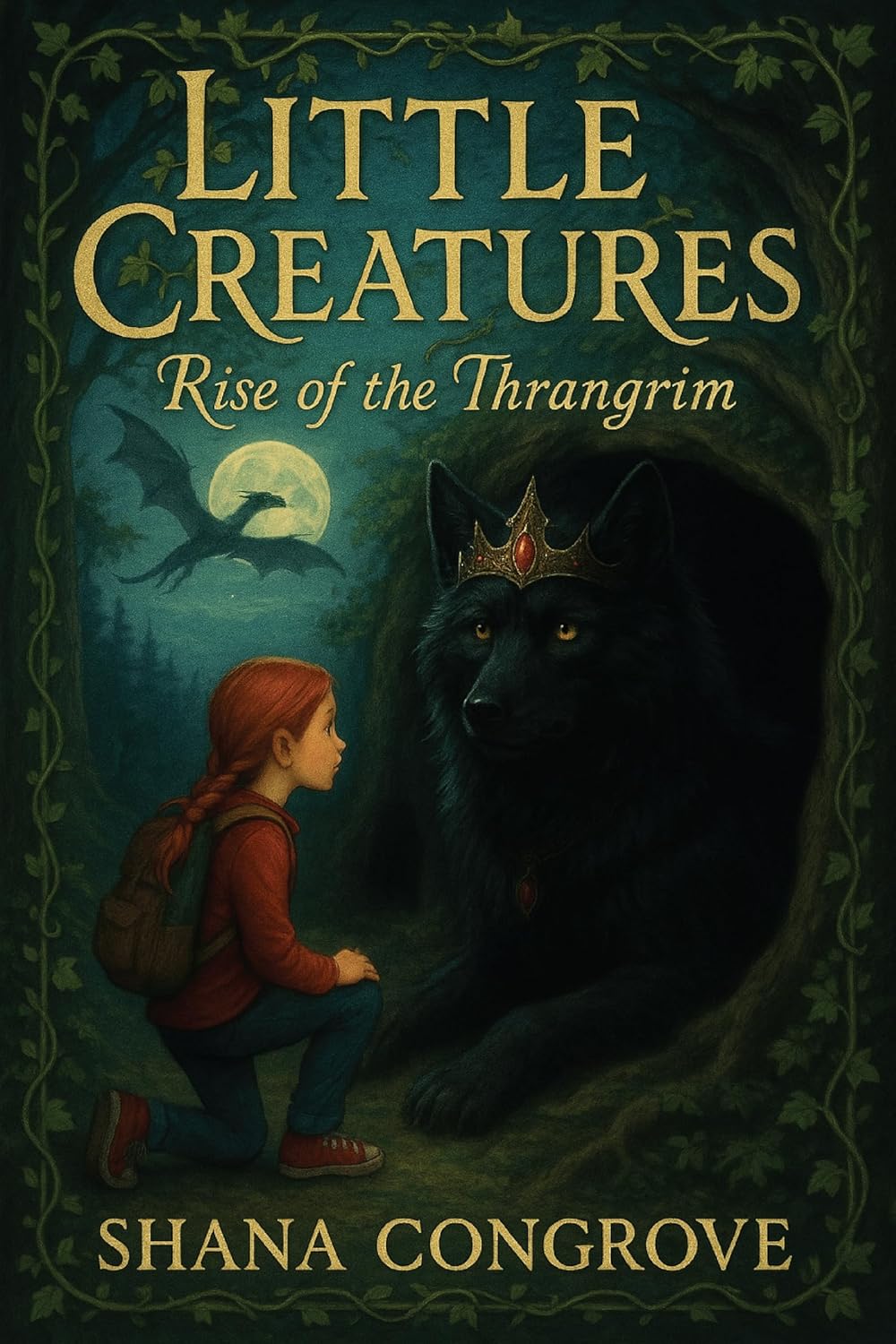
In Little Creatures: Book Two — Rise of the Thrangrim, Zowie’s “normal life” barely gets a foothold before two Little Forest Elves show up at her window with bad news: the Sky Fairies have been captured by the Thrangrim—stone-and-shadow brutes led by Grallok, who broke an ancient dream-binding spell by poisoning the fairies’ dreams with nightmares. Zowie and her dad, Daniel, slip into the supernatural realm through a tree-portal, meet the last free Sky Fairy (Aurora), and follow a living map across strange territories to gather allies and, ultimately, awaken Vortharion the Flamebound—an old, sleeping dragon whose return might be the only real answer to a threat this big.
My favorite emotional connection in this book is the father-daughter pairing. Daniel isn’t window dressing; he’s a presence, protective, a little sarcastic, and deeply tender in that “I’ll be brave because you’re watching me” way. When the quest yanks them apart (and it does, sharply), the story suddenly feels riskier, like the training wheels came off and Zowie has to discover what courage feels like in her own body, not just in her intentions. I also appreciated the book’s straightforward and earnest spirituality. Zowie begins in prayer, and the story keeps that sense of reverence without turning every page into a sermon; it’s more like a soft lantern the characters carry.
Stylistically, this reads like an episodic fantasy road trip: meet a new species, learn their rules, earn their help, move on. That structure is comforting, almost bedtime-story adjacent, even when the stakes are “everyone gets conquered by nightmare trolls.” The tradeoff is that the book sometimes pauses to explain lore in big, neat blocks (Grallok’s dream-corruption backstory, the rules of realms, the prophecy weight of the Golden Oraya). Still, the creature design has a gleeful weirdness, Glowtails, Scuttle Bugs, dire wolves with royal gravitas, and the wonderful illustrations reinforce that tactile, penciled-in fairytale mood. And when the finale hits, it delivers a clean, kid-thrilling payoff.
Kids who like middle-grade fantasy, portal fantasy, quest adventure, mythic creatures, and clean, faith-leaning fairytales will really enjoy this story, as well as parents who enjoy reading aloud without bracing for cynicism. If your shelf has The Chronicles of Narnia (or you grew up on C. S. Lewis’s blend of wonder and moral clarity), this will feel like a gentler, more creature-catalog-forward cousin. It’s a story that believes that bravery can be small and still be seismic.
Pages: 112 | ASIN : B0GGJCZPQR
The Wizard’s Apprentice
The Wizard’s Apprentice follows sixteen-year-old Prince Lucas of Colonodona as he studies magic with the sharp-tongued wizard Kralc and tries to live up to a heavy family legacy. Night after night, he relives a vision of his kingdom burning, a dream that feels far too real, while a mysterious girl named Lettie walks into the royal orchard claiming to search for her missing father and quickly wins the trust of Princess Audrina and Lucas himself. As the bond between this royal family and their guest deepens, secrets from past generations come to the surface, Kralc’s own hidden history matters more than anyone expected, and Lucas has to face the question that sits under every lesson and every nightmare. Is he the cause of the disaster he sees, or the one person who can stop it.
As a reading experience, I had a good time with this book. I liked the way the story keeps circling back to small, domestic moments in the castle, like breakfasts, walks in the orchard, and quiet scenes in Sitnalta’s salon, then lets those moments crack open into bigger tensions. The character work is the biggest strength for me. Lucas reads like a very believable teen boy, hungry for praise, prickly about being treated like a child, heart first and brain later. Kralc is gruff and very funny in that “I hate feelings, now drink this potion” way, and I enjoyed every scene where his care slips through his bad attitude. Audrina’s mix of entitlement, kindness, and cluelessness feels honest, and her attraction to Lettie has a real spark to it without ever being turned into a joke. The writing itself is clean and very readable. The author likes straightforward descriptions and clear dialogue, and that kept the pages moving. I felt the middle of the book slow a little because Lucas repeats the same pattern of doubt and defensiveness, and Lettie’s coyness about the truth goes on a bit long, yet I still turned the pages because I wanted to see this family finally sit down and tell each other everything.
The nightmare that opens the book is not just a spooky hook, it turns into a question about fate and choice, about what it means to see a terrible future and then decide how you will live with that knowledge. Lucas’ fear that he will be the one who burns his own home felt very raw to me, especially in a world where he has real power and no full control over it. The book also plays with class in a simple, clear way. Lettie carries the anger and shame of growing up poor and illegitimate, and when she walks into this kind, shining royal family it’s easy to see why she wants both love and payback. The story is also about legacy. Kralc’s bond with the dead Learsi and the magic coin that holds pieces of all three of them gives the ending a quiet, emotional punch. Their little conversation in the green field, and her message to Sitnalta, gave me that warm ache you get when a fantasy story lets its ghosts speak with love instead of just horror.
I would recommend The Wizard’s Apprentice to readers who enjoy classic, character-driven fantasy with a strong family focus and a light, hopeful tone. It feels right for teen readers who are ready for themes of grief, guilt, and complicated loyalty, and also for adults who grew up on older school series and want something familiar yet emotionally honest. The Wizard’s Apprentice reads a bit like Harry Potter and the Sorcerer’s Stone, with a young hero learning magic and facing a dark destiny, but it trades the bustling school setting for a more intimate focus on royal family drama and personal legacy. If you like training sequences, prickly mentors, messy siblings, and magic that always has a cost, this is a solid pick.
Pages: 290 | ASIN : B0GMK611PR
Goldie and the Three Kind Bears

Goldie and the Three Kind Bears is a sweet twist on the classic Goldilocks story with a cozy baking vibe mixed in. Goldie stumbles into the home of three kind bears who do not scold her or chase her away. Instead, they welcome her in with open arms and full hearts. Goldie bakes a Gingerbread Man as a thank you. He then comes to life, panics about being eaten, and asks for freedom. In the end kindness wins, the Gingerbread Man goes off on adventures, and the bears and Goldie share blueberry biscuits and a real sense of home.
The tone of this children’s book feels warm from the very first page. The writing is simple but not dull. It flows like a bedtime story that wants you to relax. I liked how the bears are gentle and thoughtful. That choice made the whole book feel safe and comforting. It honestly made me smile more than once.
The ideas in this story really worked for me. Kindness is the big one, but it never feels preachy. It just shows up again and again in small ways. Letting someone stay. Sharing food. Letting someone go even when you want to hold on. I also loved the baking scenes. They feel homey and relatable. The Gingerbread Man storyline adds a fun bit of tension, and I genuinely felt bad for the little guy hiding under the bed.
The artwork on every page is adorable. It is bright, colorful, and soft in a way that feels cozy. Each scene feels full of little details that make kids want to look around. The Gingerbread Man is especially cute and very expressive. His big eyes and tiny face make his fear, excitement, and hope easy to feel, even without the words.
Goldie and the Three Kind Bears would be great for young kids who like fairy tales with gentle lessons. It also feels perfect for families who enjoy reading together at bedtime. If you want a picture book that leans into warmth, generosity, and cozy feelings, this one is a solid pick.
Pages: 26 | ASIN : B0DQ4YBG5C
The Song of War

The Song of War brings the Dybbuk Scrolls Trilogy to a breathless finale. The story opens with Asmodeus rallying his monstrous army and stepping out of the shadows to wage open war. Carrie, Mikhail, Lindsay, Rebecca, Emilia, and Ferne are pulled straight into danger as the conflict breaks across their worlds like a storm tide. Weddings, dreams of the Angel of Death, burning theatres, massed armies at the palace gates, and the chaos of a full-scale magical invasion all collide in a story that moves fast and hits hard. The book pushes every character to their breaking point, and it never stops reminding you that the cost of this war will be steep.
Reading this one felt different from the first two. I felt that there was a heaviness hanging over everything, and it’s hard not to feel that weight with Carrie. Her fear, her guilt, her frantic hope that she can keep the people she loves alive made me tense in a way I didn’t expect. The writing leans into emotion without getting flowery. Scenes swing from warm and funny to terrifying in a heartbeat. The wedding was especially emotional for me. It was sweet and soft and full of love. Then the dread crept in. Then the drums started. Then the world fell apart. I felt that shift in my gut.
The battles are messy and personal and frightening. Characters panic, stumble, run, freeze, and sometimes find a burst of courage they didn’t know they had. The story doesn’t pretend everyone suddenly becomes a warrior. It shows fear for what it is. It also shows love and loyalty in a raw way. Emilia’s struggle to reconcile her lineage with her future, Mikhail’s desperation to save his father, Lindsay’s reckless bravery, and Carrie’s mix of fear, anger, and determination gave the whole book a steady emotional heartbeat.
By the time I reached the end, I felt wrung out but satisfied. This book doesn’t hold back. It gives the trilogy a strong, emotional finish that feels earned. If you like fantasy stories where magic mixes with real-world problems, or if you enjoy character-driven adventures filled with danger, heartbreak, and stubborn hope, this is a series worth picking up. The Song of War is especially fitting for readers who love finales that swing big and don’t shy away from loss or triumph.
Pages: 217 | ASIN : B0FR2RBDDS
Riddles of the Ancestors

Riddles of the Ancestors is a mythic fantasy novel rooted in Arthurian legend and spiritual fiction. The story follows Merlin and his sister Ganieda across timelines, from a magical Foretime to modern-day London, as they protect the secrets of the Round Table and work to activate an ancient star-coded template called Logres. Along the way, druids, goddesses, healers, and everyday people are drawn into a larger unfolding meant to heal the Earth and usher in a new age of balance.
This book felt less like racing through a plot and more like being invited into a long, winding conversation with myth itself. Sullivan’s writing moves gently, often lingering on gardens, sacred landscapes, and quiet moments of recognition between characters. I found myself slowing down as I read. The author seems less interested in suspense than in atmosphere and meaning. At times, the story reads like a modern-day fairy tale layered with Celtic lore, astrology, and goddess wisdom. If you enjoy mythic fantasy that feels devotional rather than dramatic, this book leans into that space.
What stood out most to me was Sullivan’s choice to center Ganieda and other feminine figures alongside Merlin. The emphasis on healing, collaboration, and remembrance gives the book a softer pulse than traditional Arthurian retellings. Some scenes feel almost ceremonial, like stepping into a candlelit room where symbols matter as much as actions. Occasionally, I wished for sharper tension or more restraint with exposition, especially when spiritual concepts were explained directly rather than shown. Still, there is sincerity here. The book believes deeply in what it is saying, and that conviction carries it forward.
Riddles of the Ancestors will resonate most with readers who enjoy mythic fantasy, spiritual fiction, and reimagined Arthurian legends infused with goddess traditions and New Age themes. It is for readers who like to wander, reflect, and sit with big ideas about time, memory, and the living Earth. If you enjoy stories that feel like modern myths meant to be felt as much as understood, this book is worth your time.
Pages: 375 | ASIN : B0FW9G2ZVN


