Blog Archives
Red Sky
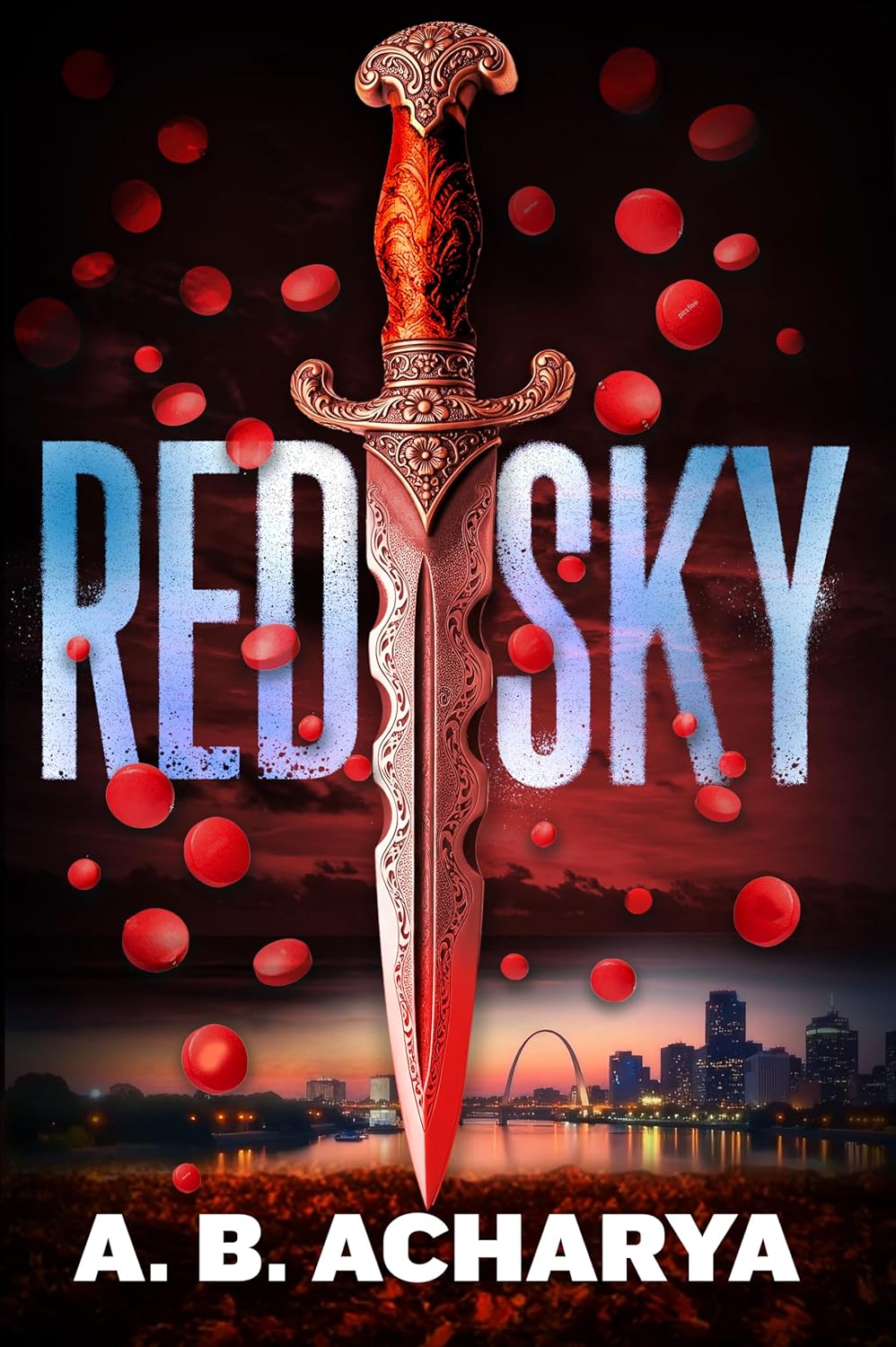

Red Sky is a tense, strange, and very readable science thriller told through the confession of Narin Roy, a brilliant but unstable researcher whose work with DMTA, the street drug known as Red Sky, pulls him into something much larger and uglier than academic ambition. Narin begins the book in an interrogation room, trying to explain “the whole story,” and that frame gives the novel a charged sense of momentum. From the start, his voice is prickly, funny, wounded, and unsettling. He’s the kind of narrator who can be painfully honest one moment and wildly self-deceiving the next, which makes the book feel intimate even when the plot expands into corporate power, experimental drugs, and national security.
What makes the novel work is how closely it stays attached to Narin’s mind. He’s obsessed with credit, status, human improvement, and his own perceived failures, but he’s also vulnerable in ways he doesn’t always understand. His family scenes, especially with Deepa and his parents, give the story warmth and texture before Harvester Pharmaceuticals and Ian Blair pull him deeper into danger. The line “I was sitting on a goldmine” captures Narin’s fatal mix of scientific excitement and personal desperation. He doesn’t just want success. He wants proof that his suffering has meant something.
The thriller elements build around that hunger. Red Sky isn’t just a drug in this story. It’s a promise, a weapon, a temptation, and eventually a moral test. Harvester’s interest in DMTA opens the door to Operation Juggernaut, H138, interrogation, and the chilling idea that clarity can be manufactured at someone else’s expense. Ian is especially effective as a charming, predatory force who understands Narin’s needs almost too well. Their relationship gives the book a slippery emotional center, part friendship, part manipulation, part mutual self-destruction.
The novel also has a surreal edge that keeps it from becoming a straight corporate conspiracy story. Narin’s visions of the Desert Prince, his attachment to the knife, and his fractured sense of reality turn the book into a psychological descent as much as a thriller. The voice can be darkly funny too, as when Narin remarks, “Everyone’s dead, so there won’t be another act.” That kind of line is disturbing, but it’s also exactly the sort of bleak, off-kilter honesty that makes him memorable.
Red Sky is a smart and unsettling novel about ambition, loneliness, chemical transcendence, and the stories people tell themselves when they want to believe they’re doing something important. It’s packed with science, moral compromise, family pressure, and strange intimacy, but its strongest feature is Narin himself. He’s not always easy to like, but he’s fascinating to follow. The book leaves you with the feeling that the real horror isn’t just what Red Sky does to the brain, but what people are willing to do once they think they’ve found a way to control it.
Pages: 334 | ASIN : B0GJJGXLTX

Science Through Storytelling

KRISPR follows a gifted woman whose life evolves from a modeling career to a career in genetics and neuroscience that forces her into an ethical showdown. What was the inspiration for the setup of your story?
I received some excellent advice from one of my colleagues who is a best-selling author. She said, “For your first book, write what you know.” This is what I know. The inspiration for my story comes, in a large part, from my personal life. My daughter was a model and a college student in midtown Manhattan. I hold a PhD in Genetics with a concentration in Neuroscience, and am a college professor in the Midwest, where I currently teach courses on these topics. When I first learned of CRISPR Cas 9 gene editing, I realized immediately that it was a revolutionary new technology that had tremendous promise for curing human disease, but that it also had the potential for abuse. I felt strongly that people should know about this technology, both its promise and its peril; and I thought: what better way to inform, educate, and entertain, than through a story? I believe that through storytelling, narrative brings science to life. Current research shows that storytelling is more effective at educating and informing than facts, and that facts alone often do not influence thinking.
The book treats genetics and neuroscience with real curiosity and detail. How did you approach researching and translating complex science for a general audience?
I believe my ability to research and translate complex science stems from my extensive training (doctorate), my teaching experience (professor), and my authentic curiosity and excitement about these fields. One of my favorite quotes is by the artist George Grosz. He said that exceptional artistry requires “endless curiosity, observation, and a great amount of joy in the thing.” I feel that these three things describe why I’m naturally drawn to science. I like to think deeply about things. In a basic sense, I like to have an understanding of why things happen the way they do in the natural world. This is exciting to me, and I like to share things I’m excited about. I’m particularly fascinated by the fields of genetics and neuroscience, just like the main character in my book, KRISPR. On page 13 of the book, it describes what fascinates her (and me) about these fields:
“Genetics and Neuroscience, on the other hand, were at the cutting edge. She was intrigued by the notion of understanding the genetic code: the entire blueprint for every single living thing in the universe (that would be both the “known” and “unknown” universe, as Dr. Gustaffason would never fail to remind his students). She was enchanted by the thought of elucidating the life story of every being, every ancestry, with all its profundity, with all its faults, with all its successes, with all its secrets, and above all, with all its messiness!
And Neuroscience, the study of the brain, that three-pound mass of gray and white matter that embodied the mind: every thought, every feeling, every memory. The good, the bad, the ugly. The entire spectrum, from the altruistic and the geniuses, to the feeble-minded and the psychopaths. The “Me” of every soul. Still, such a mystery, with so much not understood and left to be learned.
Sure, to the erudite student of neuroscience, brain anatomy is well known (perhaps even committed to memory). Every fold, every sulcus, every gyrus, every nucleus. Every structure is given a funky name like “pyramadus,” “amygdala,” “hippocampus”—but its connections, by which it integrates all that gives rise to the “Me,” were an intricate conundrum for sure.”
The Alzheimer’s storyline is particularly affecting. What made you want to include that element?
Again, personal experience. It was heartbreaking to witness my dad experience the devastating effects of Alzheimer’s. My mom, my siblings, and I were his primary caregivers. It really is the “long goodbye.” Late-onset Alzheimer’s runs in his family. A number of my aunts and uncles succumbed to it. As my cousins and my older siblings age, I can’t help but wonder if this dreadful disease, where one loses so much of their own self, will continue to prevail in our family. Will I get it? Will my children?
What is the next book you are working on, and when will it be available?
The ending of KRISPR sets the stage for a sequel. I plan to continue my “science through storytelling” endeavor in the sequel. A topic I’m currently fascinated by is brain organoids: clusters of millions of brain cells that are cultured in petri dishes. Organoids contain neurons that self-organize, fire electrical signals (action potentials), and model many brain activities. Some refer to them as “mini-brains” or “brains in a dish.” When you think of it, no other organ is as inaccessible for study as the human brain. Understanding how a healthy brain works can provide insight as to how it fails, and organoids derived from individuals with neurological disorders, particularly psychiatric disorders that are hard to model in animals (e.g., schizophrenia, bipolar disorder), could lead to the development of effective treatments. But at what point do the cells in one’s brain become sentient and have a “consciousness?”” At what point do your brain cells enable you to feel joy, pain…to think, to have memory? What happens if these developing organoids become sentient? Do they feel joy, pain? Can they think? Remember? I know it sounds like science fiction, but there are many respected research laboratories that are currently conducting research on organoids.
I’d love to have the sequel written within the next year or two.
Author Links: GoodReads | Website | TikTok | Instagram | Amazon
What she knew for sure-
Her technology was truly revolutionary. It had extraordinary promise for curing human disease, maybe even Alzheimer’s. It also had the potential for abuse-unrestrainable, diabolical abuse. It could never get into the hands of her more powerful adversaries. It should be destroyed.
But doing what’s right isn’t always easy…especially when it comes to the ones you love.
Aliya McKenna has it all…beauty, brains, grit. Her family is close-knit. Her best friends are lively and loyal. And she has met her soulmate. When a world-renowned scientist asks her to collaborate, she jumps at the chance. It was all quite wonderful-until it wasn’t. Faced with precarious choices, her gambles become perilous when she does the wrong things for the right reasons and learns a valuable lesson along the way: just because you can, doesn’t mean you should.
KRISPR is set against the backdrop of the unintended consequences of one of humanity’s greatest innovations, CRISPR-Cas9 gene editing. It is as suspenseful as it is heart-warming and features the coming of age of an intelligent, relatable young woman who out-smarts her opponents, with the added bonus of introducing cutting edge science in an understandable manner.
The Passage of Time
The Admiral’s Gamble follows a decorated officer at the end of his long career, who stumbles upon a mysterious device capable of altering time and leaving him to decide how the future will play out, and at what cost. What was the inspiration for the setup of your story?
The inspiration came from my fascination with the idea of fate versus free will, how a single decision can ripple through time and alter everything that follows. I’ve always loved sci-fi movies and have a deep respect for the military, so I wanted to see if I could combine the two in a meaningful way while keeping traditional values and storytelling at the heart of it.
I found Admiral James Harrington to be a well-written, in-depth character. What inspired him, and what drove his emotional turmoil throughout the story?
Admiral Harrington is a blend of strength, regret, and redemption. He’s inspired by real-world veterans and leaders who carry the weight of their choices long after the battles end. His turmoil comes from the struggle between doing what’s right and doing what’s necessary.
I think everyone, at some point, wonders “what if” — what if we could change a single moment or decision from our past? That’s something everyone can relate to, and it’s what makes Harrington such a human character. He represents that quiet part in all of us that looks back and wonders how life might have turned out differently.
What were some themes that were important for you to explore in this book?
The main themes are sacrifice, morality, and the passage of time. I wanted readers to think about the price of second chances, that even with the power to change the past, you might lose something far more valuable in the process. The story also touches on legacy, how we’re remembered, and whether it’s worth altering fate to protect that legacy.
What is the next book that you’re working on, and when can your fans expect it out?
My next project, Return What Was Taken, was released not long ago. It’s a psychological thriller that explores what happens when the mind begins to fracture, dealing with mental health struggles and the battle between reality and perception. I think that’s something many people in today’s world can relate to on a personal level.
I’m also working on a new full-length novel that combines elements of sci-fi, fantasy, and thriller. It’s a bold story with deep characters and moral questions, similar in tone to The Admiral’s Gamble. My goal is to have it completed sometime next year.
Author Links: GoodReads | X (Twitter) | Facebook | Amazon
Admiral James Harrington thought his final mission was behind him. After decades of service, he’s preparing for retirement until a top-secret assignment throws him into a war not bound by space or time. A temporal breach has unleashed chaos, rewriting history and threatening global collapse. Now, Harrington must lead a mission through shifting realities and fractured timelines, where every choice could erase the people he loves or doom millions. As old enemies resurface and long-buried regrets return, the Admiral must confront not only the mission but himself. This explosive sci-fi thriller blends military strategy, time travel, and deeply human stakes, perfect for fans of Jack Campbell and The Expanse. The Admiral’s Gamble is a story about courage, consequence, and the impossible decisions leaders must make when the future is on the line.


