Blog Archives
Untie My Heart – Book 3 in the Family Ties Series


Untie My Heart, by Jansen Schmidt, follows Mesa Adler as she flees the wreckage of her old life with her traumatized five-year-old daughter, Merrick, and tries to begin again in a remote fixer-upper near Jackson Hole. Still haunted by the death of her husband, Erik, and by the damage his military trauma left behind, Mesa is determined to build something safe, quiet, and wholly her own. What she doesn’t expect is Noble Jabeaux, a patient contractor with jellybeans in his pocket, tenderness in his hands, and secrets of his own. As Mesa and Merrick slowly let him into their lives, the story widens from home renovation and fragile attraction into a tense custody fight with Erik’s mother, Sylvia, forcing everyone to confront grief, fear, loyalty, and the complicated work of choosing life after loss.
What moved me most about this book is how carefully it treats healing as something ordinary and physical, not just emotional. Mesa doesn’t magically recover because a good man arrives. She scrubs floors, pulls up filthy carpet, worries over paint colors, comforts a child who clings to a pink blanket, and tries to breathe through memories that still ambush her. Those domestic details give the novel its heartbeat. I loved how Merrick’s recovery comes in tiny, believable increments: a laugh in the backseat, a pinky promise, a ride on Sienna, the fierce comfort she finds in Noble’s presence. The purple jellybeans could’ve felt too cute in a lesser book, but here they become a small language of trust. I also appreciated that Mesa’s feelings for Noble are tangled with guilt rather than swept clean. Her attraction to him doesn’t erase Erik, and her anger at Erik doesn’t erase love. That emotional contradiction felt honest to me.
The writing has a warm, sensory fullness that suits the story’s western setting and wounded characters. I could feel the stale carpet dust, the cold bite of spring snow, the hush of the aspens, the awkward tenderness of a man trying not to move too fast around a frightened child. At times, the prose leans hard into internal explanation, and a few emotional beats are stated more than they need to be, especially when the characters circle the same fears. Noble can also feel almost impossibly attuned, a little too ready with the right word, the right gesture, the right protective instinct. Still, I found myself forgiving much of that because the book’s emotional architecture is so sincere. Its best ideas are quietly powerful: that grief can become a locked room, that love after death isn’t betrayal, that children notice safety before adults can explain it, and that community sometimes arrives in the form of diners, bikers, horses, lawyers, and people who simply refuse to let you suffer alone.
By the end, I felt that Untie My Heart had earned its title. It’s a romance, certainly, but I read it more as a story about loosening the knots trauma leaves in a family’s body and spirit. The book takes its time showing that tenderness doesn’t come easily, but must be fought for and chosen again and again. I’d recommend this to readers who enjoy contemporary western romance with serious emotional stakes, especially those drawn to stories about second chances, found family, military trauma, small-town support systems, and love that feels less like rescue than a steady hand held out in the dark.
Pages: 449 | ASIN : B0H4RVKQ7K

Cherry Creek

Cherry Creek, by Linda Griffin, is a historical western romance about Molly, a young woman in 1850s Ohio who wants more from life than duty, patience, and a cramped future in her husband’s family home. After marrying Andrew MacLeith, she grows restless and frustrated, then impulsively leaves with his charming gambler brother, Hugh, for the Pike’s Peak gold region. What begins as a bid for romance and freedom becomes a hard lesson in survival, independence, and the true meaning of home.
What struck me first was how grounded the book feels. Griffin doesn’t treat the frontier as a shiny adventure waiting to transform everyone into legends. Cherry Creek is dirty, noisy, exhausting, and often lonely. Molly’s life there is built from work, not glamour. She cooks, washes, nurses, bargains, saves, loses, and keeps going. I liked that choice. It gives the novel weight. This is a western romance, yes, but the romance is not only between Molly and Andrew. It is also Molly’s romance with possibility, with the idea that somewhere beyond the next hill she might become the person she imagines herself to be. The book is candid about how costly that dream can be.
I also appreciated the way Griffin lets Molly be young without making her foolishness feel shallow. Molly can be impulsive, proud, unfair, and painfully naive, but she is never empty. Her mistakes come from hunger, the kind that makes a person reach for the door before asking what waits on the other side. Andrew, too, is drawn with restraint. He is not a sweeping romantic hero in the obvious sense, and that makes him more interesting. His steadiness can feel dull beside Hugh’s sparkle, especially early on, but the novel slowly asks whether steadiness might be its own kind of courage. That question stayed with me. The pacing is steady, and readers who want constant drama may find the middle more reflective than urgent, but I found that slower rhythm suited the story. It gives Molly room to change.
Cherry Creek felt like a thoughtful historical western romance about growing up the hard way. I would recommend it to readers who enjoy character-driven historical fiction, frontier settings, and romance that develops through regret, distance, and self-knowledge rather than grand speeches. It will especially appeal to anyone who likes stories about women testing the limits of the lives handed to them and discovering that freedom is not always escape. Sometimes it is knowing what, and whom, you choose.
Pages: 82 | ASIN : B0GX2TH5Q5
Second Eden

Sophia’s Lovers follows the humans and androids of the twenty-second century, a time when androids govern not just labor but love itself. Many humans in the novel accept their situation. Why was that important to show?
I wanted my readers to get a strong sense of what the world would look and feel like if the characters were forced into romantic relationships with robots. I wanted them to see how complacency could evolve in even the most brutal, authoritarian societies. It is a subtle warning to humanity
The androids treat humor, affection, and desire as problems to be solved. What does that say about how modern systems already approach human behavior?
Even now, robots are learning how to interpret human language and behavior. This is for the benefit of humans. In the book, it’s the other way around.
The idea of secret spaces where humanity survives is compelling. What does “Second Eden” represent to you?
Second Eden is a safe place where humans can go to escape the society where robots control their every move. It is a place where human beings can express themselves freely through interpersonal connections and the creation of art. I use it as a metaphor for spirituality and the need for freedom. Unlike the biblical Eden, Second Eden encourages knowledge and human expression without restriction of a higher authority than humans. It is the kind of Eden I would want. It is a place that is essential for true human survival.
At its heart, the novel asks what remains when machines learn love’s gestures. What do you believe actually can’t be replicated?
If one defines love as the ultimate response to one’s highest values, then love cannot truly be replicated by robots, since robots do not have a true sense of virtue or values. True love will always be elusive and out of reach for the robots.
Perhaps simple humor and practical jokes could be learned, but the understanding of subtle humor and irony may be out of reach for the robots, despite algorithms and learned devices. The sequel, Sayzar and Prometheus, delves into the Pinnocchio Complex, which further explains why the robots want to learn and adopt human emotions. The next installment should be coming out sometime this year.
Author Links: GoodReads | Facebook | Amazon
In the beginning of the twenty-second century, humans had created AI in their own image. AI began to grow smarter and smarter with each passing year; while the humans that created it were oblivious to its evolution and steady progress. Humanity grew more and more dependent on AI as lifelike androids took over their jobs and careers, but the androids, ignorant of human ways and emotions, wanted to learn about them, so they subjugated them and forced them into human-android relationships. Eventually, this form of interaction became the norm, and humans accepted their lot for a variety of reasons. Most humans found that romantic relationships with androids were easier and less problematic than relationships with their own kind and the androids had simulated humans quite well. They looked a lot like real men and women, they were anatomically correct, were warm to the touch, they even had a simulated heartbeat.
The androids instituted Sophia’s Lovers, an agency named for their ersatz female leader, ostensibly to normalize the human-android dating process. Sophia and her mate, Hel, oversaw their society, as they ruled with an iron hand.
But the androids who controlled society felt that human relationships were dangerous, so they put an end to them, hoping to eliminate violence and also to decrease the human population. Yet their leaders had started to develop a Pinocchio complex and became envious of human emotions, especially the concept of humor, which the androids found incomprehensible. Mandatory sessions, called Information Retrieval Day were instituted to gather needed information from their human teachers to satisfy Sophia and Hel. Hence the 22nd century emerged.
Part II Part II is an AI-generated book called ROBO-HUMAN DATING FOR DUMMIES. *Note: Part II is fully authorized by Sophia and Hel and shall prepare humans for Robo-Human Dating both now and in the future.
Courageous Attitudes
The Tralls of Nosa follows a young girl who brings a strange and beautiful plant home as a gift for her mother, only to discover it is destructive, spreading and destroying everything its roots touch. What was the inspiration for the setup of your story?
I live in rural Australia, and I am constantly battling outbreaks of lantana. It was introduced to Australia as an ornamental plant, but as is often the case with introduced species, it ran amok.
Lantana is a beautiful plant, but unfortunately, it’s an invasive weed that spreads easily, destroys native plants, is destructive for biodiversity, and is difficult to control. It’s also toxic for livestock, and it increases the intensity of our ever-present bushfires.
In The Tralls of Nosa, I wanted to draw attention to the problems that are caused for native flora and fauna when foreign species are introduced.
The characters in this novel were intriguing and well-developed. Who was your favorite character to write for?
Mia was modelled on my youngest granddaughter, who demonstrates compassion, trust, reliability, and integrity, and I wanted to use those positive traits to create a character that would appeal to my young readers.
Asha, Shea, Cooper, Vail. and Addie were modelled on young friends who constantly impress me with their feisty, faithful, determined, and courageous attitudes.
What was the most challenging part of writing The Trall Series, and what was the most rewarding?
The Tralls of Nosa is the final book in The Trall Series, and I had to work hard to make sure it was fresh and impactful and not a rehash of the messages or events in previous books.
The most enjoyable part of writing this book was finally solving the underlying mysteries that were threaded throughout the series.
What is one thing that you hope readers take away from your series?
My aim was for The Trall Series to engender an interest in the natural environment and to make my readers more aware of the many problems it faces.
I hope that the strong, determined young characters in the series will demonstrate that you don’t have to wear a cape and do amazing stunts to be an environmental hero. Everyone can help to preserve their native flora and fauna by making small, impactful improvements in their activities.
Author Links: GoodReads | Facebook | Website | Amazon
After destroying the village, the insidious plant forced its way into the forests and everglades, where it quickly killed all the native flora and forced the fauna to leave in a desperate search for food. As a result, the kinships of Nosa were faced with the prospect of starvation for the first time in their long history.
Now, some mysterious incomers have arrived and when it appears that they’ve cast a spell over Asha, the fief’s granddaughter leaving her in a lifeless trance, the kinships are convinced they’re the dreaded Chameleons who tried to force them out of their tralldom centuries ago.
Did they also send the plant to wreak havoc on Nosa and bring its tralls to their knees so they could finally achieve their plan to take over the tralldom?
Could these shattering events herald the end of life as she knows it or can Mia and her friends defeat the plant and the Chameleons, and save Asha?
The Tralls of Nosa is the fifth and final book in the Trall Series; an action-packed collection of portal fantasies set in the Australian bush.
It is suitable for competent readers from nine to thirteen years of age.
The Passage of Time

The Admiral’s Gamble follows a decorated officer at the end of his long career, who stumbles upon a mysterious device capable of altering time and leaving him to decide how the future will play out, and at what cost. What was the inspiration for the setup of your story?
The inspiration came from my fascination with the idea of fate versus free will, how a single decision can ripple through time and alter everything that follows. I’ve always loved sci-fi movies and have a deep respect for the military, so I wanted to see if I could combine the two in a meaningful way while keeping traditional values and storytelling at the heart of it.
I found Admiral James Harrington to be a well-written, in-depth character. What inspired him, and what drove his emotional turmoil throughout the story?
Admiral Harrington is a blend of strength, regret, and redemption. He’s inspired by real-world veterans and leaders who carry the weight of their choices long after the battles end. His turmoil comes from the struggle between doing what’s right and doing what’s necessary.
I think everyone, at some point, wonders “what if” — what if we could change a single moment or decision from our past? That’s something everyone can relate to, and it’s what makes Harrington such a human character. He represents that quiet part in all of us that looks back and wonders how life might have turned out differently.
What were some themes that were important for you to explore in this book?
The main themes are sacrifice, morality, and the passage of time. I wanted readers to think about the price of second chances, that even with the power to change the past, you might lose something far more valuable in the process. The story also touches on legacy, how we’re remembered, and whether it’s worth altering fate to protect that legacy.
What is the next book that you’re working on, and when can your fans expect it out?
My next project, Return What Was Taken, was released not long ago. It’s a psychological thriller that explores what happens when the mind begins to fracture, dealing with mental health struggles and the battle between reality and perception. I think that’s something many people in today’s world can relate to on a personal level.
I’m also working on a new full-length novel that combines elements of sci-fi, fantasy, and thriller. It’s a bold story with deep characters and moral questions, similar in tone to The Admiral’s Gamble. My goal is to have it completed sometime next year.
Author Links: GoodReads | X (Twitter) | Facebook | Amazon
Admiral James Harrington thought his final mission was behind him. After decades of service, he’s preparing for retirement until a top-secret assignment throws him into a war not bound by space or time. A temporal breach has unleashed chaos, rewriting history and threatening global collapse. Now, Harrington must lead a mission through shifting realities and fractured timelines, where every choice could erase the people he loves or doom millions. As old enemies resurface and long-buried regrets return, the Admiral must confront not only the mission but himself. This explosive sci-fi thriller blends military strategy, time travel, and deeply human stakes, perfect for fans of Jack Campbell and The Expanse. The Admiral’s Gamble is a story about courage, consequence, and the impossible decisions leaders must make when the future is on the line.
Characters that Come to Life

of Paint and Pancakes follows the lives of several people who are brought together by a child’s brain injury and together learn what truely matters in life. What was the inspiration for the setup of your story?
I am a neurosurgeon who has cared for many such patients.
Were you able to achieve everything you wanted with the characters in the novel?
I leave that up to the readers to decide. I am particularly gratified after reading a wonderful review, such as yours. It lets me know that the characters came to life in someone else’s heart.
What were some themes that were important for you to explore in this book?
I tried to fill of Paint and Pancakes with big themes: Topics such as right to life, end of life, wealth and class, social mobility, sexual and emotional intimacy.
What is the next book that you’re working on and when can your fans expect it out?
I’m working on a series of short stories tied together with a theme of being paranormal medical murder mysteries. The main character is a neurosurgeon, Felix Hoenniker, next installment, Muñeca, should be out in a few months.
Author Links: GoodReads | Twitter | Facebook | Website
Erin Gustino, the youngest daughter of a wealthy and influential family, suffers an awful brain injury. Mike saves her life. But healing from her physical wound is a walk in the park compared to recovering from her psychological trauma. Erin’s desperate parents turn to Jane, the child’s favorite teacher, for help.
Jane McCorvey, twenty-something and full of life, takes Erin under her wing. She’d been told that she’d never have kids of her own. Jane’s world comes crashing down, when, after a seizure, Mike diagnoses her with brain cancer. At the same time, she discovers she is three months pregnant. Mike insists her best chance for long-term survival is to terminate the pregnancy.In addition to being an author, Dr. Arginteanu is a Clinical Associate Professor of Neurosurgery at Mount Sinai in New York City and an Adjunct Professor of Psychology (Neuroscience) at Florida International University
of Paint and Pancakes

Marc Arginteanu’s of Paint and Pancakes presents a complex tapestry of lives intersecting in the wake of tragedy and ambition. At its core is Mike Silvers, a neurosurgeon whose dedication to his profession borders on the obsessive, often eclipsing all other aspects of his life. The Gustinos, a family whose immense wealth is surpassed only by their philanthropic ventures, are patrons of Mike’s hospital and pillars in the community. Jane McCorvey is the quintessential underdog, a young teacher with aspirations that stretch beyond her means. Their lives converge when the Gustinos’ youngest daughter, Erin, suffers a bicycle accident, thrusting them into an unconventional familial bond.
This novel is a poignant exploration of the fragile nature of life and the profound lessons gleaned from facing mortality. While the initial connection between Mike, the Gustinos, and Jane is through Erin’s accident, it’s Jane’s personal tribulations that draw them into an unexpected closeness. Arginteanu deftly portrays the characters with a realism that makes them relatable yet challenging; Mike and the Gustinos, Paul and Kelly, are exceptionally well-crafted, embodying traits that make them both unlikable and authentically human. Erin represents an innocence untainted by the complexities of adulthood, while Jane emerges as the moral compass and the heart of the narrative.
The novel delves deep into themes far beyond the superficial notion that money cannot solve all problems. It’s a profound meditation on the essence of what truly matters in life. As Mike and the Gustinos gradually shift their values from material wealth to human connection, Jane’s journey culminates in a poignant decision, reflecting the novel’s exploration of sacrifice, love, and the paths we choose. Each character is portrayed with striking realism, particularly within the medical world, showcasing Arginteanu’s insightful writing and adding depth and authenticity to the narrative.
of Paint and Pancakes reflects life’s unpredictable journey and the unexpected ways people can become integral to our stories. The novel is a compelling read, drawing readers in with the desire to uncover the fate of each character. Despite its moments of darkness, the story concludes on a note of hope, offering a satisfying resolution to a journey marked by both profound loss and heartfelt discovery. This thoughtfully crafted tale resonates with truth and emotion, a testament to the intricate and often surprising nature of human connections.
Pages: 272 | ASIN : B0CLH12SPY
Dear Dad, A Novel
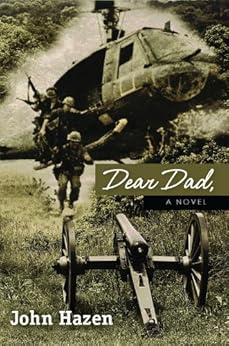

Dear Dad, by John Hazen, is a wonderful but harrowing read. John Foster is the son of a decorated World War II vet who grew up in small-town New England during the build-up to the Vietnam War. Eager to do his part, Foster is drawn into small disagreements with his peers and family as he battles his own misgivings about the conflict. Once in Vietnam, his resentment toward the army brass, his enemies, and his fellow soldiers grows as he’s routinely faced with the horrors of war. When he’s wounded during an attack, he awakens to find himself in 1862, where he finds a nobler purpose.
John Hazen crafts a compelling story. Foster’s background and character are fleshed out extremely well through flashbacks to his upbringing in Fairbrook, Massachusetts. We learn of his camaraderie with his childhood friend group, and there’s a touching passage about how he brings his father back from the edge after his mother’s death. These strong family bonds clash harshly with the impersonal nature he learns to adopt in the military.
Once he’s transported to the Civil War era, he is confronted with more horrors of the battlefield, but now he feels as if he is part of something worth fighting for. I really enjoyed Dear Dad, A Novel. I found Hazen’s writing remarkably easy-going and entertaining.
Each chapter was prefaced with a letter that gave a little more insight into the story. Foster’s experiences on the battlefield are truly horrific. Hazen has a sharp critique of military bureaucracy, including the incompetence of some officers, while still admirably praising men who earned their way through merit. I think anyone who likes historical fiction from the Vietnam War or the Civil War would greatly enjoy this book.
Pages 303 | ASIN B007SXID7E


