Blog Archives
Fairy Tales

The Changeling follows a self-assured gray cat who must outwit fairies, reverse a tangled chain of enchantments, and rescue his beloved human’s baby before magical bargains throw two kingdoms into lasting chaos. What inspired the setup to this story?
The idea of a changeling story dropped into my brain many years ago, probably around 2003. I actually did an entire research paper on changelings for a Library Science class to get background information and understand changeling mythology. The story originally started as a picture book in which a fairy was defending himself in a fairy court because he had given himself away as a changeling. I really couldn’t get it to work, and every time I workshopped it, it was suggested that I expand the idea into a full-length novel. I resisted the idea as long as I could until a story wormed its way into my brain. I started to read tons of fairy tales – The Green Fairy Book, The Violet Fairy Book, The Yellow Fairy Book – to get an idea of how fairy tales work, and specific details I might be able to use in mine. Smokey, the cat, is based on my beloved Kula, who was devoted to me and me alone. I drew on many of his cat behaviors and mannerisms to create Smokey’s character.
How did you balance traditional changeling folklore and fairy-tale conventions with the novel’s distinctly comic tone?
The traditional convention is the use of an omniscient narrator to tell the story without much character development or emotion. Although my original picture book was in first person, I couldn’t figure out how to write a novel that way. Who would tell the story, and who could be everywhere to witness everything? Subsequently, my early drafts as a novel were in third person. As a Children’s Librarian, I constantly read current fiction for kids and young adults. At the time I was trying to write THE CHANGELING I was reading the Bartemeus trilogy by Jonathon Stroud. I loved the sarcastic voice of the djinnie Bartemeus, which Stroud did so well, and wanted to create that kind of humor in my story. The humor came with the change of having Smokey tell the story, who could easily access any point in the kingdom and know everything going on. In first person, his personality came to life naturally and added the comic tone I was hoping for.
The princesses ultimately prove themselves worthy heirs through ingenuity and courage. Was challenging traditional ideas about royal succession part of the story from the beginning?
No. The princesses didn’t exist in early versions. A mentor whose opinion I greatly value, Anne Ursu, suggested I write the story from the point of view of a princess. I didn’t follow her advice since at this point I had fallen in love with Smokey and was determined on having a cat be my narrator. Her advice stuck in my brain, however, and I came to the conclusion that I could include a princess to help unravel all the enchantments, because I didn’t know how Smokey could do it alone as the events became more entangled. The other princesses were added as I figured out whose baby would be taken and why.
Choice becomes increasingly important as characters reconsider family, duty, power, and even the lives they want to lead. What drew you to that theme?
I’ll be honest and say the current political atmosphere, although I don’t think I realized that at the time. People in charge make decisions without giving a lot of thought about what they are asking or who it affects. Luckily, I found ways to make those decisions comical, for example, when the servants became invisible except for their gloves. While writing the story, I was not aware of the developing theme, but as I neared the end, I thought quite a bit about choices and repercussions and was pleased I had provided choices at the end for all involved and to give Smokey a happily ever after. Plus, it has led to the sequel I’m working on. In Book 2 of the series, which I am calling The Kingdom of Cats, Princess Rose will narrate the story for Anne.
Author Links: GoodReads | Facebook | Website | Jennifer Sommer | Amazon
The Changeling


Jennifer Sommer’s The Changeling is a lively middle-grade fairy tale that draws on changeling folklore, fairy bargains, leprechauns, enchantments, royal succession, and traditional storybook magic while giving the material a distinctly comic personality. The novel is narrated by Smokey, a self-assured gray cat whose devotion to his human, Maeve, provides the emotional center of the story. When Maeve’s newborn son, Malachy, becomes part of a secret bargain involving Queen Eglantine and Fairy Queen Oona, Smokey finds himself trying to undo a complicated chain of magical exchanges and retaliatory spells. His determination grows naturally from the bond established early in the book, when he explains that one human is enough for him and that he remains devoted to Maeve. Sommer uses that loyalty to give the increasingly elaborate fantasy plot a clear purpose: beneath the fairies, palace intrigue, magical flowers, and talking cats is a story about protecting the people one has chosen to love.
Smokey’s voice is the book’s strongest distinguishing feature. He observes human behavior with the confidence of a cat who considers himself considerably more perceptive than the people around him, and his commentary keeps even dangerous situations buoyant. The humor ranges from feline observations and wordplay to elaborate comic episodes involving invisible servants, a royal court transformed into cats, prank-loving wagwits, and an unfortunately persistent magical case of flatulence. Yet Smokey is more than a vehicle for jokes. His frustration when Maeve can’t understand his warnings about the changeling gives the story genuine tension, and his developing relationship with Lady Camellia adds warmth without pulling attention away from the central rescue. Sommer also gives the supporting cast clear personalities, particularly the resourceful princesses, whose search for the ingredients needed to restore their baby sister allows them to become active participants in solving the kingdom’s problems.
The novel’s many enchantments are tied together by a recurring concern with decisions and their consequences. Queen Eglantine’s original bargain comes from her fear that she has failed to provide the king with a male heir, while King Geoffrey’s temper repeatedly worsens his conflicts with Carabosse. As the story progresses, characters have to reconsider assumptions about duty, family, power, and what makes someone worthy to rule. The princesses prove themselves through ingenuity, persistence, and loyalty, and Geoffrey’s eventual recognition of their abilities gives the succession plot a satisfying resolution. His declaration that his daughters “have proved themselves more worthy heirs than I ever was” marks a meaningful change in both the king and the values of his kingdom. Importantly, that change grows out of what the girls have actually accomplished over the course of the novel, so the conclusion feels connected to the adventures that precede it.
The Changeling works as an affectionate and humorous fairy-tale adventure built around loyalty, resourcefulness, family, and choice. Its large cast and intersecting enchantments give the story an episodic quality, with each new magical complication creating another problem for Smokey and his allies to solve. Those episodes gradually converge as Malachy is recovered, Fleur is restored, the royal family changes, and several characters discover that an enchantment can open a path toward a life they freely prefer. The Christmas epilogue brings that idea home through Smokey, Camellia, and their kittens, with Smokey reflecting that “Choices are peculiar things. They can cause havoc on a kingdom, but sometimes, sometimes, things turn out just as they should.” It’s an apt closing thought for a book in which magic creates the trouble, but character, affection, and deliberate choices finally determine what happens next.
Pages: 216 | ASIN: B0GSH6B7JG

“The Mother of Hubble”

Her Eyes Were On the Stars: Nancy Grace Roman, “Mother of Hubble” Space Telescope, tells the story of how one girl’s dream of becoming an astronomer turned into a reality. What inspired you to tell her story?
At the time, I was looking for subjects to write about. I was hearing a lot about STEM and biographies for women in science, so maybe it was prophetic when I was watching an episode of NOVA on PBS about the Hubble Telescope and “the Mother of Hubble” when the name of Nancy Grace Roman was mentioned, and I thought she might be an interesting person to write about. She was certainly someone I had never heard of before and I was willing to bet others hadn’t either. I realized how remarkable she was after I started some preliminary research. I was fortunate to find her email on NASA’s website and to receive a quick response from her saying she would be interested in doing a telephone interview with me. From there, there was no turning back!
Your background in Engineering and having an MLIS in children’s literature gives you a unique perspective on writing nonfiction children’s books. What is the most rewarding part of writing books for children to you?
For me, it is that feeling I want to recreate that I had as a child reading really good books, magical books, or those that gave me a glimpse into someone else’s life. I’ve always had an interest in science, so maybe I am more interested in writing about those subjects. But I am also a very creative person, and my interest in architecture and interior design goes back to my creativity. So even though I love writing nonfiction, I also love making stories up, too.
What were some educational aspects that were important for you to include in this children’s book?
One thing I wanted to convey was how important first-hand accounts are to research. Primary sources are essential, and that was why I wanted so badly to interview Dr. Nancy Grace Roman in person. I wanted her account of events. I always tell kids that research can be like a game of telephone. The original message gets tangled the more times it gets told. So, one thing I really wanted to include in this book were the actual quotes Dr. Roman said to me. Also, I included all the other sources I used in the bibliography in the back that can be checked against my work. We all need to remember that just because someone says something, it doesn’t mean it’s true. Check your facts!
Will this book be the start of a series? I would love to see more books about other women in science, or are you working on a different story?
This book is a stand-alone, with no plans for more in a series. I do have other books, both nonfiction and fiction. One nonfiction book I am very proud of is Octopus Capers that is still unpublished, but with my agent, Stephen Fraser of Jennifer DeChiara Literary Agency. He also has a middle-grade fantasy called The Changeling. Currently, I am working on a Halloween picture book called Every Creature Eats about a witch’s party where she is pushing lots of “treats” on her guests. It’s the kind of book I would’ve loved to have had as a Children’s Librarian at the library, where I would read a story to the kids, and then we’d have an activity related to the book, in this case, a snack.
Author Links: GoodReads | Twitter | Facebook | Website | Amazon
As a child, Nancy Grace Roman moved from home to home. The only constant? The nighttime sky. She loved the stars and knew from a young age that she wanted to become an astronomer. But could she, during a time when many women weren’t even allowed into colleges? Nancy Grace found a way to overcome each barrier placed before her. Her persistence paid off when she was named the first female executive as Chief of Astronomy at the newly created National Aeronautics and Space Administration, or NASA, in 1959. It was here she faced her biggest challenge to date.
Astronomers across the country wanted a telescope that would orbit in space above the Earth’s atmosphere allowing for the clearest view of the stars a telescope had ever seen. The problem? At this early stage of the United States space program, engineers hadn’t even successfully launched a rocket. How would Nancy Grace ever get a telescope into space? HER EYES WERE ON THE STARS introduces readers to a female scientist in the field of astronomy who will be forever affectionately known as “Mother of Hubble.”
“…is often forgotten by our younger generation of astronomers who make their careers by using the Hubble Space Telescope. Regretfully, history has forgotten a lot in today’s Internet age, but it was Nancy Grace Roman in the old days before the Internet and before Google and e-mail and all that stuff, who really helped to sell the Hubble Space Telescope, organize the astronomers, who eventually convinced Congress to fund it.” – Ed Weiler, former NASA Chief Scientist for Hubble
Her Eyes Were on the Stars: Nancy Grace Roman, “Mother of Hubble” Space Telescope
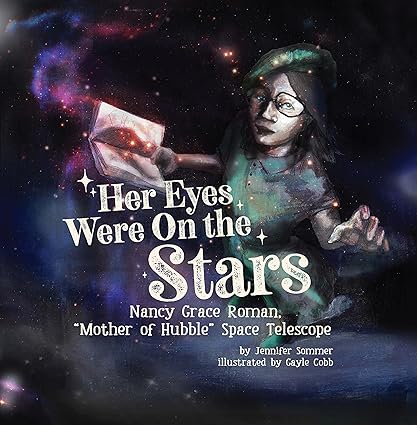

From a tender age, Nancy Grace Roman harbored an unwavering fascination with the stars. The ever-shifting backdrop of her life, due to her father’s profession, meant frequent relocations. Yet, wherever they settled, Nancy would swiftly shift her gaze upwards, always finding comfort in the constellations. Living in an era where societal norms often dictated the paths women could take, many of Nancy’s contemporaries aspired to professions like nursing. However, Nancy was not to be swayed from her celestial aspirations.
Opting for the path less traveled, she pursued her ambitions and secured a coveted spot at Swarthmore College in Pennsylvania—a progressive institution that admitted women during a time when many did not.
Nancy’s journey was marked by audacity and brilliance. Graduating with a degree in astronomy in 1946, she navigated the male-centric world of her profession with tenacity. Nancy’s indomitable spirit saw her make significant contributions to our understanding of the Milky Way. When she joined NASA, her stellar trajectory culminated as she assumed the esteemed role of the first female Chief of Astronomy. Among her many accolades, Nancy’s pivotal role in the conception and realization of the Hubble Space Telescope stands out—a monumental endeavor that has since become instrumental in myriad research projects.
This biography underscores the potency of persistence and fortitude. It serves as a compelling testament to women’s capabilities and a call for society to nurture and uplift their ambitions. It conveys the importance of believing in oneself and pushing boundaries.
Accompanying the narrative are Gayle Cobb’s illustrations, which are nothing short of mesmerizing. The artistry she brings to the pages draws readers into Nancy’s world. However, I felt that the font size was a tad small.
As an astronomy enthusiast, I was thoroughly engrossed by the tale and the visuals. Her Eyes Were on the Stars seamlessly melds the essence of an autobiography with the brevity of a short story. A captivating read that is sure to inspire and enlighten young readers.
Pages: 36 | ISBN : 1955791511


