Blog Archives
A Family Across Town


Aynah V. Askanas’s A Family Across Town is a candid memoir about growing up inside a secret whose effects were visible long before its facts were known. Askanas’s father, a Los Angeles pediatrician, maintained two households for more than thirty years, dividing his time between six children and two women. The memoir begins with the revelation of that double life, then returns to the family histories and childhood experiences that preceded it. This structure turns a startling discovery into a broader examination of secrecy, inheritance, and the emotional atmosphere parents create for their children.
Askanas writes in an intimate, conversational voice, building the family portrait through sharply remembered domestic details. Her mother’s cracked hands, her father’s closed bedroom door, an altered wedding photograph, and holidays celebrated on the wrong day all become evidence of a reality the children could sense but couldn’t name. Askanas captures that experience vividly: “Like corpses in an attic, the secrets emitted an odor that permeated our home, though my siblings and I didn’t know where it came from.” Her humor, often dry and self-questioning, provides necessary relief while preserving the gravity of the story.
The book’s emotional reach extends well beyond its central revelation. Askanas traces how the concealed family shaped each sibling differently, contributing to depression, aggression, substance use, perfectionism, and her own prolonged insomnia. She also places her mother’s choices within the economic and social constraints faced by women of her generation. These reflections give the memoir historical and psychological breadth. At times, Askanas presses the secret into service as an explanation for nearly every illness or misfortune, including physical disease. That interpretive consistency gives the narrative coherence, though some connections remain more speculative than demonstrable.
I think what distinguishes A Family Across Town is its willingness to hold affection and anger together. Askanas recounts her father’s deceit and cruelty while acknowledging the confidence, education, and love of reading he gave her. Her mother emerges as wounded and complicit, but also stylish, funny, devoted, and increasingly independent after the secret is exposed. The later chapters, which include a cruel dispute over paternity and the gradual softening of old judgments, deepen the book’s moral complexity. This is a clear-eyed family reckoning that finds healing in truthful testimony and in the durable bonds among those who survived the same divided home.
Pages: 256 | ASIN : B0GPDMYWJM

The Rug Dealer

Martha L. Thompson’s The Rug Dealer is a candid, fast-moving memoir about desire, reinvention, and the stories we tell ourselves when reality threatens a cherished fantasy. It begins with Thompson at the Turkish Consulate in Los Angeles, trying to finalize a divorce from a man who disappeared decades earlier, then circles back to 1980, when she arrived in Konya as an adventurous but sheltered teenage exchange student. There she becomes infatuated with Mehmet, a charismatic rug dealer whose pull on her shapes years of romantic decisions, dangerous travels, and startling misjudgments.
Thompson writes in a direct, conversational voice that preserves the immediacy of her younger self. Her descriptions of Turkish tea, crowded trains, family apartments, ancient landmarks, Manhattan streets, and backstage life give the memoir a vivid sense of place. The most revealing moments come when the older author allows us to recognize dangers that the young Martha can’t yet understand. Attraction repeatedly overrides warning signs, and acting becomes both a genuine vocation and a way to escape feelings she hasn’t learned to face. That tension gives the book its emotional momentum.
The memoir’s many short chapters create an episodic rhythm, carrying Martha through Turkey, Paris, Portugal, New York, regional theaters, Juilliard, and Los Angeles. Some emotional patterns recur often, particularly her search for men who resemble Mehmet and her habit of treating risky situations as romantic adventures. Yet that repetition also conveys the stubborn nature of obsession. Thompson doesn’t polish her younger self into an easy heroine. She records her dishonesty, self-absorption, cultural assumptions, and reckless choices with unusual openness. The warmth brought by her acting career, her dog Gus, and her eventual relationship with Don gradually deepens the story beyond romantic fixation.
The Rug Dealer will appeal most to readers who enjoy memoirs about complicated relationships, youthful risk-taking, international travel, and the slow work of gaining self-knowledge. Theater lovers will appreciate the substantial account of Thompson’s training and professional acting life, while readers interested in Turkey will find plenty of sensory and cultural detail viewed through an American visitor’s evolving perspective. It’s an especially good choice for anyone who’s ever looked back on an old obsession and wondered how much of its power came from the person involved, and how much came from the life they imagined around them.
Pages: 242 | ASIN : B0GKQXRLF9
Held in the Vanishing


Ti Mougne’s Held in the Vanishing is an intimate memoir about caring for two parents whose lives are being altered by different forms of dementia. Her father has Alzheimer’s disease, while her mother has Primary Progressive Aphasia, which gradually takes away her ability to understand and use language. Mougne writes from the complicated middle of this experience, where caregiving, marriage, parenting, work, and grief all occupy the same crowded space. Early in the book, she explains its purpose with striking simplicity: “Stories don’t offer maps. They offer companionship.” That idea shapes everything that follows.
The memoir begins with the lively multigenerational home Mougne created with her husband, son, and parents. Holiday dinners, elaborate parties, piano lessons, bad jokes, pets, and familiar household sounds give the reader a clear sense of what the family shared before dementia began changing its rhythms. This attention to ordinary life matters because it gives every later loss a history. Her parents aren’t presented only through their diagnoses. They’re a devoted couple who dance at their fiftieth-anniversary celebration, a mother who loves Halloween, and a father whose trusting nature becomes dangerous when Alzheimer’s damages his judgment. The warmth of these memories keeps the story grounded in people rather than conditions.
Mougne is especially perceptive about the work of caregiving that happens beyond public view. She describes the constant calculations involving medications, finances, safety, housing, dignity, and medical care, along with the guilt that seems to attach itself to every decision. She also examines how that responsibility affects her husband and son, and she’s candid about the anger, numbness, resentment, and exhaustion she carries. One of the book’s most honest insights is that “Sometimes love is nothing more than showing up again tomorrow.” Here, love often takes the form of gluten-free toast, a corrected television setting, a difficult phone call, or another visit after an emotionally bruising day.
The book’s short chapters and spacious, line-broken prose give it the feel of a memoir written partly through poetry. That style suits Mougne’s subject because dementia rarely unfolds as a smooth narrative. It arrives through fragments, repetitions, silences, brief recoveries, and sudden recognitions. Concrete images, including vanished ducklings, clouds admired from a car window, weekly margaritas, lightning bugs in a jar, and an empty road across the prairie, carry much of the emotional meaning. The later chapters turn inward as Mougne considers the identity she built around being a “good daughter” and begins finding a version of care that allows her to remain present without erasing herself.
Held in the Vanishing is a memoir about how love changes when memory, language, independence, and familiar family roles begin slipping away. It holds tenderness and frustration together without forcing either into a comforting conclusion. Mougne’s parents continue to decline, difficult choices continue to surface, and her understanding of herself continues to evolve. What gives the book its power is its close attention to what remains: humor, ritual, touch, shared meals, flashes of recognition, and the decision to stay connected even when connection has to take a new form. It’s a deeply personal account, but its emotional clarity makes the experience feel shared.
Pages: 151 | ASIN : B0H6N8CGHC
A Story Worth Telling

In Home, you share your childhood experiences with hunger, addiction, shame, and repeated uprooting through the lens of adult trauma therapy. What inspired you to share your story with readers?
In the beginning, I wrote to give voice to the child I was, to bear witness to her pain and her struggle. It was a way of reclaiming myself. For so long, my childhood was a tremendous source of shame to me, a story I’d never told anyone. Somewhere along the start of the almost ten-year process of writing my memoir, I found Brené Brown and her work on shame. Her quote, “You either walk inside your story and own it or stand outside your story and hustle for your worthiness,” stopped me cold. I realized that I had a story worth telling, and that in doing so, it had the potential to help others.
Was there a particular childhood memory that was especially difficult to put on the page?
The most difficult memory for me was contained in the chapter “Dragons.” It describes the story of when my family lived in a hippie commune in the Haight-Ashbury district of San Francisco in 1970. It was particularly difficult to write about because I was dissociative for much of that time.
How did learning about trauma change the way you viewed your childhood?
Previous to learning about trauma, I perceived many of the skills and strategies I used to survive as weaknesses. Learning that these were, in fact, “hidden talents” was an absolute game changer for me. It shifted my thinking from someone with significant deficits to a woman with assets and adaptive skills she could use in positive ways.
Looking back, were you surprised by how much small gestures shaped your resilience?
Yes. Before trauma therapy, I had difficulty remembering positive moments. After therapy and through the writing process, I was able to remember what I once described as lily pads of safety in otherwise stormy waters, which allowed me to hopscotch to a better life on the other side—teachers, caring neighbors, bus drivers, cafeteria ladies, the parents of friends, and other caring individuals who were sources of support and nurturance.
Author Links: GoodReads | Amazon
After nearly losing her husband, Amy Smyth Miller’s panic spirals out of control. Therapy reveals a diagnosis: Complex PTSD. In search of healing, Amy embarks on a harrowing excavation of her past-childhood neglect, homelessness, parental addiction, and a family history shadowed by suicide. Amid the wreckage, she discovers the people and circumstances that kept her safe and helped to shape her life: her wise great-grandmother’s teachings, the watchful eyes of caring adults, and her own fierce determination. Each memory is a clue, each family story a piece of the puzzle. But the most elusive truth is buried in a forgotten childhood memory-one that holds the key to her deepest fear.
Part investigation, part love letter to survival, Home is a courageous story of trauma and transformation, love and forgiveness, and realizing that sometimes the home you’re searching for is the one you build inside yourself.
Home: A Memoir of Family, Forgiveness, and Healing from Complex PTSD

Amy Smyth Miller’s Home is a tender and unsparing account of a childhood shaped by instability, hunger, addiction, shame, and repeated uprooting, then revisited through the clearer lens of adult trauma therapy. The memoir begins with Miller’s terror after her husband Ron’s heart attack, when an ordinary marital crisis opens a trapdoor into old abandonment wounds. From there, she moves backward through a life of van rides, motels, Catholic school humiliations, vanished homes, family secrets, her mother’s despair, her father’s volatility, and the small mercies that kept her intact: Grandma’s pie crust lessons, warm bread at a friend’s house, a teacher’s faith in her, the fierce shelter of women she calls Las Madres, and finally the hard-won understanding that “home” is not merely a place but a repaired relationship with the self.
I enjoyed the way Miller writes childhood from the inside out. She doesn’t flatten young Amy into a symbol of suffering; she lets her be hungry, observant, funny, embarrassed, furious, loyal, and achingly hopeful all at once. The scenes have a lived-in texture that makes them difficult to shake. I could feel the dread in the old house with the locked room and water-filled storm cellar, the humiliation of being sent home because a dress was too short, the quiet heartbreak of a forgotten birthday, and the surreal horror of cleaning blood from the bathroom floor after her mother’s suicide attempt. Miller’s prose is strongest when it trusts sensory memory: bleach coiling through a room, a motel sign blinking in the desert night, homemade bread arriving like grace. The explanatory passages about trauma and research slow the narrative, but I also understood why they were there. It’s a memoir about what happened and also about learning how to name what happened after spending years surviving it without language.
I found the book’s ideas about forgiveness especially moving because Miller doesn’t make forgiveness feel soft or easy. She refuses the shallow version of it, the kind that asks a wounded person to tidy up the past for everyone else’s comfort. Instead, forgiveness here feels more like excavation: painful, dusty, uneven, and necessary only because carrying the old verdicts became its own kind of captivity. I appreciated that she can see her parents clearly, including their addictions, racism, neglect, and emotional damage, while still refusing to reduce them to monsters. That nuance gives the book its moral weight. The most powerful thread, for me, was the way Miller keeps finding evidence of resilience where she once saw only damage. Singing “Is That All There Is?” in class, protecting her siblings, finding belonging in books and music, working in the fields, returning to school credits when a teacher tells her she can still graduate – these moments don’t erase the pain, but they complicate it. They show a girl repeatedly trying to build a self from whatever scraps of safety she can find.
Home felt less like a straight path from trauma to healing and more like a house slowly being lit room by room. Miller’s final reflections, especially her recognition that the cycle has been broken and that her wounds did not become her children’s inheritance, give the memoir a quiet and deeply earned beauty. I’d recommend it to readers who appreciate reflective memoirs about family trauma, complex PTSD, addiction, resilience, and forgiveness, especially those who want a personal story that’s emotionally honest without being self-pitying. This is a book for anyone who understands that healing rarely arrives as a grand revelation; sometimes it comes as the courage to look back, take the child self by the hand, and finally lead her home.
Pages: 306 | ASIN : B0G736Q1LS
Mud, Microbes & Medicine

Mud, Microbes, and Medicine is a memoir of reinvention, but it never feels neatly prepackaged. Elizabeth Aden begins with the rupture of an early, stifling marriage and follows that break into graduate school, fieldwork in what was then the New Hebrides, painstaking hepatitis B research on Malo, and eventually a striking rise through biotech and global pharma leadership. What gives the book its shape is not simple career ascent, though, but the way curiosity keeps dragging her forward into harder and stranger terrain. A scene as comic as her arrival in a “Safari Barbie” outfit on a remote island sits beside the slow, exacting labor of gathering blood samples and behavioral observations, work that eventually helped explain how chronic HBV infection was being transmitted in infants through intimate, ordinary caregiving behaviors.
Aden writes with a brisk, unembarrassed clarity that lets the absurdity of life show itself without much coaxing. She’s funny in a dry, self-implicating way, especially when she recounts her own naïveté, whether she’s blurting out the wrong thing on arrival, imagining Pacific fieldwork as a sun-drenched fantasy, or learning business, contracts, and drug development on the fly. That candor makes the book feel lived rather than curated. I also liked that the memoir resists the usual triumphalist glaze. Her progress comes with loneliness, bad judgment, professional bruising, gendered disrespect, and the kind of fatigue that success stories usually airbrush away. Even when she rises quickly in biotech and pharma, the tone stays grounded, as if she still can’t quite believe where saying yes, and sometimes refusing to behave as expected, has taken her.
The author makes a persuasive case that science without cultural attention is half blind. Her HBV work is the clearest example. The breakthrough does not arrive as abstract lab brilliance alone, but through patient attention to who holds a child, who feeds a child, who sleeps beside a child, and how everyday life carries risk in ways a cleaner, more conventional hypothesis could miss. That interplay between anthropology and epidemiology gives the memoir real intellectual voltage. I found the chapter-end lessons explicit. The lived material is often richer than the distilled takeaway, and I trusted the story more than the summary. This is a book written by someone who has spent a lifetime extracting meaning from mess, and there’s something moving in that habit.
I found Mud, Microbes, and Medicine invigorating precisely because it is not only about achievement. It’s about learning how to move through bewilderment without becoming smaller, and how a life can be built from nerve, improvisation, intellect, and a refusal to accept the script handed to you. I closed it feeling I’d been in the company of a mind that is restless, capable, sometimes bruised, often funny, and unmistakably alive. I’d recommend it especially to readers who like memoirs with real intellectual substance, to women in science or business, and to anyone drawn to books about fieldwork, medicine, and the unruly ways a life can unfold.
Pages: 352 | ASIN : B0FD43F4X8
Unconverted: Memoir of a Marriage
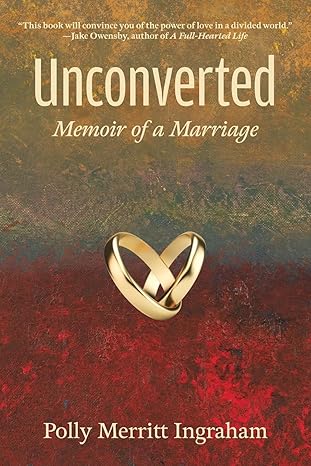
Polly Ingraham’s Unconverted is a moving, often funny, and beautifully written memoir chronicling her unexpected marriage to an Episcopal priest and the even more surprising journey that followed. The book tells the story of a secular woman navigating life, love, and identity inside the deep tradition of the Episcopal Church, not as a convert, but as a skeptic and sometimes reluctant participant. Through candid reflection, Ingraham explores what it means to love someone whose beliefs are fundamentally different from your own and how a marriage can flourish without shared faith, provided there’s shared respect, curiosity, and deep affection.
Ingraham’s writing is sharp and unpretentious, often funny and achingly honest. She manages to be both thoughtful and down-to-earth as she walks us through moments of discomfort, discovery, and the quiet ache of being the odd one out in a world of ritual and belief. Her prose doesn’t waste words. She brings you in close, never asking for sympathy, only understanding. I especially appreciated her refusal to fake devotion just to fit in. That kind of integrity made me root for her all the way through. Her love for Rob is never in doubt, but she doesn’t sugarcoat the strain of being partnered with someone whose life is woven into a faith you don’t share.
There’s also something deeply comforting about her insistence on staying herself, even when the pressure to change would’ve made it easier. I felt her unease during the high church services, her resistance to the wafer and wine, her side-eye at the church politics, and clunky old houses with drafty corners. It felt real. And yet, what held this book together wasn’t doubt or division, it was tenderness. Her marriage, though often challenged by theological distance, is grounded in mutual admiration and a kind of quiet, dogged love that I found deeply moving. There’s no dramatic conversion here, no tidy resolution, but there is growth. And a kind of grace that doesn’t require belief to feel.
I’d recommend Unconverted to anyone who’s ever felt like a bit of an outsider in their own life or who’s struggled to be true to themselves while loving someone very different. It’s especially poignant for secular readers navigating religious families, marriages, or communities. This book doesn’t offer easy answers, but it offers something better: honesty, humor, and hope that two people can build a beautiful life without having to believe all the same things. That feels pretty miraculous to me.
Pages: 284 | ISBN : 978-1578694006
Such a Pretty Picture


Andrea Leeb’s Such a Pretty Picture is a devastating and intimate memoir that tells the story of a childhood marked by trauma, silence, and survival. Set in 1960s and ’70s New York, the book opens with a gut-wrenching scene: a four-year-old Andrea is molested by her father during bath time. Her mother, upon discovering the abuse, collapses and goes temporarily blind—both literally and emotionally. That moment becomes a metaphor for what follows: a house where appearances are cherished, secrets are guarded, and a child is left alone in the fallout. What unfolds is a gripping narrative of emotional abandonment, maternal betrayal, and the long shadow of incest.
Reading this memoir gutted me. Not just because of the trauma Leeb endured, but because of how plainly she lays it bare. She doesn’t use flowery language or metaphors to distance herself—she brings you into the room with her. In Chapter 1, when she says, “The way he touched me felt strange: good but not good,” I felt that sick knot of confusion and fear. What shook me even more was her mother’s reaction—not to rescue, but to disappear. That decision to prioritize denial over protection sets the tone for the emotional cruelty that follows.
Leeb’s mother, Marlene, is portrayed with brutal honesty. She’s fragile, vain, jealous, and deeply wounded, but also dangerous in her indifference. You feel Andrea’s heartbreak not in screams, but in those small silences where a child should have been loved and wasn’t. The mother’s obsession with order and appearances, like matching pink nightgowns or birthday parties, just made the contrast sharper. I found myself mourning what Andrea never had more than anything she lost.
The darkest chapter for me was Chapter 6. Andrea, still a child, tapes her mouth shut, stuffs cotton in her nose and ears, and lies in bed trying to suffocate herself. Her suicide attempt is not melodramatic; it’s quiet, methodical, almost innocent in its execution. All she wants is for her mother to love her again. And when her mother finally holds her and says, “My poor baby. What have I done to you?”—You feel hope. But deep down, you know it’s just a pause before the next wave of pain. That’s the emotional rhythm of this book: brief tenderness followed by long stretches of ache.
This book is brutal. It’s heavy. But it’s honest in a way few memoirs are. It doesn’t try to make pain pretty. It doesn’t ask for pity. Andrea Leeb writes like someone who has lived through hell and made it her mission to tell the truth. I’d recommend this memoir to survivors, to those who work with trauma, and to anyone who’s ever wondered how abuse hides behind closed doors.
Pages: 256 | ASIN : B0DWYSSLL6



