Blog Archives
Focusing on the Photos
Around the World in Eighty Photos is more than just a photography book; it’s a visual adventure that takes readers across the globe to view the often-overlooked corners of the world through the lens of an experienced traveler. What inspired you to create this pictorial travel book?
My previous book, On to Plan C: A Return to Travel, which documented my return to travel after the pandemic, was the first to include my photography. I really enjoyed the experience of putting it together, even though it required editing both the text and photos. For this book, I knew I wanted to include photography again, but this time make the photos the focus.
There are many books out there showing you photos of famous places around the world, but I wanted to steer the reader toward lesser known locations and give them some insight into how each photo was created—what caught my eye, what challenges I faced, how I dealt with less than ideal lighting in some situations, and so on.
I also wanted to include background information on each location for those less interested in the photography. For those interested, I disclose the settings I used for each photo along with a glossary of photographic terms at the end. So, it can be used as a guide to lesser known locations and/or as a guide to creating better travel photos.
What photo in this collection do you feel has the best “story” surrounding it?
The photo created inside Iglesia El Rosario in San Salvador, El Salvador. From the outside, the church looks like a concrete bunker. In fact, I wasn’t sure it was not abandoned and walked past it without much thought while exploring the area. When our local guide started eventually heading toward it, I was a little unsure of why he was taking my wife and I there.
Turns out, its nondescript concrete exterior conceals an arched roof that sheds a rainbow of natural light that spreads across the altar and bounces off the metal and rock inside. Designed by sculptor Ruben Martinez and completed in 1971, Iglesia El Rosario is radically beautiful and one of the finest churches I have ever visited.
As I don’t travel with a tripod, and it being a church with occasional visitors, made this a very challenging photo to create. I chose settings I felt would let in a good amount of light and used a shutter speed that wouldn’t cause blur being handheld. Situations like this I tend to hold my breath for steadiness and hope for the best.
What advice do you have for aspiring travel photographers?
Study the fundamentals and know your camera well so that you don’t have to hesitate when changing a setting. I have my camera setup so that I can change things like aperture or the type of focusing very quickly. Things can happen fast while on the road and you don’t want to miss them while fiddling around trying to change something.
I’m also a big believer in previsualization. This allows me to determine the lens and general settings before I even start to take photos. For instance, if a situation calls for street photography, then I’m going to use a lens in the 35mm to 50mm range with an aperture around f/8 to keep everything in focus and a minimum shutter speed of 1/250 to of a second to stop motion. This was, I can concentrate more on composition and less on adjusting settings.
What is one thing you hope readers take away from Around the World in Eighty Photos?
There are so many more places in the world than the handful that always seem to be promoted. Yes, Venice is a stunning location filled with canals, but so is Bruges in Belgium or Wuzhen in China. The world is full of surprises. For instance, the Salt Cathedral of Zipaquirá is a remarkable underground cathedral built within the tunnels of a salt mine just north of Bogotá. I hope this book inspires readers to seek out such places and take more inspired photos while there.
Author links: GoodReads | Instagram | Website
This captivating visual odyssey takes readers to the farthest corners of the earth, from bustling cities to serene landscapes, offering a window into the world’s most awe-inspiring sights. Each carefully curated photograph is paired with a short reflection or story, capturing the essence of diverse cultures, iconic landmarks, and hidden gems.
Whether you’re an armchair traveler or a seasoned explorer, Around the World in Eighty Photos is your passport to adventure, offering a unique perspective on the beauty and wonder that unite us all. Prepare to be inspired by the world’s splendor, one photo at a time.
Around the World in Eighty Photos
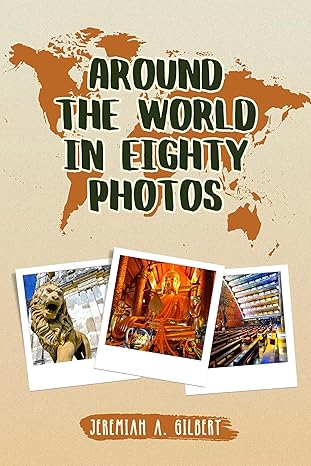

Jeremiah A. Gilbert’s Around the World in Eighty Photos is more than just a photography book; it’s a visual adventure that takes you across the globe through the lens of an experienced traveler. Instead of sticking to well-known landmarks, Gilbert hones in on the often-overlooked corners of the world, giving them the spotlight they deserve. Each photograph is accompanied by a story—sometimes historical, sometimes personal, always engaging. He also shares the technical details behind each shot, making it both an inspiring and educational experience for photographers and travel enthusiasts alike.
As a photographer, I appreciate that Gilbert doesn’t just show beautiful places—he invites us into his thought process. His image of Rano Raraku on Easter Island struck me the most. He describes setting up his shot without people, then serendipitously capturing two figures stepping into the frame, perfectly enhancing the composition. That’s what photography is about—being prepared, yet open to unexpected moments. The book is filled with these little surprises, making it feel like you’re traveling right along with him.
Another highlight is the way Gilbert balances storytelling with technical insight. In his photo of Mexico City’s Basilica de Guadalupe, he explains how he had to ride the moving walkway twice to figure out the best composition. The first trip was for analysis, the second for execution. That’s dedication. And in his shot of Iguazu Falls, he makes a conscious decision to use a fast shutter speed to capture the violent, thundering energy of the water, rather than the dreamy, silky look so many photographers go for. His approach reminds me that technical choices should serve the emotion of the image, not just the aesthetics.
This book is a must for photographers who love to travel, travelers who love photography, and anyone who dreams of seeing the world through fresh eyes. If you want a collection of images that tell stories, that teach you something new, and that make you want to grab your camera and book a flight, Around the World in Eighty Photos is an absolute treat.
Pages: 268 | ASIN : B0DY46TYP3

Finding The Right Photos

‘On to Plan C’ is a riveting travelogue that chronicles your unforgettable post-pandemic journey, capturing the essence of exploration, resilience, and beauty. Why was this an important book for you to write?
After having international travel sidelined for two-and-a-half years, it was imperative for me to get back on the road. While my first two books focused on past travels, I wanted this one to center on the current state of travel. Seeing how travel had changed and how it had stayed the same was an interesting draw as well. This is also the first collection to include my photography. I liked the challenge of finding the right photos to enhance the narrative. It meant this book took a little longer to edit, but it was worth the effort.
As you transitioned from one unique location to another, how did you keep your narrative cohesive and maintain the balance between cultural insights and personal experiences?
While each journey is told in a separate chapter, I was aware that it was all part of a collective. As such, I refer back to prior chapters or experiences now and again and also look ahead at times. I also included the thought process of my travels. I begin in Fiji, for instance, because that was the first trip canceled in 2020 (and I had a flight credit about to expire). I next headed to Europe as two previously planned trips for that summer, sailing up West Africa and a trip to Russia, had both fallen through, leading to the Plan C of the title.
I’ve always tried to balance insights and experiences with my travel writing. I find facts and figures interesting, though I try to avoid going on and on as readers might not find everything as interesting as I do. And, for me, a large part of travel is personal encounters, so including snippets of dialogue and sharing adventures helps flesh out the writing and bring the reader along with me.
What were some ideas that were important for you to share in this book?
I wanted this book to capture a moment in time. We had all gone through this seemingly endless pandemic together, and I wanted to focus on the return to normalcy. For me, that entails getting back on the road, including long- and short-haul flights, baggage claims, shuttles, taxis, hop-on hop-off busses, trains, and longships. I wanted to show how much of this has returned to normal, though with a few modifications here and there.
What do you hope is one thing readers take away from your story?
That the world is back open and ready to be explored. It’s still a good idea to do some research to keep up with ever-changing requirements, though most have now all been lifted. If you’re still deciding whether to explore, then I hope my travelogues and photos will provide a vicarious inspiration.
Author Links: GoodReads | Website
Biography
Jeremiah Gilbert is an award-winning travel writer and photographer based out of Southern California. His travels have taken him to over a hundred countries and territories around the world. His photography has been published internationally and exhibited worldwide. He is the author of Can’t Get Here from There: Fifty Tales of Travel and From Tibet to Egypt: Early Travels After a Late Start. He can be found online at http://www.jeremiahgilbert.com.
On to Plan C: A Return to Travel

On to Plan C by Jeremiah A Gilbert offers a captivating travelogue that chronicles the author’s and his wife’s remarkable journey, marking their first significant international excursion since the onset of the pandemic. This literary gem documents their ingenious “Plan C” after their original travel plans were disrupted by the challenges posed by Covid-19. Their adventure commences in the idyllic tropical paradise of Fiji before leading them to the vibrant tapestry of Europe. Along their path, they explore the iconic cities of London, Bergen, Copenhagen, and Berlin, culminating in an unforgettable European river cruise that meanders through the picturesque landscapes of the Netherlands and Germany, offering glimpses of charming villages, resplendent vineyards, and captivating Christmas markets. Emerging from the depths of the European winter, the author and his wife find solace in the embrace of a warmer climate during a three-week Caribbean cruise. Setting sail from Bridgetown, they embark on an enchanting voyage through the jewels of the Caribbean region, immersing themselves in its unrivaled beauty and allure.
The author enriches the narrative with stunning photographs revealing his remarkable skill behind the lens. These captivating visuals provide a profound context to the written words, allowing the reader to embark on a visual odyssey alongside the author. Immersing myself in this book, I relished the opportunity to experience the author’s perspective as they embarked on their first post-pandemic adventure. Overall, the author’s experience proved to be an engaging and enlightening read. The book’s prose consistently shines with its ability to transport readers to remarkable destinations. Gilbert’s descriptions offer valuable insights into the island’s allure. Take, for example, the author’s account of their visit to Great Stirrup Cay. In describing the island’s geographical features, the author paints a vivid picture of its northern part, which boasts sandy beaches and snorkeling havens, while the southern counterpart holds a helicopter airfield and remnants of a bygone US military installation and satellite tracking station. Elevating the memoir further with a touch of creative flair and emotional resonance adds an extra layer of enchantment to the storytelling. Furthermore, while the encounters with people along their journey were not extensively detailed, this only serves to ignite the reader’s desire for a deeper, more profound human connection within the captivating narrative.
I found On to Plan C to be an effortlessly readable and captivating account. I was particularly enthralled by the mesmerizing travel photography that accompanied the text. I highly recommend this travelogue to those who want to be taken on a thrilling adventure.
Pages: 250 | ISBN: 8196316135



 LITERARY TITAN